.png)

Every wire you send has a cost. Every conversion your bank runs has one too. Most businesses have never added those costs up across a full year. The wire fee shows up on the statement. The foreign exchange (FX) margin doesn't. It's just the rate you got, quietly adding up across every supplier payment and customer collection you process.
That's what makes choosing an international business bank account a cost decision. The account you pick sets your FX margin and wire fees on every cross-border transaction until you switch.
Businesses that compare their annual FX and wire costs against available options routinely find five-figure savings. This guide gives you the plan to do that. You'll compare account types based on your workflow, learn which opening requirements apply to your business, then see which provider best fits your actual payment pattern.
Main Takeaways
- The FX markup in your exchange rate typically costs more per year than your wire fees. It never appears as a separate line item on your statement.
- At $300,000 in annual international payments, switching from a traditional bank to a transparent-FX option can close a gap of roughly $8,000 to $9,000 per year.
- Local receiving accounts let your customers pay you via domestic transfer. Payments arrive faster and avoid intermediary deductions that reduce what you actually collect on international wires.
- Pass-through FDIC coverage at a fintech only applies if the provider keeps accurate beneficial-owner records in the custodial account. The protection model requires a check, not an assumption.
- If your U.S. business holds more than $10,000 across foreign financial accounts at any point during the year, you must file a Report of Foreign Bank and Financial Accounts (FBAR). The requirement applies to your combined balance, not each account separately.
See Where Your FX Costs Actually Hide
Most businesses track wire fees and miss the markup baked into every exchange rate. This guide breaks down the full cost stack across corridors, account types, and payment volumes.
Read the B2B Cross-Border Payments Guide
What an International Business Bank Account Actually Does

An international business bank account is built to send, receive, and hold funds across borders, often in multiple currencies. It lets you pay suppliers, collect from customers, and manage FX without routing every transaction through your domestic bank. The term covers three main models: traditional bank accounts with international wire capability, fintech multi-currency accounts, and electronic money institution (EMI) accounts.
Your regular business checking account can technically send an international wire, but it wasn't designed for that workflow. You pay a fee for every transfer and accept whatever FX markup the bank builds into the exchange rate. You also lose access to local receiving rails in other currencies. An overseas business bank account is built for these payments from the start. Each of the three models works differently.
Traditional banks like Chase and HSBC operate under full banking licenses with FDIC insurance. They charge higher fees and onboard slowly. Fintech and multi-currency platforms like Wise and Airwallex offer faster onboarding and FX at or near the mid-market rate, with deposit protection that is pass-through or absent depending on the provider's structure. Payments-first platforms, like Quotable AI, are built around the cross-border payment workflow itself. Each model changes what you pay every time you send or receive money internationally.
One more distinction matters. A single foreign-currency account holds just one non-USD currency, say EUR or GBP, and fits a business operating in one overseas market. A multi-currency account holds several at once. Traditional banks tend to offer the single-currency version, while fintech and payments-first platforms typically offer full multi-currency support.
Why the Distinction Matters for Cross-Border Operators
The model you choose locks in your default FX margin, wire-fee structure, and settlement speed across every payment. A traditional bank may waive the wire fee on foreign-currency sends, yet hide the cost in the exchange rate. Bank of America, for example, lists a $0 wire transfer fee on foreign-currency wires, but exchange rate markups apply, according to its wire transfer page. The fee looks like zero. The cost isn't.
Traditional banks often bundle the FX margin into a single quoted exchange rate, so it's hard to see what you're paying. Fintech providers typically show the mid-market exchange rate and a separate fee. The difference may seem small on a single payment, but it adds up quickly if you're paying international suppliers or collecting customer payments every week.
According to the Financial Stability Board, the average cost of a cross-border payment for micro, small, and medium-sized businesses (MSMEs) was 1.6% in 2024. About one in four payment corridors averaged more than 3%. Those costs compound every time you send or receive money internationally, which for cross-border operators is all the time. That makes the distinction between platforms crucial.
Best International Business Bank Accounts at a Glance

The table below covers six international business account options. It compares the factors that drive your actual operating cost: wire fees, FX markup approach, monthly fees, currencies supported, remote-opening access, and fund-protection model.
Each row is a provider or provider category. The columns reflect the line items that add up into annual cost, which the next section breaks down in detail. The best international bank for business depends on your specific model. The scenario section later maps each option to concrete use cases.
Provider | Wire Fee (Outbound) | FX Markup Approach | Monthly Fee | Currencies Supported | Remote Opening | Fund Protection
Quotable AI | Varies by corridor | Transparent FX pricing | $0 for payments (no monthly platform fee) | Hold in 35; pay out in 140+ | Yes; fully remote | Funds held with licensed partners
Bank of America | $45 (USD outbound); $0 (foreign-currency, FX markup applies) | Embedded in exchange rate | Starts at $16/month for Fundamentals account | Send in 140+ currencies to 200+ countries | Limited; online applications available for eligible U.S. businesses | Direct FDIC
Wells Fargo | Varies by account (digital); $40 (branch) | Embedded in exchange rate | Starts at $15/month for Initiate account | Send in 30 currencies to 200+ countries; receive 27 currencies | Limited; online applications available for eligible businesses | Direct FDIC
HSBC | Varies by market and relationship | Embedded in exchange rate | Not publicly listed; contact HSBC | Send in 60+ currencies to 200 countries | Limited; in-person in many markets | Direct FDIC or equivalent (jurisdiction-dependent)
Wise Business | Transparent per-transfer fee | Mid-market rate + disclosed % | None (pay-per-use); $31 one-time charge | Hold and convert 40+ currencies; send to 160+ countries | Yes; fully remote | Non-FDIC; funds safeguarded
Airwallex | Varies by corridor | 0.5%–1% above interbank rate; higher for minor currencies | $0 Explore tier (US); fees or deposit minimums in some regions | Collect and hold 20+ currencies; send to 200+ countries | Yes; fully remote | Varies by jurisdiction; partner-bank arrangements
If you send fewer than 10 wires per month, the wire-fee column matters less than the FX markup. The spread on every conversion will outweigh the per-transaction charge at most volumes.
If you receive payments from multiple countries, focus on currencies supported. Check whether the provider offers local receiving accounts (IBAN, sort code, or local bank number) so your customers pay via domestic transfer instead of international wire. Fund protection varies across these providers. The safety section below explains what each model actually covers.
Provider-by-Provider Breakdown: Who Fits Where
No single option wins across every overseas business bank account scenario. Each provider below gets a short profile covering who it fits, where it's strong, and the limits worth knowing before you apply. These profiles help you filter quickly by your payment pattern.
Quotable AI
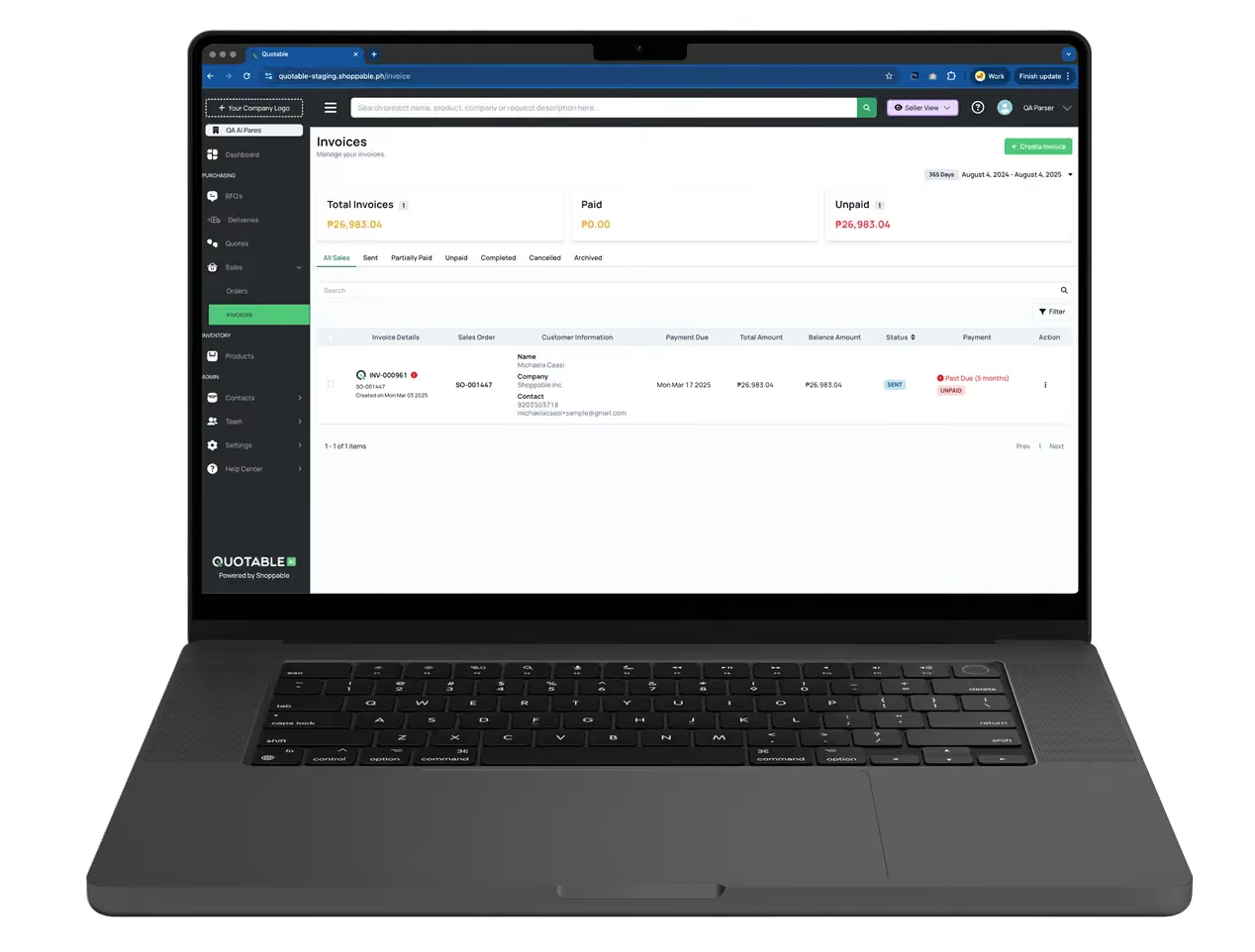
Quotable AI fits small and mid-market businesses whose cross-border payment needs tie to supplier payments, customer collections, or payouts. These businesses want the payment workflow connected to the transaction rather than siloed in a separate banking app. Quotable isn't an ERP; every capability connects directly to cross-border trade workflows. The platform holds balances in 35 currencies and pays out in 140+ currencies across 200+ countries, and it connects to Xero, with additional accounting and ERP integrations rolling out. Recipients don't need a Quotable account to receive funds. An account is only needed to send. For companies who don’t need the end-to-end workflows connected, Quotable Payments is available for making and receiving payments only. Get started with just payments here.
Bank of America
Bank of America fits businesses that want international wire access through a traditional U.S. bank. You can send foreign-currency wires with no outbound wire fee, but the bank builds its markup into the exchange rate. USD international wires cost $45. The account also supports payments in more than 140 currencies to over 200 countries. Eligible deposits receive direct FDIC insurance. The main drawback is pricing transparency. You'll need to compare the quoted rate to the mid-market rate to see your full FX cost.
Wells Fargo
Wells Fargo suits businesses that want international payments tied to an established U.S. banking relationship. Digital wire fees vary; branch wires cost $40. Some account types waive or reduce those fees. Wells Fargo supports foreign-currency payments to more than 200 countries, but it also builds a markup into its exchange rate. Eligible deposits receive direct FDIC insurance. The trade-off is the same one many traditional banks present: your wire fee is visible, but your total FX cost takes more work to calculate.
HSBC International Business Account
HSBC fits mid-market and larger businesses with existing HSBC relationships. It's strongest in corridors where HSBC has deep presence: the UK, Hong Kong, Singapore, and the Middle East. A global branch network, full banking services including trade finance and letters of credit, and direct deposit protection by jurisdiction give it capabilities fintechs can't match. The cost is higher monthly fees and slower onboarding with in-person rules in many markets. FX markup is embedded and less transparent than fintech options.
Airwallex
Airwallex works well for ecommerce sellers and businesses collecting in several markets. Its Global Accounts let you receive and hold more than 20 currencies. You can also run batch payouts and connect payment workflows through its APIs. This API-first design suits tech-enabled teams. Non-technical teams may face a more complex setup. Fund protection depends on jurisdiction and partner-bank arrangements rather than a single consistent model.
Wise Business
Wise Business fits companies that send frequent, smaller international payments and want FX pricing at or near the mid-market rate. You get full transparency on what each transfer costs. The account includes local receiving details in 22 currencies and fast onboarding. The trade-off: Wise isn't a bank, so there's no direct FDIC coverage and no credit or lending products. It's not built for businesses that need trade-finance features or large-batch supplier payouts.
What an International Business Account Actually Costs

The real cost of a business account for international payments isn't the monthly fee or the wire fee alone. It's the annual total when you combine monthly fees and per-wire charges. It's also the intermediary deductions and FX markups across every payment you send. Most businesses track the first two and miss the last two, and those are often the largest parts.
The Line Items That Add Up
Four cost layers stack on every cross-border payment. The monthly account fee is the most visible and usually the smallest. Per-wire or per-transfer fees show up on your statement and feel manageable alone.
Intermediary and correspondent bank deductions are harder to spot. They reduce the amount your supplier receives rather than appearing as a charge on your end. The FX markup is the spread between the mid-market rate and the rate you're quoted. Most businesses never quantify it because it's baked into the exchange rate itself.
Banks are straightforward about the economics even if the pricing isn't transparent. Wells Fargo states it "makes money" when converting one currency to another via embedded markups in the exchange rate. That's the cost layer that scales with your payment volume, and it's the one most operators overlook when comparing accounts by wire fee alone.
Worked Example: $25,000/Month in International Payments
Consider a business sending $25,000 per month internationally. That totals $300,000 per year across roughly eight wire transfers per month (96 annually). The table below models approximate annual cost across three account types: a traditional US bank, a Wise-style fintech, and a transparent-FX platform.
The FX markup column uses a conservative 2% midpoint for traditional banks (the common range is 1.5% to 3%). It uses 0.5% for fintechs and 0.5% as an illustrative category figure for the transparent-FX platform, which varies by corridor. Take a look at how each compares.
Cost Component | Traditional Bank | Fintech (Wise-style) | Transparent-FX Platform (illustrative)
Monthly fee (×12) | $200 | $0 | $0
Wire/transfer fees (×96 transactions) | $3,840 | $480 | Varies by corridor
Estimated FX markup (on $300K) | $6,000 (at 2%) | $1,500 (at 0.5%) | $1,500 (at 0.5%)
Intermediary deductions (estimate) | $500–$1,000 | $0–$200 | $0–$200
Total Annual Cost | $10,540–$11,040 | $1,980–$2,180 | ~$1,500 FX + corridor fees
The gap between a traditional bank and a transparent-FX option at this volume is typically $8,000 to $9,000 per year. FX margin drives almost all of it. At higher volumes, the gap scales in step. A business sending $600,000 annually through a traditional bank could be leaving roughly $16,000 to $18,000 on the table, again driven almost entirely by FX margin. This isn't guesswork. It's arithmetic anyone can run with their own numbers, their own corridors, and their own bank's quoted rate versus the mid-market rate on the day of each transaction.
The transparent-FX column uses illustrative figures for the category, not any single provider's published pricing. For Quotable's actual FX pricing, see the pricing page.
How to Choose the Right Account by Business Model
There's no single best international business bank account. The right one depends on whether you're importing, exporting, selling on platforms, or running a cross-border entity. Each model has different payment flows, currency needs, and compliance risk. Starting from your situation narrows the field faster than comparing feature lists.
Importers Paying Foreign Suppliers
Your workflow centers on sending payments to suppliers in one to three countries, usually in their local currency, on net-30 or net-60 terms. Low FX markup on outbound payments and reliable delivery timing matter most. A multi-currency fintech or payments-first platform with transparent FX and corridor coverage in your supplier markets fits this pattern well.
Wise Business or Quotable give you visibility into what each conversion costs. HSBC makes sense if you need trade-finance capability like letters of credit or documentary collections that fintechs don't offer.
Exporters Receiving Foreign Payments
You're invoicing customers in their currency and receiving payments into local collection accounts. Your priority is local receiving accounts that avoid incoming wire fees. You also want to avoid forced conversion into your home currency at the provider's rate and timing. A multi-currency international business account with local receiving details lets your customers pay via domestic transfer. That means IBANs in Europe, sort codes in the UK, or BSBs in Australia.
Airwallex or Wise Business are strong here for local collection accounts. Consider whether your platform also handles outbound payments, so you aren't managing two separate systems. Quotable handles both sending and receiving in one platform.
Ecommerce Sellers with Payouts
You receive payouts from Amazon, Shopee, Lazada, or similar platforms in multiple currencies. You need to combine, convert, and withdraw or reinvest that money. Native payout receiving and multi-currency wallets are critical. Competitive withdrawal and conversion rates are the features that matter.
Wise has the broadest integration with those platforms. Airwallex offers strong multi-currency wallets for holding and converting. Quotable fits if you also pay suppliers from the same platform and want the payment workflow connected to your trade operations.
Cross-Border Founders and Foreign-Registered Entities
You're a non-US founder or a foreign-registered entity that needs a US-dollar account or a multi-currency account to operate globally. Remote opening, minimal in-person rules, and entity-type flexibility are your priorities. Traditional banks often require in-person checks and US-registered entities. That rules them out for many foreign founders.
Wells Fargo is an exception. There are online applications available for eligible businesses, but you may need to visit a branch in person. Wise Business or Airwallex support foreign entities with fully remote onboarding. Check each provider's entity-type restrictions before applying. The rules vary more than the feature sets.
Pay Suppliers and Collect in One System
Running outbound supplier payments and inbound customer collections through separate platforms means double the reconciliation work. See how Quotable handles both sides of cross-border B2B payments.
Explore International Vendor Payments
How Multi-Currency Accounts Work in Practice
A multi-currency account lets you hold balances in multiple currencies and choose when to convert. The real value depends on how holding, conversion timing, local rails, and off-hours policies play out in your day-to-day payment flows.
Holding Balances vs. Converting on the Spot
Holding a balance in a multi-currency account means you receive funds in a foreign currency and keep them there until you need to pay a supplier, reinvest, or convert at a good rate. Forced conversion, where the bank or platform converts on arrival at their rate and their timing, is the default at most traditional banks. That means you pay the FX markup twice: once when the money comes in, once when you send it back out in that currency. Holding cuts one conversion entirely.
Conversion timing is a treasury decision. If you're paying a EUR supplier in 30 days and you just received EUR from a customer, holding that EUR balance avoids conversion altogether. When you do need to convert, doing it during market hours when liquidity is highest typically gets you a tighter spread. Many providers widen their margins on weekends or holidays, or apply fixed off-hours rates.
How Local Rails Affect Speed and Cost
When your multi-currency provider gives you local bank details (an IBAN in Europe, a sort code in the UK, a BSB in Australia), your customers pay via domestic transfer instead of international wire. This is faster, often same-day versus one to five days. According to SWIFT, about 90% of cross-border payments reach the destination bank within an hour, yet only 43% are credited to the end customer's account within that hour.
Local receiving accounts bypass that bottleneck entirely for collection. The payment never enters the correspondent banking network in the first place. It's also cheaper: there are no incoming wire fees or intermediary deductions eating into what you receive.
Who Can Open One and What You Need
Opening an international business bank account requires standard business documents. But the specific papers, approval timelines, and friction points differ sharply between banks and fintechs, and between US-based and foreign-registered entities.
Standard Documents and Timelines
Most providers require the same core set of documents:
- Government-issued ID for all beneficial owners
- Articles of Incorporation or equivalent formation documents
- Employer Identification Number (EIN) or equivalent tax ID
- Proof of address for the business and beneficial owners
- Beneficial ownership information (BOI)
Banks may ask for information about your company's beneficial owners as part of their Know Your Customer (KYC) and anti-money laundering checks. U.S. companies generally don't need to file separate BOI reports with FinCEN. Certain foreign reporting companies still do, according to FinCEN.
Traditional banks typically take one to four weeks to approve an international business account. They may require in-person checks, a branch visit, or notarized documents. Fintechs and payments platforms often approve in one to three business days with fully remote KYC.
The speed gap isn't just about ease of use. If you need to pay a supplier next week, a three-week bank onboarding timeline is a blocker. It forces you onto a more costly payment rail in the meantime.
Opening an Account as a Non-US Founder or Foreign Entity
Yes, a foreigner can open a business bank account in the US. You'll typically need:
- A US-registered entity (LLC or C-Corp)
- An EIN
- Government-issued ID for all beneficial owners
- Proof of address
- Some banks also require a US physical address or a registered agent
For foreign-registered businesses, the options narrow further. Many traditional US banks won't open accounts for entities incorporated outside the US. Fintechs are more accessible. Wise, Airwallex, and Quotable all support remote onboarding.
Document rules may expand to include apostilled formation documents, a foreign tax ID, and added KYC for beneficial owners in certain jurisdictions. BOI reporting rules apply to many foreign-owned US entities. Failing to have ownership documents ready can delay onboarding or trigger re-KYC requests months later.
Bank vs. Fintech: Safety and Fund Protection
How your funds are protected depends on your provider type. You might bank directly with an FDIC-insured institution. You might use a fintech with pass-through FDIC coverage. Or you might hold money with a non-bank provider under a different regulatory model entirely. International business banking involves real balances sitting in accounts between transactions. The protection model matters most for the operating cash you hold.
Three distinct protection models govern how your deposits are covered:
- Direct FDIC means you hold an account at an FDIC-insured bank. Deposits are insured up to $250,000 per depositor, per bank.
- Pass-through FDIC means a fintech places your funds at an FDIC-insured partner bank. Coverage applies only if the fintech keeps proper beneficial-owner records and the partner bank's records reflect your ownership.
- Non-FDIC means the provider operates under an EMI license or money-transmitter license. Funds may be safeguarded in segregated accounts but carry no FDIC insurance.
The FDIC's own guidance is direct: "Funds you send to a nonbank company are not eligible for FDIC insurance until the company deposits them in an FDIC-insured bank." Even then, pass-through coverage requires strict recordkeeping, according to the FDIC. The chart below breaks it down further.
Protection Model | How It Works | Coverage Limit | Key Condition | Best Fit
Direct FDIC | You hold an account directly at an FDIC-insured bank | $250,000 per depositor, per bank | Account must be at the insured institution | Businesses prioritizing maximum deposit security
Pass-Through FDIC | Fintech places funds at an FDIC-insured partner bank on your behalf | $250,000 per depositor, per bank (if conditions met) | Fintech must maintain accurate beneficial-owner records; partner bank must reflect your ownership | Businesses using fintechs that can verify custodial recordkeeping
Non-FDIC (EMI / Safeguarded) | Provider holds funds in segregated accounts under EMI or money-transmitter license | No FDIC coverage; safeguarding rules vary by jurisdiction | Funds are ring-fenced but not insured against provider failure | Businesses comfortable with regulatory safeguarding for transaction balances
In September 2024, the FDIC proposed requiring banks with certain custodial deposit accounts to maintain end-user depositor records and conduct daily reconciliations. The proposal was driven in part by incidents where customers lost access to funds held through fintech intermediaries.
If you're evaluating a fintech account for operating cash, ask whether the provider's partner-bank arrangement meets pass-through rules. Ask whether they can document your beneficial ownership in the custodial account. The answer tells you more about your actual risk than the provider's FAQ page does.
FBAR and FATCA: Compliance When You Hold Foreign Accounts
If your U.S. business holds more than $10,000 in total across foreign financial accounts at any point during the year, you may have a reporting obligation. In many cases, that means filing a Report of Foreign Bank and Financial Accounts (FBAR). Depending on your circumstances, you may also need to file Foreign Account Tax Compliance Act (FATCA) Form 8938.
When the combined value of all your foreign financial accounts exceeds $10,000 at any point during the calendar year, even for one day, you generally must file an FBAR electronically through FinCEN's Bank Secrecy Act (BSA) E-Filing System. The $10,000 threshold applies to all of your foreign accounts combined, not each account separately. For example, a $6,000 account in the UK and a $5,000 account in Singapore would trigger the filing requirement. The FBAR is due April 15 and automatically extends to October 15 if you don't file by the original deadline.
Foreign financial accounts can include bank accounts, brokerage accounts, and certain other financial accounts held outside the United States. Multi-currency accounts offered by U.S.-based fintechs may or may not qualify. It depends on where the account is legally maintained and where the funds are held. That's why it's a good idea to consult a tax professional.
Foreign Account Tax Compliance Act (FATCA) Form 8938 is a separate IRS filing with higher reporting thresholds. For many taxpayers, reporting begins at $50,000 for U.S. residents and $200,000 for taxpayers living abroad. The exact thresholds depend on filing status and whether you file jointly. You attach Form 8938 to your federal tax return if you meet the applicable threshold.
Filing Form 8938 doesn't replace the FBAR, so some businesses and individuals may need to file both. Because the rules vary by entity type, filing status, and account structure, check with a qualified tax professional before deciding whether a foreign or multi-currency account triggers a reporting requirement.
Put Your International Business Account Strategy Into Action with Quotable AI

You now have a plan for evaluating international business accounts by cost structure, business model fit, and fund protection. That plan lets you choose the account that actually reduces what you pay on cross-border payments. The biggest gains come when your payments don't live in a separate system.
We built Quotable AI to connect your cross-border payment workflow to the account that holds your money. Pay vendors in 140+ currencies and receive payouts in 35 currencies inside the same system you use to manage quotes, POs, and supplier relationships. Every supplier payment routes through transparent FX pricing. Your finance team can prove what each transaction cost with data they can reconcile without spreadsheet archaeology or chasing wire confirmations across three platforms.
See how Quotable AI handles both sides of cross-border B2B payments for small and mid-market businesses: paying international vendors and receiving money in multiple currencies.
Stop Paying Your Bank's FX Margin Every Month
If you're sending supplier payments through a traditional bank, the markup in your exchange rate is costing you more than your wire fees. Quotable gives you transparent FX pricing across 140+ currencies from day one.
Get Started with Just Payments
FAQs About International Business Bank Accounts
What is the best bank for international business banking?
There's no single best bank for international business banking. The right choice depends on your payment pattern and business model. It also relies on whether you focus on FX transparency, local receiving accounts, or full banking services. Importers paying suppliers in a few corridors typically fit best with multi-currency fintechs like Wise Business. Exporters collecting from multiple countries need providers with local receiving accounts like Airwallex. Businesses requiring trade finance or letters of credit still need traditional banks like HSBC.
How do I know if my business actually needs a multi-currency account?
You need a multi-currency account if you send or receive payments in more than one foreign currency each month. Holding balances cuts one conversion per transaction and lets you time FX decisions instead of accepting your bank's rate on demand. If you only send occasional wires in a single currency, a standard business account with international wire capability is usually enough. The cost trigger is when forced conversion fees exceed the multi-currency account's monthly cost.
What's the difference between SWIFT and local payment rails?
SWIFT is the messaging network banks use to route international wires. A payment can pass through one or more intermediary (correspondent) banks along the way, which adds time and deductions. Local payment rails are a country's domestic transfer system, such as ACH in the US, SEPA in Europe, or Faster Payments in the UK. When your provider gives you local account details, your counterparty pays into that domestic system instead of sending an international wire. That's faster and usually avoids incoming wire fees and intermediary deductions. The trade-off is that local rails only work in the markets where your provider actually holds local details.
Can I open an international business account if my company is registered outside the US?
Yes, but your options narrow. Many traditional US banks require a US-registered entity and in-person checks. Fintechs like Wise and Airwallex support foreign-registered entities with remote onboarding. You'll typically need apostilled formation documents, a foreign tax ID, government-issued ID for all beneficial owners, and proof of address. Check each provider's entity-type restrictions before applying. The rules vary more than the feature sets.
Are international wire transfers over $10,000 reported to the IRS?
International wire transfers are not automatically reported to the IRS the way cash transactions over $10,000 are. The $10,000 cash-reporting rule (Form 8300) applies to physical cash, not wires. Your bank may still file a Suspicious Activity Report with FinCEN if a transfer looks unusual, and the IRS can access those reports if it investigates. Separately, holding more than $10,000 across foreign financial accounts can trigger FBAR and FATCA reporting, but those obligations attach to the accounts you hold, not to any single wire. Confirm your situation with a tax professional.
What happens if I exceed the FBAR $10,000 threshold mid-year and then drop below it?
You still have to file. The FBAR threshold is triggered if your total foreign account balance exceeds $10,000 at any point during the year, even for a single day. The filing obligation doesn't go away if your balance drops later. Report all accounts that helped exceed the threshold. Consult a tax professional to confirm your specific filing rules.
Does FDIC pass-through coverage apply if the fintech goes under but the partner bank stays solvent?
Yes, if the fintech kept proper beneficial-owner records and the partner bank's records reflect your ownership. But access to your funds may be delayed while the FDIC verifies those records. Recent fintech intermediary failures prompted the FDIC's September 2024 proposed rulemaking on custodial accounts. Ask any fintech provider for documents on their custodial account structure and partner-bank arrangement before you move operating cash.