Most procurement teams don't have a spending problem. They have a visibility problem. When quotes live in email threads, purchase orders sit in spreadsheets, and invoices get processed through a different system entirely, the real cost isn't just the goods you're buying. It's the hours lost reconciling data, the duplicate orders nobody catches, and the supplier discounts you never knew you qualified for.
For SMEs and mid-market companies doing between $1M and $50M in annual transactions, even small inefficiencies compound fast. A miskeyed line item here, a late payment penalty there, and suddenly your margins are thinner than your P&L suggests. The good news: companies using AI in procurement have reduced operational costs by 8 to 15 percent in the first year alone. The hard-won lesson from working with businesses at this scale is that cutting procurement costs isn't about squeezing suppliers or slashing budgets. It's about eliminating the friction that makes every transaction more expensive than it needs to be.
Here are five practical ways to do exactly that.
Consolidating the Quote-to-Payment Lifecycle
The most expensive thing in your procurement operation probably isn't a line item on any invoice. It's the gap between systems. When your quoting tool doesn't talk to your purchase order system, and your PO system doesn't connect to your invoicing workflow, every transaction requires manual translation. Someone copies data from a quote into a spreadsheet. Someone else re-enters that data into an ERP. A third person reconciles the invoice against the original terms. Each handoff introduces delay, error, and cost.
One client we worked with, a $12M construction materials distributor, discovered they were spending 14 hours per week just reconciling quotes against invoices. Their quoting happened in email, POs were managed in one platform, and payments went through their bank's portal. Three systems, zero integration, and a full-time employee's worth of administrative labor every single week.
The fix isn't adding another tool to the stack. It's collapsing the entire quote-to-payment lifecycle into a single workflow where data flows forward automatically. When a quote becomes a PO, and that PO becomes an invoice, and that invoice triggers a payment, you eliminate the re-keying that causes most procurement errors.
Eliminating Fragmented Data Silos
Data silos are the silent budget killer in mid-market procurement. Your sales team quotes in one system. Your procurement team manages vendors in another. Finance reconciles everything in a third. Each silo creates its own version of the truth, and when those versions conflict, someone has to spend time figuring out which one is right.
The real damage shows up in three places. First, you lose negotiating power because you can't see your total spend with any given supplier across departments. Second, you create audit risk because your documentation trail has gaps. Third, you slow down approvals because every stakeholder needs to verify data they don't fully trust.
Breaking down these silos means centralizing your transaction data, from the initial RFQ through final payment, in one place. This doesn't necessarily mean replacing your ERP. It means creating a layer that connects your existing systems so that a quote, a PO, and an invoice all reference the same underlying data. Quotable AI, for example, integrates with existing ERPs and accounting systems so organizations can modernize supplier collaboration without ripping out their financial infrastructure.
Reducing Transactional Friction with Quotable AI
Friction in procurement isn't always obvious. It's the supplier who takes three days to respond to an RFQ because they need to create an account in your portal. It's the buyer who can't approve a PO from their phone. It's the finance team waiting on a signed document before they can process payment.
Every point of friction adds time, and time is money in a very literal sense. A procurement cycle that takes 15 days instead of 5 means your cash is tied up longer, your project timelines slip, and your team spends more hours following up on tasks that should be automatic.
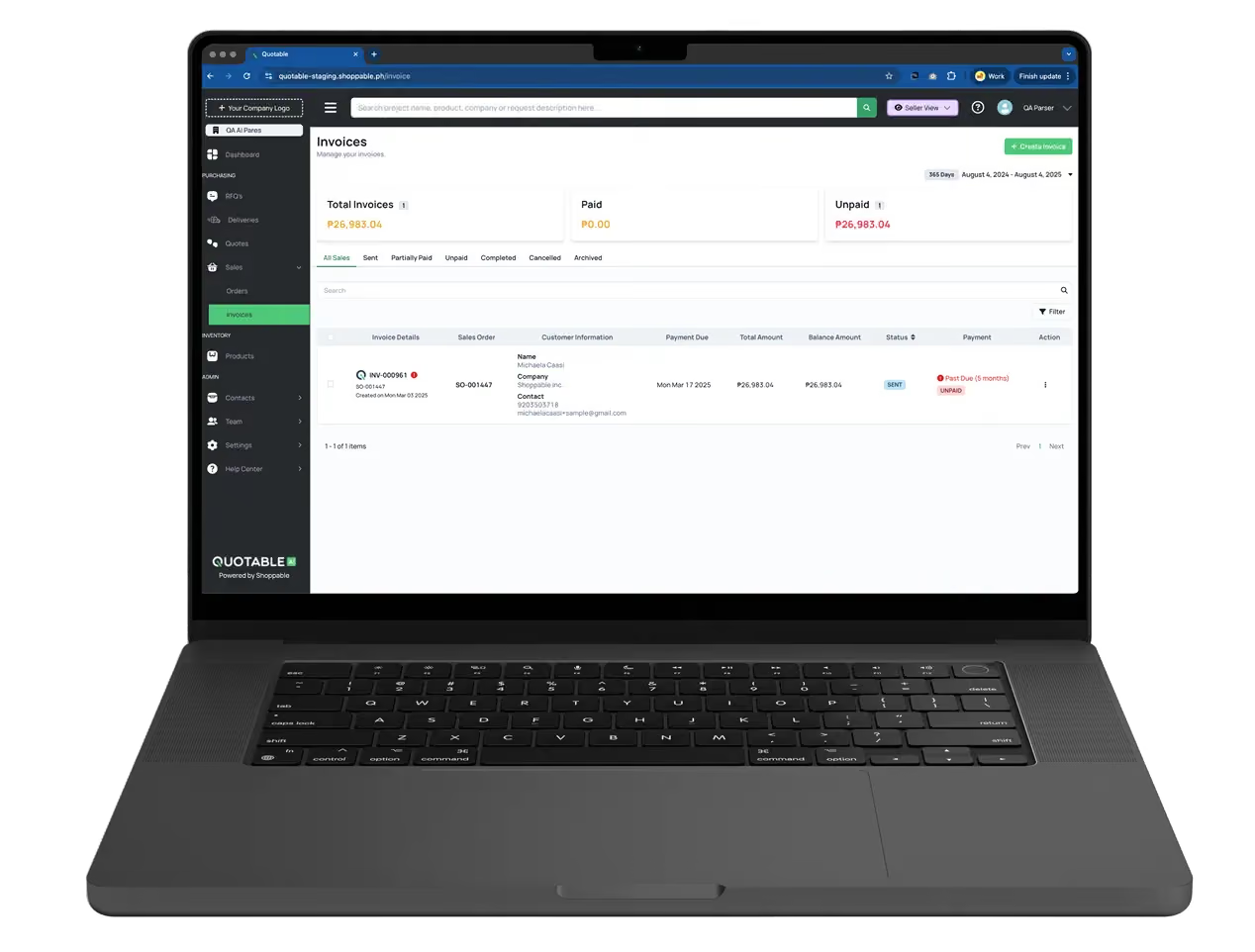
Quotable AI's approach treats the quote as a live transaction state, meaning the data in your original quote carries forward through every subsequent step. Suppliers can respond to RFQs through a secure link without creating accounts or learning new software. Buyers approve through no-login links. The universal AI parser extracts and structures data from quotes, invoices, POs, and bills of materials automatically. This kind of frictionless participation is what turns a 15-day cycle into a 2-day one.
Leveraging Automation to Minimize Administrative Overhead
Manual procurement processes don't just cost you time. They cost you accuracy, consistency, and the ability to scale. When your team is processing 30 to 50 orders per month manually, things work well enough. Cross that threshold, and cracks appear: duplicate orders, missed approvals, invoices that don't match POs, and month-end closes that drag on for days.
Automating procurement processes can lead to 25 to 30 percent reductions in processing costs. That's not a theoretical number. It reflects the elimination of manual data entry, the reduction in error correction, and the time saved on approval routing.
The key is knowing what to automate first. Not every process benefits equally. Start with the highest-volume, lowest-complexity tasks: invoice matching, PO generation from approved quotes, and payment reminders. These are the activities that consume the most administrative hours while requiring the least human judgment.
Accelerating Procurement Cycles by 10X
Speed in procurement isn't about rushing decisions. It's about removing the dead time between decisions. In a typical mid-market procurement cycle, the actual decision-making, choosing a supplier, approving a price, confirming delivery terms, takes maybe an hour total. The rest of the cycle, often 10 to 20 business days, is waiting. Waiting for quotes. Waiting for approvals. Waiting for someone to re-enter data into the right system.
Here's a concrete example. A manufacturing firm sourcing $8M in raw materials annually sends an RFQ to five suppliers. Traditionally, each supplier receives an email, prepares a quote in their own format, and sends it back. The procurement team then manually enters each response into a comparison spreadsheet. This process alone can take five to seven business days.
Now imagine those same suppliers receive a structured RFQ link, submit their responses in a standardized format, and the system automatically generates a comparison matrix. That seven-day process becomes a same-day process. Multiply that acceleration across hundreds of transactions per year, and you're recovering weeks of productive time.
The 10X acceleration Quotable AI references isn't hyperbole when you look at it this way. It's the natural result of eliminating manual handoffs at every stage of the quote-procure-pay workflow.
Automating Invoicing and B2B Payments
Invoicing and payments are where procurement cost savings either materialize or evaporate. You can negotiate the best price in the world, but if your payment process is slow enough to miss early-payment discounts, or error-prone enough to trigger duplicate payments, those savings disappear.
A common mistake we see: companies that automate their sourcing and PO creation but still process invoices manually. The invoice arrives as a PDF. Someone opens it, checks it against the PO, verifies quantities and pricing, enters it into the accounting system, and routes it for approval. If anything doesn't match, the whole process stalls while someone investigates.
Three-way matching, comparing the PO, the goods receipt, and the invoice, should be automatic. When your system can parse an incoming invoice, match it against the original quote and PO data, flag discrepancies, and route clean invoices for payment, you eliminate the bottleneck that causes most payment delays.
Embedded payment options matter here too. When suppliers can receive payment via bank wire, ACH, credit card, or e-wallet through the same system that generated the invoice, you remove yet another manual step. No more logging into a separate banking portal. No more emailing payment confirmations back and forth.
Optimizing Supplier Relationships through Data Orchestration
Your suppliers aren't just vendors. They're partners whose performance directly affects your margins. But most mid-market companies manage supplier relationships reactively. They notice a problem, maybe a late delivery or a price increase, and then scramble to address it. Proactive supplier management requires data, specifically the kind of longitudinal transaction data that reveals patterns over time.
Poor contract management alone costs businesses roughly $2 trillion per year globally. Much of that waste comes from companies that simply don't have visibility into their own supplier agreements. They can't tell you which suppliers consistently deliver early, which ones creep prices up by 2% every quarter, or which ones offer volume discounts that nobody's tracking.
Data orchestration means connecting every touchpoint in your supplier relationship, from the first RFQ to the latest payment, into one centralized order view and record. This isn't just about having a dashboard. It's about making that data actionable so your procurement team can negotiate from a position of knowledge rather than guesswork.
Treating the Quote as a Live Transaction State
Most systems treat the quote as a static document. Someone creates it, someone else approves it, and then it sits in a folder until the invoice arrives. Any changes, a revised delivery date, an updated unit price, a substituted material, happen through email or phone calls that never get formally documented.
This is where maverick spend creeps in. A verbal agreement to change terms on a $50,000 order might seem harmless, but when the invoice arrives with different pricing than the original PO, your finance team has no way to verify what was actually agreed upon. The result: either they pay the disputed amount to maintain the supplier relationship, or they delay payment while they investigate, triggering late fees or damaging the partnership.
Treating the quote as a live transaction state means that every modification, every approval, every counter-offer is captured in the same data object that flows through to the PO and invoice. If a supplier changes their lead time from 14 days to 21 days, that change is logged, timestamped, and reflected in every downstream document. This creates the audit trail that SOX compliance requires and that your finance team needs to close the books cleanly each month.
The practical benefit is significant. When every dollar of spend placed under procurement's control can yield 6 to 12 percent savings, having clean, traceable data on every transaction isn't a nice-to-have. It's a direct contributor to your bottom line.
Strategic Sourcing for SMEs and Mid-Market Firms
Strategic sourcing sounds like something only Fortune 500 companies do, but the principles apply at every scale. The core idea is simple: don't just buy what you need from whoever's available. Analyze your spending patterns, identify your highest-impact categories, and build supplier strategies around them.
For a $15M distributor, this might mean recognizing that 60% of your spend goes to just three suppliers. That concentration is both a risk and an opportunity. It's a risk because losing one supplier could cripple your operations. It's an opportunity because that volume gives you real negotiating power, if you have the data to back it up.
Top-performing procurement teams are allocating up to 24% of their budgets to procurement technology because they understand the ROI. Smart money goes toward systems that give you spend visibility, supplier performance tracking, and the ability to run competitive sourcing events quickly. Dumb money goes toward adding headcount to manage processes that should be automated.
Cost Containment in Construction and Manufacturing
Construction and manufacturing procurement present unique challenges that generic purchasing advice doesn't address. Materials prices fluctuate weekly. Lead times shift based on global supply chain conditions. And the cost of a wrong order isn't just the price of the goods: it's the idle crew on a job site or the halted production line waiting for parts.
In these industries, cost containment starts with three specific practices:
- Locking in pricing through structured quote agreements that specify validity periods, escalation clauses, and volume commitments
- Tracking landed costs, not just unit prices, by linking payment workflows with logistics data like bills of lading, packing lists, and freight invoices
- Assigning cost codes to every purchase so you can track spending at the project or job level, not just the vendor level
A red flag we see often in construction procurement: companies that track costs by vendor but not by project. They know they spent $400,000 with a steel supplier last quarter, but they can't tell you how much of that went to Project A versus Project B. Without that granularity, you can't identify which projects are running over budget until it's too late.
Organizations that use spend data to drive their sourcing strategy can reduce costs by up to 15 percent. In construction and manufacturing, where margins are often single digits, that 15% can be the difference between a profitable year and a break-even one.
Improving Cash Flow with Integrated Fulfillment Tracking
Cash flow is where procurement strategy meets financial reality. You can negotiate great prices and automate your invoicing, but if you don't know where your goods are in the fulfillment pipeline, you can't plan your cash position accurately. This is especially true for companies managing international supply chains where duties, freight charges, and currency fluctuations affect the true cost of goods.
Integrated fulfillment tracking means connecting your procurement data with your logistics data. When a PO is placed, you should be able to track the shipment status, the expected delivery date, and any cost adjustments (duties, FX impact, demurrage charges) in the same system. This gives your finance team the visibility they need to forecast cash requirements accurately and avoid the surprises that blow up monthly budgets.
Here's a scenario that plays out constantly in mid-market companies. You place a $200,000 order with a 30-day payment term. The goods ship, but customs delays push delivery back by two weeks. Meanwhile, your payment term clock is ticking. By the time you receive and inspect the goods, you've already used up most of your payment window. Now you're rushing to process the invoice, which means skipping verification steps, which means potential overpayment.
When your procurement, fulfillment, and payment systems share data, this scenario doesn't happen. You see the customs delay in real time. You adjust your payment timeline accordingly. You maintain your verification process without sacrificing your supplier relationship.
The companies that cut procurement costs most effectively aren't the ones with the biggest budgets or the most sophisticated technology. They're the ones that treat procurement as a connected workflow rather than a series of disconnected steps. From the first RFQ to the final payment, every handoff is an opportunity to either lose money or save it.
If you're running a mid-market operation and your procurement process still involves copying data between systems, chasing suppliers for responses, or manually matching invoices to POs, you're leaving real money on the table. The five strategies outlined here, consolidating your quote-to-payment lifecycle, automating administrative tasks, orchestrating supplier data, sourcing strategically, and integrating fulfillment tracking, aren't theoretical. They're the practical steps that companies at your scale are using right now to protect and grow their margins.
Start where the pain is worst. For most teams, that's the gap between the quote and the payment. Close that gap, and the savings follow.