Procurement teams at mid-market companies are drowning in manual work. Between chasing quotes from suppliers, re-keying data into spreadsheets, waiting on email approvals, and reconciling invoices against purchase orders, the average purchasing officer loses hours each week to tasks that should take minutes. If you're running a business that buys $10M to $50M in goods and services annually, those lost hours translate directly into delayed projects, strained supplier relationships, and missed cost savings. The pressure to save time in procurement has never been more intense, and the strategies that worked five years ago won't carry you through 2026. This guide lays out a practical framework for eliminating the bottlenecks that slow your purchasing cycles, with specific tactics for automation, system integration, and industry-specific approaches that actually move the needle.
The 2026 Procurement Landscape: Moving Beyond Manual Workflows
The gap between companies that have digitized procurement and those still relying on manual workflows is widening fast. Companies are aiming to digitize 70% of procurement processes by 2027, and organizations that haven't started are already falling behind their competitors on cost, speed, and supplier quality.
Here's what the manual workflow problem actually looks like at a $15M distributor: a purchasing officer receives a request from the sales team, opens a browser to email three suppliers for quotes, waits two to five days for responses, manually compares pricing in a spreadsheet, gets approval via email chain, creates a PO in the ERP, and then re-enters the same data when the invoice arrives. That's six to eight touchpoints for a single transaction, each one a chance for errors, delays, and lost information.
The real cost isn't just labor hours. It's the compounding effect of slow cycles on your entire business. When procurement takes a week instead of a day, your sales team can't confirm delivery dates, your finance team can't forecast cash flow, and your suppliers start prioritizing faster-paying customers. We've seen companies hit a breaking point around 30 to 50 purchase orders per month: below that threshold, manual processes feel manageable, but above it, errors multiply and the team spends more time fixing problems than preventing them.
The 2026 procurement strategy isn't about buying expensive enterprise software. It's about identifying the specific friction points in your quote-to-payment cycle and applying targeted automation where it delivers the highest return. For most mid-market companies, that means starting with the quote itself, the document where every B2B transaction begins but where most systems stop paying attention.
A telling data point: 94% of procurement executives already use generative AI tools on a weekly basis. If your competitors' procurement teams are using AI weekly and yours isn't, you're not just behind on technology. You're behind on speed, accuracy, and supplier intelligence.
The Quote-to-Payment Revolution: Eliminating Fragmented Systems
Most procurement tech stacks treat each stage of a transaction as a separate event. You have one tool for sourcing, another for purchase orders, a third for invoicing, and maybe a fourth for payments. Each handoff between systems creates a gap where data gets lost, duplicated, or corrupted. The quote-to-payment approach collapses these stages into a single continuous process, and it's the single most effective way to save time across your procurement operations.
Think of it this way: if your quote data flowed automatically into your purchase order, then into your goods receipt, then into your invoice match, and finally into your payment, how many hours would your team reclaim each week? For a company processing 100 POs per month, we're typically talking about 40 to 60 hours of manual data handling eliminated.
Treating the Quote as a Live Transaction State
The conventional approach treats a quote as a static PDF: a snapshot of pricing that someone prints, files, or attaches to an email. But a quote contains the DNA of the entire transaction. It holds the line items, quantities, unit prices, lead times, payment terms, and supplier details that every downstream document needs.
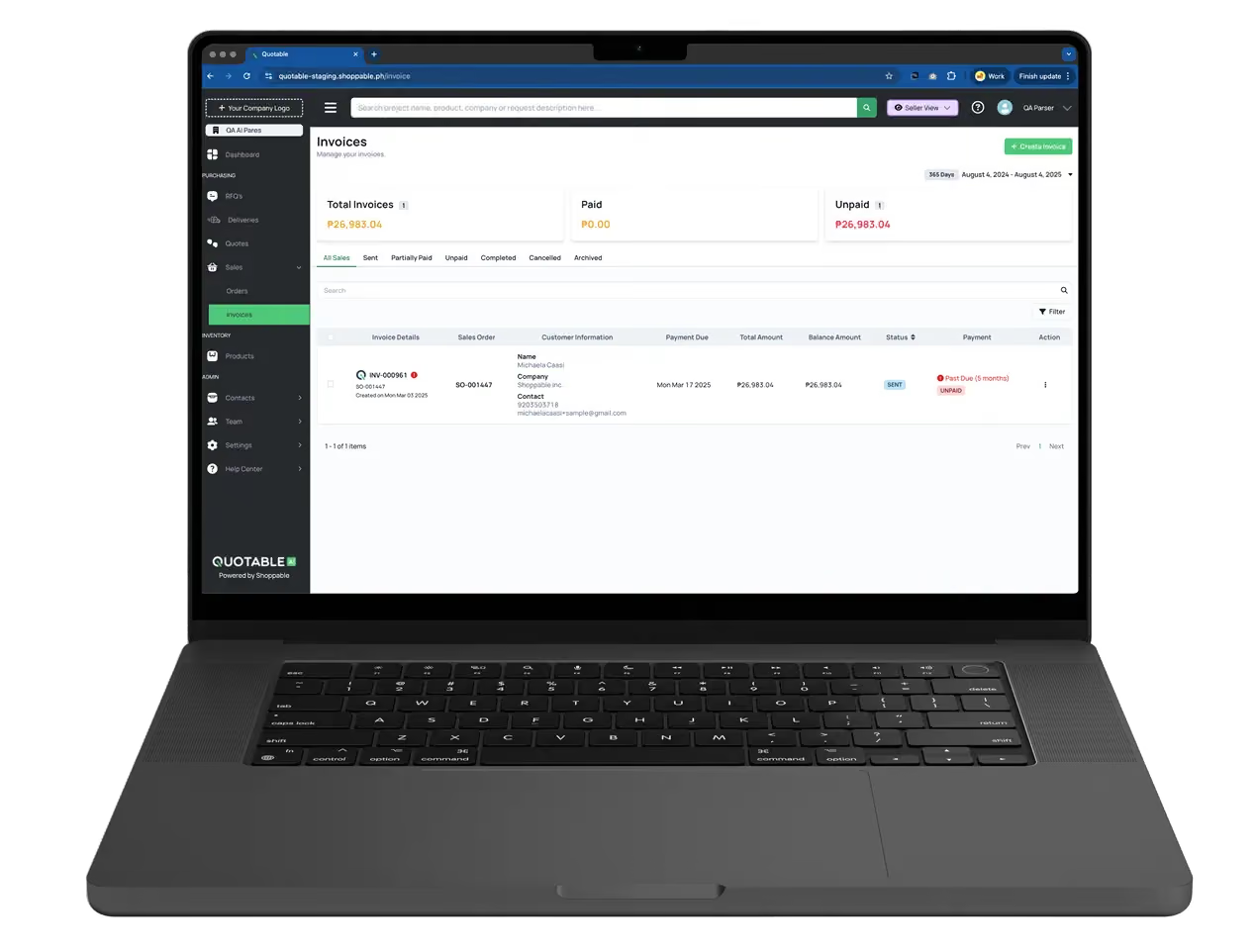
When you treat the quote as a live transaction state, it becomes the single source of truth that updates as the deal progresses. A supplier revises pricing? The quote updates, and so does every linked document. The buyer approves a partial quantity? The PO reflects that instantly. Quotable AI was built around this exact principle: treating the quote as the operating system for the transaction rather than a throwaway document. Their platform lets suppliers submit structured quotations through secure links without needing to create accounts, which means you're collecting comparable data from day one instead of parsing inconsistent PDF formats.
This approach eliminates the most common procurement error: mismatched data between the quote, PO, and invoice. If you've ever had your AP team reject an invoice because the unit price didn't match the PO by two cents, you know how much time these discrepancies consume.
Integrating Procurement and Fulfillment into One Continuous Workflow
The second piece of the quote-to-payment model connects procurement decisions to fulfillment outcomes. When your purchasing system knows what's been ordered, what's been shipped, and what's been received, it can automatically trigger the next step without human intervention.
For distributors and manufacturers, this means linking payment workflows with logistics data: bills of lading, packing lists, and delivery confirmations. A PO shouldn't sit in "awaiting receipt" status for days because someone forgot to update the system. The fulfillment data should flow back into the procurement record automatically.
One practical example: a construction materials distributor processing 200 orders per month reduced their order-to-payment cycle from 14 days to 4 days by connecting their quoting, procurement, and payment systems into one workflow. The key wasn't replacing their ERP. It was adding a data orchestration layer that connected the systems they already had.
Automating Data Orchestration to Achieve 10X Faster Procurement
Data orchestration is the process of automatically moving, transforming, and validating data between systems so humans don't have to. In procurement, this means your quote data, PO data, invoice data, and payment data all flow through a single intelligent layer that catches errors, flags exceptions, and keeps everything synchronized.
Organizations implementing digital procurement solutions report a 40% increase in procurement efficiency, and data orchestration is the primary driver of those gains. The speed improvement isn't incremental: it's the difference between a purchasing officer spending 45 minutes on a single PO versus completing it in under 5 minutes.
Reducing Friction Between SME Suppliers and Purchasing Officers
Here's a hard-won lesson from working with mid-market procurement teams: the biggest time sink isn't your internal process. It's the back-and-forth with suppliers. SME suppliers, the ones making up 60 to 80 percent of most companies' vendor bases, don't have sophisticated systems. They're sending quotes as email attachments, responding to RFQs inconsistently, and formatting invoices differently every time.
The fix isn't forcing suppliers onto your platform. That approach fails because small suppliers won't adopt new software for a single customer relationship. Instead, you need frictionless supplier participation: a way for vendors to respond to RFQs and submit documents through simple, no-login links that don't require training or onboarding.
Quotable AI's approach here is worth noting. Their universal AI parser automatically extracts and structures data from quotes, invoices, purchase orders, and bills of materials regardless of format. Whether a supplier sends a handwritten quote as a photo or a formal PDF, the system pulls the relevant data into a structured format. That eliminates the manual encoding step that typically costs purchasing officers 15 to 20 minutes per document.
Red flags that your supplier communication process needs automation:
- You're receiving quotes in three or more different formats from the same supplier category
- Purchasing officers are manually re-typing line items from supplier emails into your ERP
- RFQ response rates are below 60% because suppliers find your process too cumbersome
- You're discovering pricing discrepancies between quotes and invoices after payment
Leveraging AI for Instant Quote Validation and Approval
AI in procurement isn't about replacing human judgment. It's about removing the repetitive validation work that slows decisions down. AI implementation has cut contract lifecycle time by 39%, and the biggest gains come from automating three specific tasks: quote comparison, compliance checking, and approval routing.
Quote comparison is the most obvious win. When you receive five supplier responses to an RFQ, an AI system can instantly normalize the data, flag outliers, compare against historical pricing, and rank options by total cost of ownership. What used to take a purchasing officer two hours now takes seconds.
Compliance checking catches problems before they become expensive. Does the quote include the required payment terms? Are the lead times within your project timeline? Does the supplier's pricing fall within your approved budget thresholds? AI handles these checks automatically.
Approval routing eliminates the email chase. Instead of forwarding a quote to a manager and waiting for a reply, automated workflows route approvals based on dollar thresholds, categories, and project codes. A $5,000 office supply order gets auto-approved. A $50,000 equipment purchase routes to the VP of operations with all supporting data attached.
Vertical Integration: Connecting Finance and Procurement Teams
The wall between procurement and finance is one of the most expensive inefficiencies in mid-market companies. Procurement buys things. Finance pays for them. And the two teams often operate in separate systems with separate data, creating a reconciliation nightmare at month-end.
Procurement organizations can become 25 to 40 percent more efficient with AI when they connect purchasing decisions directly to financial outcomes. This means your CFO can see committed spend in real time, not two weeks after the fact. It means your AP team isn't manually matching invoices to POs. And it means your procurement team understands the cash flow impact of their buying decisions before they make them.
The "if/then" scenario makes this concrete: if your company processes 150 invoices per month and each three-way match (PO, receipt, invoice) takes 20 minutes manually, that's 50 hours of AP labor per month. Automate the match, and you're down to exception handling only, maybe 5 to 8 hours. That's not a theoretical gain. That's a full-time employee redeployed to higher-value work.
Streamlining Invoicing and B2B Payments in Real-Time
Payment delays are a trust killer in B2B relationships. "Treating every supplier the same is the fastest way to waste time and miss value." Your strategic suppliers deserve faster payment. Your commodity suppliers need predictable payment. And your finance team needs a system that handles both without manual intervention.
Real-time invoicing means the invoice is generated or validated the moment goods are received, not days later when someone gets around to processing it. Embedded payment options: bank wire, ACH, credit cards, and e-wallets: let suppliers choose how they want to get paid, which reduces payment disputes and accelerates cash application on both sides.
Quotable AI's centralized payment system is a good example of this principle in action. Buyers can approve, submit POs, and pay through a single link. Suppliers receive payments via their preferred method. The entire chain from quote acceptance to final payment happens in one system, eliminating the manual back-and-forth of payment verification that typically adds three to five days to every transaction.
For companies doing international trade, connecting payment workflows to logistics documents is critical. Your landed cost calculation: duties, freight, currency conversion: should update automatically as shipment data flows in, not require a manual spreadsheet reconciliation after the fact.
Industry-Specific Strategies for Construction, IT, and Manufacturing
Generic procurement advice falls apart when you look at how different industries actually buy. Here's what works in three of the most quote-heavy sectors.
Construction procurement runs on speed and accuracy. A general contractor managing 15 subcontractor relationships needs to compare material quotes across multiple suppliers daily. The winning strategy is standardized RFQ templates that force apples-to-apples comparison, combined with automated re-ordering for recurring materials like concrete, rebar, and lumber. Construction teams should also track lead time trends by supplier: a vendor who quoted two-week delivery six months ago but now consistently delivers in three weeks is a risk to your project timeline.
IT procurement has a different challenge: complex configurations and rapid price changes. A $200,000 server purchase might involve 40 line items with different lead times, compatibility requirements, and licensing terms. AI-powered quote parsing is especially valuable here because it can validate technical specifications against requirements, not just pricing. IT procurement teams should also build approved vendor catalogs with pre-negotiated pricing to bypass the full RFQ cycle for repeat purchases.
Manufacturing procurement is all about volume, consistency, and landed cost. When you're buying 10,000 units of a component, a $0.03 per-unit price difference across suppliers represents $300 per order. Multiply that across hundreds of SKUs and you're talking about serious money. Manufacturing buyers need systems that track total cost of ownership: unit price plus freight plus duties plus quality rejection rates: not just the number on the quote. Bill of materials management becomes the critical capability: your procurement system needs to understand that ordering finished product X requires components Y and Z from different suppliers with different lead times.
Right-sizing your solution matters here. A $5M construction subcontractor doesn't need the same procurement platform as a $40M manufacturer. Start with the bottleneck that costs you the most time, whether that's supplier communication, quote comparison, or invoice matching, and automate that first.
Future-Proofing Your Supply Chain with a Quote-Centric Operating System
The companies that will win in procurement over the next three to five years are the ones building their operations around a simple idea: the quote is where every B2B transaction begins, and the system that captures, structures, and activates quote data controls the entire downstream process.
A quote-centric operating system doesn't mean abandoning your ERP. It means adding an intelligent layer that sits on top of your existing infrastructure and connects the dots between quoting, procurement, fulfillment, and payment. Quotable AI's integration approach reflects this: connecting with existing financial systems so organizations can modernize supplier collaboration without ripping out what already works.
The procurement teams saving the most time in 2026 share three characteristics. First, they've automated data capture so no one is manually typing information from one system into another. Second, they've connected their procurement and finance workflows so approvals, invoicing, and payments happen in a continuous flow. Third, they've made it easy for suppliers to participate, recognizing that procurement speed depends as much on vendor responsiveness as internal efficiency.
If you're processing more than 30 purchase orders per month and still relying on email-based workflows, you're past the breaking point where manual processes can keep up. The path forward isn't a massive digital transformation project. It's identifying the two or three highest-friction points in your quote-to-payment cycle and automating them with tools designed for your scale. Start with the quote. Everything else follows from there.