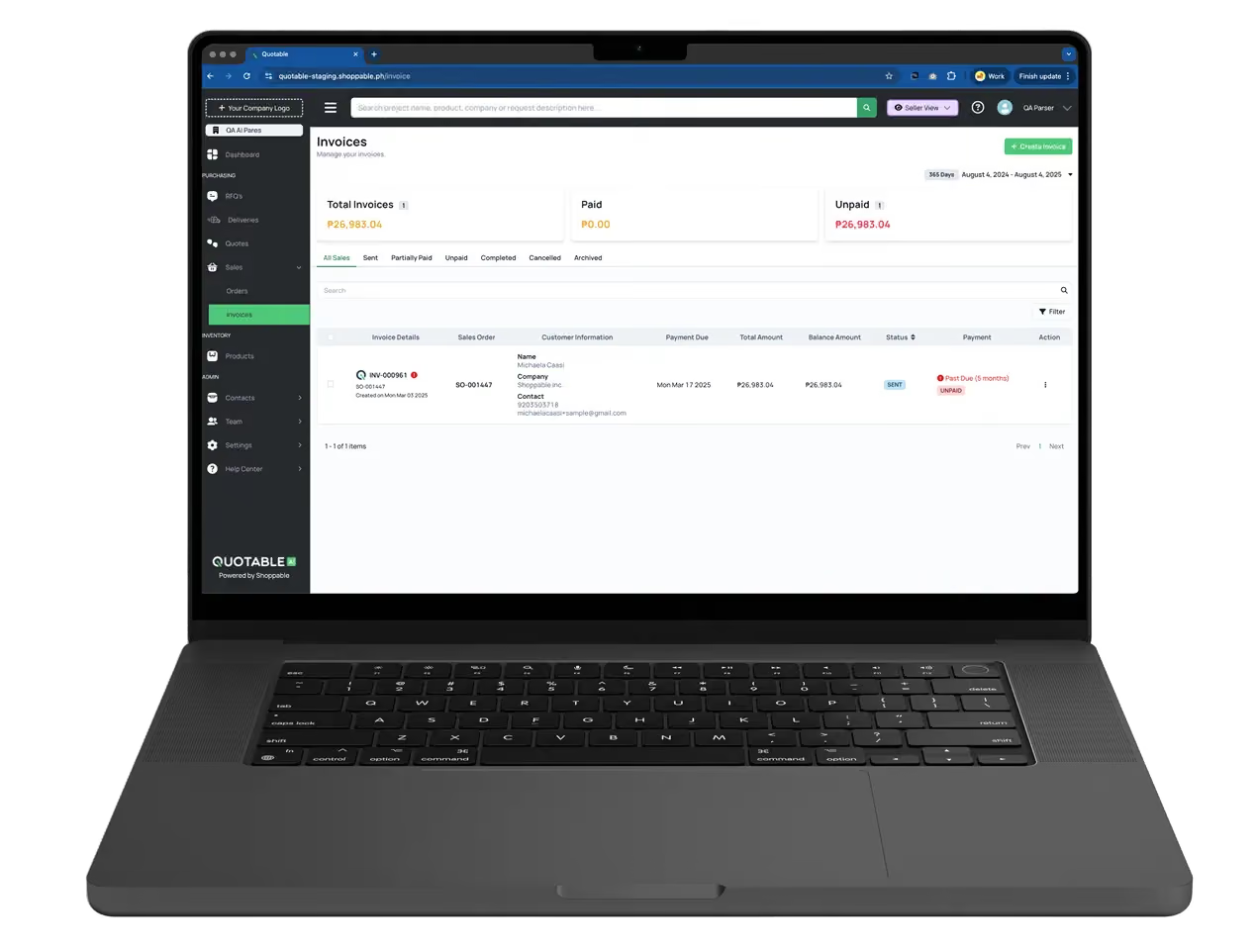
Small and mid-market companies doing business across borders face a unique set of headaches that their enterprise counterparts solved years ago with massive ERP investments and dedicated treasury teams. For SMEs processing $1M to $30M in annual revenue, the reality is different: you're often stuck juggling wire transfers across time zones, reconciling invoices in spreadsheets, and chasing payments through email threads that stretch on for weeks. The cost of this friction isn't just administrative. It's lost deals, strained supplier relationships, and cash flow gaps that can threaten your entire operation. Getting global payment solutions right as an SME means rethinking the entire transaction lifecycle, from the moment a quote is issued to the second funds land in your account. Cross-border transactions don't have to be the bottleneck that slows your growth. But solving this problem requires more than just picking a new payment processor. It demands a strategic shift in how you connect quoting, procurement, invoicing, and settlement into a single, coherent workflow. That's the hard-won lesson many growing companies are learning right now, and it's reshaping how B2B trade actually works for businesses outside the Fortune 500.
The Evolution of B2B Payments for SMEs and Mid-Market Companies
The way SMEs handle B2B payments has changed more in the last five years than in the previous twenty. Traditional bank wires and paper checks dominated for decades, not because they were efficient, but because nothing better existed at the right price point. According to APQC benchmarks, top-performing organizations process invoices for under $3 each, while the median cost sits closer to $8 to $12. For SMEs handling hundreds of cross-border invoices monthly, that gap represents tens of thousands of dollars in unnecessary overhead every year.
The shift we're seeing now isn't just about digitizing old processes. It's about collapsing the distance between a sale being agreed upon and payment being received. Companies selling $5M or $15M annually can't afford the 45 to 60-day payment cycles that have become the norm in global B2B trade. Every day a payment sits in limbo is a day you can't reinvest that capital into inventory, hiring, or new market expansion.
Moving Beyond Traditional Invoicing and Collections
Most SMEs still rely on a patchwork of tools for invoicing and collections. You generate a quote in one system, create an invoice in another, and then manually track whether payment arrived via your bank portal. This fragmented approach creates three specific problems: data entry errors that lead to disputes, delayed reconciliation that clouds your cash position, and zero visibility into where a payment actually stands in the pipeline.
One common mistake we see is treating invoicing as a standalone function rather than a natural extension of the quoting process. When your invoice doesn't directly reference the original quote terms, line items, and agreed pricing, you're inviting disputes. A purchasing officer on the other end will flag any discrepancy, and suddenly a 30-day payment term becomes a 60-day negotiation. The fix isn't more follow-up emails. It's ensuring your invoice is born from the same data as your quote, with no manual re-keying in between.
Collections on international transactions add another layer of complexity. Currency conversion fees, intermediary bank charges, and inconsistent payment methods across regions mean that the amount you quoted isn't always the amount you receive. Companies that don't account for these variables in their pricing or payment terms end up absorbing costs they never planned for.
Bridging the Gap Between Sales Quotations and Fulfillment
Here's where many B2B distributors hit a breaking point: the handoff between sales and operations. A sales rep closes a deal and generates a quote, but the fulfillment team works from a completely different set of documents. Purchase orders get created manually, shipping instructions are communicated via email, and the finance team doesn't know what's happening until someone asks them to send an invoice.
This disconnect is especially painful for companies in construction, IT distribution, and manufacturing logistics, where a single order might involve multiple suppliers, partial shipments, and progress-based billing. The quote isn't just a price agreement. It's the blueprint for everything that follows. When that blueprint lives in a PDF attachment buried in someone's inbox, the entire downstream process suffers.
Bridging this gap requires treating the quote as the origin point for every subsequent transaction. The purchase order should flow from the quote. The invoice should flow from the purchase order. And the payment should close the loop back to the original terms. This isn't a theoretical ideal. It's how companies that process 30 to 50 orders per month without drowning in admin actually operate.
The Quote-to-Payment Lifecycle: A Strategic Foundation
Think of every B2B transaction as a lifecycle with the quote at its center. Most systems pick up the story midway through, starting at the purchase order or the invoice. But by that point, critical context has already been lost: the negotiated terms, the specific line-item pricing, the delivery conditions that were verbally agreed upon but never formally captured.
The companies that get global payments right are the ones that treat the entire journey from quote to payment as a single, connected process. This isn't about adding more software. It's about eliminating the gaps between the software you already use.
Treating the Quote as a Live Transaction State
This concept is borrowed from how Quotable AI approaches the problem, and it's worth understanding even if you're evaluating different solutions. The idea is simple but powerful: a quote shouldn't be a static document. It should be a live transaction state that updates as the deal progresses through approval, procurement, fulfillment, and payment.
In practical terms, this means that when a buyer approves your quote, that approval triggers the creation of a purchase order. When goods ship, the quote's status updates to reflect fulfillment progress. When you issue an invoice, it pulls directly from the quote data, eliminating discrepancies. And when payment arrives, the entire chain is reconciled automatically.
Why does this matter for cross-border transactions specifically? Because international deals involve more handoffs, more document types, and more opportunities for data to get lost or corrupted. A quote that lives as a static PDF can't tell you whether the buyer's procurement team has approved it, whether the PO has been issued, or whether payment terms have changed. A live transaction state can.
The operational impact is significant. Companies that connect their quoting and payment processes typically reduce their days sales outstanding (DSO) by 15 to 25 days. For a distributor doing $10M in annual revenue, shaving 20 days off DSO can free up $500,000 or more in working capital.
Integrating Procurement and Payments into One Continuous Workflow
The traditional B2B procurement workflow has at least six distinct stages: need identification, supplier selection, RFQ issuance, quote comparison, PO creation, and payment. Most companies use different tools or manual processes for each stage, which creates what procurement professionals call "process leakage," the loss of data, context, and accountability between steps.
For SMEs managing cross-border supplier relationships, this leakage is expensive. Consider a mid-market company buying $20M in materials from suppliers across three countries. If their procurement team issues RFQs via email, compares quotes in spreadsheets, and processes payments through a separate banking portal, they're likely spending 15 to 20 hours per week on tasks that should be automated.
A continuous workflow looks different:
- A purchasing officer issues an RFQ to multiple suppliers through a centralized system
- Suppliers respond with structured quotations, including pricing, lead times, and payment terms
- The system enables side-by-side comparison without manual data entry
- The selected quote converts directly into a purchase order
- The invoice is generated from the PO data, and payment is processed within the same platform
This is the kind of workflow that platforms like Quotable AI are built around, where suppliers can respond to RFQs through a secure link without creating accounts, and the entire chain from quote to payment stays connected. The frictionless supplier participation piece is particularly important for global trade, where asking an overseas supplier to adopt new software is often a non-starter.
Overcoming Common Global Payment Obstacles
Cross-border payments for SMEs come with a specific set of obstacles that don't apply to domestic transactions. Currency volatility, regulatory compliance requirements, varying payment method preferences by region, and the sheer complexity of multi-party transactions all contribute to delays and errors. According to a 2023 Juniper Research report, B2B cross-border payment transaction values are expected to exceed $40 trillion by 2028, yet the infrastructure serving small and mid-market companies remains frustratingly outdated.
The most common pain points we hear from founders and finance teams fall into three categories: data fragmentation, payment method incompatibility, and manual reconciliation. Each of these is solvable, but not with point solutions alone.
Automating Data Orchestration Across Global Trade
Data orchestration is a term that sounds technical but describes something painfully practical: getting the right information to the right system at the right time. In global B2B trade, this means ensuring that a quote generated in your sales system, a PO issued by your buyer's procurement platform, an invoice sent to their accounts payable team, and a payment processed through their banking system all reference the same data.
The reality for most SMEs is that each of these documents is created independently. A sales rep types up a quote. A buyer manually creates a PO based on that quote. The seller manually creates an invoice based on the PO. And the buyer's AP team manually enters the invoice into their accounting system. At each step, there's a chance for errors: wrong quantities, mismatched pricing, incorrect payment terms.
Universal AI document parsing is one approach to solving this problem. Systems that can automatically extract and structure data from quotes, invoices, purchase orders, and bills of materials reduce manual encoding and improve accuracy. This is especially valuable in cross-border contexts where documents might arrive in different formats, languages, or standards.
The goal isn't to replace your ERP or accounting system. It's to create an orchestration layer that connects your existing tools and eliminates the manual re-keying that causes 60% to 70% of invoice disputes, according to Ardent Partners research.
Reducing Friction in Construction, IT, and Manufacturing Logistics
Different industries experience payment friction in different ways. Construction companies deal with progress billing, retention holdbacks, and complex change order processes. IT distributors manage high-volume, low-margin transactions where payment speed directly impacts profitability. Manufacturing logistics companies juggle multi-supplier BOMs (bills of materials) where a single delayed payment can halt an entire production line.
One client we worked with, an IT distributor doing $8M annually across Southeast Asia and North America, was losing an average of 12 days per transaction due to manual quote-to-invoice conversion and payment verification. Their finance team spent roughly 25% of their time chasing payment confirmations across email, WhatsApp, and bank portals. By centralizing their payment methods (bank wire, ACH, credit cards, and e-wallets) into a single system and connecting invoices directly to the original quotes, they cut that 12-day delay to under three days.
For construction firms, the challenge is different but equally painful. Verbal changes to project scope that aren't captured in updated quotes lead to billing disputes months later. The fix is ensuring that every change order generates an updated quote, which flows into an updated invoice, which references the original contract terms. Without this audit trail, you're exposed to both financial and legal risk.
Leveraging AI for Faster Invoicing and Global Settlement
AI's role in B2B payments isn't about replacing human judgment. It's about eliminating the repetitive, error-prone tasks that slow down your payment cycles. For SMEs handling cross-border transactions, this means three things: faster document processing, smarter matching and reconciliation, and predictive cash flow management.
Consider the typical invoice processing workflow. A supplier sends an invoice as a PDF. Your AP team opens it, manually enters the line items into your accounting system, matches it against the PO, flags any discrepancies, gets approval, and schedules payment. For a domestic transaction with a trusted supplier, this might take a day or two. For an international transaction with currency conversion, tax implications, and unfamiliar document formats, it can take a week or more.
AI-powered document parsing can reduce that initial data entry step from 15 to 20 minutes per invoice to seconds. When the system can automatically extract line items, payment terms, tax amounts, and banking details from any document format, your team shifts from data entry to exception management. They're only spending time on the invoices that actually need human attention.
The settlement side of the equation matters just as much. Global settlement involves coordinating payment timing across time zones, managing currency conversion, and ensuring compliance with local regulations. SMEs that batch their international payments weekly or monthly are leaving money on the table. Faster settlement cycles mean better supplier relationships, early payment discounts, and improved cash flow visibility.
Accelerating Payment Cycles for Suppliers and Distributors
The average B2B payment cycle in cross-border trade runs 45 to 60 days. For suppliers and distributors operating on thin margins, this timeline is a serious constraint on growth. You can't take on a larger order if the cash from your last order hasn't arrived yet.
Accelerating payment cycles requires attacking the problem from both ends. On the invoicing side, you need to eliminate the lag between fulfillment and invoice delivery. If your team waits until the end of the month to batch invoices, you've already added 15 to 30 days to your cycle. Automated invoicing that triggers upon delivery confirmation or milestone completion can cut this delay to zero.
On the payment side, offering multiple payment methods is critical for global transactions. A buyer in Germany might prefer SEPA transfers. A buyer in the Philippines might want to pay via e-wallet. A buyer in the US will expect ACH or credit card options. If you only accept bank wires, you're adding friction that delays payment.
Quotable AI's approach of embedding multiple payment methods (bank wire, ACH, credit cards, and e-wallets) directly into the invoice is one model worth considering. When a buyer can click a link and pay immediately without logging into a separate system, the psychological barrier to prompt payment drops significantly. No-login payment links are a small feature that makes a big difference in practice.
Scaling Global Operations with Vertically Integrated Finance Systems
As your company grows from $1M to $10M to $30M in annual revenue, the tools and processes that worked at one stage start breaking at the next. The spreadsheet that tracked 20 invoices per month can't handle 200. The manual three-way match process that one person managed becomes a full-time job for three people. The ad-hoc payment verification that worked with five suppliers becomes impossible with fifty.
Vertical integration in finance means connecting every step of the financial transaction, from quoting through payment, into a single system or tightly connected set of systems. This isn't about buying an enterprise ERP. It's about ensuring that your quote data flows into your procurement data, which flows into your invoicing data, which flows into your payment and reconciliation data, without manual intervention at each handoff.
The companies that scale global operations successfully are the ones that invest in this integration before they hit the breaking point, typically around 30 to 50 orders per month. After that threshold, manual processes don't just slow you down. They introduce errors that compound with every transaction.
Connecting Finance Teams and Purchasing Officers in Real-Time
One of the most overlooked problems in mid-market B2B operations is the disconnect between finance teams and purchasing officers. Purchasing commits to a price and delivery schedule. Finance doesn't learn about it until an invoice arrives weeks later. This gap creates budget surprises, approval bottlenecks, and strained internal relationships.
Real-time visibility solves this. When a purchasing officer approves a quote or issues a PO, the finance team should see it immediately, along with the payment terms, expected invoice date, and budget impact. When an invoice arrives, purchasing should be notified so they can confirm that the goods or services were received as expected. This isn't about adding more meetings or status reports. It's about shared access to the same transaction data.
For companies managing global supplier relationships, this real-time connection becomes even more critical. A purchasing officer in your US office might approve a quote from a supplier in Vietnam at 3 PM Eastern. By the time your finance team in the same office reviews it the next morning, the supplier has already begun production. If there's a payment term issue or budget concern, you've lost your window to address it without disrupting the order.
Systems that integrate procurement and finance workflows, connecting the RFQ, quote, PO, invoice, and payment into a single visible chain, eliminate these blind spots. The result isn't just operational efficiency. It's better decision-making, because everyone involved in a transaction can see its full context.
Building Your Cross-Border Payment Strategy
The path to mastering global payments as an SME isn't a single technology purchase. It's a strategic decision to treat every transaction as a connected lifecycle rather than a series of disconnected events. Start with your quote. Make sure it carries accurate, structured data that flows through procurement, invoicing, and payment without manual re-entry. Choose tools that match your current scale but can grow with you, and don't underestimate the impact of offering your international buyers the payment methods they actually prefer.
The companies winning in global B2B trade right now aren't the ones with the biggest budgets. They're the ones that eliminated the gaps between quoting and getting paid. That's founder-to-founder advice from watching hundreds of SMEs tackle this exact challenge.
If you're ready to connect your quoting, procurement, and payment workflows into a single system, explore what Quotable AI can do for your business.