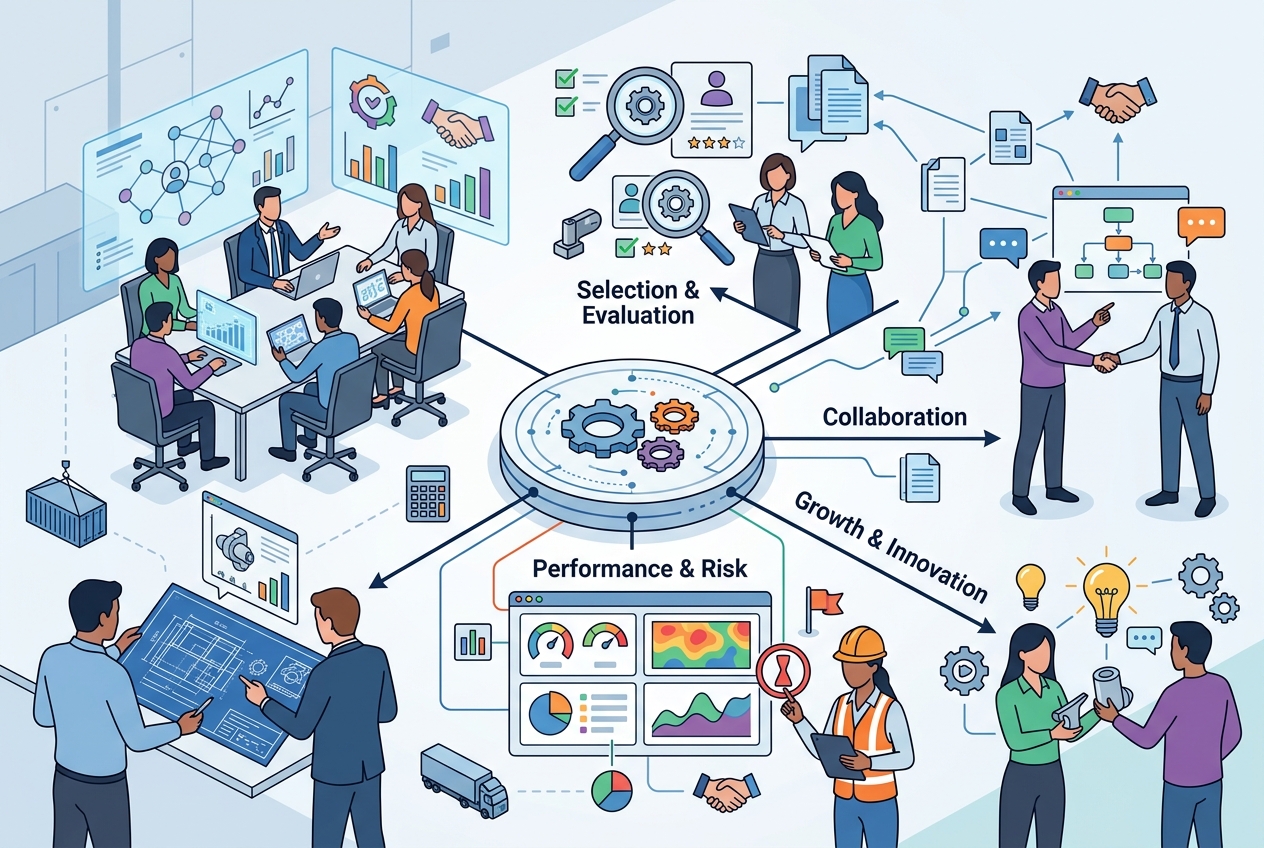
Most B2B companies treat their suppliers like vending machines: insert a purchase order, receive goods, repeat. But the businesses pulling ahead right now are the ones that recognize their vendor base as a strategic asset, not just a line item. Managing those relationships well isn't a soft skill - it's a hard competitive advantage that directly affects margins, fulfillment speed, and cash flow.
The global supplier relationship management market is projected to reach approximately USD 11.9 billion by 2032, growing at a CAGR of 9.6%. That kind of growth tells you something: companies are investing real money in how they manage vendors because the payoff is measurable. If you're running a distribution business doing $1M to $30M in annual revenue, or a mid-market company managing $10M to $50M in procurement spend, this is the playbook you need. We've seen firsthand how the right systems and habits can compress quote-to-payment cycles, eliminate costly errors, and turn suppliers into genuine partners.
Here's the hard-won lesson: you don't fix supplier relationships with better emails. You fix them with better infrastructure, cleaner data, and workflows that remove friction from every transaction. What follows is a practical guide to doing exactly that.
The Shift from Transactional to Strategic Supplier Relationships
The old way of managing suppliers is simple and familiar. You need something, you call around for a price, you pick the cheapest option, and you move on. That approach works fine when you're processing ten orders a month. But once you cross the 30 to 50 orders per month threshold, transactional habits start breaking down. Quotes get lost in email threads. Payment terms get confused across vendors. Nobody knows which supplier actually delivered on time last quarter.
Strategic supplier relationship management means treating your vendor base as a portfolio. Some suppliers are critical to your core operations. Others fill niche needs. A few are probably costing you more than they're worth when you factor in late deliveries, quality issues, and the administrative overhead of chasing invoices. The shift happens when you start categorizing, measuring, and investing in those relationships differently.
Moving Beyond Cost-Plus Thinking
Cost-plus pricing has dominated B2B procurement for decades. You take the supplier's cost, add a margin, and that's your selling price. It's easy math. It's also a trap that keeps you focused on unit price when the real costs are hiding elsewhere.
Think about it this way: if Supplier A quotes you $12 per unit but consistently ships three days late, and Supplier B quotes $12.80 but hits delivery windows 98% of the time, which one is actually cheaper? When you factor in expedited shipping charges, production delays, and the customer goodwill you burn on late deliveries, that $0.80 premium disappears fast. One client we worked with in construction distribution discovered they were spending roughly $4,200 per month in rush freight charges because their "cheapest" supplier couldn't hit a deadline. They switched to a slightly more expensive vendor and saved $38,000 in the first year.
The point isn't that price doesn't matter. It absolutely does. The point is that price is one variable in a much larger equation that includes reliability, communication speed, payment flexibility, and quality consistency.
The Quote as the Foundation of the Transaction Lifecycle
Most procurement systems start tracking a transaction at the purchase order. That's too late. The real transaction begins at the quote, because the quote is where pricing, terms, quantities, and delivery expectations are first established. Everything downstream - the PO, the invoice, the payment - is just an echo of what was agreed upon in that initial quote.
When you treat the quote as a live transaction state rather than a static PDF, something powerful happens. Changes to pricing or quantities flow through the entire chain automatically. A three-way match between quote, PO, and invoice becomes trivial instead of painful. Disputes drop because everyone is working from the same source of truth.
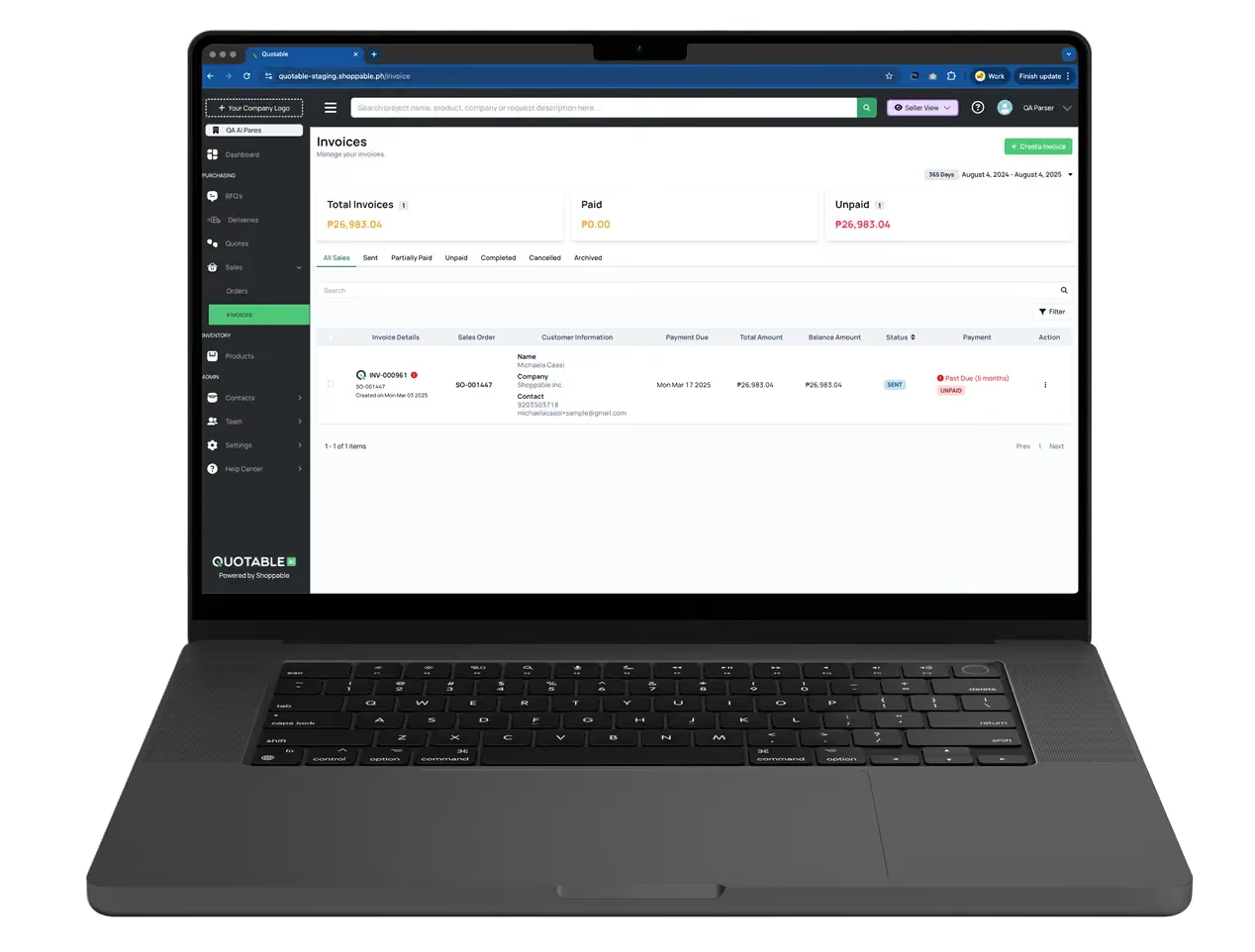
This is exactly the philosophy behind platforms like Quotable AI, which treat the quote as the origin point for the entire transaction lifecycle. Instead of stitching together separate tools for quoting, procurement, and payments, you get one continuous workflow where the quote evolves into a PO, then an invoice, then a payment record - all connected.
Centralizing Data Orchestration for Better Vendor Visibility
You can't manage what you can't see. And in most SME and mid-market operations, vendor data lives in at least four different places: a quoting tool, an email inbox, an accounting system, and somebody's spreadsheet. That fragmentation is the root cause of most supplier management failures.
Centralizing your vendor data doesn't mean dumping everything into one giant database. It means creating a single orchestration layer where quoting, procurement, invoicing, and payment data are connected and visible in real time. When your procurement team can see a supplier's quote history, delivery performance, and outstanding invoices in one view, they make better decisions. Period.
Integrating Quoting, Procurement, and Payments
The typical B2B transaction touches five to seven different systems between the initial quote request and final payment. Each handoff between systems creates an opportunity for data loss, duplication, or error. A price gets manually re-keyed incorrectly. A payment term from the quote doesn't match what's on the invoice. A cost code gets dropped.
Here's what an integrated workflow actually looks like, step by step:
- Buyer requests a quote through a shared portal or link
- Supplier generates and sends a quote with line items, pricing, and terms
- Buyer approves the quote, which automatically generates a purchase order
- Supplier fulfills the order and converts the approved quote into an invoice
- Buyer receives the invoice with a one-click payment option (ACH, wire, card, or e-wallet)
- Payment is recorded and reconciled automatically against the original quote
When these steps happen inside one system, the three-way match between quote, PO, and invoice is automatic. Disputes drop. Month-end close gets faster. And your finance team stops spending hours reconciling spreadsheets.
Eliminating Data Silos in SME and Mid-Market Operations
Data silos aren't just a big-enterprise problem. They're arguably worse for smaller companies because there's less staff to absorb the manual work of bridging gaps between systems. If you're a $5M distributor with three people in your back office, every hour spent copying data between QuickBooks, a quoting spreadsheet, and an email thread is an hour not spent on revenue-generating activity.
The red flags are easy to spot. Duplicate orders appearing because nobody could confirm whether the first one went through. Suppliers getting paid twice for the same invoice. Procurement teams re-quoting jobs that were already quoted last month because they can't find the original. These aren't edge cases - they're daily occurrences in companies that haven't centralized their vendor data.
The fix doesn't require a six-figure ERP implementation. Platforms built for SME and mid-market operations can connect quoting, procurement, and payments without requiring months of IT integration work. The key is choosing a system with native, bidirectional sync across those functions rather than one that merely "supports" integrations through manual data mapping.
Automating Communication and Quote-to-Payment Workflows
Manual communication is the silent killer of supplier relationships. Every phone call to check on a quote status, every email asking "did you get our PO?", every follow-up about an overdue invoice - these interactions add friction, waste time, and erode trust on both sides. Automation doesn't replace the relationship. It removes the administrative noise so you can focus on the relationship itself.
Companies that use advanced analytics in their SRM processes can achieve up to a 15% reduction in procurement costs. A big chunk of that savings comes from automating repetitive communication and eliminating the delays that manual processes create.
Accelerating Fulfillment with Real-Time Transaction States
The concept of a "real-time transaction state" sounds technical, but the idea is straightforward. Instead of a quote being a PDF that sits in someone's inbox until they act on it, the quote is a live object that both buyer and supplier can see, update, and act on instantly.
When a supplier updates pricing on a quote, the buyer sees it immediately. When a buyer approves a quote, the supplier gets notified and can begin fulfillment without waiting for a separate PO email. When goods ship, the transaction state updates to reflect that, and the invoice is generated automatically.
This kind of real-time visibility eliminates the most common fulfillment bottleneck: waiting. Waiting for approvals. Waiting for confirmations. Waiting for someone to forward an email to the right person. In a Quotable AI workflow, buyers can approve quotes and submit POs through no-login links, which means there's no friction from password resets, account creation, or portal fatigue. The transaction just moves forward.
Reducing Friction in B2B Invoicing and Collections
Late payments are the number one complaint suppliers have about their buyers. And the number one cause of late payments isn't cash flow problems - it's process friction. The invoice went to the wrong email. The PO number didn't match. The payment portal required a login nobody remembers.
Here's a common mistake that causes real pain: verbal changes to terms or quantities that never get documented. A buyer calls a supplier and says "add 50 more units to that last order." The supplier ships them. The invoice reflects the updated quantity, but the original PO doesn't. Now you've got a mismatch that holds up payment for weeks while both sides dig through email threads trying to reconstruct what happened.
Embedded payment options solve the last-mile problem. When an invoice arrives with a direct link to pay via ACH, credit card, wire, or e-wallet, the buyer doesn't need to log into a portal, cut a check, or initiate a bank transfer manually. This alone can compress payment cycles by 5 to 15 days for most B2B transactions.
Measuring Supplier Performance and Compliance
You can't improve what you don't measure, and most companies don't measure supplier performance with any rigor. They have a gut feeling about which suppliers are good and which are problematic, but gut feelings don't hold up in quarterly business reviews or vendor negotiations.
Organizations that measure SRM ROI effectively see up to 15% improvement in supplier performance within the first year. That improvement comes from setting clear expectations, tracking performance against those expectations, and having honest conversations backed by data.
SRM provides a strategic framework to control tail spend, enhance supply chain resilience, and align sourcing strategies with broader business goals. That framework only works if you're collecting the right data and reviewing it consistently.
Key Metrics for Construction, IT, and Manufacturing Trade
The metrics that matter vary by industry, but certain fundamentals apply across construction, IT distribution, and manufacturing:
- On-time delivery rate: What percentage of orders arrive within the agreed window? Anything below 90% should trigger a conversation.
- Quote-to-order conversion rate: How often do a supplier's quotes turn into actual orders? Low conversion might indicate pricing issues or slow response times.
- Invoice accuracy rate: What percentage of invoices match the corresponding PO on the first submission? Below 95% means you're burning admin hours on disputes.
- Average payment cycle time: How many days from invoice receipt to payment? Track this by supplier to identify where your own processes are creating delays.
- Cost variance: How often does the final cost differ from the quoted cost, and by how much?
- Defect or return rate: Especially critical in manufacturing and construction, where quality failures can shut down a job site.
By setting clear expectations and providing regular feedback, businesses can boost supplier performance by over 20% through better collaboration. The key word there is "regular." A once-a-year vendor review isn't enough. Monthly or quarterly check-ins, backed by real data from your transaction history, create accountability on both sides.
One overlooked step: sharing your performance data with suppliers. Most companies hoard this information and only bring it out during disputes. But when you proactively share delivery and quality metrics with a vendor, you give them the chance to fix problems before they become deal-breakers.
Leveraging AI to Scale Supplier Partnerships 10X Faster
AI in procurement isn't about replacing human judgment. It's about eliminating the manual work that prevents your team from exercising that judgment at scale. When your team spends 60% of their time on data entry, document matching, and status updates, they have almost no bandwidth left for strategic vendor management.
AI-powered platforms can auto-generate quotes based on historical pricing, flag anomalies in invoices before they become disputes, and predict which suppliers are likely to miss delivery windows based on past patterns. The 10X speed claim isn't hyperbole when you compare the time it takes to manually process a quote-to-payment cycle versus running it through an automated system.
North America holds approximately 35% of the global SRM market share, and much of that investment is flowing into AI-driven tools that can handle the complexity of multi-supplier, multi-currency, multi-geography operations.
Standardizing Global B2B Trade Workflows
If you're buying from suppliers in three countries and selling to customers in five, every transaction involves different currencies, tax rules, payment methods, and documentation requirements. Without standardization, each transaction is a one-off that requires manual handling.
Standardizing your B2B trade workflows means creating repeatable templates for quotes, POs, and invoices that automatically adjust for local requirements. It means having payment rails that support wire transfers for your European suppliers, ACH for domestic vendors, and e-wallets for your Southeast Asian partners - all from one platform.
The companies that scale fastest are the ones that build these workflows once and then let them run. They're not reinventing the process for every new supplier or every new market. They've got a system that handles the variation automatically, freeing their team to focus on finding and developing the next great vendor relationship.
Future-Proofing Your Supply Chain with Integrated Operating Systems
The companies that will thrive over the next decade aren't the ones with the most suppliers or the lowest costs. They're the ones with the best systems connecting their entire transaction lifecycle from first quote to final payment.
An integrated operating system for B2B trade isn't a nice-to-have anymore. It's the foundation that makes everything else possible: better vendor visibility, faster fulfillment, cleaner compliance, and stronger relationships. When your quoting, procurement, invoicing, and payment workflows all live in one connected system, you don't just manage supplier relationships better - you fundamentally change the speed and quality of every transaction.
Here's our recommendation: start with the quote. If you can get that right - if you can turn the quote from a static document into a live, trackable, actionable transaction state - everything downstream gets easier. That's the founder-to-founder advice we'd give any B2B company serious about building a supply chain that doesn't just survive disruption but actually gets stronger from it. Platforms like Quotable AI were built around exactly this principle, and the results speak for themselves in compressed cycle times and healthier vendor partnerships.
Smart money goes toward infrastructure that compounds. Invest in your supplier management systems now, and you'll be collecting returns on that investment for years.