Every procurement team has a breaking point. For most SMEs and mid-market companies, it hits somewhere around 30 to 50 inbound quotes per month, when the spreadsheets start breaking, emails get buried, and someone inevitably copies a unit price into the wrong cell. The cost of that chaos isn't abstract: it's real money lost on overpayment, delayed purchase orders, and missed volume discounts. A supplier quote comparison tool exists to solve exactly this problem, turning a scattered, error-prone process into something fast, structured, and reliable. If your company is buying or selling between $1M and $50M annually, the difference between a manual quoting workflow and an automated one can mean tens of thousands of dollars in savings each year. The question isn't whether you need a better system. It's how much your current one is already costing you.
The High Cost of Manual Procurement Workflows
Most procurement teams don't realize how expensive their existing process is until they map it out. The true cost of manual workflows isn't just the hours spent gathering quotes: it's the downstream impact of slow decisions, inconsistent data, and vendor relationships managed through inbox searches. When your purchasing officer spends half a day chasing three suppliers for updated pricing, that's time not spent negotiating better terms or evaluating alternative vendors. Multiply that across dozens of purchases per month, and the drag on your bottom line becomes significant.
The real danger is that manual procurement feels functional right up until it isn't. You're closing deals, paying invoices, and keeping the lights on. But underneath, maverick spend creeps in, duplicate orders slip through, and nobody catches the 12% price increase a supplier quietly embedded in their latest quote. These are the silent profit killers that don't show up on a P&L until someone runs a spend analysis and wonders where the margin went.
Eliminating the Fragmented Email and Spreadsheet Trap
Here's a scenario we've seen dozens of times. A purchasing manager sends an RFQ to five suppliers via email. Responses trickle in over three to seven days, each in a different format: one as a PDF attachment, another as an Excel file, a third buried in the body of an email. The manager then manually transcribes each quote into a master spreadsheet, reformatting columns, converting currencies, and trying to normalize lead times across vendors who each describe delivery windows differently.
This fragmented approach creates three specific problems:
- Version control breaks down. When a supplier revises their quote, the manager has to figure out which version is current and whether the spreadsheet reflects the update.
- Comparison is inconsistent. Without a standardized format, you're comparing apples to oranges: one supplier includes freight, another doesn't, and a third bundles packaging costs into unit price.
- Institutional knowledge disappears. When that purchasing manager leaves or goes on vacation, nobody else can make sense of their filing system.
Businesses that overpay 10-30% for similar quality products often do so not because better pricing doesn't exist, but because their comparison process can't surface it. The spreadsheet trap isn't a technology problem: it's a visibility problem.
Reducing Human Error in B2B Data Entry
Data entry errors in procurement aren't minor inconveniences. A misplaced decimal in a unit price, a transposed quantity, or a wrong SKU can cascade into purchase orders that don't match invoices, triggering three-way match failures and payment delays. For companies processing hundreds of line items per month, even a 2% error rate creates hours osf reconciliation work.
One client we worked with, a mid-size construction supply distributor, discovered they'd been overpaying a fastener supplier by $0.03 per unit for eight months because someone fat-fingered the price during a spreadsheet update. On 200,000 units per month, that's $6,000 in unnecessary spend before anyone noticed. The fix wasn't training: it was removing the manual step entirely.
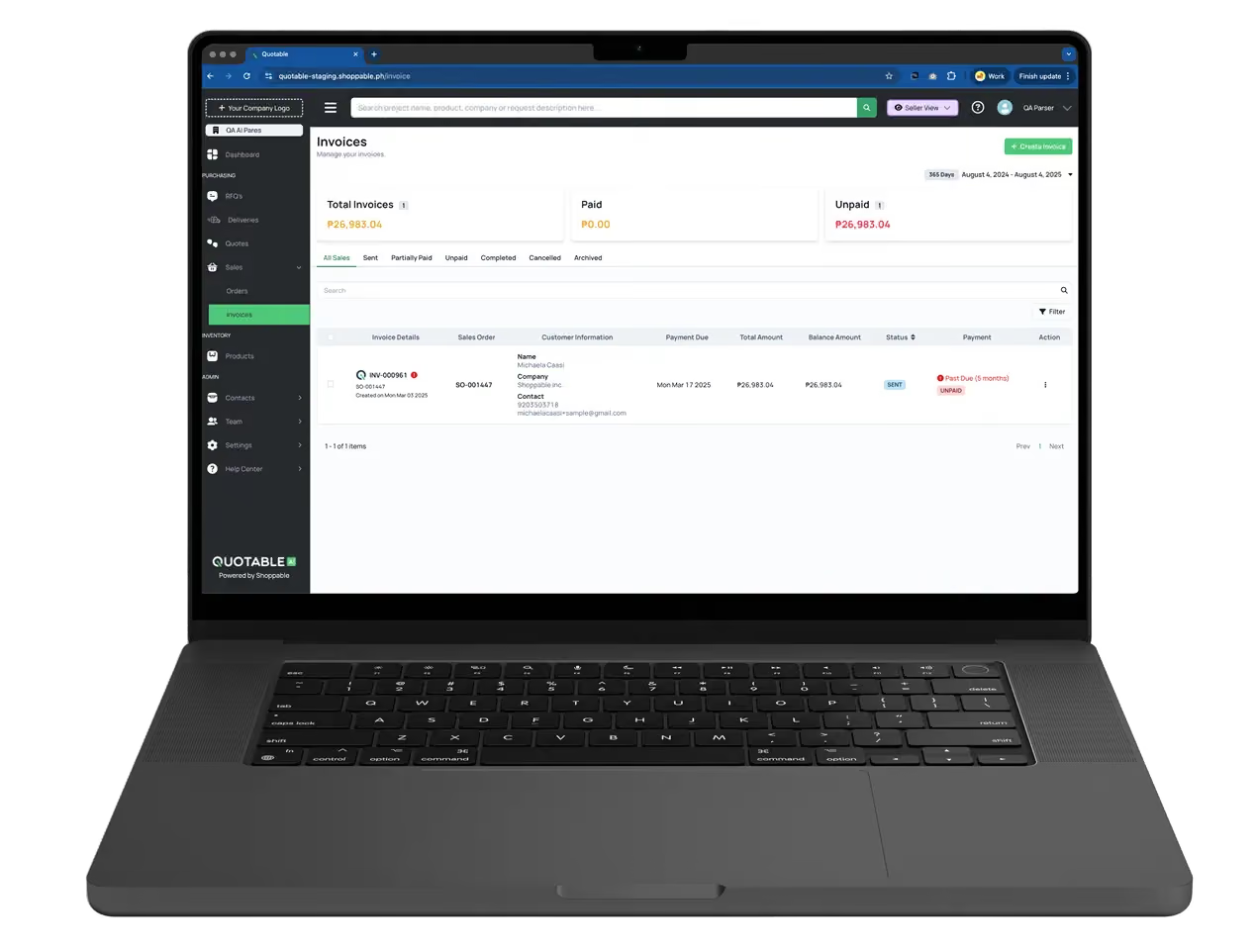
Tools like Quotable AI address this with a universal AI parser that automatically extracts and structures data from quotes, invoices, and purchase orders. Instead of a human retyping numbers from a PDF into a spreadsheet, the system reads the document, maps the fields, and populates the comparison automatically. The error rate drops close to zero, and your team gets those hours back.
Accelerating Decision Making with Automated Quote Comparisons
Speed matters in procurement, but not just for its own sake. Faster quote comparison means faster purchase orders, which means faster fulfillment, which means your customers get what they need on time. In industries like construction, manufacturing, and IT distribution, a two-day delay in vendor selection can push a project timeline by weeks. The bottleneck is almost never the suppliers: it's the internal process of evaluating their responses.
Automated comparison tools compress that evaluation window dramatically. Instead of spending a full afternoon building a comparison matrix, your team gets a structured, side-by-side view of every quote within minutes of receiving them. That's not a marginal improvement: it's a fundamentally different way of working.
Achieving 10X Faster Procurement Cycles
The claim of 10X faster procurement sounds aggressive until you look at the math. A typical manual quote comparison cycle looks like this: two days to collect responses, one day to normalize and compare, half a day to get internal approval, and another day to issue the PO. That's roughly 4.5 business days from RFQ to purchase order.
With an automated tool for comparing supplier quotes, the collection phase shrinks because suppliers can respond through structured digital channels rather than email. The comparison phase drops from hours to minutes. Approval workflows trigger automatically. The entire cycle can compress to half a day or less.
Research shows that automated procurement processes run 76% faster and cost 55% less than their manual equivalents. For a distributor processing 40 purchase orders per month, that time savings translates directly into faster inventory turns and better cash flow. You're not just saving time: you're accelerating revenue.
Quotable AI's approach to this is worth noting. Suppliers don't need to create accounts or learn new software. They receive a secure link, submit their quote in a structured format, and the system handles the rest. That frictionless participation means you actually get responses faster, which is half the battle.
Real-Time Side-by-Side Vendor Analysis
The value of a comparison tool isn't just speed: it's clarity. When you can see five vendors side by side with standardized columns for unit price, MOQ, lead time, freight cost, and payment terms, patterns emerge that are invisible in a spreadsheet.
Maybe Supplier A has the lowest unit price but a 45-day lead time. Supplier B is 8% more expensive but offers net-15 payment terms and ships in a week. Supplier C matches Supplier A's price but requires a 5,000-unit minimum order. These trade-offs are where real procurement skill lives, and they're impossible to evaluate quickly when data is scattered across emails and spreadsheets.
Real-time analysis also means you can respond to market changes as they happen. If a supplier updates their quote mid-cycle, the comparison refreshes automatically. If raw material prices spike and you need to re-evaluate, you're not starting from scratch. This kind of agility is what separates companies that manage costs from companies that merely track them.
Maximizing Profitability Through Data Orchestration
Procurement isn't an isolated function. Every purchase you make connects to inventory, fulfillment, invoicing, and ultimately your P&L. When your quoting data lives in one system, your purchase orders in another, and your payments in a third, you lose the connective tissue that makes spend analysis possible. Data orchestration means treating the quote not as a static document but as a live transaction state that flows through your entire operation.
This is where the concept of a quote as a living object becomes powerful. A quote that automatically converts into a PO, then into an invoice, then into a payment record gives you end-to-end visibility without anyone re-entering data. That's not just efficiency: it's the foundation for strategic procurement.
Optimizing Costs for SMEs and Mid-Market Companies
Enterprise companies have dedicated procurement departments, category managers, and seven-figure software budgets. SMEs and mid-market companies don't. If you're a $5M distributor with a two-person purchasing team, you need tools that match your scale, not an enterprise ERP that takes six months to implement and costs more than your annual procurement savings.
The right-sized approach for most companies in the $1M to $30M range is a platform that handles the core workflow: receive quotes, compare them, issue POs, and track payments. With rising freight rates and stricter compliance requirements, a thorough quote comparison process can save 15-40% on total landed cost and prevent costly mistakes. For a company spending $3M annually on materials, even the low end of that range represents $450,000 in savings.
Here's what that looks like in practice. Suppose you're sourcing electrical components from four suppliers. Your current process takes 90 minutes per comparison. An automated tool reduces that to 3-5 minutes. Over 20 comparisons per month, you've saved roughly 28 hours of labor. But the bigger win is the pricing insight: when you can actually see that Supplier D is consistently 18% higher than the others with no quality advantage, you renegotiate or switch.
Leveraging Quotable AI as a Live Transaction Layer
Quotable AI treats the quote as the origin point of every B2B transaction. Rather than bolting procurement onto an existing accounting system as an afterthought, the platform builds the entire workflow around the quote itself. When a supplier submits pricing, that data doesn't just sit in a comparison table: it flows into purchase orders, invoices, and payment records without manual intervention.
This matters for a specific reason. Most procurement breakdowns happen at the handoff points: quote to PO, PO to invoice, invoice to payment. Each handoff traditionally involves someone re-entering data, which introduces errors and delays. By treating the quote as a live object that persists across the transaction lifecycle, you eliminate those handoffs entirely.
The platform also connects with existing ERP and accounting systems, so you're not ripping out infrastructure. You're adding a collaboration and automation layer on top of what you already have. For mid-market companies that can't afford a full system migration, this is the practical path forward.
Bridging the Gap Between Quoting and B2B Payments
One of the least discussed inefficiencies in B2B procurement is the gap between agreeing on a price and actually getting paid. A supplier sends a quote, the buyer approves it, a PO gets issued, goods ship, an invoice arrives, and then: silence. Payment sits in a queue for 30, 60, sometimes 90 days. The supplier follows up. The buyer's AP team can't find the matching PO. Someone pulls up the original quote to verify pricing. Hours are wasted on what should be a straight line from agreement to payment.
This gap costs both sides. Suppliers deal with unpredictable cash flow. Buyers deal with late-payment penalties and damaged vendor relationships. The root cause is almost always disconnected systems: the quoting tool doesn't talk to the invoicing tool, which doesn't talk to the payment platform.
Integrating Procurement with Invoicing and Fulfillment
The fix is integration, not just between software systems, but between the stages of a transaction. When your quote data flows directly into invoicing, three-way matching becomes automatic. The PO quantity matches the invoice quantity matches the quote price, and payment releases without manual review.
For companies involved in international trade, this integration has to extend further. You need to link payment workflows with logistics documents: bills of lading, packing lists, customs declarations. Landed cost tracking requires visibility into duties, freight charges, and FX impact, all of which should tie back to the original quote.
A case study from the procurement space illustrates this well. A beauty tools company used competing quotes to negotiate their MOQ down by 60%, saving $18,000 in upfront capital. That negotiation was only possible because they had structured, comparable data from multiple suppliers. The savings didn't come from a better supplier: they came from better information.
Quotable AI's embedded payment system supports bank wire, ACH, credit cards, and e-wallets, all within the same platform where quotes and invoices live. Suppliers receive payments through their preferred method, and buyers can pay vendors from one centralized system. That eliminates the manual back-and-forth of payment verification that plagues most B2B relationships.
Future-Proofing Your Supply Chain with AI-Powered Intelligence
The companies that will thrive over the next decade aren't the ones with the lowest costs today: they're the ones building systems that get smarter over time. AI-powered procurement tools don't just compare quotes faster. They learn from your purchasing patterns, flag anomalies, and surface opportunities you'd never spot manually.
Imagine your system noticing that a particular supplier's pricing has drifted 22% above market over six months, or that consolidating two orders into one could save $4,000 in freight. These aren't hypothetical features: they're the natural output of structured, centralized procurement data combined with machine learning.
For SMEs and mid-market companies, this kind of intelligence was previously available only to enterprises with dedicated analytics teams. A well-designed supplier quote comparison tool democratizes that capability. You don't need a data scientist: you need a system that captures clean data at every step and surfaces insights automatically.
The practical advice here is straightforward. Start by centralizing your quoting and procurement data in a single system. Make sure that system connects to your existing financial infrastructure so you're not creating another data silo. Choose a platform that doesn't require your suppliers to adopt new software, because the best tool in the world is useless if your vendors won't use it.
If you're spending more than 10 hours per week on manual quote comparison, spreadsheet reconciliation, or payment follow-ups, you've already passed the threshold where automation pays for itself. The hard-won lesson from companies that have made this transition is simple: the ROI isn't theoretical. It shows up in your first month.
Quotable AI was built for exactly this inflection point: the moment when your procurement volume outgrows your manual process. If you're ready to stop losing margin to spreadsheets and start turning quotes into revenue faster, it's worth exploring what a purpose-built platform can do for your operation. Visit Quotable AI to see how the quote-to-payment workflow works in practice.