Every B2B company eventually faces a fork in the road: do you sell your products directly to a retailer or marketplace that resells them, or do you list and sell them yourself through a third-party platform? The choice between a 1P and 3P supplier model shapes everything from your margins and cash flow to your data access and brand positioning. For SME distributors and mid-market companies moving between $1M and $50M in annual revenue, this decision isn't academic. It determines who owns the customer relationship, who sets the price, and who absorbs the risk when inventory doesn't move. The stakes grow even higher when you factor in the quote-to-payment lifecycle that sits underneath every transaction. A wrong model choice doesn't just hurt your top line; it creates operational drag that compounds month after month. This guide breaks down both models, compares them across the dimensions that matter most, and shows you how to build a supplier operation that scales regardless of which path you choose.
Defining 1P and 3P Supplier Models in Modern B2B Trade
The terms "1P" and "3P" originated in the Amazon ecosystem, but the underlying concepts apply across B2B marketplaces, retail partnerships, and procurement networks. Understanding the mechanics of each model is the first step toward making a decision that fits your business, not just your ambitions.
At the highest level, a 1P supplier sells products to a platform or retailer, which then resells those products to end buyers. A 3P supplier sells directly to end buyers through a platform, retaining ownership of the product until the customer pays. The distinction sounds simple, but it ripples through every part of your operation: pricing, inventory management, fulfillment, and how quickly you get paid.
For B2B distributors, the choice often shows up in less obvious ways. You might be a 1P vendor to a large construction materials marketplace that buys your stock at wholesale, or you might be a 3P seller listing your IT components on a procurement portal where buyers issue purchase orders directly to you. Both paths generate revenue, but they create very different businesses.
The First-Party (1P) Relationship: Selling Directly to the Retailer
In a 1P arrangement, you're essentially a wholesale supplier. The retailer or marketplace places purchase orders with you, takes ownership of the inventory, and handles the end-customer transaction. On Amazon, for example, 1P sellers are known as vendors and operate through Vendor Central, while the product detail page displays "Ships from and sold by Amazon.com" to the end buyer.
The appeal is straightforward: you get large, predictable orders, you don't worry about individual customer service, and you benefit from the retailer's brand trust. For a mid-market manufacturer selling fasteners or electrical components, a 1P deal with a major distributor can mean guaranteed volume.
But the trade-offs are real. You lose control over retail pricing, you're subject to the retailer's payment terms (often 30 to 90 days), and you have limited visibility into who's actually buying your products. One hard-won lesson from founders who've gone this route: the moment you become dependent on a single 1P relationship, you've handed someone else the steering wheel.
The Third-Party (3P) Marketplace: Retaining Control of the Sale
The 3P model flips the dynamic. You list your products on a marketplace or procurement platform, but you own the inventory, set the price, and manage the customer relationship. The platform takes a commission or listing fee, and you handle fulfillment either directly or through a logistics partner.
Third-party sellers now account for 62% of paid units on the Amazon marketplace as of Q4 2024, and Amazon's annual revenue from third-party seller services reached roughly $140 billion in 2023. Those numbers reflect a broader trend: sellers want more control, and platforms are happy to collect fees rather than own inventory risk.
In B2B contexts, the 3P model shows up when suppliers list on procurement portals, respond to RFQs through digital platforms, or sell through industry-specific marketplaces. You keep your margins, you own the data, and you can adjust pricing in real time. The cost? You're responsible for everything: quoting, invoicing, shipping, returns, and collections.
Comparative Analysis: Control, Margins, and Operational Complexity
Choosing between 1P and 3P isn't just a pricing decision. As one industry analyst put it, most brands think the 1P vs 3P decision is operational, but it actually determines who controls your pricing, your margins, your data, and ultimately your growth. That framing applies just as much to a $5M construction supply distributor as it does to a consumer brand on Amazon.
Let's compare the two models across the dimensions that matter most to B2B sellers.
Pricing Power and Inventory Ownership
In a 1P model, the retailer sets the final price. You negotiate a wholesale cost, and whatever happens downstream is out of your hands. If the retailer decides to discount your product to drive traffic, your brand perception takes a hit, and you have no recourse. For B2B suppliers selling specialized components, this can erode the premium positioning you've spent years building.
The 3P model gives you full pricing authority. You can run promotions, adjust for market conditions, or offer volume-based pricing to specific accounts. This flexibility is especially valuable in industries like IT distribution or manufacturing, where component prices fluctuate weekly based on supply chain conditions.
Inventory ownership is the other side of this coin. In a 1P setup, once the retailer accepts your shipment, the inventory risk transfers to them. That's a genuine advantage if you're cash-constrained or dealing with perishable or seasonal goods. But it also means you can't redirect that stock if a better opportunity appears.
With 3P, you carry the inventory risk. If a product doesn't sell, it's sitting in your warehouse burning cash. For a distributor managing 5,000 SKUs, this risk isn't trivial. The upside is that you can allocate inventory dynamically across channels, customers, and geographies.
Fulfillment Responsibilities and Logistics Overhead
The 1P model typically offloads fulfillment to the retailer. You ship bulk orders to their warehouse, and they handle last-mile delivery. This simplifies your logistics but limits your ability to offer custom packaging, kitting, or white-glove delivery, things that B2B buyers in construction and manufacturing often expect.
The 3P model puts fulfillment squarely on your shoulders. You need warehouse capacity, shipping partnerships, and a reliable process for tracking orders from pick to delivery. For companies processing 30 to 50 orders per day, this is a significant operational commitment. Miss a delivery window or ship the wrong spec, and you're absorbing the cost of returns and chargebacks.
Here's a red flag to watch for: if your team is spending more than 20% of their time on manual order coordination, emails, and spreadsheet tracking, you've hit a breaking point. That's the signal to automate your fulfillment workflows before adding more volume.
Optimizing the Quote-to-Payment Lifecycle Across Both Models
Whether you're a 1P vendor shipping pallets to a retailer or a 3P seller managing hundreds of individual transactions, the quote-to-payment lifecycle is where money gets made or lost. Most procurement and sales tools handle pieces of this lifecycle, but few connect the entire chain from initial quote to final payment.
This gap is especially painful for B2B distributors operating in hybrid environments, selling 1P to some accounts and 3P to others. You end up with separate workflows, disconnected data, and finance teams reconciling invoices across multiple systems.
Automating B2B Quotations for Faster Procurement
The quoting process is where most B2B transactions begin, and it's where most delays originate. A buyer sends an RFQ, your sales team manually builds a quote in a spreadsheet or legacy system, emails it back, and waits. If the buyer wants changes, the cycle repeats. For a distributor handling 200 quotes per month, each round-trip adds days to the sales cycle.
Automation changes this math dramatically. Platforms like Quotable AI treat the quote as the starting point of the entire transaction, allowing suppliers to receive RFQs from multiple organizations in one place, submit structured quotations directly, and showcase competitive pricing and lead times. Suppliers can respond through a secure link without creating accounts or adopting new software, which means procurement teams collect responses faster.
Consider an if/then scenario: if your average quote takes 48 hours to turn around and you close 30% of quotes, cutting that turnaround to 4 hours could let you respond to twice as many RFQs in the same period. Even if your close rate stays flat, you've doubled your pipeline.
The key is treating quoting not as a document exchange but as a live transaction. When a quote connects directly to inventory data, pricing rules, and approval workflows, it becomes the foundation for everything that follows: purchase orders, invoices, and payments.
Managing Invoicing and Collections in Hybrid Environments
Invoicing and collections are where the 1P and 3P models diverge most sharply. In a 1P relationship, the retailer typically has rigid payment terms and a standardized invoicing process. You submit invoices through their portal, and you get paid on their schedule. Late payments are common, and disputes over quantities or pricing can delay collections by weeks.
In a 3P model, you invoice buyers directly. This gives you more control but also more responsibility. You need to track payment status across dozens or hundreds of accounts, chase overdue invoices, and reconcile payments against purchase orders.
For companies operating in both models simultaneously, the complexity multiplies. One client I worked with, a mid-market IT distributor, was managing 1P invoices through one system and 3P invoices through another, with a finance team manually reconciling everything in a spreadsheet. Their days sales outstanding (DSO) had crept above 55 days, and they were losing visibility into which accounts were actually profitable.
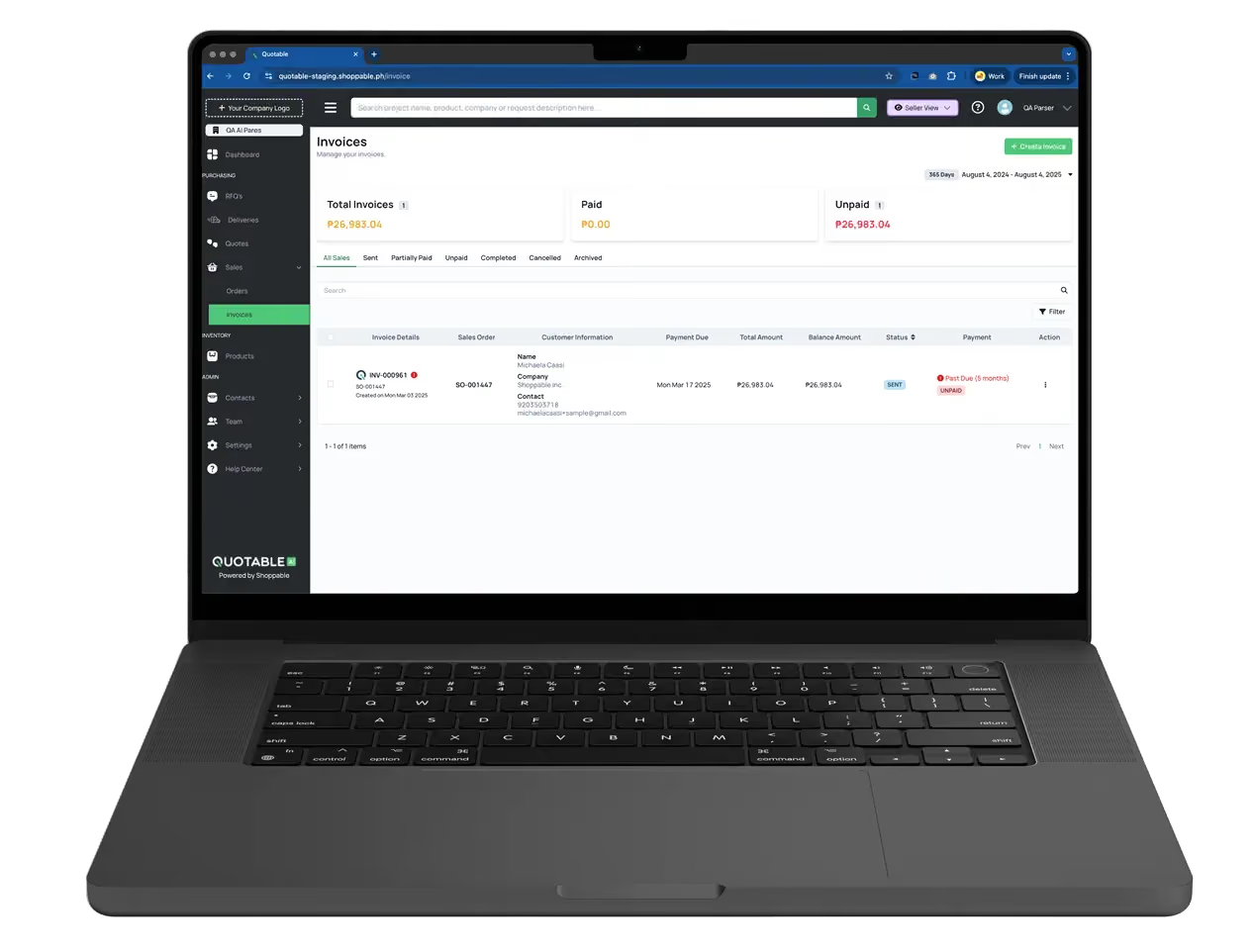
The fix was consolidating invoicing and payment tracking into a single system. Quotable AI's approach to this problem is worth noting: it connects quoting, invoicing, and payments into one continuous workflow, with embedded payment options including bank wire, ACH, credit cards, and e-wallets. Buyers can approve and pay through no-login links, which removes friction from the collection process.
If your DSO is climbing above 45 days and your team is spending hours each week on manual payment follow-ups, that's a clear sign your invoicing process needs consolidation.
Data Orchestration: The Key to Scaling SME Supplier Growth
Data is the quiet differentiator between suppliers who grow and suppliers who plateau. In a 1P model, you often get limited data: the retailer knows who bought your product, but you don't. In a 3P model, you own the customer data, but it's scattered across platforms, email threads, and spreadsheets.
The real opportunity is treating your transaction data, quotes, orders, invoices, payments, as a connected dataset that informs decisions across your business. Which products have the highest quote-to-close ratio? Which customers consistently pay on time? Where are your margins thinning? These questions can't be answered if your data lives in silos.
For SME suppliers doing $1M to $30M in revenue, the breaking point usually comes around 500 to 1,000 transactions per month. Below that threshold, you can manage with manual processes and periodic reporting. Above it, you need a system that captures and connects data automatically.
Treating the Quote as a Live Transaction State
Most B2B systems treat the quote as a static document: a PDF that gets emailed, revised, and eventually filed away. But the quote contains some of the richest data in your business. It captures what the buyer wants, at what price, in what quantity, and on what timeline. When that data dies in a PDF, you lose the ability to track conversion rates, identify pricing trends, and forecast demand.
Quotable AI's universal AI parser addresses this directly by automatically extracting and structuring data from quotes, invoices, purchase orders, and bills of materials. This means every quote becomes a live data point that feeds into your sales pipeline, inventory planning, and financial reporting.
Think about it this way: if you quoted 500 line items last quarter and only 180 converted to orders, the other 320 represent lost revenue, competitive intelligence, and demand signals. A system that captures and analyzes that data gives you a structural advantage over competitors who are still working from memory and gut feel.
For companies involved in international trade, the data picture gets even more complex. You need to link payment workflows with logistics documents like bills of lading and packing lists, and you need to track landed costs including duties, freight, and currency impact. Without a connected data layer, these calculations happen in spreadsheets that nobody trusts.
Choosing the Right Model for Your Industry and Revenue Goals
There's no universal answer to the 1P vs 3P supplier question. The right model depends on your industry, your margin structure, your operational capacity, and your growth ambitions. Some companies thrive as 1P vendors because they want volume and simplicity. Others need the control and margin upside that 3P provides.
In late 2024, Amazon systematically terminated smaller vendor accounts, pushing them toward its third-party marketplace. That move signaled a broader industry shift: platforms increasingly prefer the 3P model because it shifts inventory risk and fulfillment cost to sellers. If you're building your business around a single 1P relationship, that's a vulnerability you need to plan for.
The smartest approach for most mid-market suppliers is a hybrid model: maintain 1P relationships with your largest accounts for volume stability, while building 3P capabilities for direct sales, niche markets, and new customer acquisition. This gives you diversification without forcing an all-or-nothing bet.
Success Strategies for IT, Construction, and Manufacturing
Each industry has its own dynamics that shape the 1P vs 3P decision.
- IT distributors often operate in a hybrid model by default. They buy from OEMs (acting as a 1P buyer) and resell through marketplaces and direct channels (acting as a 3P seller). The key challenge is managing rapid price changes across hundreds of SKUs. Automated quoting that pulls real-time pricing data is essential here.
- Construction suppliers deal with project-based purchasing, where a single quote might include 50 line items across multiple product categories. The 3P model works well because buyers need custom quotes, specific delivery schedules, and flexible payment terms. A platform that connects RFQs to structured quotations and payment processing eliminates the back-and-forth that slows down project timelines.
- Manufacturing companies selling components or finished goods often start as 1P vendors to large distributors, then expand into 3P channels as they build brand recognition. The transition requires investing in direct fulfillment capabilities and a quoting system that can handle both wholesale and individual orders.
Regardless of industry, the common thread is this: your quote-to-payment infrastructure needs to support whichever model you choose. If you're running 3P sales through one system, 1P invoicing through another, and reconciling payments in a spreadsheet, you're leaving money on the table and creating risk.
Finding Your Path Forward
The 1P and 3P models aren't inherently better or worse. They're tools, and like any tool, their value depends on how well they fit the job. Smart money goes toward building flexibility: the ability to serve 1P accounts with predictable volume while capturing 3P margin on direct sales.
What separates growing suppliers from stagnant ones isn't the model they choose. It's whether their operational infrastructure can support that model at scale. If your quoting takes days, your invoicing is fragmented, and your payment collection is manual, no business model will save you.
Start by auditing your current quote-to-payment lifecycle. Identify where time and money leak out of the system. Then right-size your technology to close those gaps. Quotable AI was built specifically for this problem, connecting quoting, procurement, invoicing, and payments into one workflow that scales with your business. If you're a B2B distributor or mid-market buyer ready to eliminate the friction between your first quote and your last payment, it's worth exploring what a unified platform can do for your bottom line.