Every B2B company eventually hits a wall with its payment processes. Maybe it's the third time this quarter your team has chased down a missing invoice, or perhaps you've just realized that your finance staff spends more time on data entry than actual financial strategy. The way you handle money flowing out of your business shapes everything from supplier relationships to quarterly margins. For SMEs and mid-market companies moving between $1M and $50M in annual volume, a broken payable process doesn't just create headaches: it bleeds cash. The good news? The tools and frameworks to fix this have matured dramatically, and the companies adopting them are pulling ahead fast. What follows is a practical breakdown of how to build, refine, and scale your AP operations from the first quote request to the final payment confirmation.
The Evolution of Accounts Payable in Modern B2B Trade
The traditional view of accounts payable treats it as a back-office function: invoices come in, someone matches them to a PO, approvals happen, and checks go out. That model worked fine when transaction volumes were low and supplier relationships were simple. But B2B trade has changed. Companies now manage dozens or hundreds of suppliers across multiple categories, each with different payment terms, pricing structures, and compliance requirements.
The real shift isn't just about speed or automation. It's about recognizing that AP sits at the center of your commercial relationships. How quickly you pay, how accurately you process, and how transparently you communicate with vendors all affect your negotiating power and your reputation in the market. A distributor processing 200+ orders per month can't afford to treat payables as an afterthought.
Moving Beyond Post-Transaction Accounting
Most legacy systems treat AP as something that kicks in after the deal is done. You've already agreed on terms, received the goods, and now you're just settling up. But this post-transaction mindset creates blind spots. If your procurement team negotiates a 2% early payment discount but your AP team doesn't process the invoice until day 45, that discount evaporates. The disconnect between buying and paying costs real money.
One client we worked with, a mid-size construction supply distributor doing about $12M annually, discovered they were losing roughly $80,000 per year in missed early payment discounts alone. The problem wasn't that their AP team was slow: it was that invoice receipt, approval routing, and payment execution lived in three separate systems with no shared timeline. By the time finance saw the invoice, the discount window had closed.
The fix requires treating your payable workflow as a continuous process that begins at the moment of purchase, not at invoice receipt. When your procurement and finance teams share a single timeline from quote acceptance through payment, those gaps close naturally.
The Quote-to-Payment Lifecycle
Think of the full transaction lifecycle in stages: need identification, supplier selection, quote request, quote comparison, PO creation, goods receipt, invoice matching, approval, and payment. Most companies have tools for some of these stages but gaps between them. The quote-to-payment concept treats all of these as a single connected workflow.
Here's why that matters practically. When a buyer requests quotes from three suppliers, the pricing and terms captured in those quotes should flow directly into the PO. The PO terms should then become the baseline for invoice matching. And the payment should reference the original agreed terms without anyone re-keying data. Each handoff between systems or people is a chance for errors, delays, and disputes.
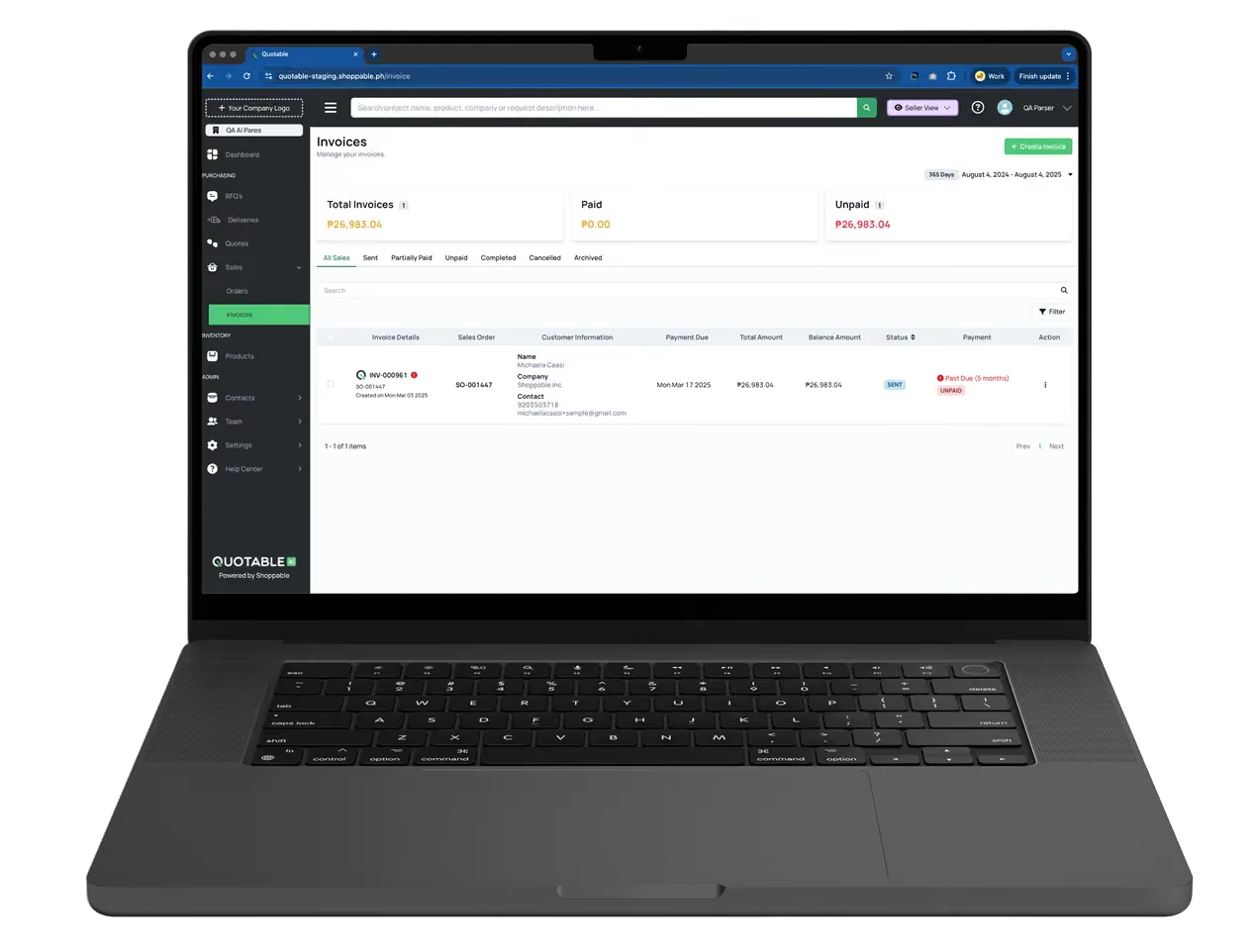
Platforms like Quotable AI are built around this idea: treating the quote as a live transaction state that carries data forward through procurement, invoicing, and payment. Instead of starting your AP process when an invoice arrives, you start it when the quote is accepted. That single change eliminates a surprising amount of downstream friction.
Core Components of a High-Performance AP Workflow
Building a strong AP operation isn't about buying one tool and calling it done. It's about connecting several core capabilities: document capture, data extraction, matching logic, approval routing, and payment execution. Each component needs to work reliably on its own and communicate cleanly with the others.
The breaking point for most SMEs comes somewhere between 30 and 50 supplier invoices per week. Below that threshold, manual processes are annoying but manageable. Above it, errors compound. Duplicate payments start slipping through. Month-end close stretches from three days to ten. If you're seeing those symptoms, your workflow components need attention.
Automating Procurement and Invoice Matching
Three-way matching, comparing the PO, goods receipt, and invoice, is the backbone of AP accuracy. But doing it manually is brutal. Your team pulls up the PO, cross-references line items against the packing slip, then checks the invoice totals. For a 15-line-item order, that's easily 20 minutes of work per transaction. Multiply that across hundreds of monthly invoices and you've got a full-time job that adds zero strategic value.
AP teams still spend over 10 hours a week on invoice processing alone, and that's just the processing time: it doesn't account for exception handling, vendor follow-ups, or correction cycles. Automation changes the math entirely. A well-configured system can auto-match 70-80% of invoices without human intervention, flagging only the exceptions that genuinely need review.
The key is data quality at the front end. If your POs are created from structured quote data with accurate line items, quantities, and pricing, the matching engine has clean inputs to work with. If your POs are created from email threads and verbal agreements, no amount of automation downstream will save you. This is where a universal AI parser for business documents becomes critical: automatically extracting and structuring data from quotes, POs, and invoices so that matching logic has consistent, reliable inputs.
Data Orchestration Across Suppliers and Distributors
Your suppliers don't all operate the same way. Some send structured EDI files. Others email PDF invoices. A few still fax. And your internal systems, your ERP, your accounting software, your procurement tool, each expect data in their own format. The result is a translation problem that most finance teams solve with manual re-entry.
Data orchestration means creating a layer that normalizes all of this. Supplier A's PDF invoice and Supplier B's CSV export both get parsed into the same structured format, matched against the same PO data, and routed through the same approval workflow. The goal isn't to force every supplier onto one platform. It's to make your internal process consistent regardless of how suppliers communicate.
This is especially important for distributors managing complex bills of materials. A single customer order might trigger purchases from five different suppliers, each with their own invoicing format and payment terms. Without a unified data layer, your AP team is juggling five separate workflows for what is essentially one transaction. Quotable AI addresses this by connecting with existing ERP and accounting systems while normalizing supplier data into a single workflow, so your team isn't rebuilding processes for every vendor relationship.
Optimizing Cash Flow for SMEs and Mid-Market Companies
Cash flow isn't just a finance metric: it's the oxygen supply for your business. And AP is one of the biggest levers you have to control it. Pay too early and you're giving up working capital you might need. Pay too late and you damage supplier relationships, miss discounts, and potentially trigger penalties. The sweet spot requires visibility and precision.
For companies in the $1M to $30M revenue range, even small improvements in payment timing can free up significant working capital. If you're processing $500,000 in monthly payables and you can shift your average payment timing by just five days closer to terms without going late, that's meaningful float. But you can only do this if you have real-time visibility into what's owed, what's due, and what's been approved.
Managing Payments in Construction and Manufacturing
Construction and manufacturing present unique AP challenges. Payment terms are often tied to project milestones or delivery schedules rather than simple net-30 arrangements. Retainage, progress billing, and change orders add layers of complexity that generic AP tools weren't designed to handle.
Consider a typical scenario: a general contractor receives a progress invoice from a subcontractor for $45,000. Before approving payment, the project manager needs to verify that the work matches the completion percentage claimed, that the invoice aligns with the original contract terms (including any change orders), and that retainage has been correctly calculated. If any of these checks require pulling up separate documents from separate systems, the approval cycle stretches from days to weeks.
Red flags that your construction or manufacturing AP process is breaking down include:
- Duplicate payments on change orders because the original PO wasn't updated
- Retainage calculations done manually in spreadsheets with no audit trail
- Subcontractor disputes over payment amounts that trace back to verbal scope changes
- Project managers approving invoices without visibility into cumulative spend against budget
The fix starts with connecting your project data to your payment data. When a change order is approved, it should automatically update the PO and adjust the expected invoice amounts. When a progress invoice arrives, it should be matched against the updated contract terms without anyone digging through email chains.
Reducing Friction in Finance Team Collections
Here's a pattern we see constantly: the finance team spends as much time chasing internal approvals as they do managing actual vendor payments. An invoice sits in someone's inbox for a week because the approver is traveling. Or it bounces between three departments because nobody's sure who owns the cost code. These internal bottlenecks are invisible to suppliers, who just see late payments.
Approval routing needs to be automatic and rule-based. Invoices under $5,000 go to the department manager. Invoices over $5,000 go to the director. Invoices that don't match a PO get flagged for procurement review. Escalation triggers fire after 48 hours of inaction. This isn't complicated logic, but it requires a system that knows the rules and enforces them.
The payment side matters too. Businesses reported attempted or actual fraud in 79% of cases during 2024, and the payment method you use directly affects your exposure. Organizations using virtual cards experienced only 5% fraud susceptibility compared to 63% with check payments. Moving to electronic payment methods, whether ACH, virtual cards, or embedded payment links, isn't just about convenience. It's a risk management decision.
Leveraging AI for 10X Faster Processing
The accounts payable automation market in North America alone reached $1.473 billion in 2024 and is projected to grow to $4.716 billion by 2035. That growth reflects a hard truth: manual AP processes don't scale. They worked when your company was doing $2M in revenue with 15 suppliers. At $15M with 150 suppliers, they collapse.
AI-powered processing isn't about replacing your finance team. It's about removing the tasks that shouldn't require human judgment in the first place. Data extraction, field mapping, PO matching, duplicate detection: these are pattern-recognition tasks that machines handle faster and more accurately than people. Your team's time is better spent on exception management, vendor negotiations, and cash flow strategy.
Eliminating Manual Entry with Integrated Systems
The single biggest time sink in most AP departments is manual data entry. Someone receives an invoice PDF, opens the accounting system, and types in the vendor name, invoice number, line items, amounts, and tax calculations. For a 10-line invoice, that's five to eight minutes of work, assuming no interruptions or errors. Automation can cut processing costs by as much as 70%, and most of those savings come from eliminating this exact step.
Here's what an integrated workflow looks like in practice. A supplier submits an invoice through a secure link: no login required, no new software to adopt. The system's AI parser extracts all relevant data fields automatically. It matches the invoice against the corresponding PO and goods receipt. If everything aligns, it routes to the pre-configured approver. Once approved, payment executes through the buyer's preferred method: bank wire, ACH, credit card, or e-wallet. The whole cycle, from invoice submission to payment, can happen in hours rather than weeks.
The integration piece is critical and often overlooked. Your AP automation tool is only as good as its connection to your existing systems. If your team still has to export data from one platform and import it into another, you haven't eliminated manual work: you've just moved it. Look for platforms that offer native, bidirectional sync with your ERP and accounting software. Don't settle for "supported" integrations that require manual data mapping. Request a live demo of the specific workflow: watch the data move from invoice receipt through to your general ledger without human intervention.
Common mistakes that undermine automation investments include:
- Implementing automation without first cleaning up your vendor master data
- Automating a broken process instead of fixing the process first
- Choosing a tool that handles invoices but ignores the upstream quote and PO data
- Failing to set up proper exception-handling rules, so every flagged item becomes a bottleneck
Scaling AP Operations with Vertical Integration
As your company grows, your AP needs don't just increase in volume: they increase in complexity. You add new product lines, new suppliers, new geographies, new compliance requirements. A system that handles 50 invoices per month from 10 domestic suppliers won't necessarily handle 500 invoices from 80 suppliers across three countries.
Vertical integration in AP means connecting every stage of the commercial transaction into a single system. The quote feeds the PO. The PO feeds the invoice match. The invoice match feeds the payment. The payment feeds the accounting entry. And all of it generates data that informs your next purchasing decision. This isn't about having one monolithic tool: it's about having a connected workflow where data flows without manual intervention at each handoff.
For B2B distributors and quote-heavy sellers, the critical gap in most procurement tools is the connection between sales quoting and supplier purchasing. You quote a customer at a certain margin. To fulfill that quote, you need to procure materials from your suppliers. If those two workflows live in separate systems, you lose visibility into your actual margins until after the fact. By the time you realize a supplier price increase has eroded your margin on a committed quote, it's too late.
The companies that scale their AP operations successfully share a few traits. They treat payable processes as strategic, not administrative. They invest in data quality at the source, particularly in how quotes and POs are created. They automate the predictable work and focus human attention on exceptions and relationships. And they choose systems that grow with them rather than tools they'll outgrow in 18 months.
If you're running a B2B operation between $1M and $50M and your AP process still relies on email chains, manual matching, and disconnected systems, you're leaving money and time on the table. The path forward isn't a massive ERP overhaul. It's connecting the workflow from quote to payment in a way that gives your team visibility, speed, and control. Platforms built specifically for this purpose, like Quotable AI, make it possible to start where the transaction actually begins and carry that data all the way through to payment, without ripping out what you already have. That's not just an efficiency play: it's a competitive advantage that compounds over time.