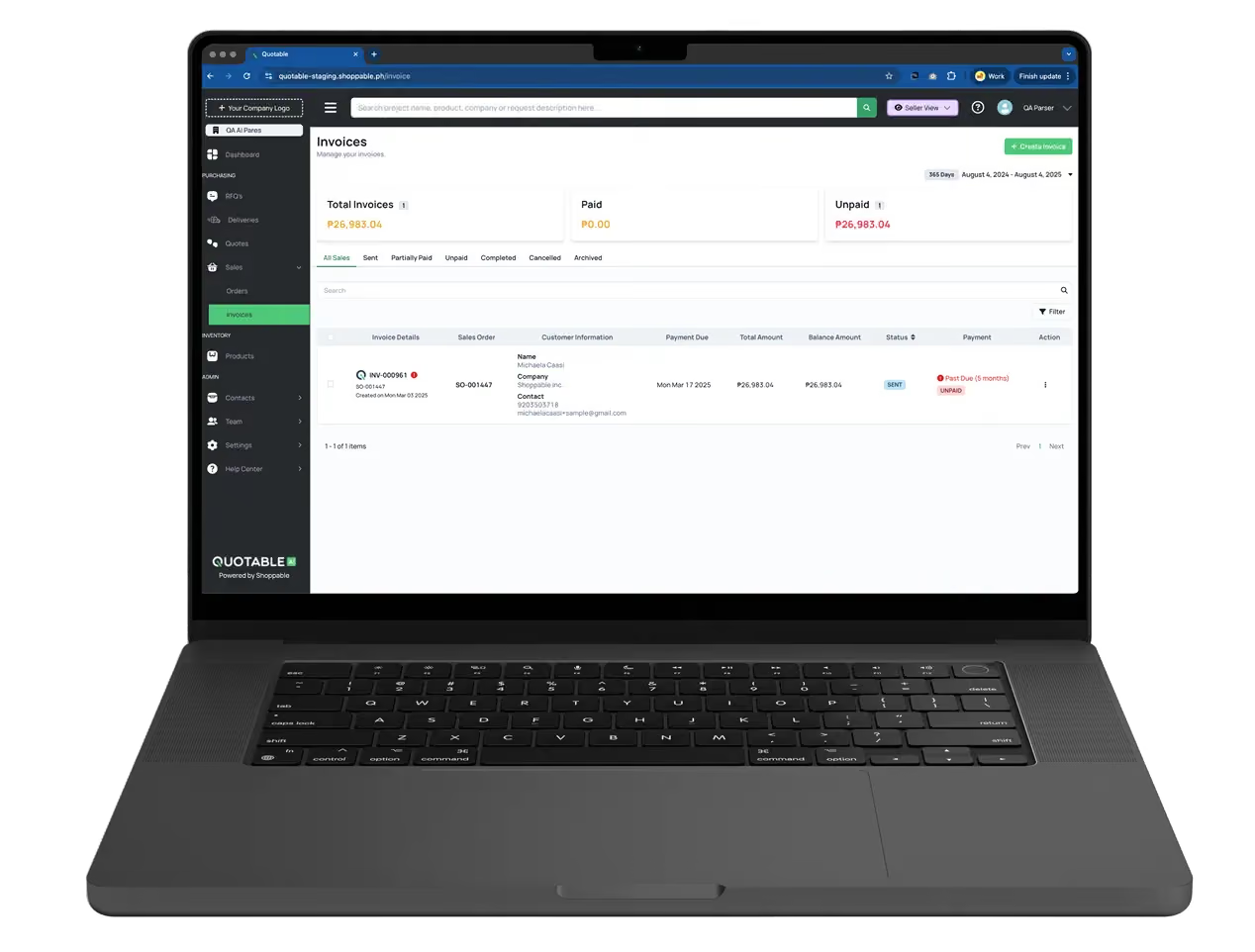
Most B2B companies don't have a payments problem. They have a workflow problem that shows up as late payments. The quote gets emailed as a PDF, the invoice gets created in a separate system weeks later, and the payment arrives (maybe) 45 to 60 days after that. Every handoff between systems is a place where cash flow stalls, data gets lost, and someone on your team spends 20 minutes chasing down a discrepancy. The B2B payments market is projected to grow to $3.79 trillion by 2034, yet the infrastructure most mid-market companies use to move that money looks like it was designed in 2005. If you're running a distribution or supply business doing $1M to $30M in annual sales, the five steps below are a practical playbook to streamline your B2B payments and reclaim the hours your team currently wastes on manual reconciliation, duplicate data entry, and payment follow-ups. We've built these recommendations from hard-won lessons working with SMEs and procurement teams who needed to move faster without hiring bigger back-office staff.
The Evolution of B2B Payments: Starting at the Quote
The traditional view of B2B payments treats them as the final step in a long chain: sell, fulfill, invoice, collect. That model made sense when transactions were simpler and supply chains were local. It doesn't hold up anymore.
What's changed is speed. Buyers expect faster turnaround. Sellers need cash sooner. And the gap between a quoted price and collected revenue is where most mid-market companies hemorrhage time and margin. A quote isn't just a sales document; it's the first financial commitment in a transaction. It contains pricing, terms, quantities, and often the seed data for every downstream document: the purchase order, the invoice, the packing slip, the payment request.
Yet most businesses treat the quote as disposable. It lives in a spreadsheet or a one-off PDF, disconnected from everything that follows. That disconnect is the root cause of most B2B payment delays.
Why Traditional Payment Cycles Delay Cash Flow
Picture a typical cycle for a mid-market distributor. A sales rep sends a quote on Monday. The buyer takes a week to get internal approval. The rep manually creates a sales order in the ERP. Fulfillment ships the product. Someone in accounting creates an invoice, sometimes re-keying the same line items from the original quote. The invoice goes out on Net 30 terms. The buyer pays on day 42 because the invoice had a small discrepancy that took a week to resolve.
That's not unusual. Nearly 51% of companies perform up to half of their payment operations manually, and each manual step is a place where errors creep in. A wrong SKU, a mismatched price, a missing PO number: these small mistakes add days or weeks to your collection cycle.
Red flags that your payment cycle is broken include invoices that don't match purchase orders, customers regularly disputing amounts, your AR team spending more time on follow-ups than on strategic work, and month-end close taking longer than three business days.
Treating the Quote as a Live Transaction State
Here's a founder-to-founder insight: the quote should be the origin point of your entire transaction, not a throwaway document. If you treat it as a live transaction state, every subsequent step (PO, invoice, payment) inherits accurate data from that single source of truth.
This is the core idea behind platforms like Quotable AI, which treats the quote as the operating system for the entire deal lifecycle. When the quote is live and connected, you don't re-enter data. You don't reconcile mismatches. The invoice is generated from the approved quote, and the payment link is embedded right there. The buyer clicks, pays, and you're done.
That shift from "quote as PDF" to "quote as live transaction" is what separates companies that collect in 7 days from those still chasing checks at day 60.
Step 1: Unify Your Quoting and Invoicing Workflows
The single highest-impact change you can make is eliminating the gap between your quoting system and your invoicing system. In most mid-market companies, these are two separate tools with no connection between them. The sales team uses one platform (or just email), and the finance team uses another.
This creates a predictable set of problems. Line items get changed during negotiation but don't get updated in the invoice. Discounts applied verbally never make it into the billing record. Tax calculations differ between the quote and the final invoice. Each of these discrepancies gives your buyer a reason to delay payment.
The fix is straightforward: use a single workflow where the accepted quote automatically becomes the invoice. No re-keying. No copy-paste errors. When a buyer approves a quote, the system should generate the invoice with the exact same line items, pricing, and terms. If you're using Quotable AI, this happens automatically: sellers generate quotes and invoices from the same data, and buyers can approve and pay through a single no-login link.
Here's what to look for in a unified quoting-to-invoicing workflow:
- Quote line items flow directly into the invoice without manual re-entry
- Approval status is tracked in one place, so finance knows exactly which quotes have converted
- Payment terms from the quote carry through to the invoice automatically
- Audit trails connect every change from first draft to final payment
One client we worked with, a construction materials distributor doing about $8M in annual sales, cut their average collection time from 38 days to 12 days simply by eliminating the gap between quoting and invoicing. They didn't change their payment terms. They just removed the friction that caused disputes and delays.
Step 2: Automate Vendor Payments for Better Procurement
Your outbound vendor payments deserve the same attention as your inbound collections. Most procurement teams still process vendor payments through a patchwork of emailed invoices, manual approvals, and batch check runs. That manual process doesn't just waste time; it costs real money in late payment penalties, missed early-pay discounts, and strained supplier relationships.
Automating vendor payments means creating a system where approved purchase orders trigger payment workflows without someone in AP manually matching invoices to POs to receiving documents. The classic three-way match is essential for controls, but it shouldn't require a person staring at three separate screens comparing line items.
When you automate, you gain visibility into your cash outflows, you can forecast more accurately, and you build trust with suppliers who get paid on time. That trust translates into better pricing, priority fulfillment, and more flexible terms: all of which improve your margins.
The Best Digital Payment Methods for Modern Vendors
Choosing the right payment methods for your vendors isn't a one-size-fits-all decision. The best digital payment methods depend on your vendor mix, transaction sizes, and geographic spread.
- Bank wire transfers work well for large, infrequent payments to established suppliers. They're fast and final, but fees can add up on smaller transactions.
- ACH payments are ideal for recurring domestic vendor payments. They're low-cost and can be automated on a schedule that matches your cash flow.
- Virtual credit cards give you rebate opportunities and built-in spending controls. Some vendors resist them because of processing fees, so check acceptance before rolling these out broadly.
- E-wallets and embedded payment platforms are gaining traction for mid-market companies that want to offer vendors multiple payment options from a single interface.
Despite all these digital options, roughly 40% of B2B payments in the U.S. still happen via paper checks. If you're still writing checks for most of your vendor payments, you're leaving money and time on the table. Moving even half of those transactions to ACH or embedded payment methods can save your AP team 10 to 15 hours per week.
Step 3: Simplifying Cross Border Payments for Global Trade
If you source materials or sell products internationally, cross border payments are probably one of your biggest operational headaches. Currency conversion fees, compliance requirements, slow settlement times, and opaque intermediary charges all eat into your margins and create uncertainty for both you and your trading partners.
The B2B digital payment market is expected to expand from $4.6 billion in 2024 to $57.6 billion by 2030, and much of that growth is driven by companies demanding better cross-border solutions. The old model of calling your bank, initiating a wire, and waiting three to five business days for confirmation is being replaced by platforms that handle currency conversion, compliance checks, and settlement in a single transaction.
For mid-market companies, the key is finding a payment solution that supports multiple currencies without requiring you to maintain foreign bank accounts. You want transparent FX rates, not the marked-up spreads that traditional banks charge. And you want your international payments to flow through the same system as your domestic ones, so your finance team isn't toggling between platforms.
Reducing Friction in International Logistics and Manufacturing
International transactions don't just involve money. They involve documents: commercial invoices, packing lists, certificates of origin, bills of lading. When your payment system is disconnected from your trade documents, you create friction that slows down customs clearance, delays shipments, and increases the risk of compliance violations.
The practical solution is to link your payment workflows to your order and fulfillment data. When a shipment clears customs, the corresponding payment should be ready to execute, not sitting in someone's email inbox waiting for manual approval. If you're importing components for manufacturing, your procurement system should track landed costs (including duties, freight, and FX impact) alongside the purchase order, so you know your true cost of goods before the payment even goes out.
Companies that get this right tend to share a common trait: they've centralized their trade data so that finance, logistics, and procurement are all working from the same numbers. That's the foundation for the next step.
Step 4: Centralize Data with a Vertical Orchestration Layer
Most mid-market companies run on a stack of disconnected tools. The CRM holds customer data. The ERP holds inventory and financials. The quoting tool (if there is one) lives somewhere else entirely. Payments flow through a bank portal or a third-party processor. Each system has its own version of the truth, and reconciling them is a monthly nightmare.
A vertical orchestration layer connects these systems into a single data flow. Think of it as the connective tissue between your quote, your order, your shipment, and your payment. Instead of each department maintaining its own spreadsheet, everyone pulls from the same transaction record.
This isn't about replacing your ERP. It's about adding a layer on top that treats the entire transaction lifecycle, from first quote to final payment, as one continuous process. Quotable AI was designed with this exact architecture: the quote is the anchor, and every subsequent action (PO creation, invoice generation, payment collection, fulfillment tracking) is a state change on that same record.
The practical benefits are immediate:
- Month-end close gets faster because there's nothing to reconcile between systems
- Disputes drop because buyers and sellers see the same data
- Cash flow forecasting improves because you can see where every transaction sits in the pipeline
- Audit trails are automatic, which matters for SOX compliance and financial controls
If you're hitting a breaking point around 30 to 50 orders per month where manual data management starts falling apart, that's your signal to invest in a centralized orchestration layer. Don't wait until you're at 200 orders and drowning.
Step 5: Leverage AI to Accelerate Collections and Fulfillment
AI in B2B payments isn't about replacing your finance team. It's about giving them superpowers. The most practical applications right now are in collections prioritization, anomaly detection, and document generation.
For collections, AI can analyze your receivables and flag which invoices are most likely to go past due based on customer payment history, invoice amount, and current aging. Instead of your AR team working through a list alphabetically, they focus on the accounts that need attention first. That shift alone can reduce days sales outstanding (DSO) by 5 to 10 days for most mid-market companies.
For fulfillment, AI helps by matching incoming purchase orders to inventory, flagging potential stockouts before they happen, and auto-generating shipping documents. If you're a distributor handling hundreds of SKUs, the time savings are significant.
Document generation is where AI delivers the most visible ROI. Creating accurate quotes, invoices, and order confirmations used to take 15 to 30 minutes each. With AI-powered tools, that drops to under two minutes. The data is pulled from existing records, formatted correctly, and ready to send. Quotable AI uses this approach to let sellers generate complete quote packages in minutes rather than hours.
One thing to watch for: don't over-automate before your data is clean. AI amplifies whatever data you feed it. If your product catalog has inconsistent SKUs or your customer records have duplicate entries, AI will propagate those errors faster than a human would. Clean your data first, then automate.
Scaling Your B2B Operations with Integrated Financial Tools
The five steps above aren't a one-time project. They're a progression. Most companies start by unifying quoting and invoicing (Step 1) because it delivers the fastest ROI. Then they move to vendor payment automation and cross-border improvements as their volume grows. The orchestration layer and AI capabilities come into play as you scale past the point where manual processes break down.
The B2B payments market is growing at a CAGR of 9.14% from 2025 through 2034, which means your competitors are investing in these capabilities right now. The companies that streamline B2B payments early will have a structural advantage: faster cash cycles, lower operational costs, and stronger supplier relationships.
Here's what we believe: the quote is where the transaction begins. If your payment infrastructure starts at the invoice, you've already lost weeks of potential cash flow. Start at the quote. Connect every step from there to payment. Eliminate the handoffs where data gets lost and delays pile up.
If you're running a distribution, manufacturing, or trade business and you're tired of chasing payments, reconciling spreadsheets, and explaining invoice discrepancies to customers, it's time to rethink your stack. Quotable AI was built for exactly this problem: one system from quote to payment, designed for the way mid-market B2B companies actually work. Your next step is simple: pick the one workflow that causes you the most pain, fix it first, and build from there.