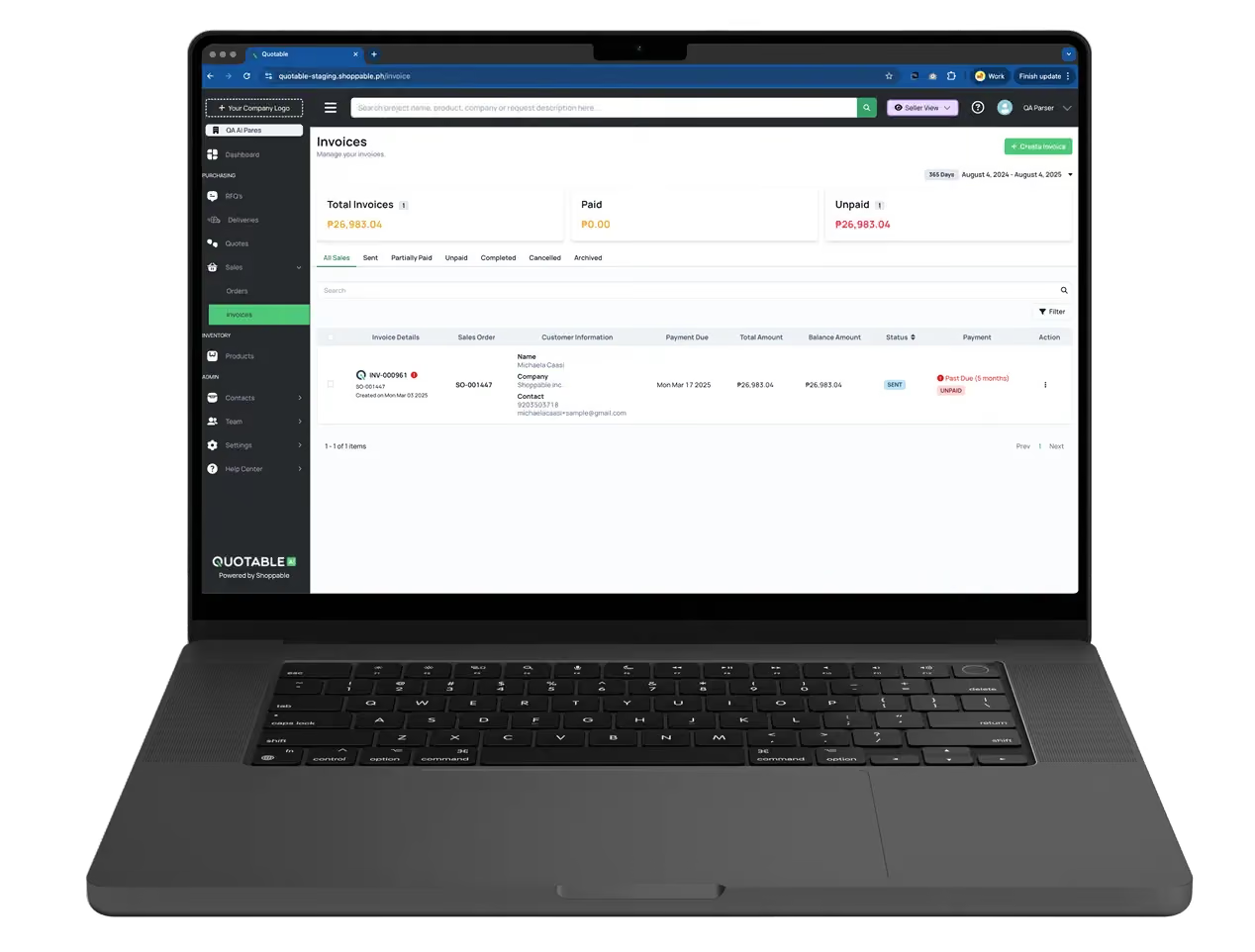
Most B2B finance teams still treat invoicing as a back-office chore: something that happens after the real work is done. But if you've ever lost a week chasing down a missing PO number or reconciling a payment that doesn't match the original quote, you know the invoice isn't just paperwork. It's the financial heartbeat of every transaction. The companies pulling ahead right now are the ones that recognize this and automate invoices not as an afterthought, but as part of a connected workflow that starts the moment a quote is created. For distributors and mid-market buyers moving millions in annual volume, the gap between manual processing and automated invoicing isn't a minor efficiency gain. It's the difference between scaling profitably and drowning in administrative overhead. This piece breaks down how to rethink your accounts payable function from the ground up, connecting procurement, fulfillment, and payment into a single, continuous process. We'll cover where the real costs hide, what modern automation actually looks like, and how to implement it without ripping out your existing systems.
The Evolution of Accounts Payable: Moving Beyond Manual Entry
For decades, accounts payable departments operated on a simple loop: receive an invoice, match it to a PO, get approval, cut a check. That loop worked fine when transaction volumes were low and supplier relationships were simple. But B2B trade has grown more complex. A single order might involve multiple line items quoted at different price points, partial shipments, freight adjustments, and payment terms that vary by supplier. The old loop can't keep up.
What's changed isn't just volume. It's the expectation of speed. Buyers want instant confirmation. Suppliers want faster payment. And finance teams are stuck in the middle, manually keying data into spreadsheets or legacy ERPs that were never designed for this pace. The result is a department that spends most of its time on data entry rather than financial strategy.
The High Cost of Traditional AP Bottlenecks
The numbers tell a painful story. Manual invoice processes can cost an average of $15 per invoice when you factor in labor, error correction, and late payment penalties. If your company processes 500 invoices a month, that's $90,000 a year spent just on pushing paper through approvals.
But the dollar cost per invoice is only part of the picture. The real damage shows up in delayed month-end closes, strained supplier relationships, and missed early payment discounts. I've seen mid-market distributors lose 2% discount terms on six-figure orders simply because the invoice sat in someone's email for five days waiting for a three-way match. Over a year, those missed discounts add up to tens of thousands in lost savings.
Here are the red flags that signal your AP process is breaking down:
- Duplicate invoices appearing because the original was "lost" in an approval queue
- Suppliers calling your team to ask about payment status more than once per invoice
- Month-end close taking more than five business days
- Finance staff spending over 60% of their time on data entry rather than analysis
- Frequent discrepancies between quoted prices and invoiced amounts
Each of these symptoms points to the same root cause: a disconnected, manual workflow that can't scale past a certain transaction threshold. For most companies, that breaking point hits around 300 to 500 invoices per month.
Shifting Focus from Post-Transaction to the Quote-to-Payment Lifecycle
Here's a hard-won lesson from working with B2B companies: most AP problems don't actually start at the invoice. They start at the quote. When a salesperson sends a quote with one set of terms and the invoice arrives weeks later with slightly different line items, someone in finance has to reconcile the gap manually. Multiply that by hundreds of transactions, and you've built a full-time job out of fixing preventable mismatches.
The smarter approach is to treat the entire quote-to-payment lifecycle as one connected process. The quote sets the terms. The purchase order confirms them. The invoice reflects them. And the payment closes the loop. When these stages live in separate systems with no shared data, every handoff introduces risk: wrong pricing, missing cost codes, unapproved changes.
Companies that shift their thinking from "how do we process invoices faster" to "how do we prevent invoice problems before they start" see dramatically better results. That shift requires treating the quote as the source of truth for every downstream document.
Core Benefits of Automating the Invoice Workflow
The global e-invoicing market is projected to reach $24.28 billion in 2025, up from $19.64 billion in 2024. That growth isn't driven by hype. It's driven by finance teams that have done the math and realized automation pays for itself within months, not years.
But "automation" means different things to different vendors. Some tools just digitize the inbox: they scan PDFs and extract data. That's useful, but it's only one piece. True invoice automation connects the invoice to every upstream document, validates data automatically, routes approvals based on rules you set, and triggers payment without manual intervention.
Accelerating Processing Speeds by 10X
Speed isn't just about convenience. For a distributor processing $10M in annual purchases, the difference between a 14-day invoice cycle and a 2-day cycle directly impacts cash flow forecasting, supplier negotiations, and working capital.
Organizations using AP automation report 70% faster invoice processing times. Some platforms push that even further. Quotable AI, for example, positions its system around a 10X speed improvement by starting automation at the quote stage rather than the invoice stage. When the invoice is auto-generated from an approved quote and matched PO, there's nothing left to manually process. The data already exists in the system.
Consider a concrete scenario. Your procurement team receives a quote for 500 units of industrial fasteners at $4.20 per unit, with net-30 terms. In a manual workflow, that quote gets emailed, the PO gets created in a separate system, and the invoice arrives weeks later as a PDF that someone re-keys into your ERP. In an automated workflow, the quote data flows directly into the PO, the supplier confirms fulfillment, and the invoice is generated and matched automatically. The finance team reviews exceptions only, not every single transaction.
Eliminating Human Error in Data Entry and Reconciliation
Every manual keystroke is a chance for error. A transposed digit in a unit price. A wrong GL code. A tax calculation that doesn't match the supplier's jurisdiction. These mistakes don't just create rework: they create audit risk.
AP automation delivers a 90% reduction in manual errors, which matters enormously for companies subject to SOX compliance or industry-specific regulatory requirements. When your system automatically pulls line-item data from the original quote and validates it against the PO and receiving report, the three-way match happens without human interpretation.
One common mistake I see in mid-market companies is treating verbal changes to terms as informal. A buyer calls a supplier, negotiates a 3% price reduction on a reorder, but nobody updates the quote or PO in the system. The invoice arrives at the original price, and finance has no documentation to support the discount. Automated systems prevent this by requiring all changes to flow through a documented, auditable workflow.
Integrating Procurement and Invoicing into a Single System
The biggest inefficiency in most B2B operations isn't any single step. It's the gap between steps. Procurement uses one tool. Sales uses another. Finance uses a third. Data gets re-entered at every transition, and nobody has a complete view of the transaction.
Bringing procurement and invoicing into one system isn't just an IT project. It's a fundamental shift in how your company manages commercial relationships. When the same platform handles quoting, purchasing, and payment, you eliminate the data silos that cause 80% of AP headaches.
Treating the Quote as a Live Transaction State
Most companies treat a quote as a static document: a PDF that gets emailed, maybe printed, and eventually filed. But a quote contains critical data that every downstream process needs: item descriptions, unit prices, quantities, delivery terms, and payment conditions.
Quotable AI's approach treats the quote as a live transaction state that persists across the entire deal lifecycle. When a supplier submits a quote through the platform, that data becomes the foundation for the PO, the shipping documentation, and the invoice. If the buyer requests a change, it's tracked in real time. If the supplier updates lead times, it's reflected immediately.
This matters because it eliminates the most common source of invoice disputes: mismatched data between what was quoted and what was billed. For construction companies managing hundreds of material orders per project, or logistics firms juggling freight quotes from multiple carriers, this single-source-of-truth approach prevents the reconciliation nightmares that consume finance teams.
Synchronizing Finance and Procurement Teams
Finance and procurement teams often operate with different priorities and different data. Procurement cares about getting the best price and ensuring delivery. Finance cares about cash flow, compliance, and accurate reporting. When these teams work in separate systems, their priorities collide at the invoice.
A synchronized system gives both teams visibility into the same transaction data. Procurement can see payment status. Finance can see contract terms. Nobody has to send an email asking "did we approve this?" because the approval history lives in the transaction record.
The practical impact is significant. When finance can see that a PO was issued against an approved quote with specific payment terms, they don't need to chase down the procurement manager for context. When procurement can see that a supplier's invoice was flagged for a price discrepancy, they can resolve it immediately rather than discovering the issue during month-end close. This kind of real-time collaboration turns AP from a bottleneck into a strategic function.
Leveraging Vertical Data Orchestration for SMEs
Small and mid-market companies face a unique challenge. They have the transaction complexity of larger enterprises but lack the IT budgets and dedicated teams to build custom integrations. They need systems that connect their workflows out of the box, without requiring a six-month implementation project.
Vertical data orchestration is the concept of linking every stage of a B2B transaction: quoting, procurement, shipping, fulfillment, invoicing, and payment, into one continuous data flow. For SMEs, this isn't a luxury. It's a survival mechanism.
Connecting Quoting, Shipping, and Fulfillment
Think about what happens after a quote is accepted. The supplier confirms the order, schedules production or picks inventory, arranges shipping, and generates a bill of lading. Each of these steps produces data that the invoice eventually needs to reference: quantities shipped, freight charges, delivery dates, and any adjustments for partial fulfillment.
In a disconnected workflow, this data gets compiled manually. Someone pulls the shipping confirmation from one system, cross-references it with the PO in another, and creates the invoice in a third. Every handoff is a chance for error and delay.
A connected system tracks the entire lifecycle. When the shipment is confirmed, the invoice is automatically updated with actual quantities and freight costs. When the buyer receives the goods and confirms delivery, the payment terms clock starts automatically. For companies dealing with landed costs, including duties, freight, and currency conversion, this integration is especially critical. Without it, you're guessing at your true cost of goods until weeks after delivery.
Industry-Specific Applications: Construction, Logistics, and Manufacturing
Different industries have different pain points, but the underlying problem is the same: disconnected transaction data.
In construction, a general contractor might issue 50 material quotes per week across multiple subcontractors and suppliers. Each quote needs to tie to a specific cost code, project phase, and budget line. When invoices arrive without proper cost code references, the project accountant spends hours manually allocating expenses. Maverick spend, where purchases happen outside the approved procurement process, becomes nearly impossible to track.
Logistics companies face a different version of the same problem. Freight quotes change constantly based on fuel surcharges, route adjustments, and carrier availability. An invoice that doesn't match the original freight quote triggers a dispute, which delays payment, which strains the carrier relationship. Automated systems that carry quote data through to the invoice eliminate these disputes before they start.
Manufacturing firms deal with bill-of-materials complexity. A single finished product might require components from five different suppliers, each quoted at different prices with different lead times. Tracking which supplier invoice corresponds to which component, and whether the invoiced price matches the quoted price, is a full-time job without automation. Quotable AI's universal AI parser can extract and structure data from quotes, invoices, POs, and bills of materials automatically, reducing the manual encoding that bogs down these workflows.
Implementing a Modern Operating System for B2B Trade
AP automation is evolving into a core system for cutting costs, reducing risk, and helping finance teams scale. But implementation doesn't have to mean a painful, multi-year overhaul. The best approach is incremental: start with the highest-pain process and expand from there.
Transitioning to AI-Powered Quotation and Payment Platforms
The first step for most companies is eliminating the manual data entry that consumes the most time. If your team processes over 1,000 invoices monthly, you can reduce costs by 80% by embracing AP automation. But the key is choosing a platform that doesn't require your suppliers to adopt new software or create new accounts.
This is where frictionless supplier participation matters. If your automation tool requires every supplier to log into a portal, upload documents in a specific format, and manage their own account, adoption will stall. The best platforms let suppliers respond to RFQs and submit invoices through secure links without creating accounts. Quotable AI takes this approach, allowing suppliers to respond to requests, submit quotes, and receive payments through no-login links that reduce the friction that kills adoption.
Here's a practical implementation roadmap:
- Audit your current AP workflow and identify the top three bottlenecks by time spent
- Map your quote-to-payment lifecycle and note every point where data is manually re-entered
- Select a platform that integrates with your existing ERP and accounting system rather than replacing it
- Start with a pilot group of 10 to 15 high-volume suppliers
- Measure processing time, error rate, and cost per invoice before and after automation
- Expand to all suppliers once the pilot proves ROI
The companies that succeed with automation are the ones that treat it as a workflow transformation, not just a software purchase.
Ensuring Scalability for Mid-Market Growth
Mid-market companies between $10M and $50M in revenue sit in a tricky spot. They've outgrown spreadsheets and basic accounting software, but they don't need the enterprise-grade complexity of systems designed for Fortune 500 companies. They need something that scales with them.
The right platform grows as your transaction volume grows. If you're processing 200 invoices a month today and expect to hit 800 within two years, your system needs to handle that increase without requiring a new implementation. Look for platforms that offer embedded payments across multiple methods, including bank wire, ACH, credit cards, and e-wallets, so you're not managing separate payment infrastructure as you add suppliers and customers.
Scalability also means handling complexity, not just volume. As you expand into new markets or product lines, your quoting and invoicing workflows will become more varied. A system that handles a simple domestic PO today needs to handle multi-currency quotes, international shipping documents, and duty calculations tomorrow. Building on a platform designed for this complexity from the start is far cheaper than retrofitting one later.
The venture-scale idea here is straightforward: the companies that will dominate mid-market B2B trade over the next decade are the ones building their financial operations on connected, automated systems today. Every month you delay is another month of manual costs, preventable errors, and missed growth opportunities.
Building Your AP Function for the Next Decade
The shift from manual invoicing to automated, connected workflows isn't optional for growing B2B companies. It's the foundation for everything else: better supplier relationships, faster cash cycles, cleaner audits, and finance teams that actually have time for strategic work.
Start where the pain is greatest. For most companies, that's the gap between the quote and the invoice, where data gets lost, terms get changed informally, and reconciliation becomes a monthly fire drill. Close that gap with a system that treats every transaction as a continuous data flow, and the downstream benefits compound quickly.
If you're a distributor or mid-market buyer ready to stop treating AP as a cost center and start treating it as a competitive advantage, the first step is mapping your current workflow and identifying where automation will deliver the fastest return. Smart money says that's sooner than you think.