.png)

You know Payoneer charges a percentage on currency conversions. You know Wise has a fee too. What you don't know is what either one costs on the transfer you're about to send. Percentages don't tell you dollars. The all-in cost stays buried until after you've moved the money.
That's the real challenge in the Wise vs. Payoneer debate. The fees you see upfront are only part of the story. Exchange rate (FX) markups, transfer fees, and the way each platform handles currency conversion all affect what you actually pay.
Comparing percentages alone isn't enough. The right platform depends on your payment volume, direction, and workflow. Once you can see the true cost at your actual transfer size, you can stop guessing and route payments with intention.
Main Takeaways
- Wise Business charges a visible upfront fee starting at 0.57% on top of the mid-market rate. Payoneer embeds cost in transfer and withdrawal fees running 1.2% to 4%, plus a separate 0.5% to convert between balances, none of which appears as a line item.
- At $10,000 per transfer, the all-in cost gap runs roughly $63–$343, which compounds quickly at higher sending frequency.
- Payoneer fits marketplace sellers and freelancers receiving platform payouts. Wise fits direct-client invoicing, personal remittances, and contractor payroll.
- Both platforms can freeze your account during compliance reviews. The risk rises with sudden volume increases or incomplete documentation.
- Holding balances in the currency you'll spend avoids double conversion costs, but each conversion event on Payoneer still carries the full FX markup.
See How FX Markup Hides the Real Cost
FX markup works differently from a transfer fee. This guide breaks down how cross-border payment costs stack up across corridors and transaction sizes.
Read the Global Payments Guide
What Wise and Payoneer Actually Do
Wise converts currencies at the mid-market exchange rate. It also charges a visible, upfront fee per transaction. Payoneer is built around marketplace payout integrations, multi-currency receiving accounts, and an FX markup model that embeds cost in the converted amount. Both platforms let you send, receive, and hold multiple currencies. But they make money in very different ways.
How Wise Works
Wise Business uses the mid-market exchange rate for every conversion and adds a transparent, upfront fee starting at 0.57% for sending and converting, as per its business pricing page. Receiving account details in 22 currencies carries a one-time 31 USD fee, and conversions above 25,000 USD qualify for a volume discount.
There's no monthly fee and no inactivity fee for U.S. accounts, according to its long-form disclosure. Wise Business also offers virtual local bank details, with a one-time 31 USD fee to unlock receiving details in 22 currencies. Receiving domestic payments is free, while USD wire and Swift payments cost 6.11 USD each. Holding balances costs nothing, so you can receive in multiple currencies and convert when it suits you.
How Payoneer Works
Payoneer is a payments and commerce platform built for marketplace payouts and freelance receiving. It has deep integrations into Amazon, Upwork, Fiverr, and similar platforms. Sellers and freelancers receive earnings directly into a Payoneer account using virtual local bank details. The pricing page notes that fees vary based on transaction type and marketplace.
Payoneer applies an FX markup of 0.5% on standard currency conversions, per the Manage Currencies page, and up to 3.5% on cross-currency card payments (covered in the rate comparison below). An Annual Account Fee of $29.95 also applies in certain countries if the account receives less than $6,000 in any rolling 12 months.
The pricing model difference drives everything in the comparison that follows. Wise charges a visible fee on top of the real exchange rate. Payoneer embeds cost mainly in FX markup and ancillary fees. A "free" transfer with an FX markup built into the exchange rate isn't actually free.
Payoneer vs. Wise: Head-to-Head Comparison
The table below compares Wise and Payoneer across seven dimensions: fees, exchange-rate model, receiving options, marketplace support, cards, speed, and best fit. The "best fit" row is a starting signal. The segment verdict section further down gives specific guidance by user type.
Dimension | Wise | Payoneer
Transfer fees | From 0.57% to send or convert; 31 USD one-time for receiving account details; no monthly or inactivity fee | Fees vary by transaction type; $29.95 Annual Account Fee in certain countries if receipts fall below $6,000/year
Exchange-rate model | Mid-market rate, no markup | 1.2%–4% on transfers and withdrawals; 0.5% additional to convert between your own balances; up to 3.5% on cross-currency card payments
Receiving options | Virtual local bank details in multiple currencies | Virtual local bank details in multiple currencies
Marketplace integrations | Limited; not a native payout option for major marketplaces | Deep integrations with Amazon, Upwork, Fiverr, and others
Card offering | Multi-currency debit card | Payoneer card (FX markup applies on cross-currency transactions)
Speed | 75% of Q4 FY2026 payments completed in under 20 seconds | Varies by corridor; industry-wide, 90% of SWIFT payments reach the destination bank within an hour, but only 43% credit the end customer that fast
Best fit | Direct client payments, personal remittances, contractor payroll | Marketplace sellers, freelancers receiving platform payouts
Rates and fees vary by corridor, payment method, and account type. Always verify corridor-specific pricing before sending.
How the Exchange Rates Actually Compare
Wise Business converts at the mid-market rate and adds a visible fee starting at 0.57%, which you see before confirming.
Payoneer's costs work differently depending on what you're doing. Converting between balances you already hold costs 0.5%. Withdrawing or transferring funds to a bank account runs 1.2% to 4%, per its pricing page, whether or not the transfer involves a currency conversion. Card payments in a different currency carry an FX markup of up to 3.5%. These fees stack rather than substitute: converting a balance and then withdrawing it means paying both.
Here's what that looks like on a $5,000 transfer. At Wise Business rates starting at 0.57%, the fee is roughly $29. At Payoneer's published transfer range, the same $5,000 costs $60 to $200 depending on corridor and method. Because Payoneer's cost is built into the converted amount rather than shown as a separate line item, comparing providers is harder.
The exchange-rate model is the single biggest cost lever here. A platform can advertise low transfer fees and still cost you more if the FX markup offsets the savings.
True Cost Calculator: What You Actually Pay at $1K, $10K, and $50K
Percentages help with comparison, but they don't tell you what you lose on a specific transfer. The table below estimates the all-in cost of sending $1,000, $10,000, and $50,000 through each platform. You can see the dollar gap at your transfer size.
These estimates use Wise Business's published starting rate of 0.57% for sending and converting, and Payoneer's published transfer and withdrawal range of 1.2% to 4%. Both are published rates rather than blended company take rates. Wise applies volume discounts above 25,000 USD, and Payoneer's rate within its range depends on corridor, method, and account tier. Actual costs vary; these are estimates, not quotes.
Transfer Amount | Estimated Wise Cost (~0.57%) | Estimated Payoneer Cost (1.2–4%) | Dollar Difference
$1,000 | ~$5.70 | ~$12–$40 | ~$6–$34
$10,000 | ~$57 | ~$120–$400 | ~$63–$343
$50,000 | ~$285 (before volume discount) | ~$600–$2000 | ~$315–$1,715
At $10,000 per transfer, Wise Business's estimated cost is roughly $57. Payoneer's published range puts the same transfer at $120 to $400, a gap of $63–$343. Sending $10,000 twice a month puts the annual difference between roughly $1,500 and $8,200 depending on where Payoneer's rate lands in its range. At $1,000 the gap may not justify switching. At $50,000 it becomes a margin decision.
Wise vs. Payoneer: Honest Pros, Cons, and Real Disadvantages
Both platforms have genuine strengths and genuine problems. Here's what each does well, where each falls short, and the specific drawbacks that most roundups tend to skip.
Wise: Pros and Cons
Wise's strengths center on cost clarity and speed:
- Mid-market exchange rate with no hidden FX markup
- No monthly fee or inactivity fee for U.S. accounts
- Fast delivery: 75% of Q4 FY2026 payments completed in under 20 seconds
- Multi-currency account with virtual local bank details for receiving
Where Wise falls short:
- Limited marketplace integrations (not a native payout option for Amazon, Upwork, or Fiverr)
- Fewer ancillary services (no working capital, no integrated marketplace seller tools)
- Account suspension risk during mandatory regulatory compliance checks
- Less suited for sellers whose primary income flows through marketplace payout rails
If your income depends on marketplace payouts, Wise's cost advantage doesn't help much. You can't easily route those earnings through it in the first place.
Payoneer: Pros and Cons
Payoneer's strengths are built around marketplace payout systems:
- Deep marketplace integrations (Amazon, Upwork, Fiverr, and others) for direct payout receiving
- Working capital and seller services ecosystem
- Virtual local bank details in multiple currencies
- Established workflows for freelancer and marketplace seller operations
Payoneer's real drawbacks:
- Transfer and withdrawal fees of 1.2% to 4%, with a separate 0.5% to convert between balances
- $29.95 Annual Account Fee in certain countries if receipts fall below $6,000/year
- Card transactions stack the FX markup on top of Mastercard's rate
- Account-hold complaints are a recurring theme in user communities, with compliance reviews that can freeze funds and offer limited clarity
- Published transfer rates run several times Wise Business's 0.57% starting rate
These aren't edge cases. The FX markup and inactivity fee affect many Payoneer users. Yet Wise's marketplace gap affects most freelancers and sellers who depend on platform payouts. Wise wins on cost clarity and speed. Payoneer wins on marketplace payout systems. The question is which tradeoffs matter for your specific payment flow.
Which Platform Fits Your Use Case
The right platform depends on your payment volume, direction, and workflow. The table below gives a direct pick for six user types, with one-line reasoning. Each pick assumes your primary payment flow matches the described scenario.
User Type | Recommended Platform | Why
Freelancer (marketplace-linked) | Payoneer | Native payout integrations with Upwork, Fiverr, Amazon
Freelancer (direct clients) | Wise | Lower FX cost on invoice-based payments, no marketplace dependency
Marketplace seller (Amazon, etc.) | Payoneer | Payout rails built for marketplace disbursements
Individual sender (personal remittance) | Wise | Mid-market rate, lower all-in cost for one-off transfers
Contractor-paying small business | Wise | Transparent per-transfer pricing scales better than FX markup on recurring payroll
B2B importer/exporter | Neither fully solves the workflow | See interpretation below
DTC brand with international suppliers | Neither fully solves the workflow | See interpretation below
Why B2B Trade Operators Need More Than Either Platform
B2B importers, exporters, manufacturers, and DTC brands have different needs than freelancers or marketplace sellers. Their workflows demand:
- Larger invoice sizes
- Vendor-payment workflows that require PO-to-payment traceability
- Multi-currency holding for strategic FX timing
- Compliance documentation beyond basic KYC
Wise handles FX conversion well but doesn't connect to procurement workflows. Payoneer handles marketplace payouts but charges more on direct conversions. Neither platform was built for the full vendor-payment process.
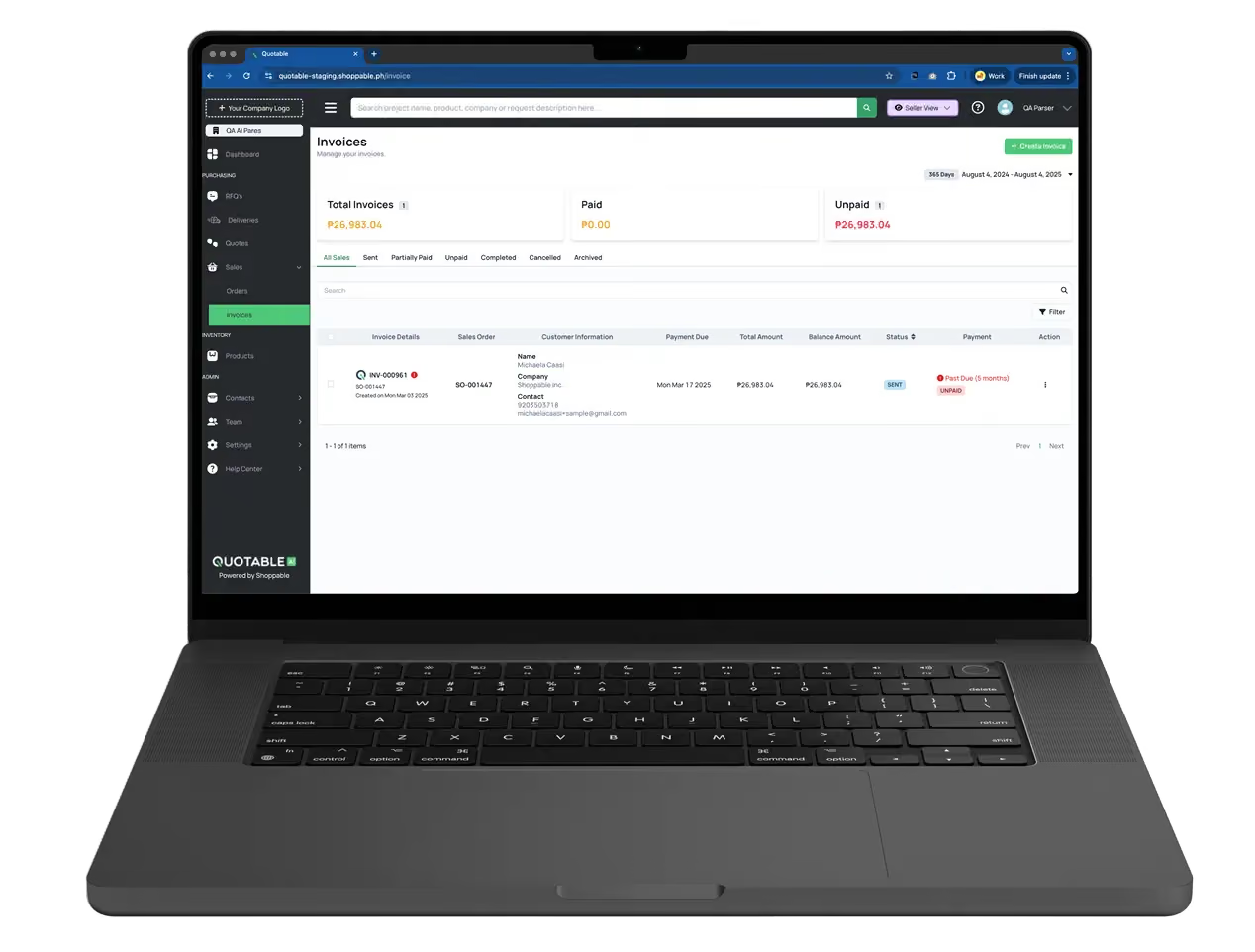
Quotable Payments is an example of what's emerging for this segment. It's a platform built for cross-border B2B vendor payments with multi-currency holding across 35 currencies. Payouts reach 140+ currencies across 200+ countries. Vendors receive payment in their local currency without needing a Quotable account.
For B2B trade operators, the question isn't which of these two platforms to pick. It's whether either one fits the workflow you actually run.
Pay International Vendors Without the Workflow Gap
B2B importers and exporters need PO-to-payment traceability that consumer-focused platforms don't cover. See how Quotable Payments handles the full vendor-payment workflow.
Explore International Vendor Payments
Account Freeze Risk and How to Reduce It
Both Wise and Payoneer can suspend your account during mandatory compliance reviews. The risk increases with transfer size, frequency changes, and incomplete documentation.
What Triggers an Account Freeze
Both platforms can freeze your account when automated compliance screening flags unusual activity. The most common triggers are:
- Sudden increases in transfer volume
- Incomplete or outdated documentation
- Payments to or from high-risk jurisdictions
Both platforms are required to comply with anti-money laundering (AML) and know your customer (KYC)/know your business (KYB) regulations. That means either one may temporarily suspend an account while reviewing unusual activity or requesting additional documentation. Wise states in its help documentation: "We may need to suspend your account while we perform a mandatory regulatory compliance check."
How to Reduce Your Risk
- Keep KYC/KYB documents current before you scale transfer volume. Don't wait for the platform to ask.
- Increase transfer sizes gradually rather than jumping from $2,000 to $50,000 in one transaction.
- Maintain transaction records and supporting documentation. Think invoices, contracts, and POs that explain each payment's business purpose.
- Respond to compliance requests right away. Delays extend review timelines.
Account freezes aren't rare events. They're a structural feature of regulated payment platforms. The difference between a minor delay and a cash-flow crisis is whether you've prepared before the review happens.
Multi-Currency Holding, Switching Costs, and Operational Friction
Holding balances in the currency you'll spend avoids double conversion costs. And if you're already on one platform and weighing a switch, knowing the migration friction helps you plan without surprises.
When Holding Currencies Saves You Money
Say you receive $10,000 USD from a U.S. client into your Wise or Payoneer multi-currency account. You also need to pay a U.S.-based supplier $6,000 USD. If you convert the full $10,000 to your home currency and then convert $6,000 back to USD for the supplier, you've paid FX costs twice. That's double conversion. It's one of the most common ways operators lose money without realizing it.
A better approach is to hold the USD balance and pay the supplier directly in USD. That leaves only the remaining $4,000 to convert into your home currency. On Payoneer, converting that balance costs 0.5%, plus the transfer fee if you're moving it out. On Wise Business, the same conversion runs at the mid-market rate plus a fee starting at 0.57%, or roughly $23 on $4,000.
Both platforms support multi-currency holding with virtual local bank details. The cost of each conversion event is where they diverge.
What It Takes to Switch Platforms
Withdraw remaining balances from your current platform before closing. Both Wise and Payoneer allow withdrawals to linked bank accounts. Processing times vary from one to five business days depending on currency and destination.
Do you receive marketplace payouts from Amazon, Upwork, or Fiverr? You'll need to update your payout settings on each marketplace to point to the new platform's virtual bank details. This is the biggest friction point. Some marketplaces take a full pay cycle to reflect changes. That means you could have a gap where earnings are in transit between platforms.
Export your transaction history before closing your account. Both platforms offer CSV and PDF exports, but post-closure access may be limited. There's no transfer fee for closing either account. But timing matters: close a Payoneer account before the annual fee billing date if you're below the $6,000 threshold. That avoids the $29.95 charge.
Start Paying International Vendors with Confidence Using Quotable Payments
At this point, you can navigate between Wise and Payoneer based on your actual transfer size, payment direction, and workflow. You can calculate the all-in cost before you commit. You can identify which platform fits your use case. And you can prepare for the compliance reviews that come with either option.
We built Quotable Payments for the B2B operators who land in the "neither platform fully solves the workflow" row. Our platform connects to the vendor-payment workflows importers, exporters, and DTC brands actually run. Holding balances to avoid double conversion is built in.
You can pay suppliers in their currency and receive client payments across borders. Vendors don't need a Quotable account to receive funds, so payment doesn't wait on their onboarding. You can see exactly what each payment costs with transparent FX pricing across 140+ currencies in 200+ countries.
Learn how Quotable Payments handles both sides of cross-border B2B payments: paying international vendors and receiving money in multiple currencies.
Stop Paying Hidden FX Costs on Every Supplier Payment
If you're paying suppliers across borders, the FX markup on each conversion is a real line item. Quotable Payments gives you transparent pricing across 140+ currencies so you know the cost before you send.
Start for Free
FAQs About Wise vs. Payoneer
Which platform is actually cheaper for a $10,000 transfer?
Wise Business is usually cheaper for a $10,000 transfer. Its published rate starts at 0.57% putting the estimated cost around $57, per its business pricing page. Payoneer's published transfer and withdrawal range of 1.2% to 4% puts the same transfer at $120 to $400, per its pricing page. Where Payoneer lands in that range depends on corridor and method. Converting between Payoneer balances adds a separate 0.5%, and cross-currency card payments carry a markup of up to 3.5%. Multiply the per-transfer difference by your monthly frequency to see the annual impact.
Can I hold USD in my account and pay a USD supplier without converting twice?
Yes. Both Wise and Payoneer let you hold balances in multiple currencies. You can pay directly in those currencies using virtual local bank details. This avoids double conversion. If you receive $10,000 USD and pay a $6,000 USD supplier, you only convert the remaining $4,000 to your home currency. This strategy works when you receive and spend in the same currency.
How long does it actually take to switch from one platform to the other?
Withdrawing balances takes 1–5 business days depending on currency and destination. Updating marketplace payout settings on Amazon, Upwork, or Fiverr can take a full pay cycle to reflect. The technical steps are simple. The friction is in relinking payouts and exporting your transaction history before you close your old account. Post-closure access may be limited.
Do I need Quotable Payments if I'm already using Wise or Payoneer?
If you're paying international vendors as part of a B2B trade workflow, we built Quotable Payments for you. It handles the vendor-payment system that Wise and Payoneer don't cover. That means connecting payments to POs and invoices, multi-currency holding for strategic FX timing, and paying vendors in their local currency. Vendors don't need to sign up for anything. It complements either platform for operators whose workflows go beyond FX conversion.