Every procurement team has a shared language, a set of terms that shapes how deals get structured, how goods move, and how payments clear. If you're running a distribution company doing $5M in annual sales or managing purchasing for a mid-market manufacturer, knowing the right B2B procurement terminology isn't just academic: it's the difference between smooth operations and costly misunderstandings. A misread Incoterm, a confused PO state, or a fuzzy grasp of payment rails can stall shipments, blow budgets, and erode supplier trust. This guide breaks down the vocabulary that matters most across the full quote-to-payment cycle, with a focus on practical application for SMEs and mid-market companies navigating real transactions every day. Whether you're onboarding a new purchasing analyst or tightening up your own knowledge, the terms here reflect how modern B2B trade actually works: not textbook definitions, but the language your counterparts are already using.
Foundational Procurement Concepts in Modern Trade
The Evolution from Manual Sourcing to Digital Procurement
Ten years ago, most SME procurement teams ran on email chains, spreadsheets, and phone calls. A buyer would email three suppliers for quotes, manually compare pricing in Excel, and then key the winning bid into an ERP. That process worked when you were handling 15 to 20 purchase orders a month. Once you cross the 30 to 50 PO threshold, cracks appear fast: duplicate orders, missed approvals, and zero audit trail.
Digital procurement flipped that model. The shift started with e-procurement portals in the early 2000s, but adoption among smaller companies lagged until cloud-based tools dropped the cost of entry. Now, platforms handle everything from RFQ distribution to invoice matching without requiring six-figure implementation budgets.
The vocabulary shifted alongside the tools. Terms like "e-sourcing," "spend analytics," and "supplier onboarding" replaced older phrases like "vendor lists" and "bid tabs." If you're still using language from the paper-based era, you're likely using processes from that era too: and that's where margin leaks hide.
One critical term to understand is "maverick spend," which refers to purchases made outside approved contracts or procurement channels. Research from Ardent Partners consistently shows that maverick spend accounts for roughly 20-30% of total procurement spend in organizations without strong controls. Knowing this term helps you spot the problem and build policies around it.
Strategic Sourcing vs. Tactical Purchasing
These two terms get used interchangeably, but they describe fundamentally different activities. Tactical purchasing is reactive: you need 500 units of copper fittings by Friday, so you call your usual supplier and place the order. Strategic sourcing is proactive: you analyze your total annual spend on copper fittings, evaluate five suppliers on price, quality, lead time, and risk, and negotiate a framework agreement that locks in favorable terms for 12 months.
The distinction matters because it shapes your entire procurement vocabulary. Tactical purchasing involves terms like "spot buy," "rush order," and "blanket PO." Strategic sourcing introduces "total cost of ownership" (TCO), "supplier scorecards," "category management," and "should-cost modeling."
For a distributor doing $10M in revenue, the shift from tactical to strategic sourcing typically happens when you realize that 70% of your spend concentrates in just 15 to 20 suppliers. That's your signal to move from one-off transactions to structured relationships with negotiated pricing tiers, penalty clauses for late delivery, and quarterly business reviews.
The Quote-to-Payment Lifecycle: Beyond the Basics
Understanding Quotation Management and Live Transaction States
Most people think of a quote as a static PDF: a snapshot of pricing sent to a buyer. But in modern B2B trade, a quote is better understood as a live transaction state. It's the first binding data object in a chain that connects sourcing, ordering, fulfillment, and payment. When a quote changes, everything downstream should update accordingly.
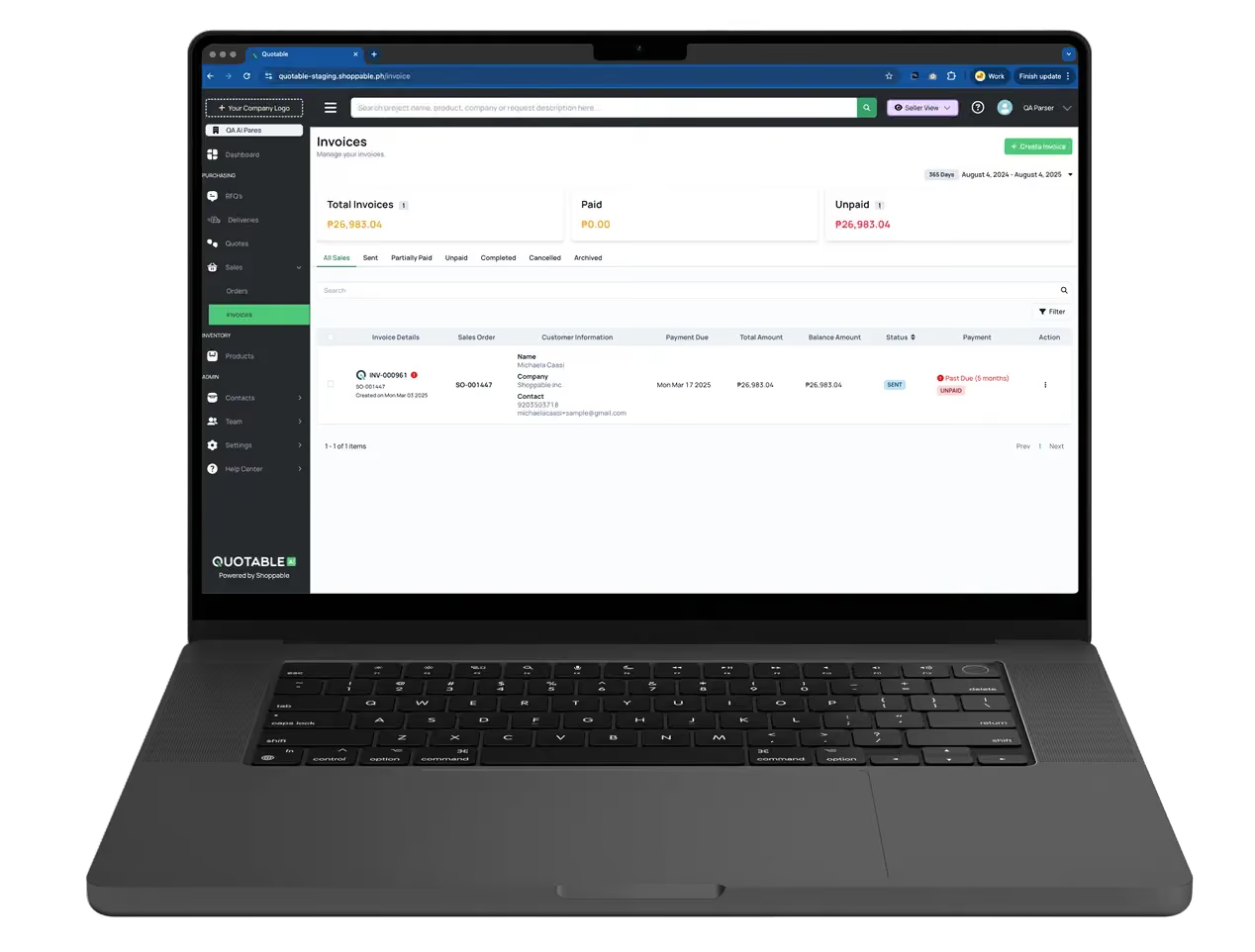
This concept of treating the quote as a live state is central to how platforms like Quotable AI operate. Rather than generating a quote in one system, then re-keying data into an ERP, then manually creating an invoice, the quote itself becomes the source record. Pricing, quantities, terms, and delivery dates flow from that single object into purchase orders, invoices, and payment requests without re-entry.
Key terms in this space include "RFQ" (request for quotation), "RFP" (request for proposal), "bid comparison matrix," and "quote validity period." The validity period is one that trips up newer buyers: if a supplier quotes you $12.50 per unit with a 15-day validity and you don't respond until day 20, that price isn't guaranteed. Raw material costs, currency fluctuations, or simple demand shifts can change the numbers.
Another term worth knowing is "requote" or "revision," which refers to an updated quotation issued after the buyer requests changes to scope, quantity, or delivery terms. Tracking revision history matters for audit purposes and for resolving disputes later.
Purchase Orders (PO) and Pro Forma Invoicing
A purchase order is the buyer's formal commitment to purchase goods or services at agreed terms. It's a legally binding document once the supplier acknowledges it. The PO number becomes the reference point for every subsequent document: goods receipt, invoice, and payment.
There are several PO types worth distinguishing. A "standard PO" covers a one-time purchase. A "blanket PO" (also called a "standing order") covers recurring purchases over a set period, usually with a not-to-exceed amount. A "contract PO" references a negotiated agreement and pulls terms from that master contract. If you're buying $2M in electrical components annually from one supplier, a blanket PO with quarterly release schedules saves you from issuing 200 individual orders.
Pro forma invoices sit between the quote and the final commercial invoice. They're common in international trade, where a buyer needs a document to arrange import licenses, letters of credit, or advance payments before goods ship. The pro forma isn't a demand for payment: it's a preview of what the final invoice will look like, including item descriptions, HS codes, weights, and Incoterms.
The "three-way match" is a critical control term here. It refers to matching the PO, the goods receipt note, and the supplier's invoice before approving payment. If all three align, the invoice gets paid. If they don't, someone needs to investigate. Companies that skip this step often discover duplicate payments or overpayments during year-end audits.
The Role of Vertically Integrated Data Orchestration
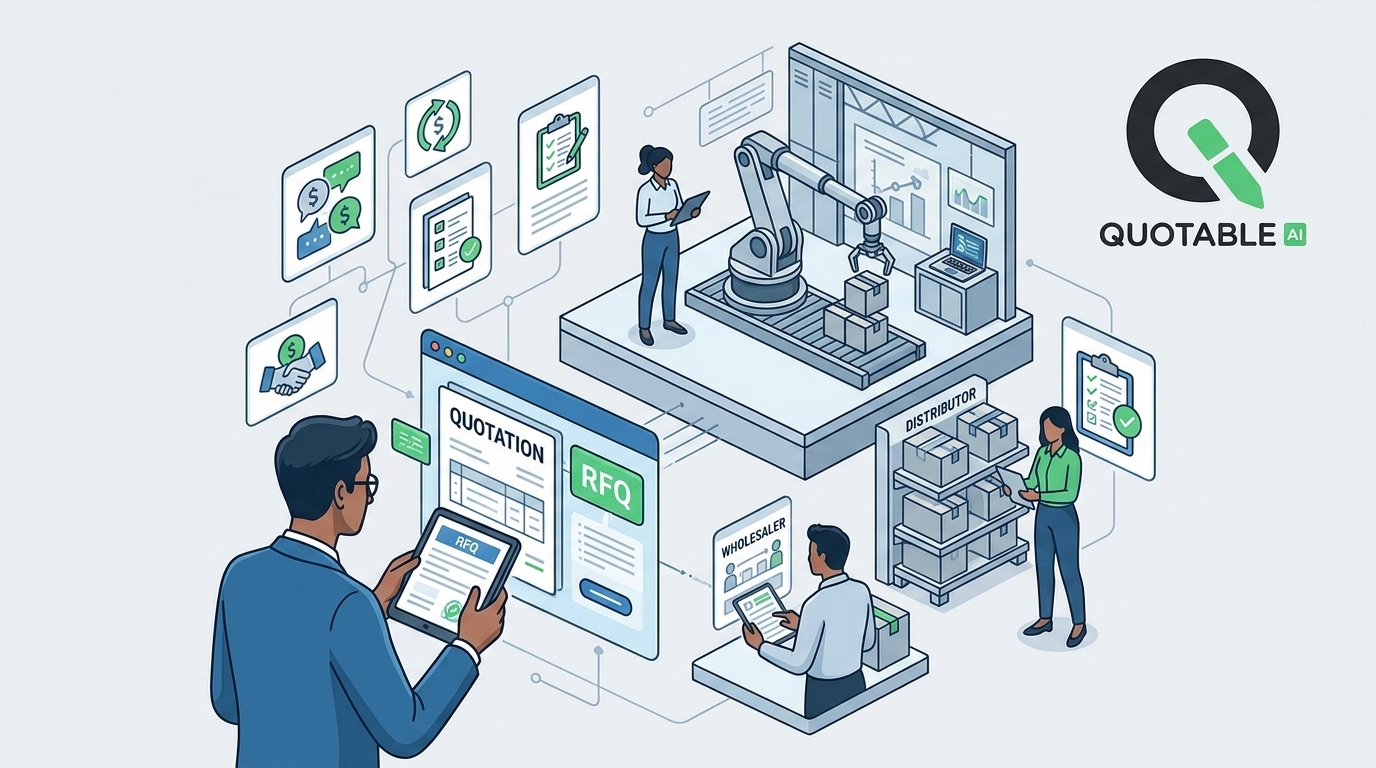
This phrase sounds heavy, but the concept is straightforward: it means connecting every stage of a B2B transaction, from quote through payment, into a single data flow. Instead of siloed systems where quoting lives in one tool, procurement in another, and payments in a third, the data moves through one continuous pipeline.
Why does this matter for terminology? Because disconnected systems breed inconsistent language. Your sales team calls it a "proposal," your procurement team calls it a "quotation," and your finance team calls it an "estimate." Those aren't just semantic differences: they create real confusion when you're trying to reconcile documents.
Quotable AI's approach treats the quote as the origin point for this orchestration. A quote converts into a PO, which triggers fulfillment, which generates an invoice, which initiates payment: all within one system. The AI parser extracts and structures data from each document type automatically, reducing manual encoding errors. For a mid-market company processing 500 transactions a month, that kind of integration eliminates hours of data entry and the errors that come with it.
Financial Terminology for SMEs and Mid-Market Suppliers
Accounts Payable (AP) and Receivable (AR) Automation
AP refers to money your company owes to suppliers. AR refers to money owed to you by your customers. Simple enough in concept, but the operational complexity of managing both at scale is where most SMEs struggle.
AP automation covers invoice capture (scanning or parsing incoming invoices), matching (comparing invoices against POs and receipts), approval workflows (routing invoices to the right person for sign-off), and payment execution. The goal is to reduce "days payable outstanding" (DPO) strategically: not just paying faster, but paying on terms that preserve your cash position while keeping suppliers happy.
AR automation focuses on the other side: getting paid. Key terms include "days sales outstanding" (DSO), "dunning" (the process of sending payment reminders), and "aging reports" (which categorize outstanding invoices by how overdue they are: 30, 60, 90+ days). If your DSO is 45 days but your DPO is 30 days, you're financing your customers' working capital with your own cash. That's a problem.
The growth of AI in procurement processes has been projected to increase by 446% by 2025, and much of that growth concentrates in AP/AR automation, where pattern recognition and exception handling deliver immediate ROI.
B2B Payment Rails and Global Trade Settlement
"Payment rails" refers to the infrastructure through which money moves between businesses. The main rails in B2B include bank wire transfers (SWIFT for international, Fedwire for domestic U.S.), ACH (Automated Clearing House, used for batch payments in the U.S.), credit card networks, and increasingly, digital wallets and embedded payment platforms.
Each rail has different cost, speed, and risk profiles. A SWIFT wire might cost $25 to $50 per transaction and take 2 to 5 business days. ACH is cheaper (often under $1) but slower for same-day settlement. Credit cards offer speed but carry 2 to 3% processing fees that eat into margins on large orders.
For companies involved in cross-border trade, "FX impact" and "landed cost" are essential terms. Landed cost includes the product price plus freight, duties, insurance, and any currency conversion costs. If you're importing $500,000 in materials from Germany and the euro strengthens 3% between your PO date and payment date, that's $15,000 in unplanned cost. Smart procurement teams track FX exposure and sometimes use forward contracts to hedge it.
Platforms like Quotable AI consolidate these payment methods into one system, so suppliers can receive payment via wire, ACH, credit card, or e-wallet without the buyer juggling multiple portals. That consolidation also creates a single audit trail linking every payment back to its originating invoice, PO, and quote.
Logistics and Fulfillment Vocabulary
Shipping Documentation and Proof of Delivery
Once a PO is confirmed and goods are ready to ship, a new set of documents enters the picture. The "bill of lading" (BOL) is the most important: it's both a receipt for shipped goods and a contract between the shipper and carrier. In ocean freight, the BOL can also serve as a document of title, meaning whoever holds it can claim the goods.
Other key documents include the "packing list" (itemized contents of each package or pallet), "commercial invoice" (the final billing document used by customs), and "certificate of origin" (which determines applicable tariff rates under trade agreements). If you're importing steel from South Korea and can prove origin under a free trade agreement, you might save 5 to 25% in duties.
"Proof of delivery" (POD) confirms that goods arrived at the buyer's location. It typically includes a signature, timestamp, and sometimes photographic evidence. POD is critical for triggering payment under many contracts: no proof of delivery, no payment. For construction materials distributors, where deliveries go to job sites rather than warehouses, capturing reliable POD has historically been a pain point.
Supply Chain Visibility in Construction and Manufacturing
"Supply chain visibility" means knowing where your materials are, what condition they're in, and when they'll arrive: at every stage from supplier to end customer. In construction and manufacturing, poor visibility creates cascading delays. If your steel beams are stuck in customs and you don't know until the truck fails to show up, your entire project timeline shifts.
Key terms here include "lead time" (the total time from order placement to delivery), "cycle time" (how long it takes to complete one production or fulfillment cycle), and "safety stock" (extra inventory held to buffer against supply variability). A recent survey from the Institute for Supply Management found that supply chain disruptions remain a top concern for procurement professionals, making visibility tools a priority investment.
"Track and trace" refers to the ability to follow a shipment in real time, often using GPS, RFID, or IoT sensors. "Exception management" is the process of identifying and resolving deviations from the plan: a late shipment, a damaged pallet, a quantity discrepancy. The best procurement teams don't just track shipments; they set up automated alerts that flag exceptions before they become crises.
Optimizing Workflows with Procurement Technology
AI-Powered Automation in the Procurement Operating System
The phrase "procurement operating system" describes a platform that manages the full transaction lifecycle rather than just one piece of it. Think of it as the difference between using five separate apps for quoting, ordering, invoicing, payments, and reporting versus having one system that handles all five.
AI plays a growing role in these systems. Document parsing is one of the highest-value applications: extracting line items, quantities, unit prices, and terms from a PDF quote or invoice and converting them into structured data. Quotable AI's universal AI parser handles quotes, invoices, POs, payments, and bills of materials this way, which eliminates the manual data entry that typically consumes 30 to 40% of a procurement analyst's week.
Other AI applications include spend classification (automatically categorizing purchases into spend categories), anomaly detection (flagging invoices that deviate from historical patterns), and predictive analytics (forecasting demand based on order history and market signals). For a distributor processing hundreds of SKUs across dozens of suppliers, these capabilities turn raw transaction data into usable intelligence.
One practical red flag to watch for: if your team is still manually re-typing data from supplier quotes into your ERP, you're operating below the automation threshold where errors multiply. Even one transposed digit on a unit price, say $12.50 entered as $125.00, can trigger a payment dispute that takes weeks to resolve.
Reducing Lead Times through Continuous Workflow Integration
"Continuous workflow integration" means that each step in the procurement process automatically triggers the next. A quote acceptance generates a PO. A PO acknowledgment triggers a fulfillment order. A shipping confirmation creates an invoice. A delivery confirmation initiates payment.
The opposite of this is batch processing, where documents pile up and get processed in groups: invoices entered every Friday, payments run twice a month. Batch processing introduces delays at every handoff. If your supplier ships on Monday but you don't process the invoice until Friday and don't run payments until the 15th, your supplier waits 2 to 3 weeks for money they've already earned. That damages the relationship and limits your negotiating power on future deals.
Reducing lead times isn't just about shipping faster. It's about compressing the administrative time between each transaction stage. If you can cut 3 days of processing time out of every order cycle, and you process 100 orders a month, you've recovered 300 days of cumulative cycle time annually. That translates directly into faster cash conversion and stronger supplier relationships.
The Hackett Group's procurement benchmarking data consistently shows that top-performing procurement organizations have 50% lower process costs than their peers, largely because of workflow automation and integration.
Building Your Procurement Vocabulary for Growth
Mastering B2B procurement terminology isn't a one-time exercise. The language evolves as technology, trade regulations, and market conditions shift. What matters is building a shared vocabulary across your sales, procurement, finance, and logistics teams so that everyone interprets documents, deadlines, and obligations the same way.
Start by auditing your current processes. Where are you re-keying data? Where do document handoffs create delays? Where have misunderstood terms caused disputes or payment delays? Those friction points tell you exactly which terminology gaps need closing.
If you're ready to move from fragmented tools and manual processes to a system that connects quoting, procurement, invoicing, and payments in one workflow, Quotable AI is built for exactly that transition. It's designed for SMEs and mid-market companies that have outgrown spreadsheets but don't need a six-figure ERP overhaul. The hard-won lesson we've seen repeated across hundreds of businesses: the companies that invest in getting their procurement language and systems right at $5M in revenue are the ones that scale smoothly to $25M without the operational chaos that derails their competitors.