Most B2B companies don't lose money because of bad products. They lose it in the gaps between vendors, invoices, purchase orders, and payments that nobody owns. A single misquoted price on a $50,000 order can cascade into weeks of back-and-forth, delayed shipments, and strained relationships. For distributors and mid-market buyers processing hundreds of transactions each month, those gaps compound fast. Effective vendor management isn't just an operational nice-to-have; it's the difference between a supply chain that scales and one that slowly bleeds margin. These seven best practices represent hard-won lessons from companies that have moved past spreadsheets and email chains into systems that actually work.
The Evolution of Vendor Management: From Silos to Orchestration
A decade ago, managing vendors meant maintaining a spreadsheet of contacts, negotiating annual contracts, and hoping your AP team could reconcile invoices before month-end close. Each department operated in its own silo: procurement owned the RFQ, sales owned the quote, finance owned the payment, and logistics owned the shipment. Nobody had a unified view of the transaction lifecycle, and the result was predictable: duplicate orders, maverick spend, and visibility gaps that made audits a nightmare.
The shift we're seeing now is from siloed vendor management toward what's better described as orchestration. Instead of treating each step as an isolated handoff, leading companies connect quoting, procurement, payments, and fulfillment into one continuous workflow. This isn't just a technology upgrade. It's a fundamental rethinking of how B2B transactions flow between organizations.
The market reflects this shift. The global vendor management software market is expected to reach USD 23.16 billion by 2033, growing at a CAGR of 10.5% from 2026. That growth is driven by companies recognizing that the old way of managing vendors through disconnected tools and manual processes simply can't keep pace with the speed and complexity of modern supply chains.
The Role of the Quote as a Live Transaction State
Here's a concept most systems get wrong: they start after the transaction. The PO triggers the workflow, the invoice initiates the payment, the shipment closes the loop. But the real transaction begins earlier, at the quote.
Think of the quote not as a static PDF you email to a buyer, but as a live transaction state that carries data forward through every subsequent step. When a quote contains accurate pricing, lead times, and terms, it becomes the foundation for the PO, the invoice, the payment, and the fulfillment record. When it doesn't, every downstream step inherits that error.
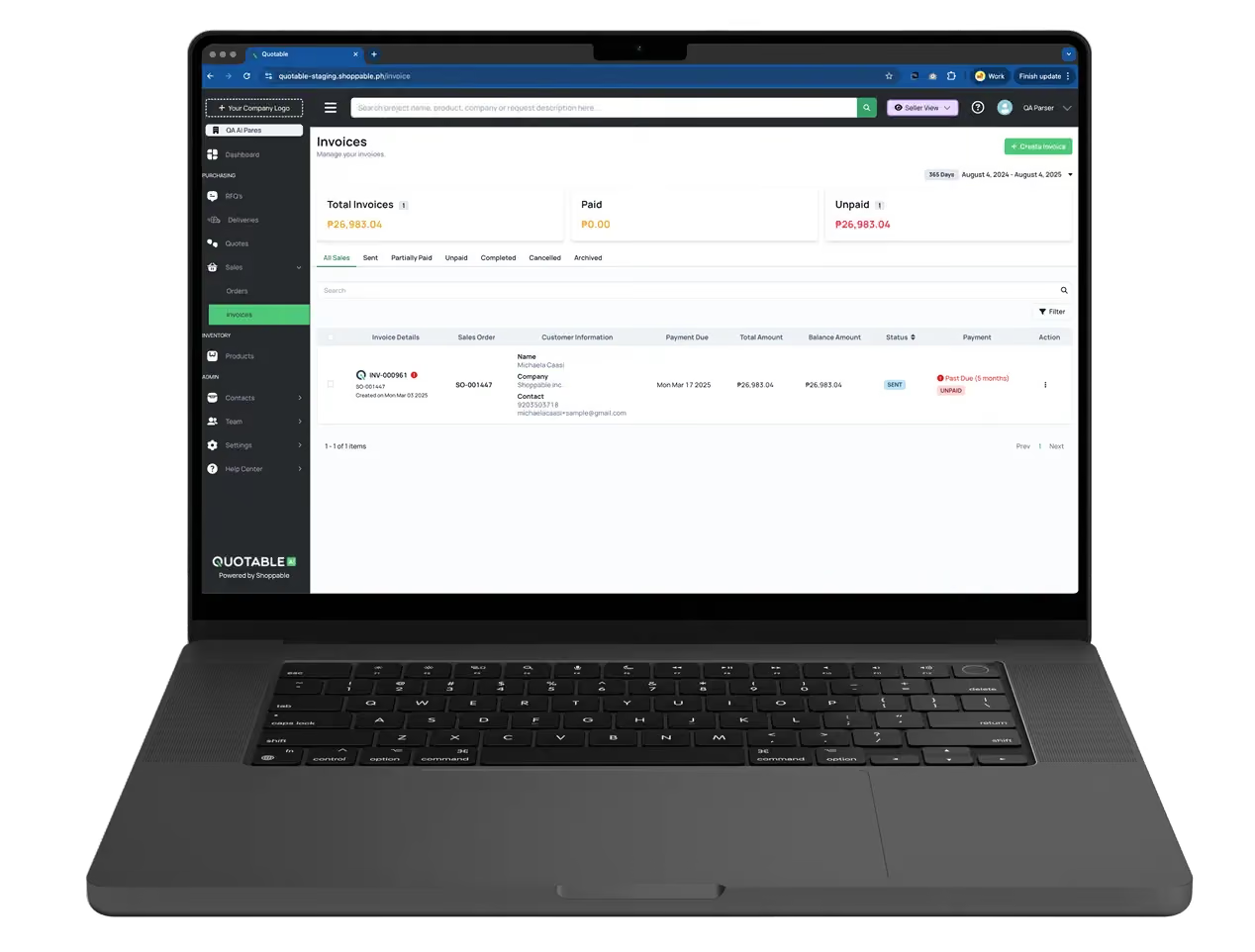
One client we worked with, a mid-size industrial distributor doing $12M annually, discovered that 30% of their invoice disputes traced back to discrepancies between the original quote and the final PO. The fix wasn't better invoicing. It was treating the quote as the single source of truth and ensuring it flowed cleanly into every subsequent document. This is the core idea behind platforms like Quotable AI, which treat the quote as an operating layer that connects the entire transaction lifecycle.
Establish Clear Communication Channels and KPIs
The most common mistake in vendor relationships isn't choosing the wrong supplier. It's failing to define what "good" looks like before the work starts. Without explicit KPIs and structured communication, you're left evaluating vendors on gut feeling, and gut feeling doesn't survive an audit.
Start by defining the metrics that matter for your business. For most B2B distributors, these fall into a few categories:
- On-time delivery rate (target: 95%+)
- Quote response time (how quickly vendors respond to RFQs)
- Order accuracy (percentage of orders shipped without errors)
- Invoice accuracy (percentage of invoices matching POs on first submission)
- Payment terms compliance
These aren't just numbers for a dashboard. They're the basis for quarterly business reviews, contract renewals, and escalation protocols. If a vendor consistently delivers at 88% on-time when your threshold is 95%, you need that data to have a productive conversation rather than an accusation.
Communication channels matter just as much as the metrics themselves. We've seen companies where verbal changes to pricing or delivery terms never make it into the system. A buyer calls a vendor, negotiates a 3% discount on a rush order, and nobody updates the PO. Three weeks later, AP rejects the invoice because it doesn't match. Define where changes get documented, who approves them, and how they flow into your financial systems. If it's not in the system, it didn't happen.
Automate the Quote-to-Payment Lifecycle
Manual processes have a breaking point, and for most mid-market companies, that point arrives somewhere around 30 to 50 orders per month. Below that threshold, a competent team can manage with email, spreadsheets, and phone calls. Above it, errors multiply, response times stretch, and your best people spend their days chasing documents instead of building relationships.
Automation across the quote-to-payment lifecycle addresses the root cause of most procurement friction: data re-entry. Every time someone manually types a line item from a quote into a PO, or transcribes invoice details into an accounting system, they introduce the possibility of error. Automation doesn't just speed things up; it can cut errors in manual supervision by up to 45%.
Reducing Friction in Procurement and Invoicing
The friction points in procurement are well-documented but rarely addressed holistically. Consider the typical lifecycle: a buyer identifies a need, issues an RFQ, receives quotes from multiple vendors, selects a supplier, generates a PO, receives goods, matches the invoice to the PO and receiving report (the three-way match), and finally processes payment. Each handoff is a potential failure point.
The biggest source of friction we see? The RFQ-to-quote stage. Procurement teams send RFQs via email, vendors respond in different formats (PDF, Excel, sometimes just a phone call), and someone has to manually consolidate and compare responses. Platforms that allow suppliers to respond to RFQs through a secure link, without creating accounts or adopting new software, dramatically reduce this bottleneck. When vendors can submit structured quotations directly, procurement teams collect responses faster and compare them on equal terms.
The invoice side is equally painful. A common red flag: if your AP team spends more than 15 minutes per invoice on data entry and validation, you're leaving money on the table. AI-powered document parsing can automatically extract and structure data from invoices, purchase orders, and quotes, reducing manual encoding and improving accuracy.
Achieving 10X Faster Processing with AI-Powered Systems
The 10X claim sounds aggressive, but the math checks out when you look at the full cycle. A manual quote-to-payment process for a mid-market distributor might take 5 to 7 business days from RFQ issuance to payment initiation. With automation handling document parsing, approval routing, three-way matching, and payment execution, that same cycle can compress to hours.
AI adoption in procurement is accelerating rapidly. Procurement teams are increasingly adopting GenAI tools, with 94% of procurement teams now using GenAI weekly and 92% of CPOs planning AI integration into their workflows. AI transforms vendor management from reactive (fixing problems after they occur) to predictive (flagging risks before they become disputes).
Consider a concrete scenario: you receive 200 invoices per month from 40 vendors. Each invoice requires validation against a PO and receiving report. Manually, that's roughly 50 hours of AP time per month. An AI-powered system like Quotable AI's Universal AI Parser can extract line items, match them against POs, flag discrepancies, and route exceptions for human review, reducing that 50 hours to under 5.
Centralize Data for Better Vendor Visibility
If you can't see it, you can't manage it. That's the fundamental problem with decentralized vendor data. When quote history lives in email, POs live in your ERP, invoices live in your accounting system, and payment records live in your bank portal, you don't have a vendor management system. You have four disconnected systems with a human being as the integration layer.
Centralization means creating a single view of each vendor relationship that includes every quote, PO, invoice, payment, and communication. The analytics and reporting module is expected to contribute the highest share (68.6%) in the vendor management market in 2026, which tells you where the industry sees the most value: not in data collection, but in data visibility.
The practical benefits are immediate. When a vendor calls to dispute a late payment, your team can pull up the complete transaction history in seconds rather than digging through email threads. When you're negotiating contract renewals, you have actual spend data, delivery performance, and quality metrics at your fingertips. When an auditor asks for documentation of your vendor qualification process, you can produce it without a two-week scramble.
One overlooked benefit of centralized data: it exposes landed costs. For companies importing goods, the true cost of a vendor relationship includes not just the unit price but duties, freight, FX impact, and warehousing. Without centralized data connecting purchase orders to shipping documents like bills of lading and packing lists, you're making sourcing decisions based on incomplete information.
Implement Vertically Integrated Data Orchestration
Vertical integration in this context doesn't mean owning your supply chain end-to-end. It means ensuring that data flows vertically through every layer of a transaction, from the initial quote through procurement, fulfillment, and payment, without manual re-entry or format translation.
Most companies have horizontal integrations: their ERP talks to their accounting system, their accounting system talks to their bank. But the vertical connections, linking a specific quote to its resulting PO, to the shipment that fulfilled it, to the invoice that billed for it, to the payment that settled it, are often maintained manually or not at all.
This is where the concept of the quote as a live transaction state becomes operational. When your quoting system, procurement platform, shipping tracker, and payment processor all reference the same underlying data object, discrepancies become visible instantly. A price change in the quote automatically flags a mismatch in the invoice. A shipping delay automatically triggers a notification to the buyer. A payment confirmation automatically closes the loop on the vendor's side.
Connecting Quoting, Shipping, and Fulfillment
The connection between quoting and fulfillment is where most B2B operations lose track of their data. Here's a scenario we see constantly: a distributor quotes 500 units of a component at $42 each. The buyer orders 500 but requests split shipments of 200 and 300 units. The vendor ships the first batch but invoices for the full 500. The buyer's AP team rejects the invoice because they've only received 200 units. Now you have a dispute that could have been avoided if the shipment data was linked to the quote and PO.
Connecting these systems requires either a platform that handles the full lifecycle or strong integrations between specialized tools. Quotable AI's approach, connecting with existing ERP and accounting systems while providing a unified transaction layer, lets organizations modernize their vendor collaboration without ripping out their existing infrastructure. The key is ensuring that every document in the chain, from quote to payment, references the same transaction ID and carries forward the same terms.
Prioritize Secure and Seamless B2B Payments
Payment is where vendor relationships are won or lost. You can have the best procurement process in the world, but if your vendors wait 60 days to get paid through a manual wire transfer process, they'll prioritize other customers. And they should.
The B2B payments space is still surprisingly manual for many mid-market companies. A typical process involves receiving an invoice, entering it into the accounting system, routing it for approval, scheduling a payment run, initiating a bank wire, and then emailing the vendor a remittance advice. Each step adds days and introduces the possibility of error.
Smart money is on embedded payments, where the payment method (bank wire, ACH, credit card, or e-wallet) is built into the same platform where quotes and invoices are managed. This eliminates the manual back-and-forth of payment verification. When a vendor can see that payment has been initiated directly within the system where they submitted their invoice, trust increases and follow-up calls decrease.
Security is non-negotiable. B2B payment fraud is rising, and the most common vector is business email compromise, where a fraudster impersonates a vendor and requests a payment redirect. Centralized payment systems reduce this risk by maintaining verified vendor banking details within the platform rather than relying on email-based payment instructions. If a payment destination changes, the system flags it for verification rather than processing it blindly.
For companies with international vendors, linking payment workflows to logistics data is critical. You need to track landed costs, including duties, freight, and FX impact, alongside the payment itself. A payment that looks like $42 per unit might actually cost $48 when you factor in tariffs and shipping, and that 14% difference matters when you're calculating margin on a $200,000 order.
Conduct Regular Performance Reviews and Audits
Vendor performance reviews shouldn't be annual events driven by contract renewal deadlines. They should be quarterly at minimum, structured around the KPIs you established at the outset, and supported by actual data rather than anecdotal impressions.
A strong review process follows a consistent format:
- Pull the vendor's scorecard from your centralized system (on-time delivery, quote accuracy, invoice accuracy, quality metrics).
- Compare current performance against contractual SLAs and historical trends.
- Identify specific incidents (late deliveries, pricing errors, quality issues) and their root causes.
- Discuss upcoming demand changes, capacity constraints, or pricing adjustments.
- Document agreed-upon action items with deadlines and owners.
The audit side is equally important, especially for companies subject to SOX compliance or industry-specific regulations. Your audit trail should demonstrate that vendor selection followed a documented process, that pricing was competitive (supported by RFQ responses), that approvals followed your delegation of authority, and that payments matched approved invoices and receiving reports.
Red flags that suggest your vendor management process needs attention: duplicate payments appearing in your AP aging report, vendors consistently invoicing above quoted prices without documented change orders, inability to produce a complete transaction history for a given vendor within 24 hours, and month-end close delays caused by unresolved vendor disputes. If any of these symptoms sound familiar, you're past the point where manual processes can keep up.
An advanced analytics approach to vendor management can deliver an 18% procurement cost reduction by identifying patterns that humans miss: price creep over time, seasonal delivery performance drops, or concentration risk in your supply base.
Future-Proofing Your Supply Chain with Quotable AI
The vendor management practices outlined here share a common thread: they all depend on connected, accurate, real-time data flowing across the transaction lifecycle. You can't establish meaningful KPIs without centralized data. You can't automate the quote-to-payment cycle without treating the quote as a live transaction state. You can't conduct effective vendor reviews without a complete audit trail.
North America currently holds a 27.90% share in the global vendor management systems market, but the fastest growth is happening among mid-market companies that are moving beyond spreadsheets for the first time. If you're a distributor doing $5M to $30M in revenue and still managing vendors through email and manual data entry, the competitive gap is widening every quarter.
Quotable AI was built for exactly this inflection point: the moment when a growing B2B company realizes that its vendor processes need to scale but doesn't want to rip out its existing ERP. By treating the quote as the starting point of every transaction and connecting it through procurement, fulfillment, and payment, you get the visibility and automation that enterprise companies take for granted, without the enterprise price tag or implementation timeline. Start where the transaction begins, and the rest follows.