.png)

Your payment is mid-transfer. Your vendor is waiting. Then Wise flags your account for review. The support ticket you opened three days ago hasn't moved, and the wire deadline has already passed.
At that point you don't just need another payment provider. You need one that fits the way you move money. That might mean paying international suppliers, receiving marketplace payouts, or sending remittances along one corridor.
The right Wise alternative does three things. It cuts foreign exchange (FX) costs you don't need to pay. It removes the reconciliation delays that damage supplier relationships. And it reduces the compliance friction that triggers new holds.
Main Takeaways
- Your switching trigger tells you what to prioritize. That could be an account freeze, a fee surprise, or a feature gap.
- Consumer-priced platforms win on small transfers. Business platforms pull ahead at $10,000 and above.
- Each alternative is built for one workflow. Quotable Payments for supplier payments tied to purchase orders, OFX for high-value business sends, Payoneer for marketplace payouts, Revolut for travel, and Remitly for remittance.
- Regulated and deposit-insured aren't the same thing. Most platforms here safeguard funds rather than insure them, and the one exception applies to a specific entity only. Check your coverage before moving large balances.
- If your account was restricted, find the trigger before you switch. Otherwise you may hit the same compliance hold with the next provider.
What Cross-Border B2B Payments Actually Cost
FX margin, transfer fees, and corridor gaps hit differently at $1,000 versus $50,000. This guide breaks down how the math works across payment types and business sizes.
Read the B2B Cross-Border Payments Guide
Why People Switch from Wise
People look for a Wise alternative when something breaks mid-workflow. The trigger is rarely vague. It's a specific failure at the worst moment, and it falls into one of five categories:
- Account restrictions or freezes tied to Know Your Customer (KYC) and compliance reviews
- Fees that scale badly on larger transfers
- Transfer or holding limits that cap business use
- Corridor gaps where Wise doesn't serve the destination well
- Feature gaps like missing invoicing, multi-party approval, or a procurement connection
Of these, account restriction is the biggest emotional driver. User forums are full of people describing a frozen account with no clear timeline. If your account was flagged, you're far from alone. And if you're searching for "TransferWise alternatives," that's the same company. Wise rebranded in 2021.
One distinction to settle before you compare anything. Wise sells a personal account and Wise Business, and they aren't the same product. Wise Business carries a one-time setup fee of roughly $31 USD. That's $45 GBP in the UK and $50 EUR in Europe. It adds batch payments, multi-user access, invoice tools, and accounting integrations. The personal account has none of those. In some regions, using a personal account for business breaches Wise's terms. Where this comparison covers B2B use, it means Wise Business.
Whatever the trigger, switching between non-bank providers is now routine. Between 35% and 50% of SMEs used a fintech provider for cross-border payments in 2024, according to McKinsey. Research from Coalition Greenwich finds that a meaningful share of US small and mid-size businesses actively consider switching financial providers each year.
So the question isn't whether alternatives exist. It's which one fits the payment workflow you run.
Your trigger tells you what to prioritize. A fee surprise on a large transfer points you toward volume-priced platforms. A compliance hold is more urgent, and worth fixing before you shop at all.
Top Wise Alternatives for 2026

The best Wise competitors cover five use cases: B2B trade, general business, freelancer and marketplace, personal and travel, and remittance.
They're ordered below by how much of a business payment workflow each one carries. The option built for supplier payments comes first. The right pick depends on which workflow you're solving for.
Quotable Payments
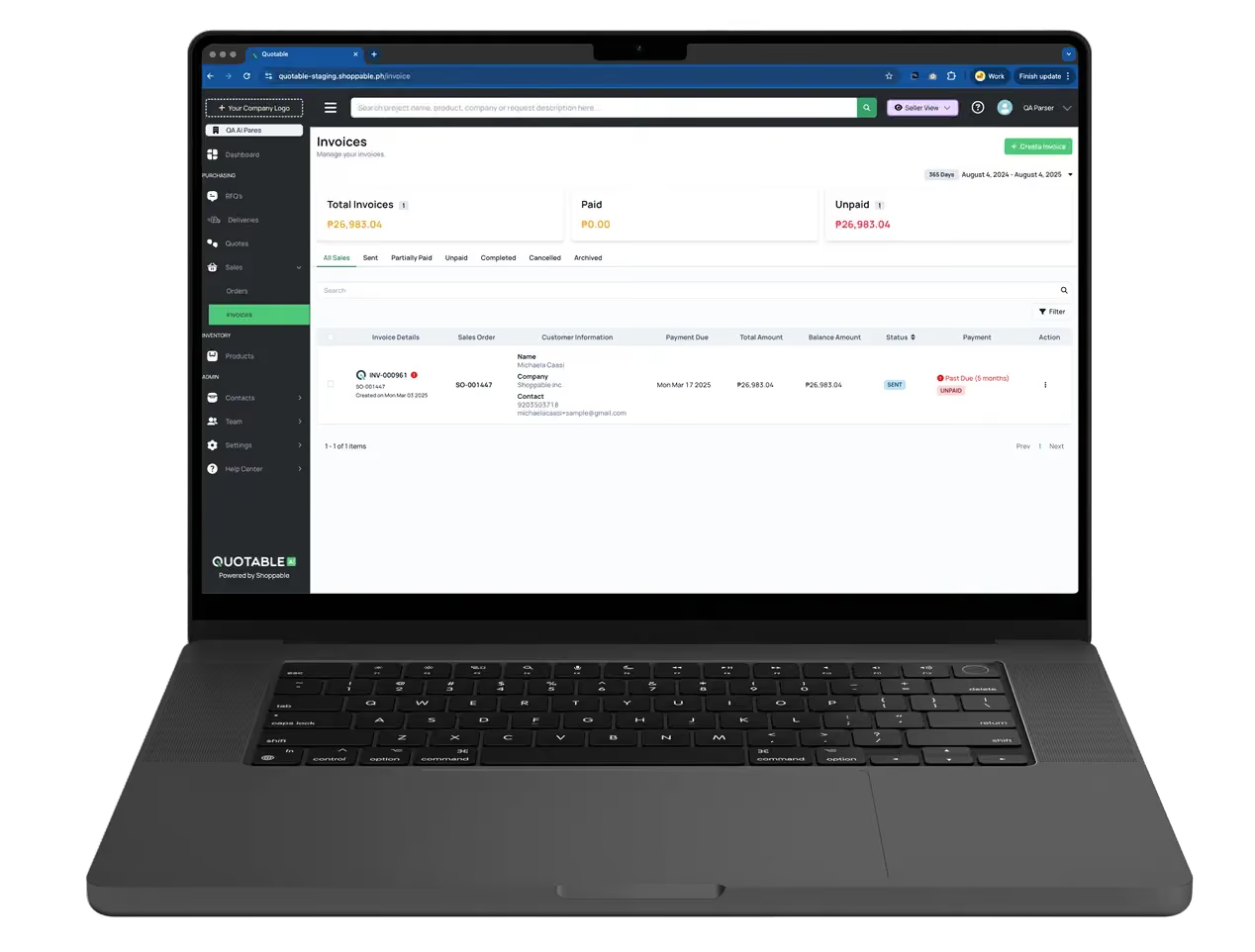
Quotable Payments is Quotable's cross-border payments app. It handles B2B payments, multi-currency holding, and reconciliation. It works standalone, or connected to the broader Quotable AI platform for procurement and invoicing. It's best for B2B trade. Think importers, exporters, manufacturers, and distributors paying international suppliers at scale.
International sends carry no Quotable fee on outbound vendor payments. Connect it to purchase orders and invoices, and it closes the reconciliation gap between "paid" and "applied." That's the gap a standalone transfer app leaves open by design.
Payouts run across 140+ currencies and 200+ countries, with multi-currency holding in 35+ currencies. Only your side needs a Quotable account. Your vendors receive and track payments without creating one.
OFX
OFX is a business-focused transfer service. It's built for larger, recurring international payments with dedicated dealer support. It suits general business users sending $10,000 and above who want a named contact and room to negotiate.
There's no fixed transfer fee on most routes. Revenue comes from the FX margin, which narrows on larger amounts. Competitive rates on high-value transfers, backed by human support, are the core advantage.
The trade-off is that OFX has no multi-currency account for holding or receiving. It works as a send-only tool and falls short on small or frequent micro-payments.
Payoneer
Payoneer is a business and freelancer payment platform. It's best for freelancers and marketplace sellers receiving payouts from Amazon, Upwork, or Fiverr. Receiving from supported marketplaces is free, though withdrawal and conversion fees apply.
It's purpose-built for this segment. You get deep marketplace integrations, plus a multi-currency account for client payments. Watch the FX margins on conversions, though. They can run wider than Wise's, especially on less common corridors.
Revolut
Revolut is an app like Wise. It combines a multi-currency account, travel card, and budgeting tools in one consumer-friendly interface. It's best for personal and travel users who want spending, holding, and converting in one place.
The free tier gives you interbank FX rates up to a monthly limit, and premium tiers remove the cap. The app is polished, and multi-currency setup is fast.
The downside is that business features are less mature than dedicated B2B platforms, and support quality can vary at scale.
Remitly
Remitly is a remittance-first platform built for speed and reliability on high-volume personal corridors. It's best for remittance senders on routes like US to Philippines or US to India.
Fees vary by corridor, speed, and funding method, and express transfers carry a premium. The strength is corridor-tuned delivery with clear upfront pricing.
The limit is scope. Remitly is strictly personal remittance. There are no business accounts, invoicing, or multi-currency holding.
If Wise Restricted or Froze Your Account

If Wise restricted or froze your account, you have options. But first, work out what triggered the hold so you don't repeat it with the next provider.
Common causes include:
- Incomplete or outdated KYC documents
- Beneficial ownership information (BOI) gaps during onboarding
- Sanctions screening flags on specific corridors or counterparties
- A virtual mailbox or forwarding address that fails fixed-address checks
- Transaction patterns that trigger automated compliance reviews
Providers face real regulatory pressure to flag and review. The Office of Foreign Assets Control (OFAC) executed 12 enforcement actions totaling $48.8 million in fines in 2024, according to Gibson Dunn. These aren't arbitrary holds. They reflect an environment where processing without review carries serious consequences.
Your next steps:
First, check your email and in-app notices for the exact documents Wise wants. Respond with exactly what's asked. Partial paperwork drags out the hold.
Second, if the restriction is open-ended, open a parallel account with a provider that has clearer KYC rules and human support. OFX and Payoneer both offer dedicated business onboarding.
Third, before you commit to a replacement, check that it supports your corridors and transfer sizes. A rushed switch to a platform that doesn't cover your routes creates a second disruption.
When you evaluate a replacement, look for these three things:
- Clear, upfront document requirements, with a published KYC checklist before you start
- Human support with escalation paths, rather than chatbot-first
- Business-grade compliance that handles BOI and sanctions screening upfront, so you don't hit the same wall again
With the immediate problem contained, the next question is cost. The comparison below shows what each option charges, and where the crossover points fall.
Side-by-Side Fee Comparison
One table shows the real cost structure across all five Wise competitors. Wise Business sits at the top as the baseline you're comparing against.
Total transfer cost depends on five factors: FX margin, transfer fee, monthly fee, currency coverage, and best-for use case. Look at any one alone and you get an incomplete picture. Figures come from each provider's published pricing as of mid-2026 and may vary by corridor, transfer size, and account tier.
| Provider | FX Margin | Transfer Fee | Monthly Fee | Currency Coverage | Best For |
|---|---|---|---|---|---|
| Wise Business | Mid-market rate, no markup | Averages about 0.52% and varies by currency | No monthly fee; one-time setup fee of about $31 | 40+ currencies | Businesses making occasional transfers on well-served corridors |
| Quotable Payments | Real-time rate that refreshes at a negotiated rate based on your volume, no hidden spread or fees | $0 on international sends | Platform plan pricing | 140+ payout currencies | B2B trade and supplier payments |
| OFX | Varies; volume-based pricing on enterprise plans | $20 per cross-border SWIFT transfer | From $0/month | 30+ currencies | General business ($10K+) |
| Payoneer | Varies by corridor; 1.2%-4% for sending money | Varies by payment method and corridor | None; $29.95 annual account fee may apply | 70+ currencies | Freelancers and marketplaces |
| Revolut | 0% within plan allowance; 0.6% above | $5 international; some plans include an allowance | $10/mo to $140/mo; enterprise tier custom | 25+ currencies | Personal and travel |
| Remitly | Varies by corridor | Varies by payment method and recipient location | None | 100+ currencies | Remittance |
The cheapest option depends on three things: transfer size, corridor, and frequency. A platform with no FX markup may charge a monthly fee that costs more if you send rarely. A platform with no transfer fee may carry a wider FX spread that hurts on large amounts. The table gives you the inputs. The worked examples give you the answer.
What a $1,000, $10,000, and $50,000 Transfer Actually Costs
The cheapest alternative to Wise changes with how much you send. A platform that wins at $1,000 can lose at $50,000, and the reverse is just as true.
The examples below assume a USD to EUR corridor at the mid-market rate. Each uses the provider's published standard pricing, with no negotiated rates. Corridor matters, so these numbers shift on USD/GBP, USD/INR, and other pairs.
On a $1,000 transfer, Wise charged an average of 0.52% across all its transfers in 2026. That's about $5.20. Its pricing page advertises fees from 0.23%, or $2.30, but that rate only applies on the cheapest corridors. The rate is the same on personal and business accounts, though Wise Business adds the one-time setup fee.
Revolut charges a flat $5 for international transfers, though some plans fold that into a monthly allowance. Inside that allowance there's no added FX cost. Remitly and Payoneer both price by corridor and payment method at this size. Your real cost depends on the route. Payoneer also adds 0.5% when converting between Payoneer balances. OFX's flat $20 SWIFT fee alone eats 2% of a $1,000 transfer, before any FX margin. At this tier, providers with low or no fixed fees hold the advantage.
At $10,000, the math shifts. Quotable Payments charges $0 on the send, so the only cost is the FX rate itself. That makes it the strongest option for business users already managing vendor invoices. OFX's flat $20 fee becomes a small fraction of the total at this size. Its FX margin also narrows with volume-based pricing on enterprise plans. The Wise Business conversion fee averages about 0.52%, or roughly $52. It can drop to $23 on the cheapest corridors and run higher on others. Revolut's monthly allowance rarely covers $10,000, so the 0.6% markup applies above it, on top of the flat $5 fee.
At $50,000, business platforms pull ahead. Quotable Payments' free-send model matters most at this scale. The value compounds when the payment connects to a purchase order and cuts downstream reconciliation work, rather than just moving money. OFX's $20 flat fee barely registers here either. Enterprise-tier volume pricing also pushes its FX margin below what smaller senders see. The Wise Business conversion fee scales directly with the amount, so there's no relative benefit at higher volumes. Revolut's 0.6% markup applies to nearly all of a $50,000 transfer once the allowance runs out, on top of its monthly plan fee.
The crossover point matters. Consumer-priced platforms tend to win on small, frequent transfers. Business-priced platforms tend to win on larger, less frequent ones. Remittance platforms tune for specific corridors rather than transfer size. Run the math at your real volume and corridor.
How to Choose the Right Alternative to Wise
Choosing the right Wise alternative is a routing decision. Match your use case to the platform built for it, and the fee, speed, and feature questions answer themselves.
The cases below run from the heaviest workflow requirement to the lightest. Each one ends with the exact condition under which that provider beats Wise.
B2B Trade
If you pay international suppliers, the payment has to connect to a purchase order and invoice. A standalone wire isn't enough. Importers, exporters, and manufacturers need reconciliation built into the payment itself. Knowing a payment went out doesn't help if matching it to the right invoice takes weeks.
Quotable Payments builds vendor payments into procurement workflows, with free international sends across 140+ currencies. The gap it closes is workflow, not just cost. Best-in-class AP teams process invoices for $2.78 in 3.1 days, while everyone else averages $12.88 and 17.4 days, according to Ardent Partners.
Quotable Payments beats Wise Business when the payment has to connect to a purchase order and invoice, rather than go out as a standalone wire. That's the gap no transfer app closes, because none of them sit upstream of the payment.
Pay Suppliers Without the Reconciliation Backlog
When payments connect to purchase orders and invoices, matching stops being a manual job. See how Quotable handles international vendor payments for importers and manufacturers.
Explore International Vendor Payments
General Business
General business senders care most about competitive rates above $10,000, plus human support and room to negotiate. OFX is built for recurring business transfers. You get dealer support and margins that narrow at volume. There's no multi-currency account for receiving, so pair it with another tool if you need to hold or collect foreign currency.
OFX beats Wise Business when you send transfers above $10,000 regularly and want a named dealer who can negotiate rates.
Freelancer and Marketplace
Here the priority is receiving payouts from Amazon, Upwork, and Fiverr, plus multi-currency holding and withdrawal flexibility. Payoneer is built for this, with deep marketplace integrations and receiving accounts made for freelancer workflows. Watch the FX conversion margins on withdrawal. They can erode payout value. Compare the all-in cost, not just the receiving fee.
Payoneer beats Wise when you receive payouts from several platforms and want one multi-currency receiving account.
Personal and Travel
App experience, a multi-currency account, a travel card, and low-cost small transfers matter most here. Revolut is the best fit, and the closest app like Wise, with consumer-grade design and card features built in.
Revolut beats Wise when you want a combined spending and travel card with a multi-currency account in one app, and your monthly volume stays inside the free-tier FX limit.
Remittance
Corridor pricing, delivery speed, and recipient access drive this decision. That means bank deposit, mobile wallet, or cash pickup. Remitly is tuned for high-volume personal corridors. It delivers on all three. Check your specific route first, since pricing and speed vary between pairs.
Remitly beats Wise when you send on a high-volume corridor like US to Philippines and need same-day delivery, including cash pickup.
When Wise Is Still the Right Answer
One scenario is worth naming honestly. For small, one-off personal transfers on well-served corridors, Wise's mid-market rate model and clear fee calculator are hard to beat. If your use case is simple and your account is in good standing, switching may not be worth the onboarding friction.
There's a separate case the matrix above doesn't cover. It's the business that has outgrown the category, where no transfer app is the right answer.
When a Business Outgrows a Transfer App
There's a point where a standalone transfer app stops being enough. It arrives when your payment volume creates problems a send-money tool was never built to solve. Reconciliation, compliance, and workflow all start breaking down at once.
The signals are specific:
- You pay 10 or more international suppliers a month and match payments to invoices by hand in a spreadsheet.
- Your AP team spends more time on reconciliation than on procurement decisions.
- You manage FX exposure across several corridors with no single view.
- A provider has flagged or restricted you because your transaction patterns look unusual for a personal or small business account.
The direct payment costs are real but modest. B2B cross-border payments average close to 1.5% globally, which is nearer the G20's 1% target than any other retail payment type. And only 5.9% of B2B payments arrive within an hour, according to the Financial Stability Board. What should concern you is corridor variation, because specific routes run far above the global average.
The bigger cost is workflow drag. Teams without connected AP workflows spend multiples more per invoice and take weeks rather than days to close. A standalone transfer app can't fix that, because the gap isn't in the transfer. When payments connect to purchase orders, invoices, and supplier records, the reconciliation problem goes away. So does the compliance friction that comes from opaque transaction histories.
Two eligibility questions remain before you commit to any provider. Can you pass their onboarding? And are your funds protected once you do?
Digital Nomad and Non-Resident Eligibility

If you're a digital nomad or non-resident without a fixed address, your Wise alternative options narrow fast. Some providers handle address checks and KYC flexibility better than others. But the gap between what's advertised and what actually passes is wider than most guides admit.
Most cross-border platforms require a fixed home address tied to a government-issued ID. Virtual mailbox services like iPostal1 or Anytime Mailbox often fail verification, because providers can detect forwarding addresses and reject them during KYC. Wise flagging virtual mailbox addresses is a common complaint among nomads trying to keep an account open.
Among the alternatives, Payoneer is more flexible on non-resident business accounts. It accepts documents from multiple jurisdictions. It also has a track record with location-independent freelancers. Revolut accepts non-resident applications in some places, but requires a local phone number and address proof, and eligibility varies by country. OFX requires a fixed address in a supported country and is less flexible for nomads.
Before you sign up anywhere, contact the support team and ask directly whether your documents will pass KYC. That might mean a foreign passport plus virtual mailbox, or a foreign passport plus temporary address. Don't assume. Verify before you move funds.
Are Wise Alternatives Safe and Regulated?

Every major Wise alternative here is regulated. But the type of regulation, the way funds are safeguarded, and US suitability all vary. Those differences matter more than most comparison guides admit.
Wise is regulated by the FCA in the UK. In the US it's registered as an MSB with FinCEN. It holds licenses in several other jurisdictions too. Funds are safeguarded rather than deposit-insured.
Revolut became a fully licensed UK bank in March 2026, regulated by the PRA and FCA, with FSCS deposit protection on eligible deposits, according to Revolut. One detail matters here. That protection applies to accounts held with Revolut Bank UK Ltd, not to the e-money entity. Customers who signed up from March 2026 onward may still sit on the e-money account while migration rolls out. Check which entity holds your account in the app before you assume coverage. US operations run through a separate partner bank.
Quotable Payments provides virtual multi-currency accounts through its payment partner's regulated Global Accounts infrastructure. Eligible businesses receive local bank details that let them receive, hold, convert, and send funds in supported currencies. Funds deposited into these accounts are held through our partner's banking network and safeguarded in accordance with applicable regulations.
Remitly is registered as an MSB with FinCEN. It's licensed as a money transmitter across US states and territories, with equivalent licenses in the UK, EU, Canada, and Australia. Payoneer is a licensed MSB in the US, regulated in several jurisdictions, with funds held in segregated accounts. OFX is regulated by ASIC in Australia and registered with FinCEN and the FCA.
"Regulated" and "deposit-insured" aren't the same thing. Most platforms here safeguard funds rather than insure them. Revolut's UK banking entity is the exception, with FSCS coverage up to £120,000 on eligible deposits. Safeguarding means funds are held separately from the company's own money. That's meaningful protection, but it isn't deposit insurance.
Before you move large funds, check three things:
- The provider's license in your jurisdiction
- Whether funds are segregated or safeguarded, and with which legal entity
- Whether the provider has a track record of resolving compliance holds clearly
"Safe and regulated in the US" means FinCEN-registered and state-licensed, at minimum. Ask for specifics, not a trust badge.
Start Paying International Suppliers Through Quotable Payments
You now have a framework for choosing a Wise alternative based on the workflow you run. Personal transfers route to consumer apps with card features. Marketplace payouts route to freelancer platforms with receiving integrations. Supplier payments route to tools that connect payments to procurement. The right match cuts FX cost, reconciliation delays, and the compliance friction that triggers new holds.
We built Quotable Payments for the supplier-payment workflow that standalone transfer apps were never designed to handle. Payments connect to purchase orders and invoices. You stop reconciling in spreadsheets, and start closing invoices in days instead of weeks. Sends carry no Quotable fee across 140+ payout currencies and 200+ countries. The rate you're offered is real time and refreshes, so you can compare it against your current provider on the same corridor, with no hidden spread or fees. Find cheaper, and we'll talk about negotiated rates based on your volume.
Stop Sending Supplier Payments as Standalone Wires
If you pay 10 or more international suppliers a month, a transfer app won't close the reconciliation gap. Quotable connects payments to POs and invoices so your AP team closes in days, not weeks.
Start for Free
FAQs About Wise Alternatives
What's the best alternative to Wise?
It depends on your use case. For B2B trade, Quotable Payments connects payments to purchase orders and invoices, which is how importers, exporters, and manufacturers close the reconciliation gap. For business transfers above $10,000, OFX offers dealer support and negotiable rates. For freelancers receiving marketplace payouts, Payoneer's integrations are built for that workflow. For personal and travel, Revolut offers the most complete app experience. Remitly tunes for speed and delivery on high-volume remittance corridors.
Which alternative is actually cheaper than Wise for large transfers?
Quotable Payments and OFX typically beat Wise Business above $10,000, because their pricing favors volume over frequency. OFX drops fixed transfer fees and narrows its FX margin as size grows. Quotable Payments charges no fee on international sends. The crossover point depends on corridor and transfer size, so run the math at your real volume.
If Wise froze my account, what should I do first?
Check your email and in-app notices for the exact documents Wise wants, and respond with exactly what's asked. Partial paperwork drags out the hold. If the restriction is open-ended after 48 hours, open a parallel account with a provider that offers human support. Before you move funds, check that the new provider covers your corridors and transfer sizes.
Do Wise alternatives work for digital nomads without a fixed address?
Most require a fixed home address tied to a government-issued ID, and virtual mailbox services often fail verification. Payoneer is more flexible on non-resident business accounts and accepts documents from multiple jurisdictions. Revolut accepts non-resident applications in some countries, but requires a local phone number and address proof. OFX requires a fixed address in a supported country. Before onboarding, ask the provider's support team directly whether your documents will pass KYC.
How do I know if I've outgrown a transfer app entirely?
You've outgrown a standalone transfer app when your payment volume creates problems the app wasn't built to solve. Clear signals include:
- Paying 10 or more international suppliers a month and matching payments to invoices by hand
- Spending more AP time on reconciliation than on procurement decisions
- Managing FX exposure across corridors with no single view
- Getting flagged by a provider because your transaction patterns look unusual
At that point, the question is no longer which transfer app to use. It's whether you need payments built into your procurement workflow.