Purchase Orders: Everything You Actually Need to Know (And What Most Guides Skip)
Most purchase order guides read like a textbook chapter nobody asked for. They define the term, list the components, and call it a day. But if you're here, you probably already know what a PO is. What you need is the practical stuff: how POs actually function in real businesses, where things go wrong, and how to build a process that doesn't fall apart at 50 orders a month.
This is the guide I wish existed when I was helping a mid-size company untangle $1.2 million in unmatched invoices - almost all of which traced back to a broken PO process.
Quick Verdict
A purchase order is a formal document from buyer to seller that becomes legally binding once accepted (in most countries). Every company doing more than a handful of purchases per month needs a consistent PO process. Paper and spreadsheet systems break down around 30-50 POs monthly. If you're past that volume and still relying on email approvals and manual tracking, you're leaving money on the table through duplicate orders, missed early-payment discounts, and invoice disputes. Automate when the cost of chasing problems exceeds the cost of a tool.
What a Purchase Order Actually Is
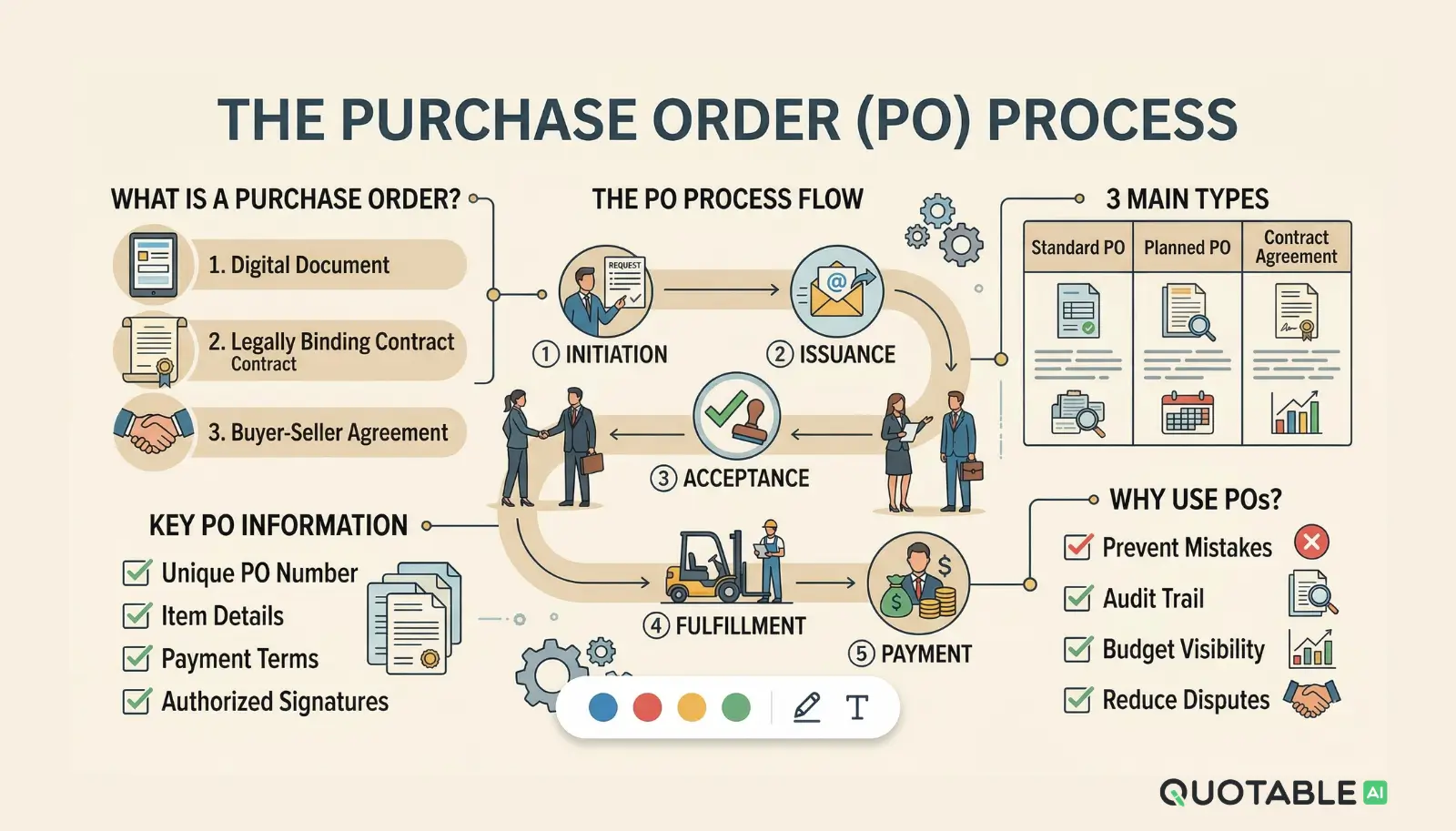
A purchase order (PO) is a document sent by a buyer to a supplier confirming what's being purchased, how much it costs, and the terms of the deal. Once the supplier accepts it, both sides are locked into a binding agreement.
That's the textbook definition. Here's the practical one: a PO is your proof. Proof that someone approved the spend. Proof of the agreed price. Proof that the supplier committed to a delivery date. Without it, you're relying on email threads and memory, and both are terrible filing systems.
Core Components of a PO
Every purchase order should include:
- PO number - unique identifier for tracking
- Buyer and supplier details - names, addresses, contact info
- Line-item descriptions - specific products or services
- Quantities and unit prices - no ambiguity
- Delivery date and location - when and where
- Payment terms - Net 30, Net 60, due on receipt, etc.
- Tax information - applicable rates and totals
- Authorized signatures - who approved this spend
- Account or cost codes - critical for reconciliation with your accounting system
That last one gets overlooked constantly. Assigning cost codes at PO creation saves finance teams hours of manual categorization later. If your system doesn't support this, you'll feel the pain at month-end close.
The Four Types of Purchase Orders
Not every purchase fits the same mold. Using the right PO type reduces administrative work and improves accuracy.
1. Standard (SPO)
Best for: One-time purchases with known details
Key feature: Fixed quantity, price, delivery
Example: Buying 50 office chairs for a new floor
2. Planned (PPO)
Best for: Known items with staggered delivery
Key feature: Delivery dates confirmed later
Example: Monthly raw material shipments over a quarter
3. Blanket (BPO)
Best for: Recurring purchases from one supplier
Key feature: Pre-negotiated pricing, flexible quantities
Example: Ongoing IT supply orders throughout the year
4. Contract (CPO)
Best for: Framework agreements
Key feature: Terms set, specifics TBD
Example: Multi-year maintenance agreement with individual work orders
A common mistake: using standard POs for everything. If you're ordering from the same supplier monthly, a blanket PO saves time and gives you better negotiating power on pricing. One manufacturing client I worked with cut their PO processing time by 40% just by switching recurring vendor orders to blanket POs.
How the Purchase Order Process Works, Step by Step
- Need identification - Someone in the organization identifies a requirement and submits a purchase request.
- Approval routing - The request goes through the appropriate approval chain (manager, department head, finance - depending on the amount).
- PO creation - Once approved, the request becomes a formal purchase order with all required details.
- Supplier receives and accepts - The PO is sent to the vendor. Acceptance creates the binding agreement.
- Fulfillment - The supplier delivers goods or performs services per the PO terms.
- Three-way matching - Finance matches the PO against the goods receipt and the invoice. All three should align.
- Payment - Once matched, payment is processed according to the agreed terms.
That three-way match in step six is where most companies either save or lose thousands. A 2023 APQC study found that organizations with strong PO matching processes had invoice exception rates below 5%, while those without consistent processes saw rates above 20%. Each exception costs between $15 and $40 to resolve manually.
The Legal Side You Can't Ignore
Once a supplier accepts your PO, it's a contract. This matters more than most people realize.
If your PO says 1,000 units at $12 each and the supplier ships 1,000 units then invoices you at $14 each, you have legal standing to dispute that charge. Without a PO, you're arguing based on verbal agreements or email threads that may or may not hold up.
Key legal elements to get right: clearly defined payment terms, penalty clauses for late delivery, dispute resolution procedures, and warranty or return conditions. Industries like healthcare, defense, and government contracting have additional compliance requirements - SOX compliance, for example, specifically requires documented approval trails that POs naturally provide.
Why Companies Outgrow Manual PO Processes
Small teams can manage POs through spreadsheets and email for a while. The breaking point usually hits when three things happen simultaneously: PO volume exceeds about 30-50 per month, multiple departments are submitting requests, and finance starts finding invoices that don't match any approved purchase.
That third one is the real alarm bell. "No-PO invoices" - where a supplier sends a bill for something nobody formally approved - are the single biggest source of maverick spend in growing organizations. Research from Ardent Partners suggests that companies with low PO adoption rates pay 5-12% more for goods and services than those with structured purchasing processes.
Signs Your Manual Process Is Failing
- Approvals stall because the right person didn't see the email
- Finance discovers committed spend only when invoices arrive
- Duplicate orders happen because nobody checked existing POs
- Month-end close takes days longer than it should
- Vendor disputes are increasing
Manual vs. Automated PO Processes: A Real Comparison

These benchmarks are consistent with data from APQC and The Hackett Group, which show that companies with strong PO matching processes maintain significantly lower exception rates and processing costs.
The impact adds up quickly. For a company processing 200 purchase orders per month, even a modest reduction in manual exceptions and processing effort can translate into $2,000 to $4,000 in monthly savings after automating their purchase order process.
When to Invest in PO Software
The right time isn't when everything is on fire. It's when you notice the early friction: approval bottlenecks, inconsistent PO quality across departments, or finance lacking visibility into what's been committed but not yet invoiced.
Good PO software should handle approval routing based on rules you set (dollar thresholds, department, category), enforce required fields so PO quality stays consistent, connect to your accounting system or ERP for clean data transfer, and provide real-time dashboards showing open POs, committed spend, and matching status.
Don't overbuy. A 20-person company doesn't need an enterprise procurement suite. Start with a tool that solves your actual bottleneck, whether that's approval routing, spend visibility, or invoice matching.
Building a PO Process That Actually Holds Up
The companies that get the most value from purchase orders aren't the ones with the fanciest software. They're the ones with consistent habits: every purchase above a set threshold gets a PO, approvals follow a defined path, and finance reconciles POs against invoices weekly rather than monthly. Start with those basics, and you'll already be ahead of most organizations trying to get their spending under control.
Frequently Asked Questions
What's the difference between a purchase order and an invoice?
A PO is sent by the buyer before goods are delivered - it's a request and commitment. An invoice is sent by the supplier after delivery - it's a request for payment. The two should match, and discrepancies between them are where most AP headaches originate.
Is a purchase order legally binding?
Yes, once the supplier accepts it. Before acceptance, it's essentially an offer. After acceptance, both parties are obligated to follow the stated terms. This is why accuracy in your POs matters so much.
Do small businesses need purchase orders?
If you're a five-person company buying office supplies, probably not. But once you have multiple people making purchases, or you're spending more than $10,000-$15,000 monthly with vendors, POs prevent the kind of spending chaos that quietly drains cash flow.
Can a purchase order be changed after it's issued?
Yes, through a formal PO amendment or change order. Both parties need to agree to the modification. Never just verbally change terms and assume the original PO still covers you - that's how disputes happen.
How long should purchase orders be retained?
Most accounting standards recommend keeping POs for seven years. Government contractors and regulated industries may require longer retention. Your PO documentation is part of your audit trail, so treat it accordingly.
What happens if a supplier doesn't fulfill a purchase order?
You have legal recourse since the accepted PO is a contract. Options range from negotiating a resolution to seeking damages, depending on the severity and your contract terms. Having clear penalty clauses in your PO terms makes this process much smoother.
What's the difference between a purchase order and a purchase requisition?
A requisition is an internal document - someone asking their own organization for permission to buy something. A PO is the external document sent to the supplier after that request is approved. Think of the requisition as the ask and the PO as the commitment.