.png)

Payoneer worked fine until you ran the actual numbers. Add the FX markup to the withdrawal fee and factor in the compliance paperwork your CA or tax authority wants, and the listed rate stops looking like the real rate. The gap between what you expected to pay and what you actually paid is where most operators start shopping.
Most Payoneer alternatives comparisons stop at the fee page. Your real switching cost includes how you invoice, which platforms accept your new provider, and what documentation your bank requires. Whether you can control when your money converts matters just as much. If you're a B2B operator managing multiple vendors rather than a freelancer chasing marketplace payouts, Quotable Payments fits best. The rest of this guide covers the full field so you can compare against your own workflow too.
Choosing a replacement is a workflow decision. Evaluate on total cost per transaction and switching effort, and you avoid the providers that look cheaper until they aren't.
Main Takeaways
- For B2B teams paying international vendors, Quotable Payments fits best: no Quotable fee on international vendor payment sends, with the payment built into your invoicing and procurement workflow instead of sitting in a separate tool. It's not built for freelancer or marketplace payouts, where Wise or Skydo fit better.
- Your real switching cost includes platform compatibility, local withdrawal options, and tax documentation, not just the FX markup.
- For most transfers under $10,000, Wise and Airwallex cluster near $10–$20 in total cost on a $2,000 invoice, while Payoneer can reach $80.
- Platform lock-in can override every other criterion: Fiverr freelancers are limited to Payoneer or PayPal, with no lower-cost option currently supported.
- Indian and Philippine freelancers need a provider that issues FIRA, e-FIRC, or BIR-compliant documentation, not just one that supports their currency.
- Once monthly volume exceeds $10,000–$20,000, forward contracts and rate alerts matter more than headline FX percentage. Payoneer offers neither.
Cut the Real Cost Out of Every B2B Payment
FX markup, withdrawal fees, and manual reconciliation all stack up. This guide breaks down how to streamline cross-border B2B payments and close the gaps where margin disappears.
Read the B2B Payments Guide
Why Operators Switch Away from Payoneer
Operators leave Payoneer for three reasons that grow with volume:
- Fees that scale faster than revenue
- Limited control over when and how currency converts
- Friction with support and local bank withdrawals
For most simple transfers, Wise offers the lowest headline cost. But the right choice changes based on your monthly volume and the corridors you use. It also depends on whether you're a freelancer, marketplace seller, or B2B operator managing multiple vendors.
Who This Guide Is For
Before you read every provider profile, use this list to find your starting point:
- Best for B2B vendor payments with invoicing and procurement: Quotable Payments
- Best for lowest headline FX cost: Wise
- Best for multi-currency business accounts: Airwallex
- Best for Amazon and marketplace sellers: WorldFirst
- Best for FX risk tools (forwards, rate alerts): Revolut Business
- Best for Indian freelancers and exporters: Skydo
The full comparison, fee table, and platform compatibility matrix are below.
The Real Switching Triggers
Payoneer's bank withdrawal fees range from 1.2% to 4% depending on the corridor, according to its published pricing. On a $15,000 supplier payment, that spread means you could pay $180 to $600 in conversion costs alone. If your receipts drop below $6,000 in a 12-month period, a $29.95 annual inactivity fee kicks in too. These costs are manageable with a few small invoices a month. They become a line-item problem once volume grows.
The fee issue gets worse because Payoneer converts at its own rate on withdrawal. You can't:
- Hold funds in the original currency
- Time your conversion
- Schedule it for a good rate
Airwallex and Revolut Business both offer those controls. Beyond FX, delayed withdrawals, unclear status tracking, and difficulty reaching support are common complaints across Reddit threads and review sites. A Visa study found that 32% of SMBs cite high or opaque FX costs as a pain point. And 81% are open to trying a new cross-border payment solution. The switching intent is real, driven by operational friction, not just price.
What to Look for in a Payoneer Alternative

Seven criteria separate a provider that looks good on a pricing page from one that fits your workflow. Evaluate every Payoneer alternative against all seven before committing to a switch.
- Receiving fees: Some providers charge to receive funds. Payoneer charges 1% to receive ACH bank transfers or marketplace payouts, though transfers between Payoneer accounts are free. Several alternatives charge nothing on receiving.
- FX markup: The spread above the mid-market rate on conversion is often the largest hidden cost. The mid-market rate is the midpoint between buy and sell prices on global currency markets. It's the rate you see on Google or Reuters before any provider adds its margin.
- Local withdrawal options: Can you withdraw to a local bank account in your currency without an intermediate conversion or SWIFT fee? Providers that use local payment rails for your corridor save you money and time.
- Marketplace and freelancer platform compatibility: Is the provider approved for Amazon PSPP, Upwork, Fiverr, Toptal, or Shopify payouts? Not all alternatives work with all platforms. This single constraint can override every other criterion.
- Compliance and documentation support: Can the provider provide the documents your tax authority requires? Indian freelancers and exporters need Foreign Inward Remittance Advice (FIRA) or electronic Foreign Inward Remittance Certificate (e-FIRC) for tax filing. Philippine service providers need invoices that comply with the Ease of Paying Taxes Act. Indian exporters may need electronic Bank Realisation Certificate (e-BRC) data.
- FX timing tools: Forward contracts let you lock an exchange rate today for a payment due in 30, 60, or 90 days. Rate alerts notify you when a target rate is reached so you can convert at a good rate. Scheduled conversions let you hold funds in the original currency until you choose to convert.
- Settlement speed: Check whether a provider uses local payment rails (faster, cheaper) or SWIFT (slower, more expensive) for the corridors you use. According to the FSB, only 67.3% of cross-border retail payment services credited recipients within one business day as of March 2025.
Fee Comparison: What You Actually Pay per Transaction
Total cost per cross-border payment includes the provider's FX markup, any receiving or sending fees, and the withdrawal fee to your local bank. The cheapest option changes depending on the amount, corridor, and payout method.
The table below models two scenarios: a $2,000 freelance invoice (USD to INR or PHP) and a $15,000 supplier payment (USD to EUR). All figures use published 2026 fee schedules with mid-range estimates where providers give ranges. Actual costs vary by corridor and timing.
| Provider | FX Markup | Scenario A: $2,000 Invoice | Scenario B: $15,000 Payment | Notes |
|---|---|---|---|---|
| Quotable AI | Personalized quote; beats your current FX cost | No Quotable fee (FX cost personalized) | No Quotable fee (FX cost personalized) | Best for B2B vendor payments with procurement built in |
| Payoneer | 1.2%–4% | ~$24–$80 | ~$180–$600 | Wide range depends on corridor |
| Wise | ~0.53% avg | ~$11 | ~$80 | Global average; corridor-specific rates vary |
| Airwallex | 0.5%–1.0% | ~$10–$20 | ~$75–$150 | 0.5% major currencies, 1.0% others |
| PayPal Business | 3%–4% | ~$60–$80 | ~$450–$600 | Currency conversion spread on business transactions |
| Skrill | Up to 3.99% | ~$80 | ~$600 | Plus potential 1.75% bank withdrawal fee |
For a $2,000 freelance invoice, Wise and Airwallex cluster near $10–$20 in total cost. Payoneer ranges from $24–$80, and PayPal or Skrill can exceed $60–$80. The winner depends on the specific corridor. For a $15,000 supplier payment, the gap widens sharply. At Payoneer's upper range, you'd pay $600 in conversion costs versus about $80 with Wise or $75 with Airwallex on major-currency corridors.
The right question isn't "which provider has the lowest fees?" Ask instead: "Which provider has the lowest total cost for my corridor and payout method?"
8 Best Payoneer Alternatives in 2026

These eight alternatives span the range from low-cost personal transfers to multi-currency business accounts to B2B vendor payment platforms. Each is profiled by who it fits best, where it's strong, how it's priced, and where it falls short.
Quotable Payments
Best for: B2B teams that need international vendor payments built into a broader procurement and invoicing workflow.
Quotable Payments carries no Quotable fee on international vendor payment sends, with payouts in 140+ currencies across 200+ countries, automatic reconciliation, and the ability to receive, hold, and convert in 35 currencies. It's free to start, with optional platform plans billed monthly or annually (25% off annual).
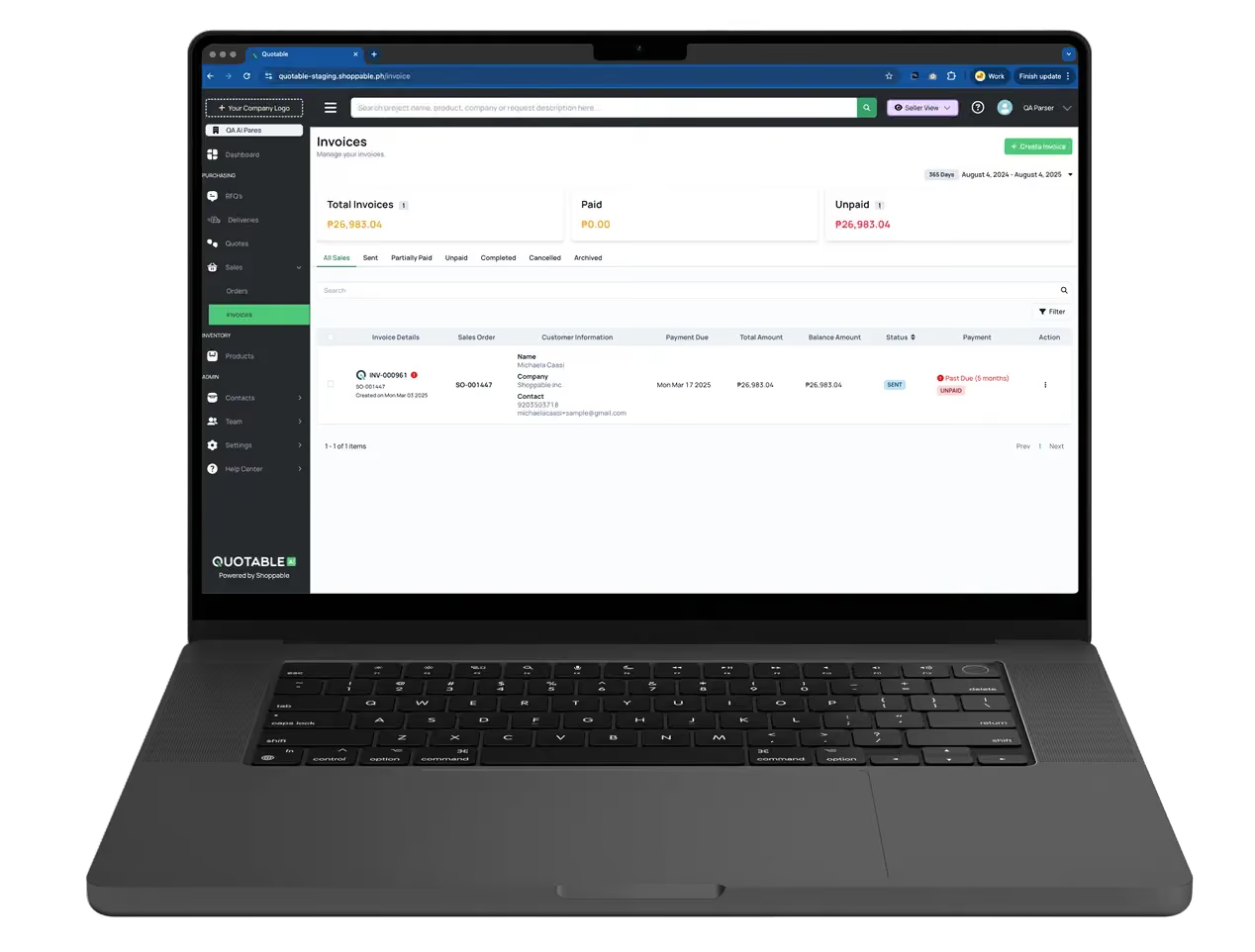
Quotable fits best for B2B operators paying multiple vendors because it's the only alternative here that connects the payment to the purchase order and invoice behind it, instead of leaving reconciliation as manual work after the fact. The honest drawback is scope: it isn't designed for freelancer-to-freelancer transfers or marketplace payouts. Choose Wise, Airwallex, or Skydo instead for those use cases.
Wise
Best for: Freelancers and small businesses that want the lowest FX cost on simple transfers.
Wise converts at the mid-market rate with a global average fee of ~0.53%. It offers multi-currency accounts with local bank details in 10+ currencies and works as a digital bank for Upwork ACH withdrawals.
Wise is the stronger low-cost option for most transfers under $10,000. Payoneer may still fit better if you're locked into marketplace payouts that require a Payoneer receiving account.
Trade-offs to consider:
- No forward contracts
- No dedicated account management for high-volume businesses
- The CFPB's 2025 amended consent order on remittance disclosures, which means you should verify corridor-specific pricing rather than relying on the global average
Airwallex
Best for: Higher-volume SMBs and ecommerce businesses needing multi-currency accounts, local collection rails, and broader FX controls.
Airwallex charges 0.5% on major currencies and 1.0% on others. It supports local transfers to 120+ countries and offers batch payments with API integrations.
Airwallex is better than Payoneer for businesses that need broader multi-currency controls and predictable FX spreads. It's not automatically better for freelancers or simple marketplace payouts. Onboarding requires business verification, the interface is less easy to use for solo freelancers, and feature availability varies by market.
WorldFirst
Best for: Amazon and marketplace sellers who need compliant disbursements and multi-marketplace account management.
WorldFirst supports payouts from Amazon, eBay, and Shopee with competitive FX for seller corridors. It's owned by Ant Group (an Alibaba affiliate), which some sellers see as a reason to prefer provider independence. Freelancer and direct-client invoicing support is limited compared to Wise.
Revolut Business
Best for: SMBs that want FX risk tools alongside everyday business banking features.
Revolut Business offers FX forwards up to two years out, rate alerts, multi-currency accounts, expense management, and business debit cards. FX is competitive on paid plans, though the free plan has limited FX allowances. Marketplace payout support is narrower than Payoneer or WorldFirst. Availability varies by market, and forward contracts require paid business plans.
Skrill
Best for: Narrow use cases like wallet-to-wallet transfers, gaming, or situations where a client insists on Skrill.
FX fees up to 3.99% and bank withdrawal fees of 1.75% in some markets make it one of the most expensive options for regular business use. It's a poor fit for B2B vendor payments, freelancer invoicing, or any workflow where FX cost matters.
PayPal Business
Best for: Receiving payments from clients who insist on PayPal, or one-off transactions where convenience outweighs cost.
Universal recognition and fast setup are real advantages. But a 3%–4% currency conversion spread erodes margins on any repeat payment flow. Funds held in a PayPal balance can face holds or freezes, making it a poor primary rail for importers or frequent B2B payments.
Skydo
Best for: Indian freelancers and service exporters who need FIRA/e-FIRC documentation and INR withdrawals with low fees.
Skydo is purpose-built for the Indian freelancer workflow. It offers competitive INR conversion rates and a flat-fee model that can undercut percentage-based providers on mid-range invoices. The trade-off is scope: it's limited to India-focused corridors. It isn't a fit for marketplace sellers, B2B importers, or businesses outside India.
Payoneer Alternatives for Freelancers: Platform Compatibility Matrix

Which Payoneer alternative works for you as a freelancer depends on which platforms you use. It also depends on whether you're paid through a marketplace or by direct-client invoice. The matrix below maps the most common freelancer payout scenarios across supported providers.
| Platform | Payoneer | Wise | Airwallex | PayPal | Skydo |
|---|---|---|---|---|---|
| Upwork | Local bank transfer | ACH via digital bank | Not a listed method | Percentage fee | No |
| Fiverr | Bank transfer or Payoneer account | Not a listed method | No | Percentage fee | No |
| Toptal | Yes | Via bank details | No | Yes | No |
| Direct Invoice (US / EU client) | Percentage fee | Low flat / percentage | Low percentage | High percentage | Flat fee (India only) |
For Upwork freelancers, Wise used as a digital bank for ACH withdrawal is the lowest-cost alternative to Payoneer. Payoneer remains the simplest option if you're already set up and don't want to change anything.
For Fiverr freelancers, options are more constrained. Payoneer or PayPal are the supported withdrawal routes. Switching away from Payoneer on Fiverr means accepting PayPal's higher FX costs unless Fiverr adds more payout options.
For direct-client invoicing, you have the most flexibility because you control the receiving account. Wise, Airwallex, and Skydo (for India) all work well. Your choice comes down to corridor and whether you prefer flat or percentage fees.
Connect Vendor Payments to Your Procurement Workflow
B2B teams managing 10+ international vendors need more than a transfer tool. See how Quotable AI connects payments to purchase orders, invoices, and automatic reconciliation.
Explore International Vendor Payments
When You Need More Than a Transfer Tool: FX Risk and High-Volume Needs
Once your monthly cross-border volume exceeds $10,000–$20,000, the FX spread on each transaction becomes a margin risk. Basic transfer tools like Payoneer, Wise, or PayPal don't give you the controls to manage it.
At lower volumes, the difference between a 0.5% and 1.5% FX markup is $10–$15 per transaction. At $50,000 a month, that same spread costs $250–$500 monthly. That's enough to affect gross margin for an importer or exporter. Say you're quoting in one currency and paying suppliers in another. Currency swings between the time you quote and the time you pay can erase a deal's margin entirely.
Three categories of FX tools address this exposure. Forward contracts, as mentioned in the selection criteria above, let you lock a rate today for a future payment so you know your cost before the invoice is due. Rate alerts notify you when your target rate hits so you can convert at a good rate. Controlled conversion timing lets you hold funds in the original currency until you choose to convert, rather than auto-converting on receipt.
Here's where each provider stands:
- Revolut Business: Forward contracts up to two years, rate alerts, multi-currency holding
- Airwallex: Future-dated conversions, multi-currency wallets, batch payments
- Wise: Multi-currency holding, but no forward contracts
- Payoneer: Limited options, auto-conversion on withdrawal, no forwards or rate alerts
Payoneer's lack of forward contracts or rate alerts is a key reason higher-volume businesses outgrow it. If you're switching because your volume has grown, make sure the replacement includes FX timing controls.
When a Payment-Only Tool Isn't Enough

Your cross-border payment problem might also be an invoicing problem. It might be a matching problem or a vendor management problem. Switching to another transfer tool solves one layer and leaves the rest untouched.
Most Payoneer alternatives, including Wise, Airwallex, and Revolut Business, are payment rails. They move money. They don't generate invoices, match payments to purchase orders, or reconcile across vendors automatically.
For B2B teams managing 10+ international vendors, the extra work isn't just the FX spread. It's the manual matching, the email chains confirming payment receipt, and the approval delays that stack up across every transaction. A 2026 Visa study found that one in three SMBs struggles with manual reconciliation, and 29% face approval delays in their cross-border payment workflows.
This is exactly the gap Quotable Payments is built for. There's no Quotable fee on international vendor payment sends, with payouts in 140+ currencies across 200+ countries. The payment is built into a broader invoicing and procurement workflow with automatic reconciliation, instead of sitting in a tool disconnected from the purchase order and vendor record that generated it.
This isn't the right fit for freelancers or marketplace sellers. It's built for B2B operators who need the payment connected to the purchase order, the invoice, and the vendor record.
Start Building Your Payoneer Replacement Strategy with Quotable AI
You now have a framework for choosing a Payoneer alternative. It covers total transaction cost, platform compatibility, regional compliance requirements, and whether your volume calls for FX risk tools. The listed rate was never the whole picture. Your corridor, your platforms, and your tax authority's documentation requirements determine the real cost of any provider.
For B2B teams moving money across borders, Quotable Payments fits best on this list: we don't treat each transfer on its own. No Quotable fee on international vendor payment sends in 140+ currencies. Automatic reconciliation that removes manual matching. Documentation that meets your tax authority's requirements, without the extra work of running payments through a separate tool.
Send International Vendor Payments With No Quotable Fee
If you're paying suppliers across borders and still running payments through a separate tool, Quotable Payments connects the send directly to your invoice and vendor record.
Start for Free
FAQs About Payoneer Alternatives
Is Wise better than Payoneer for most cross-border payments?
Wise is the stronger low-cost option for most simple transfers under $10,000. Its global average fee is ~0.53%, compared to Payoneer's 1.2%–4% withdrawal spread. Payoneer may still fit better if you're locked into marketplace payouts that require a Payoneer receiving account. The right choice depends on whether FX cost or platform compatibility drives your decision.
How do I know if I need FX risk management tools or just a basic transfer service?
If your monthly cross-border volume exceeds $10,000–$20,000 and you're paying suppliers on 30+ day terms, currency swings can erase your margin. At $50,000 a month, the difference between a 0.5% and 1.5% FX markup is $250–$500 in monthly margin impact. That's when forward contracts, rate alerts, and controlled conversion timing stop being optional. Basic transfer tools like Payoneer or Wise don't provide them. Importers quoting in one currency and paying in another face the most exposure.
What happens if I switch providers before my marketplace updates my payout settings?
If you close your Payoneer account before updating your payout settings, the platform will either hold your payment or try to send it to the closed account. A hold lasts until you provide valid account details. A failed send to a closed account triggers a multi-week reissue delay. Most marketplaces don't detect a closed account until a payout fails. Running parallel accounts for two payment cycles catches any payments still routing to the old account.
Can I use the same alternative for both freelance marketplace payouts and direct B2B vendor payments?
Wise and Airwallex work for both use cases if your marketplaces support them. Upwork accepts Wise as a digital bank for ACH. Providers like Skydo are purpose-built for freelancer invoicing and won't scale to multi-vendor B2B workflows. Quotable Payments handles B2B vendor payments with procurement integration but isn't designed for freelancer marketplace transfers. Check your specific marketplace's approved payout provider list before assuming overlap. Confirm that workflow fit matches your needs, not just the fee structure.
Do I need to notify my clients before switching from Payoneer, or can I just update my account details?
For marketplace payouts, you only need to update your settings in the platform's payment section. No client notification is required because clients never see your provider details. For direct-client invoicing, send updated payment instructions at least one invoice cycle before you stop monitoring the old Payoneer account. Clients who've saved your previous details will keep using them until you tell them otherwise. Their AP teams may need lead time to update their records.