.png)

The wire clears. Your supplier confirms receipt, then flags a short payment. You pull the breakdown. FX markup plus intermediary fees you never approved took 4% off the top before the funds landed.
It happens because paying overseas suppliers gets treated as a transaction choice. It should be a workflow decision. The best way to pay overseas suppliers depends on total all-in cost. That cost shifts by corridor, supplier constraints, and how the payment connects to your onboarding and reconciliation process.
The right method combines the lowest total cost with what your supplier can actually receive. It fits cleanly into the workflow surrounding every payment. Get that combination right, and you stop discovering losses after the fact.
Main Takeaways
- The FX spread, not the transfer fee, is usually the largest cost on five- and six-figure supplier payments.
- B2B platforms and Global ACH deliver locally, removing intermediary bank deductions that make wire costs unpredictable.
- Supplier acceptance determines which methods are actually available to you, regardless of which is cheapest.
- Beneficiary name mismatches are the top cause of rejected international payments. Upfront data collection is essential.
- For recurring payments in corridors like US-to-Philippines, US-to-Mexico, and US-to-Vietnam, local rails settle near real-time at a fraction of wire cost.
Cut the Hidden Cost Out of Every Cross-Border Payment
FX spreads, intermediary deductions, and correspondent bank fees add up fast. This guide breaks down how to stop losing margin on every international transfer.
Read the B2B Cross-Border Payments Guide
What Counts as an International Vendor (and Why the Payment Method Matters)
An international vendor is any supplier based outside your country or invoicing in a foreign currency. That could be a contract manufacturer in Vietnam, a SaaS provider billing in euros, or a freight forwarder in Mexico. The category spans physical goods suppliers like raw-materials producers and finished-goods manufacturers. It also covers service providers like logistics companies, design agencies, and freelance specialists.
Every cross-border payment passes through layers that domestic transfers skip entirely. Those layers include correspondent banks, foreign-exchange conversion, and compliance screening. Each one adds cost and delay you won't see on a local ACH or check.
Why the Method You Choose Changes What the Supplier Actually Receives
Intermediary and beneficiary banks may deduct their own fees from international wires before the funds reach your supplier, according to Wells Fargo. The amount you send and the amount that arrives can be two different numbers. You won't know the gap until the supplier flags a short payment.
On top of that, offers marketed as "no-fee" foreign-currency wires typically recover their margin through exchange-rate markups. Bank of America states plainly that its foreign-currency wires carry no wire transfer fee but that exchange-rate markups apply. So the transfer fee you compare across providers is only one piece of the total cost, and often the smallest piece.
The rest of this guide breaks down how to choose the method that keeps those hidden layers visible and matches what your supplier can actually receive.
6 Factors That Determine the Best Way to Pay Overseas Suppliers

Choosing the best way to pay an overseas supplier comes down to six factors:
- Transfer fee
- FX spread
- Delivery time
- Supplier acceptance
- Transaction size
- Compliance requirements
Operators who evaluate only one or two of these consistently overpay on the ones they ignored.
Transfer fee is the stated cost your bank or platform charges to send the payment. It ranges from $0 on some platforms to $25–$50 on bank wires. FX spread is the markup above the mid-market exchange rate. It's often the largest single cost on five- and six-figure invoices. This is where "no-fee" offers make their money back.
Delivery time ranges from seconds on local rails to 3–5 business days on correspondent-bank wires. That directly affects your cash-flow timing and supplier relationships. Supplier acceptance is equally critical. Many overseas SMEs prefer local-currency bank deposits. Some require wires. A few accept cards. Your preferred method is irrelevant if the supplier can't receive it.
Transaction size shapes the math. Card payments often cap at $10,000–$25,000 or carry percentage fees that make them expensive at scale. Wires and ACH handle larger amounts more efficiently.
Compliance requirements round out the picture. Sanctions screening (including U.S. OFAC checks), KYC/KYB verification, and regulatory holds can delay or block payments entirely. The more structured data your payment carries, the fewer exceptions it triggers. The BIS CPMI recommends full adoption of ISO 20022 (a richer, more structured payment-messaging standard) by the end of 2027 at the latest, to improve cost, speed, and transparency in cross-border payments. That means structured payment data will only matter more.
Payment Methods Compared: How to Pay International Vendors
You have six realistic options for paying overseas suppliers:
- B2B payment platforms
- Global ACH (local bank transfers)
- SWIFT wires
- Credit or debit cards
- PayPal or digital-wallet-style services
- Letters of credit
Each fits a different mix of cost, speed, and supplier scenario. The table below compares them across the six factors above. Fee ranges are typical as of 2026. Verify them against current provider terms.
| Method | Typical Fee | FX Spread | Speed | Best For | Supplier Acceptance | Limitations |
|---|---|---|---|---|---|---|
| B2B Payment Platform | $0–$10 | 0.3%–1.5% | 1–2 days | Recurring payments, multiple corridors | High (deposits locally) | Requires platform onboarding |
| Global ACH / Local Transfer | $0–$5 | 0.5%–1.5% | 1–3 days | Low-cost recurring, supported corridors | High in supported countries | Not available in all corridors |
| SWIFT Wire | $15–$50 | 1%–3% (bank) | 1–5 days | High-value, urgent, or one-off payments | Universal | Intermediary fees, unpredictable net receipt |
| Credit / Debit Card | 2.5%–3.5% of amount | Embedded in rate | Instant authorization | Small invoices, cash-flow timing | Low for overseas SMEs | Expensive at scale, supplier must accept cards |
| PayPal / Digital Wallet | $0–$5 + 2%–4% | 2.5%–4% | Instant to 1 day | Micro-payments, freelancers | Medium (common for services) | High all-in cost, limited for goods trade |
| Letter of Credit | $500–$2,000+ | Varies | 5–10+ days | High-risk shipments, new supplier relationships | Niche | Complex, slow, expensive for routine payments |
B2B Payment Platforms
B2B payment platforms are best for recurring supplier payments across multiple countries, especially in corridors where local rails deliver in seconds.
They collect your payment via ACH or card on your side. Then they deliver to the supplier's local bank account through local rails. This bridges the gap between how you want to fund and how the supplier wants to receive.
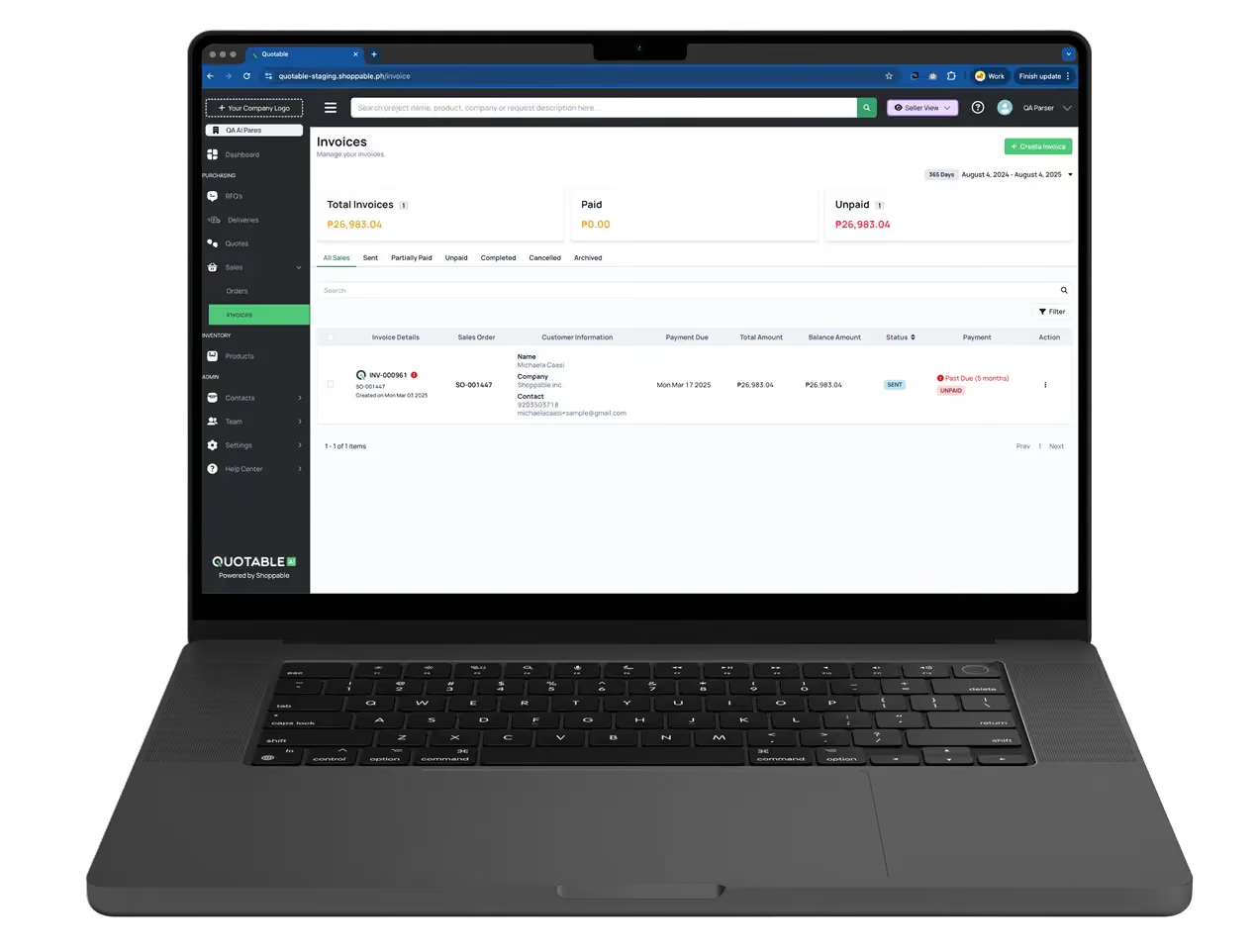
Corridors like US-to-Philippines, US-to-Mexico, and US-to-Vietnam benefit most. Local rail systems settle almost instantly: InstaPay in the Philippines, SPEI in Mexico, and NAPAS 24/7 in Vietnam. Quotable Payments connects payment to supplier onboarding and reconciliation in one workflow, covering 140+ currencies across 200+ countries.
Global ACH and Local Bank Transfers
Global ACH is best for low-cost recurring payments in supported corridors where same-day speed isn't critical.
It's a cross-border payment that originates domestically (for example, via US ACH). It settles into the supplier's local bank account abroad through local clearing rails, bypassing the SWIFT correspondent network.
This is becoming a more popular method. US B2B ACH volume hit 7.3 billion payments in 2024, up 11.6% year over year, according to Nacha. Coverage depends on the platform or bank routing the transfer, so it's not available everywhere.
SWIFT Wire Transfers
SWIFT wires are best for high-value one-off payments, urgent transfers, or corridors where local rails aren't available.
They route through correspondent banks using the SWIFT messaging network. Virtually any bank worldwide can receive one. Speed has improved: 90% of cross-border payments on the SWIFT network now reach the destination bank within one hour. But local operating hours, regulatory checks, and intermediary processing still add 1–5 business days in practice.
The tradeoff is cost. Transfer fees run $15–$50. FX spreads often hit 1%–3% at major banks. And intermediary bank deductions along the way remain a risk.
Credit and Debit Cards
Cards are best for small invoices under $1,000 and digital services where convenience outweighs the percentage-based cost.
They offer instant authorization and help with cash-flow timing because you pay your card issuer later. But the all-in cost of 2.5%–3.5% makes them expensive for anything above small amounts. Supplier acceptance is the main barrier: most overseas manufacturers and distributors don't accept card payments.
PayPal and Digital Wallet-Style Services
PayPal and similar digital wallets are best for freelancer and micro-payments where familiarity and speed matter more than cost.
They're fast and widely recognized. But all-in costs (transfer fees plus FX spread) can reach 4%–6% on cross-border transactions. They're rarely used for goods trade or recurring supplier invoices at scale.
Letters of Credit
Letters of credit are best for high-risk, high-value first shipments with new suppliers in unfamiliar markets.
A letter of credit is a bank-guaranteed payment instrument. The bank commits to pay the supplier once shipping and documentation conditions are met, protecting both parties. Costs run $500–$2,000+ per transaction, and the process takes 5–10+ days. This is a niche trade-finance tool, not a default supplier-payment method.
The True Cost of Paying an Overseas Supplier: A $10,000 Worked Example

The transfer fee your bank quotes is the smallest part of what you actually pay. The true cost of an international payment includes the transfer fee, the FX spread, intermediary bank fees, and recipient bank fees. Most operators compare only the first number and miss the rest.
The All-In Cost Formula
To find the true all-in cost, add four components: transfer fee, FX spread on the invoice amount, intermediary bank fees, and recipient bank fees.
- The transfer fee is what your bank or platform charges to send the payment.
- The FX spread is the percentage markup above the mid-market exchange rate, applied to the full invoice amount.
- Intermediary bank fees are deductions taken by banks that handle the payment between your bank and the supplier's bank.
- Recipient bank fees are charges the supplier's bank applies to incoming international transfers.
On payments above $10,000, the FX spread is usually the largest cost component. Intermediary fees are the least predictable. They're deducted while the payment is in transit. You often don't learn about them until the supplier reports receiving less than expected. Fee ranges below are illustrative and typical; verify against current provider terms.
$10,000 Payment: Wire vs. B2B Platform vs. Global ACH
Here's what a $10,000 USD-equal supplier payment actually costs across three methods, using the formula above.
| Cost Component | SWIFT Wire (Major Bank) | B2B Platform | Global ACH |
|---|---|---|---|
| Transfer fee | $25–$50 | $0–$10 | $0–$5 |
| FX spread (on $10,000) | $100–$300 (1%–3%) | $30–$150 (0.3%–1.5%) | $50–$150 (0.5%–1.5%) |
| Intermediary bank fee risk | $15–$30 (possible) | $0 (local delivery) | $0 (local delivery) |
| Recipient bank fee risk | $10–$25 (possible) | $0 (typically) | $0 (typically) |
| Estimated all-in cost | $150–$405 | $30–$160 | $50–$155 |
| Delivery time | 1–5 business days | 1–2 days | 1–3 days |
The wire's $25 transfer fee looks comparable to the platform's $0–$10. But the all-in cost difference is 2x–3x once you factor in FX spread and intermediary risk. On a $50,000 payment, the FX spread alone on a bank wire could cost $500–$1,500 before intermediary deductions even enter the picture.
This is exactly what Bank of America's disclosure means in practice. "No wire transfer fee" doesn't mean no cost. The fee just moved into the exchange rate where you're less likely to notice it.
Which Method Is Right for Your Situation? A Decision Matrix

The matrix below matches your transaction size, payment frequency, supplier geography, and supplier preference to a specific method. These are starting points for US-based payers. Your corridor and supplier relationship may shift the answer.
| Your Scenario | Recommended Method | Why |
|---|---|---|
| Recurring payments, $1K–$50K, supplier in Philippines, Mexico, or Vietnam | B2B platform or Global ACH | Local rails deliver in seconds (SPEI, InstaPay, NAPAS 24/7), lowest all-in cost |
| One-off or urgent payment, $10K+ | SWIFT wire | Universal acceptance, fast when time-critical |
| Recurring payments to EU suppliers | B2B platform with SEPA delivery | EU instant payments regulation requires 10-second posting for euro transfers |
| Small invoices under $1K, digital services | Card or PayPal | Convenience outweighs the percentage-based cost at low amounts |
| High-risk first shipment, new supplier, $25K+ | Letter of credit | Bank guarantee protects both parties until documentation is verified |
| Supplier only accepts bank transfer, you want to fund by card | B2B platform with card funding | Platform bridges the gap (see next section) |
What to Do When a Supplier Won't Accept Your Preferred Payment Method
When your preferred payment method doesn't match what your supplier can receive, a B2B payment platform that decouples funding from delivery solves the problem.
You fund by your preferred method on your side. The platform converts and delivers to the supplier's local bank account via local rails. The supplier sees a domestic deposit with no card processing required on their end.
The most common mismatch: you want to pay by card for cash-flow timing or rewards, but the supplier only accepts a bank transfer. Or you want to use ACH, but the supplier's bank only receives SWIFT wires. A B2B platform bridges this gap by accepting your card or ACH funding and converting it into a local-currency deposit on the supplier's end.
Say the supplier's preferred method is much more expensive for you. Maybe they want a wire and you're paying $50K per month. It's worth discussing alternatives. Many overseas SMEs are open to receiving local-currency deposits once they understand the payment arrives faster and in full. If the supplier is firm, use the platform bridge rather than forcing a method that creates friction in the relationship.
Pay Suppliers Globally Without the Wire Headaches
Quotable Payments connects supplier onboarding, cross-border payment, and reconciliation in one workflow. See how it handles the corridors and currencies your team deals with every month.
Explore International Vendor Payments
How to Manage FX Risk on Recurring Supplier Payments
If you're paying the same overseas suppliers monthly, FX rate fluctuations can quietly add or erase thousands of dollars across a year. Three tools help you manage this: rate locks, forward contracts, and multi-currency holding accounts.
Rate Locks and Forward Contracts
A rate lock is a guarantee from your platform or bank that fixes a specific exchange rate for a set window, often 24–72 hours. It's useful when you've agreed on a price with a supplier and need to lock in the rate before sending payment.
A forward contract goes further. You agree today to exchange currency at a fixed rate on a future date. This removes rate uncertainty for the next 30, 60, or 90 days. Forward contracts are typically available through banks, FX brokers, or B2B payment platforms.
When your monthly supplier payments total $10,000 or more and the currency pair is volatile, even a 1% rate swing costs you $100+ per payment. Forward contracts make sense when certainty matters more than chasing a better spot rate.
Multi-Currency Holding and Timed Conversions
A multi-currency account is a virtual account that lets you hold balances in multiple currencies. You convert when rates are favorable, not at the moment of each payment. Instead of converting USD to the supplier's currency at whatever rate applies on payment day, you hold the target currency and convert in batches during favorable windows.
Here's a concrete example. You pay a Philippines-based supplier $8,000 USD equivalent in PHP every month. Without a multi-currency account, you convert USD to PHP at the spot rate on each payment date. You accept whatever the market gives you.
With a multi-currency account, you hold PHP and convert in batches when the USD/PHP rate moves in your favor. Over 12 months, timing conversions during favorable windows can reduce your effective FX cost by 0.5%–1.5% compared to spot conversion on each payment date. This approach works best for operators with predictable payment schedules and the discipline to monitor rates or set rate alerts.
Start Paying Overseas Suppliers the Right Way with Quotable AI

You now have a framework for choosing the payment method that minimizes all-in cost. It matches your supplier's constraints and connects to the onboarding and reconciliation process surrounding every payment. The operators who save the most on cross-border payments stop treating each transfer as an isolated transaction. Instead, treat it as a step in a repeatable workflow.
We built Quotable Payments to connect supplier onboarding, cross-border payment, and automatic reconciliation in one workflow. It covers 140+ currencies across 200+ countries. Every supplier gets paid in full, on time, through their local bank account. You fund by the method that works for your cash flow and see the all-in cost before you send.
Your team stops chasing banking details, reconciling short payments, and explaining FX deductions to suppliers who expected the full invoice amount.
See how Quotable AI approaches international vendor payments, from supplier onboarding to local-rail delivery to automatic reconciliation.
Stop Reconciling Short Payments From Overseas Suppliers
When you pay through local rails, suppliers receive the full amount in their local currency with no intermediary deductions. Your team stops chasing the gap.
Start for Free
FAQs About Paying Overseas Suppliers
What is the cheapest way to pay overseas suppliers?
Global ACH or a B2B payment platform is cheapest when you compare all-in costs: transfer fee plus FX spread plus intermediary and recipient bank fees. For a $10,000 payment, these methods typically cost $30–$160 total compared to $150–$405 for a bank wire. The cost gap widens as payment size increases. The exception is very small payments under $500, where card or wallet convenience can outweigh the percentage-based cost.
How long does it take for an international supplier payment to arrive?
Delivery time ranges from near-instant on local rails like SPEI, InstaPay, and NAPAS 24/7 to 1–5 business days on SWIFT wires through correspondent banks. The method matters more than the corridor. A US-to-Philippines payment via InstaPay arrives in seconds. The same payment via wire takes 2–4 days and risks intermediary deductions along the way.
What happens if I send a payment with incorrect banking details?
If the account number or beneficiary name doesn't match the supplier's bank records, the payment is rejected and returned. That return process can take 5–10 business days, longer than the original payment would have taken. You'll typically get your funds back minus the original transfer fee and possibly a return fee. But the supplier doesn't get paid and you've lost time. Beneficiary name mismatches are the most common cause. The fix is validating banking details at onboarding, not at payment time.
Can I pay an overseas supplier in their local currency even if I'm sending from the US?
Yes. Most B2B payment platforms and some banks let you send in the supplier's local currency so they receive the exact amount. Their bank applies no second conversion. You pay the FX cost on your side, where you can see and compare it. The supplier gets a local-currency deposit with no deductions. You need to know the supplier's preferred currency and confirm their bank accepts it.
Do I need to set up a multi-currency account to pay overseas suppliers regularly?
No. You can pay overseas suppliers with a standard business bank account using wires or a B2B payment platform. But if you're making recurring payments in the same currency, a multi-currency account lets you convert when rates are favorable. That can reduce your effective FX cost by 0.5%–1.5% annually. It's a workflow optimization, not a requirement. The value comes from timing conversions, not from the account itself.