Every B2B distributor knows the feeling: a sales rep sends a quote from a spreadsheet, procurement scrambles to source the product, someone manually keys the order into an accounting system, and weeks later, you're still chasing payment. The entire cycle from quoting to collecting cash is riddled with handoffs, duplicate data entry, and delays that quietly erode your margins. For SMEs doing between $1M and $30M in annual revenue, this friction isn't just annoying; it's the single biggest drag on growth. The quote-to-cash process represents the full lifecycle of a transaction, from the moment a price leaves your desk to the moment funds hit your account. And yet, most small and mid-market companies still run this cycle across three, four, or even five disconnected tools. The global Q2C software market is projected to reach $9.7 billion by 2034, growing at a 10.9% CAGR, which tells you the rest of the business world has figured out what many SMEs haven't: automation here isn't optional anymore. This piece breaks down exactly where to start, what to prioritize, and how to avoid the common traps that keep smaller companies stuck in manual workflows.
The Efficiency Gap: Why SMEs Struggle with Manual Quote-to-Cash
The gap between how enterprise companies and SMEs handle their transaction cycles is enormous. Large corporations invested in end-to-end automation years ago. They have dedicated teams managing system integrations, custom APIs, and process engineering. Most SMEs? They're running quotes out of Excel, orders through email, invoices from a basic accounting tool, and payments through a separate banking portal. Each tool works fine in isolation. Together, they create a patchwork that leaks time, money, and accuracy at every seam.
The real cost isn't just inefficiency. It's invisibility. When your quoting system doesn't talk to your procurement system, and your procurement system doesn't feed your invoicing tool, you lose the ability to track where a deal actually stands. Is that $45,000 quote still pending approval? Did the supplier confirm the purchase order? Has the invoice been sent? These questions shouldn't require three phone calls and a dig through someone's inbox to answer.
One construction supply distributor I worked with was processing about 80 quotes per week across a four-person sales team. Each quote required manual re-entry into their ERP for order processing, then again into their accounting system for invoicing. They estimated 12 to 15 hours per week of pure data re-entry, not counting the time spent fixing errors. That's a full-time employee's worth of labor doing nothing but copying numbers between systems.
The Risk of Fragmented Systems in Trade and Logistics
For companies in trade, logistics, manufacturing, or construction, fragmented systems carry risks that go beyond wasted time. A miskeyed part number on a purchase order can trigger a wrong shipment. A pricing discrepancy between the quote and the invoice creates disputes that delay payment by 30 or 60 days. When you're managing international suppliers, the stakes multiply: currency conversions, compliance documentation, and shipping terms all need to align perfectly.
The core problem is that disconnected systems cause order-to-cash delays that compound across the transaction lifecycle. A two-day delay at the quoting stage becomes a five-day delay at procurement, which becomes a two-week delay in collections. For an SME running on tight cash flow, those compounding delays can mean the difference between making payroll and drawing on a credit line.
How Manual Data Entry Delays Invoicing and Collections
Here's a pattern we see constantly: a sale closes, but the invoice doesn't go out for a week because the finance team is waiting on order confirmation details from procurement, which is waiting on shipment tracking from the warehouse. Nobody's dropping the ball intentionally. The information just doesn't flow automatically between stages.
Manual data entry is the bottleneck at every transition point. Sales creates a quote. If the customer accepts, someone re-enters the line items into a purchase order. Once goods ship, someone else creates an invoice from the PO. Each re-entry is a chance for error, and each error triggers a correction cycle that adds days. Finance teams that automate billing and payment workflows can accelerate revenue recognition by 30%, but most SMEs haven't made that leap because they assume automation requires a six-figure software investment and a dedicated IT team.
That assumption is outdated. The tools have caught up to the SME budget. The real barrier now is knowing where to start.
Starting at the Source: Why the Quote is the Foundation of Automation
Most businesses think of the quote as a simple sales document: a price list you send to a prospect. That mindset is exactly why their automation efforts stall. If you treat the quote as a throwaway PDF, you've already broken the data chain before it begins. Every downstream process, from procurement to invoicing to payment, depends on the information contained in that initial quote. When the quote lives outside your transaction system, every subsequent step requires manual reconstruction of the same data.
The smarter approach is to treat the quote as the origin point of your entire transaction record. The line items, pricing, terms, customer details, and delivery requirements captured at the quoting stage should flow automatically into every subsequent document: purchase orders, invoices, shipping manifests, and payment requests. This is a hard-won lesson for many growing distributors. You don't fix your cash cycle by starting at collections. You fix it by starting at the quote.
Treating the Quote as a Live Transaction State
This concept is worth spending time on because it changes how you think about your entire workflow. A traditional quote is static: it's created, sent, and then forgotten until someone wins the deal. A live transaction state means the quote is a dynamic record that updates and triggers actions as the deal progresses.
Think of it this way. When a customer approves your quote, that approval should automatically generate a purchase order to your supplier, update your inventory forecast, and queue an invoice draft. No re-entry. No waiting for someone to notice an email. The quote becomes the single source of truth that drives the entire cycle forward. Platforms like Quotable AI are built around this exact principle: the quote isn't a document, it's the operating kernel of the transaction. Their system lets a buyer approve a quote through a simple link, and that approval cascades into procurement, fulfillment, and payment workflows without anyone touching a spreadsheet.
For an SME processing 200 to 500 transactions per month, this shift from static documents to live transaction states can reclaim dozens of hours per week and eliminate the reconciliation headaches that plague month-end close.
Bridging the Gap Between Sales, Procurement, and Finance
The organizational divide between sales, procurement, and finance is where most Q2C processes break down in mid-market companies. Sales owns the quote. Procurement owns the purchase order. Finance owns the invoice. Each team uses different tools, different terminology, and different timelines. The result is a game of telephone where critical details get lost or distorted at every handoff.
Bridging this gap doesn't require reorganizing your company. It requires a shared data layer that all three teams can access. When sales creates a quote with specific line items, quantities, and pricing, that exact data should be visible to procurement when they source the product and to finance when they bill the customer. No translation needed. No "Can you resend me the specs?" emails.
Companies that get this right, those that personalize and connect their internal workflows, can generate 40% more revenue potential because deals move faster, errors drop, and customers get a consistent experience from first quote to final payment.
Key Pillars of a Vertically Integrated Q2C Strategy
A vertically integrated approach to the quote-to-cash cycle means connecting every stage into a single, continuous workflow rather than treating each phase as a separate project. For SMEs, this doesn't mean buying one massive enterprise suite. It means choosing tools that share data natively and eliminating the gaps between quoting, procurement, fulfillment, invoicing, and payment.
The two pillars that matter most for companies in the $1M to $30M range are automated procurement workflows and streamlined B2B payments. Get these two right, and you've addressed roughly 70% of the friction in a typical transaction cycle.
Automated Procurement and Fulfillment Workflows
Once a quote converts to an order, procurement needs to act fast. In a manual environment, this means someone reads the quote, identifies the items that need sourcing, contacts suppliers, compares prices, issues a PO, and tracks delivery. For a distributor handling hundreds of SKUs across multiple suppliers, this process is a full-time job for multiple people.
Automation changes the math dramatically. Here's what an automated procurement workflow looks like in practice:
- Customer approves a quote containing 15 line items
- The system identifies which items are in stock and which need sourcing
- RFQs are automatically generated and sent to pre-qualified suppliers
- Suppliers respond through a simple link with pricing and lead times, no software adoption required
- The system compares responses and flags the best option based on your criteria
- A purchase order is generated and sent to the winning supplier
- Fulfillment tracking begins automatically
Quotable AI's approach to this is worth noting because it addresses a common pain point: supplier participation. Their platform lets suppliers respond to RFQs through a secure link without creating accounts, which means you actually get responses instead of radio silence from vendors who don't want to learn another system.
The automation of contract management alone can expedite negotiations by 50%, and when you extend that speed across the full procurement cycle, the compounding effect on your cash conversion timeline is significant.
Streamlining B2B Payments and Global Trade Compliance
Payment is where many SME automation efforts stop short. You've automated quoting. You've streamlined procurement. But then the invoice goes out and you're back to waiting: waiting for the customer to process it through their AP system, waiting for a bank wire to clear, waiting to manually reconcile the payment against the invoice.
For companies selling across borders, add currency conversion, trade compliance documentation, and varying payment preferences to the mix. A customer in Southeast Asia might prefer an e-wallet. A buyer in Europe might insist on bank wire. A domestic client might want to pay by ACH. Supporting all of these through separate channels creates a reconciliation nightmare.
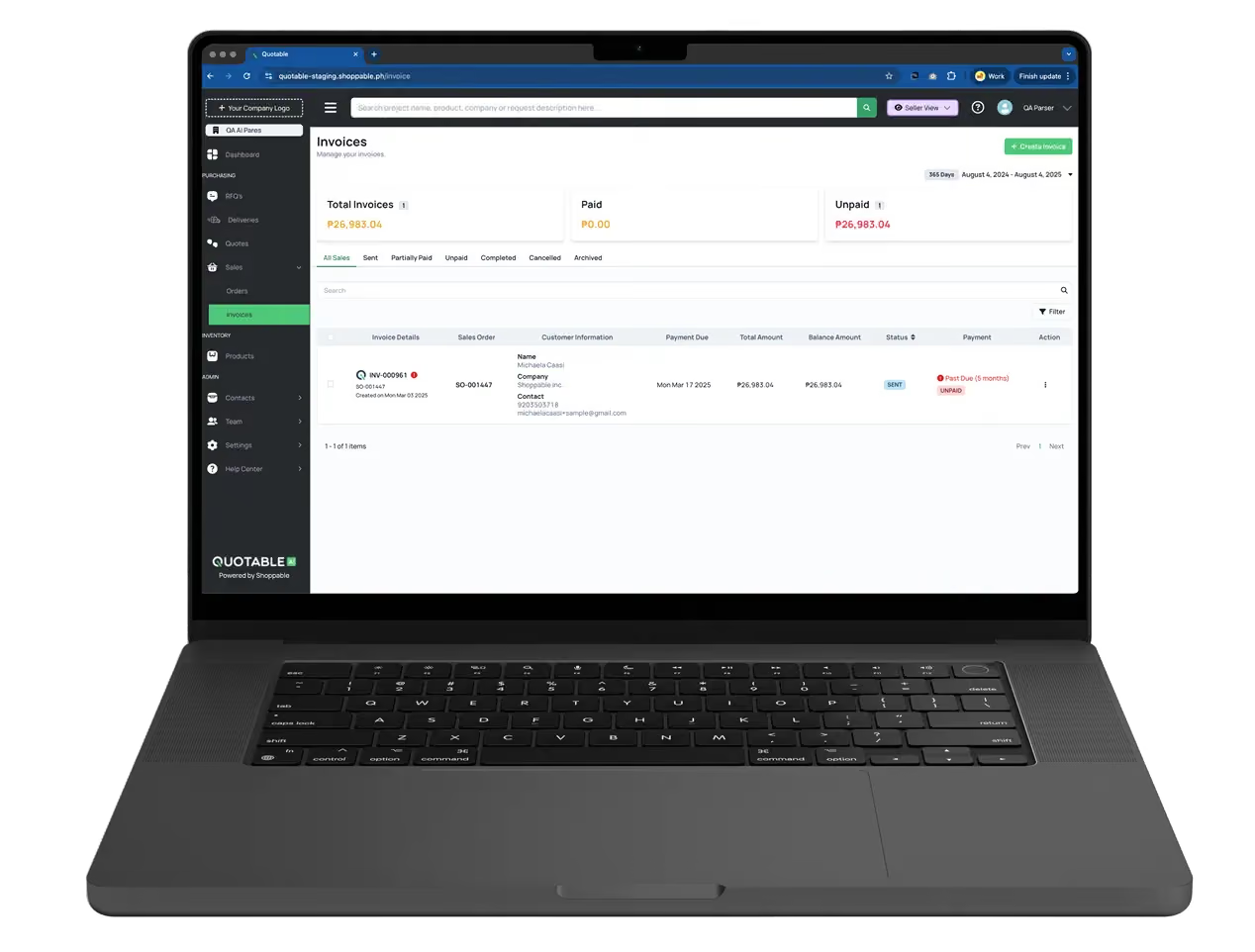
The fix is embedded payments within your Q2C platform. When the invoice itself contains a payment link that supports multiple methods, including bank wire, ACH, credit cards, and e-wallets, you remove the friction that causes payment delays. The customer clicks, pays, and the system automatically matches the payment to the invoice. No manual verification. No chasing. Quotable AI handles this by embedding payment options directly into invoice links, so buyers can pay instantly through whichever method they prefer, all tracked in one centralized system.
Implementing AI-Powered Data Orchestration for $1M–$30M Revenue Businesses
For companies in this revenue band, the biggest operational challenge isn't a lack of data. It's that data lives in too many places and requires too much human effort to move between them. You've got quotes in one system, purchase orders in another, invoices in a third, and payment records in your bank portal. AI-powered data orchestration connects these sources and automates the movement of information between them.
The most immediate application is document parsing. Every day, your team handles quotes from suppliers, purchase orders from customers, invoices, bills of materials, and shipping documents. Each arrives in a different format: PDF, Excel, email body text, even scanned images. An AI parser can extract structured data from all of these formats, eliminating the manual encoding that eats hours of your team's time. Q2C platforms can reduce quote errors by up to 40% through this kind of automated data extraction, which directly impacts your invoice accuracy and collection speed.
Here's a practical example. Say you're a building materials distributor and a contractor sends you an RFQ as a PDF with 40 line items. In a manual process, someone on your team spends 30 to 45 minutes keying those items into your quoting system, checking prices, and building the response. With an AI parser, the system reads the PDF, extracts each line item, matches it against your product catalog and current pricing, and generates a draft quote in minutes. Your sales rep reviews and sends instead of builds from scratch.
The "orchestration" piece goes beyond parsing. It's about creating rules and triggers that move transactions forward automatically. If a quote isn't responded to within 48 hours, send a follow-up. If a PO is approved, notify the warehouse. If an invoice hits 30 days past due, escalate to collections. These aren't complex AI applications. They're simple conditional workflows that most SMEs still handle manually because their systems don't support automation natively.
For businesses doing $1M to $30M in revenue, the implementation path doesn't need to be overwhelming. Start with the highest-friction point in your current process. For most distributors, that's either the quote-to-PO transition or the invoice-to-payment gap. Automate that single handoff first, measure the time savings, and expand from there. You don't need to boil the ocean. You need to stop the biggest leak.
Integration with your existing ERP and accounting system matters here too. You shouldn't have to rip out your current infrastructure. The right Q2C platform connects to your financial systems through native integrations, syncing transaction data bidirectionally so your books stay accurate without double entry. Before committing to any platform, request a live demo of the specific integration workflow with your ERP. There's a meaningful difference between "we support that integration" and "it actually works in real time."
Measuring Success: Achieving 10X Faster Transaction Cycles
Speed is the metric that matters most in quote-to-cash automation. Not because speed is inherently valuable, but because faster cycles mean better cash flow, fewer errors, and higher customer satisfaction. When Quotable AI claims businesses can quote, procure, ship, and get paid 10X faster, that's not a theoretical number. It's the difference between a 30-day cycle done manually and a 3-day cycle done through connected automation.
The two most concrete ways to measure your progress are through DSO reduction and quote accuracy improvement. Both are trackable, both have direct financial impact, and both give you clear signals about whether your automation investment is working.
Reducing Days Sales Outstanding (DSO) through Automation
DSO measures the average number of days it takes to collect payment after a sale. For many SMEs, DSO runs between 45 and 60 days, sometimes longer. Every day of DSO represents cash that's earned but not collected, sitting in your customer's account instead of yours.
Automation attacks DSO at multiple points. Faster invoicing means the clock starts sooner. Embedded payment options mean the customer can pay immediately instead of waiting for their next AP cycle. Automated reminders mean past-due invoices don't slip through the cracks. The real bottleneck isn't quoting speed but cash velocity: high-growth companies lose more than 10% of annual recurring revenue to payment delays, defaults, and post-signature friction.
If your current DSO is 50 days and you can reduce it to 30 through automation, that's 20 extra days of cash flow on every transaction. For a company doing $10M in annual revenue, that improvement can free up hundreds of thousands of dollars in working capital.
Improving Accuracy in Construction and Manufacturing Quotes
In industries like construction and manufacturing, quote accuracy isn't just about getting the price right. It's about getting the specifications, quantities, lead times, and terms right. A single error on a construction materials quote, wrong gauge of steel, incorrect delivery window, misquoted freight, can cascade into project delays, returns, and disputes that cost far more than the original margin on the deal.
Automation improves accuracy by eliminating re-entry. When the data captured at the quoting stage flows directly into procurement and invoicing without human re-keying, the error rate drops dramatically. AI-powered systems that use data analytics to tailor quotes and pricing to individual customer needs add another layer of precision by pulling from historical transaction data rather than relying on a rep's memory.
Track your quote error rate before and after automation. If you're currently seeing errors on 8 to 10% of quotes, a well-implemented Q2C system should bring that below 3%. That reduction translates directly into fewer credit memos, fewer returns, and faster payment cycles because customers aren't disputing inaccurate invoices.
Where You Go From Here
The path to automating your quote-to-cash cycle doesn't start with a massive software migration or a six-month implementation project. It starts with identifying your single biggest bottleneck: the handoff where the most time, money, and accuracy are lost. For most SMEs, that's the gap between the quote and the purchase order, or the gap between the invoice and the payment.
Pick one. Automate it. Measure the result. Then expand. This founder-to-founder advice comes from watching dozens of mid-market companies try to automate everything at once and end up automating nothing. The companies that succeed start small, prove the ROI on one workflow, and use that momentum to fund the next phase.
If you're running a distribution or trade business in the $1M to $30M range and you're still copying line items between spreadsheets and accounting software, the math is simple: you're leaving cash on the table every single day. Quotable AI was built for exactly this scenario, connecting quoting, procurement, invoicing, and payments into one continuous workflow. Start with the quote. Everything else follows.