.png)

Finding the right Airwallex alternative means more than swapping one multi-currency platform for another. Few providers handle paying overseas suppliers, collecting from global buyers, and API-driven payment automation with equal depth. Quotable AI fits best when those payments need to connect to the procurement workflow behind them, not just move money; the picks below cover the full field so you can compare against your own workflow too.
The right fit depends on your actual workflow. Before you switch, confirm these details:
- Verified FX margins
- Inbound and outbound fees
- Regional eligibility
- Workflow match
Get those locked down before you start. Otherwise you're trading one set of gaps for another.
Main Takeaways
- Quotable AI fits best for businesses that need supplier payments tied to the procurement workflow behind them: no other alternative on this list connects payment to PO, invoice, and reconciliation in one place. Its honest limit is scope: it's not a standalone FX-hedging tool or a pure multi-currency account.
- No single Airwallex alternative covers supplier payments, marketplace receivables, and API automation equally well. Workflow match matters more than brand reputation.
- Total cost of ownership stacks FX margin, inbound fee, outbound fee, monthly fee, and API access cost together. The cheapest-looking provider often isn't cheapest on your actual corridors.
- Regional eligibility can rule out a provider before features even matter. WorldFirst is unavailable to US entities, and Amnis is limited to Europe and the UK.
- Only OFX, Amnis, and WorldFirst offer full forward contract support among the standalone FX platforms. Businesses on net-30 or net-60 supplier terms face FX exposure with most other alternatives.
- Running the new provider alongside Airwallex for 30–60 days on live transactions is the only reliable way to confirm it outperforms on your corridors.
Cut the Hidden Cost Out of Every Cross-Border Payment
FX margin, inbound fees, and outbound fees stack fast. This guide walks through the full quote-to-payment lifecycle so you know exactly where the money goes.
Read the B2B Cross-Border Payments Guide
What Airwallex Does
Airwallex is a cross-border payments platform that provides multi-currency accounts, global payment rails, and business spend management tools for companies operating across borders. Its three core pillars are:
- Multi-currency accounts for holding and converting funds
- Payment infrastructure for sending and receiving globally
- Spend tools like corporate cards and expense management
Airwallex's strongest markets include Australia, Hong Kong, Singapore, the UK, and parts of Europe. Its API-first architecture makes it a natural fit for developer teams building custom payment flows.
The platform works well for many businesses, especially those pairing a multi-currency account with card issuing. But broad surface area doesn't guarantee fit for every workflow. Gaps tend to surface once you're running real supplier payments, managing receivables at volume, or pushing API automation past basic use cases.
Why Businesses Look for Airwallex Alternatives

The most common reasons businesses switch away from Airwallex include FX margin variability, inbound receiving fees, account-tier caps, support limits, and API pricing surprises. Here's where the friction shows up:
- FX margin lack of clarity: Airwallex advertises competitive rates. But the actual margin varies by corridor and volume tier. Businesses paying suppliers in CNH, PHP, or INR often find wider spreads on less liquid pairs.
- Inbound receiving fees: Collecting payments from overseas buyers can carry fees that cut into margins on smaller invoices. This hits hardest when you're receiving many mid-size payments.
- Account caps and tier limits: Features like multi-entity management, higher transaction limits, and dedicated support are gated behind volume thresholds or enterprise tiers.
- Support tier limits: Businesses below enterprise volume often report slower response times. Limited access to account managers matters when a payment is stuck mid-transit.
- API pricing friction (user-reported): Some businesses discover that API access or features like batch payments, webhooks, and FX rate locks carry costs that weren't clear during onboarding.
These triggers sit on top of an already expensive baseline. The average cost of B2B cross-border payments for MSMEs was 1.6% in 2024, according to the Financial Stability Board. When your provider's FX margin, inbound fees, and API costs stack on top of that baseline, total cost climbs fast. On a $20,000 supplier payment, even 0.5% in extra costs equals $100 lost per transaction.
What to Look for in an Airwallex Alternative
The right Airwallex alternative matches your actual payment workflow across six criteria. Comparing FX margins alone won't get you there.
Start with total cost of ownership. Stack FX margin plus inbound fee, outbound fee, monthly fee, and API access cost for each provider across your actual corridors. The cheapest-looking provider may not be cheapest in practice.
Then check payout and receivable methods. Does the provider support the rails you need? SWIFT, local bank transfers, and multi-currency accounts are table stakes. A multi-currency account lets you hold, receive, and convert multiple currencies without opening separate bank accounts in each country. Coverage still varies by corridor.
Regional eligibility narrows the field before features even matter. US-based businesses, Philippines-based businesses, and companies in Singapore, Hong Kong, or Australia each face different onboarding restrictions. Confirm eligibility before you evaluate anything else.
If you're automating payment flows, check whether API access is included in your plan tier or costs extra. Also confirm that batch payment support, webhook availability, and ERP connectors meet your procure-to-pay needs.
Reconciliation matters, too. Can you match payments to POs and invoices inside the platform? Or are you exporting CSVs into spreadsheets?
Finally, if you're paying suppliers on net-30 or net-60 terms, hedging tools protect your margins. Forward contracts lock in an exchange rate for a future payment date. Limit orders are standing instructions to convert when a target rate is reached. Both shield you from FX moves between invoice date and payment date.
Airwallex Alternatives: Fees Compared
The table below compares verified fee data across the alternatives on the dimensions that drive total cost of ownership. "Varies" means the provider publishes corridor-specific pricing. "Included" means no separate charge on standard plans. "Not published" means the provider doesn't disclose a fixed rate for that line item.
Fees are verified as of July 2026. Actual rates may vary by corridor, volume, and plan tier. Check each provider's current pricing page before committing.
| Provider | FX Margin | Inbound Fee | Outbound Fee | Monthly Fee | API Access Cost | Key Regions |
|---|---|---|---|---|---|---|
| Quotable AI | Personalized quote; beats your current FX cost | Not published | No Quotable fee on vendor payment sends | $0 to start; optional platform plans billed monthly or annually (25% off annual) | Not published | PH, SG, US, AU, (expanding) |
| Airwallex (baseline) | Varies by corridor | Varies | Varies | Free (standard) | Included (standard); advanced features may require upgrade | AU, HK, SG, UK, EU |
| Wise Business | 0.52% average take rate | Varies by currency | Varies by currency | Free | Included on all plans | US, UK, EU, AU, SG, PH |
| Payoneer | 1.2%-4% Varies by corridor | Varies | Varies | Free (standard) | Limited | US, EU, UK, SG, PH, APAC |
| OFX | Varies by corridor and deal size | N/A (receiving-focused) | No transfer fee (most corridors) | Free | N/A | US, UK, AU, EU, HK, SG |
| Amnis | 0.2–0.4% (major pairs) | Varies | Varies | Varies by plan | Limited | EU, UK, CH |
| WorldFirst | Competitive on APAC corridors | Varies | Varies | Free | Limited | HK, SG, AU, UK, EU (not US) |
| Ramp | Not published for bill pay; up to 3% on card transactions | N/A (spend-first) | $20 per USD international wire (waived from Ramp Checking) | Free (base plan) | Not published | US, CA, UK, EU |
| Mercury | 1% on non-USD wires | Not published | Free on USD international wires | Free (base plan) | Not published | US, UK, EU |
As noted earlier, the MSME average for B2B cross-border payment cost is 1.6%. Any provider consistently below that on your corridors is outperforming the market baseline. For context, traditional US banks still charge $45–$75 per outgoing international wire plus embedded FX markups, according to U.S. Bank.
8 Best Airwallex Alternatives for 2026

These eight Airwallex competitors each fit a different cross-border payment workflow. The right pick depends on whether you're optimizing for low-margin supplier transfers, marketplace receivables, card-first expense management, workflow-connected procurement, or API-driven payment automation.
1. Quotable AI
Best for: Businesses that need supplier payments connected to the procurement workflow that triggered them, not just a standalone payment rail.
Quotable AI pays suppliers in 140+ currencies across 200+ countries and supports receiving through Wire, ACH, and Instant methods, with no Quotable fee on international vendor payment sends. Multi-currency holding lets you time conversions instead of converting on every transaction, and payments reconcile automatically against the quote, invoice, or PO that generated them.
What sets it apart from the rest of this list: none of the other seven connect the payment itself to the procurement context around it. If you're managing supplier relationships in one tool and payments in another, Quotable closes that gap.
The honest drawback is scope. Quotable AI isn't a standalone FX-hedging tool or a pure multi-currency account, so if forward contracts or broad currency holding are your main need, look at OFX or Airwallex instead. Choose Quotable AI over Airwallex when your international payments start as a sourcing or procurement decision, not just an invoice to pay.
2. Wise Business
Best for: Businesses that need the lowest FX margins on high-volume supplier payments across common corridors.
Wise Business converts at the mid-market rate with a transparent fee shown before you send. It supports multi-currency accounts in 40+ currencies. Batch payments and an open API come included on all plans. The 0.52% average take rate noted in the fee table makes it the low-cost benchmark for outbound transfers among the standalone FX platforms.
Wise fits when your primary need is cost-efficient supplier payments and you don't need hedging tools or card issuing. It doesn't fit when you need forward contracts, enterprise-tier support, or card-based spend management.
3. Payoneer
Best for: Marketplace sellers and freelancers who need to receive payouts from platforms like Amazon, Shopee, and Fiverr, then convert and withdraw.
Payoneer's core strength is its marketplace payout accounts and multi-currency receiving infrastructure. Mass payout capabilities and working capital advances round out the platform. FX margins vary by corridor, and receiving and withdrawal fees follow a published schedule.
Payoneer fits when you receive from marketplaces or platforms and need a receiving-first solution. It doesn't fit when your primary workflow is paying suppliers. Payoneer's outbound B2B payment rails are narrower than its receiving infrastructure.
4. OFX
Best for: Mid-market importers and exporters who need forward contracts and limit orders to manage FX exposure on net-30/60 supplier terms.
OFX offers forward contracts up to 12 months, limit orders, rate alerts, and dedicated dealer support. Most corridors carry no transfer fee, though the FX margin varies by corridor and deal size.
OFX fits when FX hedging is a priority and you want a human dealer relationship alongside your transfers. It doesn't fit when you need multi-currency accounts, API automation, or marketplace receiving.
5. Amnis
Best for: European SMEs that need tight FX margins, forward contracts, and SEPA Instant integration for EUR-denominated trade.
Amnis offers competitive FX margins (published as 0.2–0.4% above interbank on major pairs, depending on plan), forward contracts, multi-currency accounts, and SEPA Instant support. Under the EU's instant payment regulation, instant euro transfers can't cost more than standard transfers, per the EU Council. That strengthens the economics for EUR-heavy flows.
Amnis fits when your trade flows are EUR-heavy and you're registered in Europe or the UK. It doesn't fit when you need APAC or US coverage. Amnis' regional footprint is narrower than most alternatives on this list.
6. WorldFirst
Best for: Asia-Pacific sellers and businesses that need CNY collection accounts and marketplace integrations across Alibaba, Amazon, and regional platforms.
WorldFirst provides multi-currency accounts, CNY collection, marketplace integrations, and competitive pricing on APAC corridors. It also offers forward contracts, typically with a deposit requirement, for businesses that want to lock in a rate ahead of an invoice or purchase. FX margins are competitive for China and Southeast Asia trade flows.
WorldFirst fits when your trade runs through China or Southeast Asia and you need CNY handling. It doesn't fit when you're US-registered (WorldFirst exited the US market).
7. Ramp
Best for: US-based companies that want card-first expense management with automated controls, not a cross-border payment rail.
Ramp offers corporate cards with spend controls, automated expense reporting, bill pay, and accounting integrations. The base plan has no monthly fee and runs on interchange revenue; Plus and Enterprise tiers add a platform fee for teams that need more.
Ramp fits when your pain is expense management and you want automated controls. It can pay international vendors through Ramp Bill Pay, but it doesn't offer hedging tools or deep FX features. Ramp is a spend management tool, not a cross-border payment platform.
8. Mercury
Best for: US-registered startups that need a modern banking stack with basic international wire capability, not a dedicated cross-border payment solution.
Mercury provides US business banking, domestic and international wires, Treasury for yield on idle cash, and basic multi-currency support. USD wires are free; Mercury earns on a 1% conversion fee for non-USD sends. FX margins aren't Mercury's competitive focus.
Mercury fits when you're a US startup and need a primary banking relationship with occasional international sends. It doesn't fit when cross-border payments are a core, high-frequency workflow. Mercury's international rails are basic compared to dedicated platforms.
Which Airwallex Alternative Fits Your Workflow
Picking a provider by brand reputation leads to the most common switching mistake: choosing the cheapest option overall, then discovering it doesn't support your actual payment pattern. Match your choice to one of three B2B trade workflows instead.
Paying International Suppliers
Your core workflow is sending payments to overseas suppliers on PO terms (net-30, net-60). You need low FX margins on your specific corridors and outbound wire or local transfer support. Forward contracts to lock rates between invoice and payment are a strong bonus.
Your shortlist: Quotable AI for supplier payments connected to your procurement workflow, with automatic reconciliation against the originating PO. Wise Business for the lowest margin across the broadest corridors among standalone FX platforms. OFX for hedging with dealer support. Amnis for EUR-heavy flows with forwards. Reference the fee table above to compare landed costs on your actual corridors.
Receiving From Overseas Buyers
Your core workflow is collecting payments from global buyers or marketplace platforms. You need multi-currency receiving accounts, competitive inbound fees, and fast settlement.
Your shortlist: Quotable AI for receivables that reconcile automatically against the invoice or quote that generated them. Payoneer for marketplace payouts and mass receiving. WorldFirst for APAC and CNY collection. Wise Business for multi-currency accounts with low conversion cost.
Automating Payment Flows via API
Your core workflow is programmatic payment execution: batch supplier payments, webhook-triggered disbursements, and ERP-integrated reconciliation. You need API access without surprise costs, batch support, and reliable webhooks.
Your shortlist:
- Wise Business for an open API on all plans
- Airwallex itself if cost and support tiers work for you
- Quotable AI if you'd rather have reconciliation built in than build it yourself through an API
Before you commit, confirm whether API access, batch payments, and webhooks come with your plan or cost extra. Automation economics depend on volume and use case.
Connect Supplier Payments to the PO Behind Them
Most payment platforms stop at the wire. Quotable AI ties each international vendor payment to the procurement context that triggered it, so your finance team can prove execution without the spreadsheet chase.
Explore International Vendor Payments
Which Alternatives Offer FX Hedging

Only a few Airwallex alternatives offer meaningful FX hedging tools. The distinction matters most for businesses paying suppliers on net-30 or net-60 terms.
Consider the importer scenario. You agree to a $50,000 supplier payment in CNH at today's rate, but payment is due in 45 days. If the rate moves 2% against you, that's $1,000 in unplanned cost. According to PwC, 83% of treasury teams cite FX as their top exposure, yet 36% still manage it manually.
Forward contracts lock in an exchange rate for a future payment date. Limit orders are standing instructions to convert when a target rate is reached. These are the two most practical hedging tools for SME trade workflows.
| Provider | Forward Contracts | Limit Orders | Rate Alerts |
|---|---|---|---|
| OFX | Yes | Yes | Yes |
| Amnis | Yes | Limited | Yes |
| Wise Business | No | No | Yes |
| Payoneer | No | No | Limited |
| WorldFirst | Yes | No | Yes |
| Airwallex | Limited | No | Yes |
If FX hedging is a priority, OFX and Amnis are the strongest alternatives. Most other providers leave you exposed between invoice and payment.
Regional Availability and Onboarding Eligibility
Not every Airwallex alternative accepts businesses from every market. Regional eligibility can rule out a provider before you even get to features.
Quotable AI's customer base is concentrated in the Philippines today, with US coverage expanding from its Austin headquarters. For US-registered businesses more broadly, the field is mixed: Wise Business, Payoneer, and OFX all accept US entities. Ramp and Mercury are US-only but don't offer cross-border payment rails similar to Airwallex. WorldFirst exited the US market entirely. Amnis is focused on Europe and the UK.
For Philippines-registered businesses, options are strongest. Quotable AI, Payoneer, and Wise Business all accept Philippines businesses, and Airwallex supports select APAC markets. WorldFirst has APAC strength, but check specific country eligibility before committing.
Singapore, Hong Kong, and Australia have broader provider coverage overall. Most alternatives on this list accept businesses registered in those countries.
Where Quotable AI Fits Versus Airwallex

Quotable AI is built for B2B trade workflows that need vendor payments, receivables, and procurement visibility in one stack, not a standalone payment rail.
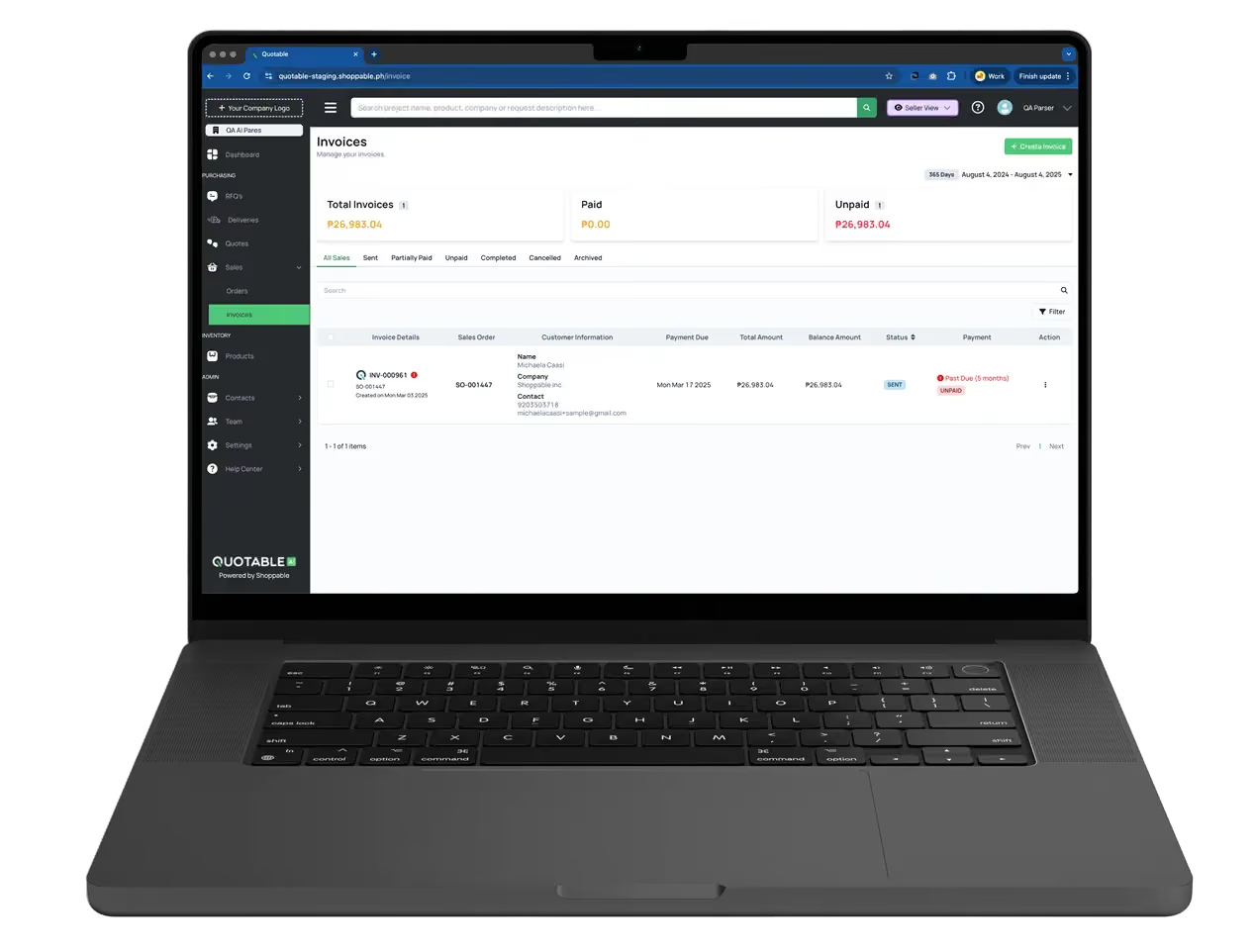
Every other alternative on this list is payment-infrastructure-first: they move money well, but the payment sits disconnected from the procurement context that triggered it. Quotable connects the two: RFQ to quote to PO to payment to reconciliation, in one workflow.
There's no Quotable fee on international vendor payment sends. The platform covers both buyer-side and seller-side workflows. Customers like Zennya Essentials, Toby Sports, and Engkanto Brewery are running cross-border trade through it today.
The honest drawback is scope: Quotable isn't a standalone payment rail with no procurement layer, and it doesn't offer hedging tools like forward contracts today. Choose Quotable AI when you're running a procure-to-pay workflow with international suppliers and want payment, procurement, and receivables visibility in one platform. Choose OFX or Wise Business instead when hedging or a lighter-weight payment rail is all you need.
Put Your Cross-Border Payment Strategy into Action with Quotable AI
You now have a framework for choosing an Airwallex alternative based on verified fees, workflow fit, and regional eligibility. The decision comes down to matching a provider to how you actually move money.
We built Quotable AI to connect the payment to the procurement context behind it. You're not managing supplier relationships in one tool and payments in another. Every international vendor payment sends with no Quotable fee. Your finance team can prove execution across locations with real data.
See how Quotable AI approaches international vendor payments for businesses running cross-border trade workflows.
Run Your First Supplier Payment at No Quotable Fee
If you're paying overseas suppliers on net-30 or net-60 terms, Quotable AI connects the payment to the RFQ, PO, and invoice in one workflow. No Quotable fee on international vendor payment sends.
Start for Free
FAQs About Airwallex Alternatives
Is Stripe or Airwallex better?
Stripe is stronger for online checkout and payment processing. Airwallex is stronger for cross-border business accounts and FX workflows. Stripe optimizes for accepting payments via cards, wallets, and subscriptions. Airwallex optimizes for holding and moving money across borders. Stripe's FX Quotes API costs 1% per transaction, making high-volume supplier payments expensive.
Which is better, Airwallex or Payoneer?
Payoneer is stronger for marketplace sellers and freelancers receiving payouts from platforms like Amazon or Shopee. Airwallex is stronger for broader B2B trade, including outbound supplier payments and API automation. If your primary workflow is collecting from platforms, Payoneer fits better. For managing both receivables and supplier payments, Airwallex's multi-currency accounts and API access offer more flexibility.
Can I use forward contracts to lock FX rates with any Airwallex alternative?
Only OFX and Amnis offer full forward contract support among the standalone FX platforms, with WorldFirst offering standard forward contracts as well. Most other providers, including Wise Business and Payoneer, don't offer hedging tools. If you're paying suppliers on net-30 or net-60 terms, your options narrow. OFX serves mid-market importers. Amnis serves EUR-heavy flows. WorldFirst fits APAC-focused corridors. See the hedging comparison table above for the full breakdown.
Do all Airwallex alternatives accept US-registered businesses?
No. WorldFirst exited the US market. Ramp and Mercury are US-focused and offer basic international payments, but they aren't dedicated cross-border platforms like Airwallex. Wise Business, Payoneer, and OFX all accept US businesses. Expect standard KYC documentation and setup times to vary across providers regardless of which one you choose.
What happens to my existing Airwallex integrations if I switch providers?
You'll need to rebuild API integrations and reconnect accounting or ERP systems. No Airwallex alternative offers a direct migration path that preserves your existing connections. Run the new provider's API in a sandbox while keeping Airwallex live. That lets you test webhook reliability and reconciliation formats before cutting over. Budget 30 to 60 days for parallel testing if you're running automated payment flows. Manual workflows can switch faster.