.png)

You send the same supplier payment every month. You still don't know which provider costs less. One transfer you go with Wise because the fee is right there on screen. The next you try OFX because someone on a forum said it's better for larger amounts. Either way, you're guessing.
The breakeven point in the OFX vs. Wise decision isn't about brand reputation. It's about transfer size. Most comparisons never run the actual cost math to find it.
Wise is cheaper below a certain threshold. OFX can win above it, especially if you negotiate. That crossover shifts by currency corridor and account type. But once you know where it falls for your typical payment, you stop overpaying without switching providers blindly.
Main Takeaways
- Wise is typically cheaper below $10,000 because its transparent fee beats OFX's flat SWIFT surcharges at smaller amounts.
- Above $25,000, OFX can win if you call and negotiate the rate markup below its 0.51% blended average.
- OFX Business accounts add a $20 SWIFT fee per transaction on top of the rate margin, which shifts the breakeven point compared to personal accounts.
- OFX offers forward contracts up to 12 months out. Wise doesn't, making OFX the only option if you need to lock a rate on a future supplier payment.
- Intermediary bank fees, card funding surcharges, and recipient-side deductions can add $20 to $65 or more per transfer, independent of which provider you choose.
Cut Transfer Costs With Smarter Supplier Payment Tools
Choosing the right FX provider is one decision. Connecting that payment to the quote, PO, and invoice it belongs to is another. This guide covers both.
Read the Supplier Quote Comparison Guide
How Wise and OFX Price Your Transfer

Both Wise and OFX take roughly half a percent on every transfer. The difference is where that cost shows up. Wise puts it on your screen before you confirm. OFX bakes it into the exchange rate you receive.
The mid-market exchange rate is the real rate banks use to trade currencies between themselves, before any provider adds its margin. Wise converts your money at this rate and charges a separate percentage fee that varies by corridor. That fee averaged 0.53% globally by late 2025, according to Wise. So a $10,000 transfer costs roughly $53 in Wise fees before any third-party charges. You see the exact cost before you hit send.
OFX works differently. Most personal transfers carry no flat fee. But OFX quotes you an exchange rate that's slightly worse than the mid-market rate. That gap is the rate markup, and it's how OFX earns its revenue. The company's blended net operating income margin was 0.51% of customer turnover in FY2026, per its annual report. OFX Business accounts now also pay clear per-payment fees: $20 for each cross-border SWIFT transaction and $5 per Fedwire.
The "no fee" versus "visible fee" framing misleads. Both providers take margin on every transfer. One shows it as a line item. The other embeds it in the rate. The only honest comparison is total cost: provider fee plus FX markup plus any third-party deductions. Both average roughly 0.5%. So the real question is simple: does Wise's fixed percentage or OFX's negotiable margin cost less at the amount you actually send?
OFX vs. Wise at a Glance: 8-Feature Comparison
Cost matters most, but it's only one variable. The table below compares OFX and Wise across eight features that shape your transfer decision. These span fee structure, delivery speed, business tools, and human support.
| Feature | Wise | OFX |
|---|---|---|
| Fee structure | Transparent percentage fee (avg. 0.53%), varies by corridor | No flat fee on most personal transfers; Business accounts pay $20/SWIFT, $5/Fedwire |
| Exchange rate model | Mid-market rate with no markup | Mid-market rate plus embedded margin (avg. ~0.51%); negotiable on larger amounts |
| Transfer speed | 75% arrive in under 20 seconds; 95% within a day (local rails); SWIFT routes take 1–3 business days | Major currencies: 1–2 business days; no instant option |
| Minimum transfer | No published minimum; supports up to $1,000,000 per transfer from USD | $150 minimum |
| Multi-currency account | Hold 40+ currencies; receive with local bank details in 22 currencies ($31 one-time setup for Business) | Limited multi-currency holding; primarily a transfer tool |
| FX risk tools (forward contracts, limit orders) | Not available | Forward contracts up to 12 months (5% deposit for business, 10% personal); limit orders available |
| Phone support | 24/7 phone support (self-serve default, phone as escalation) | 24/7 phone access to currency specialists (phone-first model) |
| Business account cost | $31 one-time setup; $6.11 to receive USD wire/SWIFT; batch payments available | Subscription-based plans with AP automation, payment controls, and cards; per-payment fees apply |
The sections that follow run the cost math so you can see which provider is cheaper at your transfer size.
Fees, Rate Markup, and What "Total Cost" Actually Means

Your real cost is the total of provider fee, FX markup, and any third-party deductions like intermediary bank fees. That total shifts depending on how much you send.
How Wise's Fee Scales with Transfer Size
Wise's percentage fee scales with your transfer amount. Send $1,000 and you'll pay roughly $5 to $7, depending on the corridor. Send $100,000 and you'll pay roughly $500 to $700. The fee is locked and visible before you confirm.
While the global average sits around 0.53%, corridor variation matters. Some currency pairs cost less, others more. You'll always know the exact number before the money moves.
How OFX's Rate Markup Works
OFX quotes you an exchange rate slightly worse than the mid-market rate. On a $1,000 transfer, a 0.51% margin costs about $5.10. On $100,000, it costs about $510. OFX Business accounts add per-transaction fees on top of the margin: $20 per SWIFT transaction and $5 per Fedwire, according to OFX's pricing page.
One advantage OFX offers at scale: the margin is negotiable. On transfers above $50,000, a phone call to OFX's currency specialists can shave basis points off the quoted rate. The 0.51% blended average may overstate what active negotiators actually pay on large transfers.
At smaller amounts, Wise's fixed percentage and OFX's rate markup produce similar dollar costs. At larger amounts, the question is whether OFX's negotiable margin drops below Wise's percentage. That's what the breakeven table below answers.
The Transfer-Size Breakeven Table: $1K to $100K
The table below estimates total provider cost for six common transfer amounts through Wise and OFX. Use it to find the crossover point for your typical payment size.
How to Read This Table
These estimates use Wise's 0.53% average fee and OFX's 0.51% blended NOI margin as baselines. Your actual costs will vary by corridor, funding method, and whether you negotiate with OFX. The table shows the pattern, not a guarantee. OFX Business accounts add a $20 SWIFT fee per transaction on top of the margin. Wise may add a SWIFT payout fee of about $7.41 on certain corridors, per Wise's platform documentation.
| Transfer Amount | Estimated Wise Cost | Estimated OFX Cost (Business) | Difference | Winner |
|---|---|---|---|---|
| $1,000 | ~$5.30 + possible $7.41 SWIFT | ~$5.10 + $20 SWIFT | Wise saves ~$12–$20 | Wise |
| $5,000 | ~$26.50 + possible $7.41 SWIFT | ~$25.50 + $20 SWIFT | Wise saves ~$11–$12 | Wise |
| $10,000 | ~$53 + possible $7.41 SWIFT | ~$51 + $20 SWIFT | Near parity (~$9 Wise advantage with SWIFT) | Wise, barely |
| $25,000 | ~$132.50 | ~$127.50 + $20 SWIFT (negotiable margin may drop further) | OFX can win if margin is negotiated below 0.50% | OFX if negotiated |
| $50,000 | ~$265 | ~$255 + $20 SWIFT (margin often negotiable to 0.40–0.45%) | OFX saves $40–$90 with negotiated rate | OFX |
| $100,000 | ~$530 | ~$510 + $20 SWIFT (margin negotiable; potential savings of $100+) | OFX saves $100–$200+ with negotiated rate | OFX |
The Breakeven Takeaway
For personal transfers under roughly $10,000, Wise is typically cheaper. Its transparent fee is competitive, and you avoid OFX's SWIFT surcharges. At $10,000 to $25,000, OFX can win if you negotiate the rate. Business accounts give you more leverage in that negotiation.
This threshold shifts by corridor. High-volume pairs like USD to EUR or USD to GBP may favor Wise further up the scale. Wise's fees on those corridors tend to run below the global average. Exotic corridors may favor OFX's human-assisted rate-setting sooner. The spread on less-liquid pairs gives OFX more room to negotiate.
Match Every Supplier Payment to Its Purchase Order
Recurring international payments create a reconciliation backlog when your transfer tool and your procurement workflow don't share data. See how Quotable AI closes that gap.
Explore the RFQ and Procurement Software
Hidden Costs Beyond the Provider Fee

Provider fees and FX margins aren't the whole story. Intermediary bank fees, card funding surcharges, and recipient-side deductions can add $20 to $65 or more to a single transfer. Neither OFX nor Wise controls all of them.
- Intermediary bank fees: When a transfer routes through the SWIFT network, one or more correspondent banks may each deduct $20 to $40 before the money reaches your recipient's bank. Wise now lists a "SWIFT payout fee" of about $7.41 on certain corridors. It warns that added correspondent fees may still apply.
- Card funding surcharges: Paying by debit or credit card instead of bank transfer adds 1–3% on Wise. OFX typically requires bank transfer only. ACH is free on both but slower.
- Recipient-side deductions: Your recipient's bank may charge an inbound wire fee of $10 to $25 that neither provider controls.
To cut these costs, fund via bank transfer (ACH or wire) instead of card. Choose local payout routes where available, because Wise excels here. Ask your recipient's bank about inbound fees before sending large amounts. Use the "OUR" charging option when available to prepay correspondent fees so your recipient gets the full amount.
Transfer Speed: Wise vs. OFX
Wise delivers 75% of transfers in under 20 seconds. 95% arrive within a day, according to its instant transfers page. Speed depends on the payout route. Local rails are near-instant; SWIFT routes take 1 to 3 business days. OFX delivers major currencies in 1 to 2 business days with no instant option.
Wise's ACH daily limit is around $50,000 for personal accounts. Business account limits run considerably higher and vary by account configuration and routing setup. It's worth confirming your specific limit in-app before relying on it for a large payment. If your transfer exceeds your limit, you'll need wire funding or multiple-day scheduling.
Safety, Regulation, and Compliance Signals

Both OFX and Wise are regulated money transfer providers. But "regulated" alone doesn't tell you enough. Here's what each provider's licensing, enforcement history, and safeguarding practices mean for your money.
OFX is registered with FinCEN as a Money Services Business in the US and holds state money transmitter licenses. It's also regulated by ASIC in Australia, where it's publicly listed on the ASX. That listing adds financial transparency through required reporting.
Wise US operates as a licensed money transmitter across US states. In July 2025, a multi-state consent order imposed about $4.2 million in penalties related to AML/CFT compliance, according to the California DFPI. The CFPB also amended a prior consent order in May 2025 related to remittance practices. Wise had separately applied for a US national trust bank charter in June 2025; in July 2026, the OCC denied that application, citing continuing AML/CFT compliance concerns tied to the 2025 consent order. Wise says it intends to resubmit under a different regulatory framework and that the decision doesn't affect its existing money transmitter licenses or day-to-day operations.
Enforcement history isn't automatically a dealbreaker; it can also signal active supervision and remediation [Link to images folder]. But the charter denial is a live compliance signal worth weighing, not just a procedural step. Both providers safeguard customer funds in ring-fenced accounts rather than using them for lending. Neither offers FDIC deposit insurance.
For high-value business payments, the relevant question is whether the provider has the licensing, day-to-day controls, and financial stability to process your transfer reliably. OFX's public listing adds a layer of financial transparency. Wise's recent regulatory history is worth factoring into your own risk tolerance, particularly if you're moving large or recurring supplier payments.
Business Accounts and FX Risk Tools
For businesses paying international suppliers, the comparison shifts. The question isn't just "which transfer is cheaper." It's "which platform gives you tools to manage recurring payments, hold currencies, and hedge FX risk."
Business Account Comparison
Wise Business: $31 one-time setup for account details in 22 currencies. Receive USD wire/SWIFT for $6.11 per payment. Hold balances in 40+ currencies. Batch payments available. ACH business limit: $100,000 per day.
OFX Business: Subscription-based plans with AP automation, payment controls, and cards. Per-payment fees: $20 SWIFT, $5 Fedwire, 20 ACH transactions included per plan (then $0.50 each). Receiving international funds: $5 per payment, waived from May 2026.
For the business account decision, the split comes down to whether you need multi-currency holding or FX hedging tools.
Forward Contracts and Limit Orders
A forward contract is an agreement to exchange currency at a locked-in rate on a future date. It protects you from rate swings between now and when your supplier payment is due.
A limit order is an instruction to execute a transfer when the exchange rate hits a target you set.
OFX offers forward contracts up to 12 months out. The deposit is typically 5% for business accounts and 10% for personal. Wise doesn't currently offer forward contracts or limit orders for business users.
Here's how this plays out in practice. Say you owe a Chinese supplier $80,000 in 90 days. Today's USD/CNH rate works for your margin. Without a forward, you're exposed to rate movement. That could add $800 to $2,400 to your cost if the rate swings 1%–3% against you.
With an OFX forward, you lock today's rate with a roughly $4,000 deposit (5%) and pay the balance at settlement. If the rate moves against you, you've protected your margin. If it moves in your favor, you've given up the upside. That's the tradeoff: certainty for flexibility.
When should you skip the forward and use a spot transfer instead? If the payment is due within days or if your margin has enough room to absorb rate movement and you'd rather keep the upside.
When Neither OFX nor Wise Fits Your Vendor Payment Workflow
Maybe your problem isn't "which transfer tool is cheaper." Maybe it's "how do I connect international payments to the quotes, POs, and invoices they belong to." Neither OFX nor Wise was built for that workflow.
Both are transfer tools. You initiate a payment, it arrives. But businesses running quote-to-PO-to-payment workflows need more. Every supplier payment ties back to a purchase order, an approved quote, and an invoice that needs reconciliation. The transfer is only one step. The gap is everything around it: matching payments to orders, tracking approval chains, and closing the books.
Are you copying payment references into spreadsheets? Emailing remittance advice separately? Reconciling supplier payments against invoices by hand? The cost of the wrong transfer tool is smaller than the cost of a disconnected workflow.
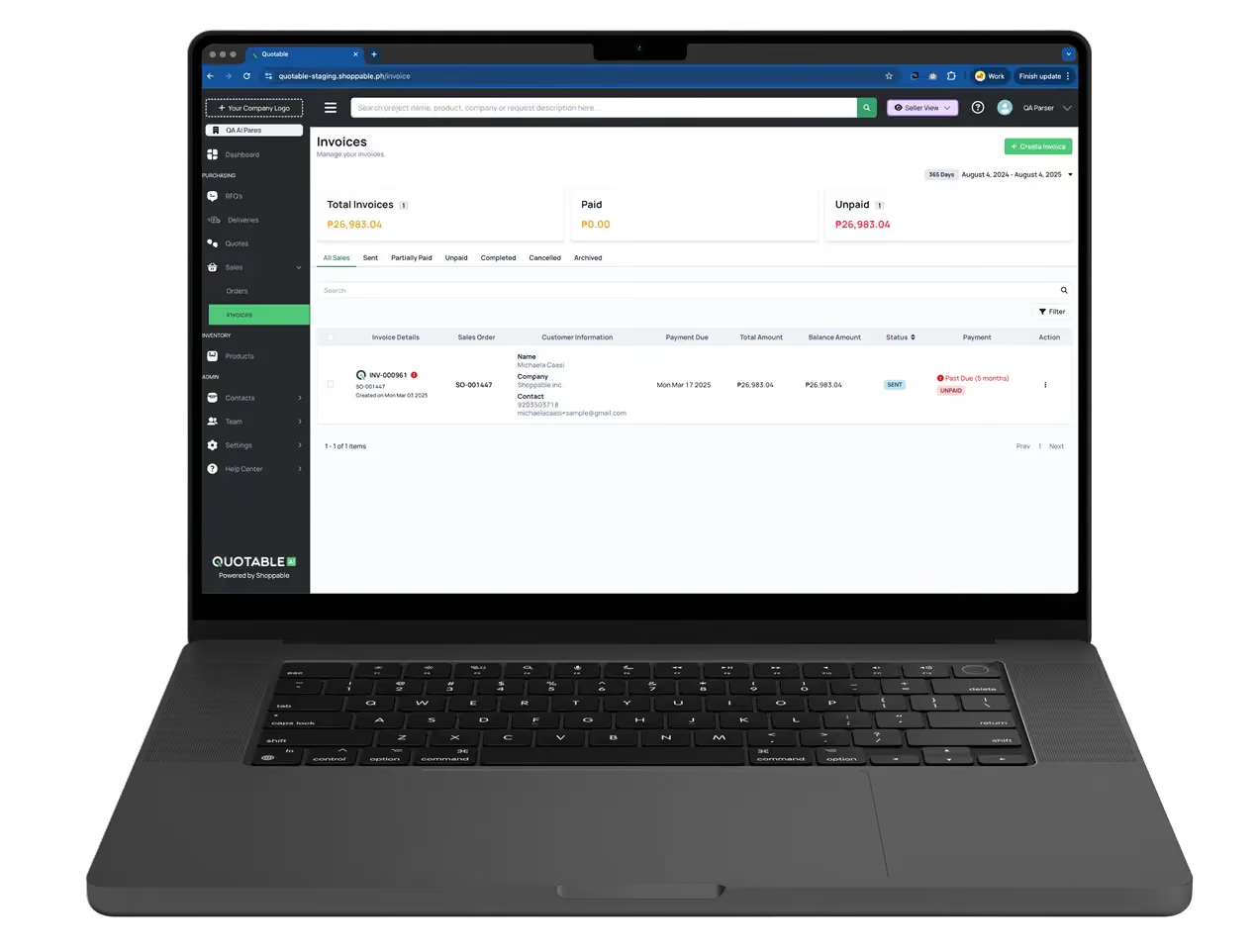
Platforms built for international vendor payments exist to close that gap. Quotable AI, for example, connects procurement to payment across 140+ currencies in 200+ countries. It handles automatic reconciliation to quotes, invoices, and orders. This isn't about replacing Wise or OFX for every transfer. It's about knowing when a transfer tool isn't enough and your payment workflow needs visibility.
Stop Reconciling Supplier Payments by Hand
If you're copying payment references into spreadsheets after every transfer, the problem isn't which FX provider you picked. It's that the transfer and the invoice live in separate systems.
Start for Free
FAQs About OFX vs. Wise
What is better, OFX or Wise?
Wise is better for personal transfers under $10,000. It's also better for businesses that need multi-currency accounts, instant delivery, and transparent pricing.
OFX is better for business transfers above $25,000 where you can negotiate rates. It also wins for any business that needs forward contracts to hedge FX risk. The breakeven shifts by corridor and account type.
How do I know if OFX will actually give me a better rate than Wise on a large transfer?
Call OFX and request a live quote for your specific amount and corridor. Then compare it against Wise's calculator at wise.com for the same transfer. OFX's rate margin is negotiable. The 0.51% blended average may not reflect what you'd pay on a $50,000+ transfer. Factor in OFX Business per-payment fees when calculating total cost on both sides. Those fees are $20 per SWIFT and $5 per Fedwire.
If I'm paying a supplier in 90 days, should I lock in a forward contract now or wait?
Lock in a forward contract if your margin depends on a specific exchange rate. This makes sense when you can't absorb a 2%–3% rate swing. Wait and use a spot transfer if your margin has room for movement. Forward contracts require a 5%–10% deposit. They lock both upside and downside. You're trading flexibility for certainty. If your supplier payment ties to a fixed-price customer order, locking the rate protects your margin.
What happens if my recipient's bank charges an inbound wire fee that neither OFX nor Wise warned me about?
Your recipient will receive less than the amount you sent. Neither provider can control or refund that deduction because the recipient's bank charges it. To avoid the shortfall, ask your recipient's bank about inbound wire fees before sending. These typically run $10 to $25. You can also use the "OUR" charging option when available to prepay all intermediary and recipient fees upfront. Wise lists some SWIFT fees (about $7.41) but can't control every correspondent or recipient-side deduction.
If I need to reconcile supplier payments back to purchase orders and invoices, do I need something beyond OFX or Wise?
Yes. OFX and Wise are transfer tools. They move money but don't connect payments to the quotes, POs, or invoices they belong to. Platforms built for vendor payment workflows, like Quotable AI, handle the transfer and the reconciliation in one system. Every payment closes the loop automatically.
The gap isn't transfer cost. It's the day-to-day work of matching payments to orders and closing the books without spreadsheets. That matters most for businesses running recurring international supplier payments across multiple vendors.