Philippine SMEs still lose an estimated 5-8% of revenue to payment friction: delayed collections, manual reconciliation errors, and the hidden cost of chasing down bank transfer confirmations. If you're running a wholesale operation, a BPO, or an import-export business, you already know the pain. The check is "in the mail," the wire is "being processed," and your cash flow is stuck somewhere between your buyer's bank and yours.
This guide breaks down the B2B payment solutions available to Philippine businesses in 2026, compares them on the criteria that actually matter, and helps you pick the right fit based on how your buyers prefer to pay and how your operations actually run.
Quick Verdict
Most Philippine SMEs handling B2B transactions need three things: coverage of local payment rails (InstaPay, PESONet, QR Ph, GCash, Maya), fast settlement, and a fee structure that doesn't punish slow months. If your transactions are purely domestic, platforms like HitPay and PayMongo cover the basics well. But if you're paying or receiving from suppliers and clients across borders, you'll want a platform that connects payments to your procurement and invoicing workflow rather than treating them as separate functions. Quotable Payments supports cross-border B2B payments across 140+ currencies. When connected to Quotable AI workflows, each payment can remain linked to the quote, purchase orders, and invoices behind it, reducing manual reconciliation between payment records and commercial documents.
Your decision should hinge on three questions: Are your transactions domestic, cross-border, or both? Do you need payment links, recurring billing, or full procure-to-pay automation? And what's your monthly volume volatility?
Why B2B Payments in the Philippines Are Still Broken
The Bangko Sentral ng Pilipinas (BSP) has pushed hard for digital payment adoption, and the infrastructure has improved. InstaPay and PESONet now handle billions in monthly volume. GCash and Maya have become standard business tools, not just consumer apps.
But infrastructure availability and actual B2B adoption are different things. A 2025 BSP report found that while person-to-person digital payments surged, business-to-business transactions remained disproportionately manual. Many SMEs still process supplier payments through over-the-counter bank deposits, and a surprising number of wholesale transactions in provincial areas still settle in cash.
The real cost isn't the payment method itself. It's the operational overhead: your finance team manually matching bank transfer screenshots to invoices, following up on payments that may or may not have cleared, and reconciling accounts at month-end with incomplete data. For a distributor processing 50+ invoices per month, that overhead starts eating into margin fast.
Which Payment Methods Actually Matter for Philippine B2B?
Not every payment method carries equal weight in B2B contexts. Here's what you should prioritize and why.
InstaPay and PESONet
These are your baseline requirements. Any platform that doesn't support both is immediately disqualified for serious B2B use.
InstaPay handles real-time transfers up to ₱50,000 per transaction. It's ideal for smaller invoices and quick settlements. PESONet supports larger batch transfers with no per-transaction cap and settles on the next banking day. If you're running payroll, paying suppliers in bulk, or handling inter-company transfers, PESONet is the workhorse.
Both operate under the Philippine Payment and Settlement System (PhilPaSS Plus) framework. The practical difference: InstaPay gives you speed on smaller amounts, PESONet gives you capacity on larger ones.
QR Ph
Increasingly used for in-person B2B collections. A distributor collecting from a retailer in a Divisoria warehouse doesn't want to deal with exact change or wait for a bank transfer to confirm. QR Ph creates an instant digital record, which makes reconciliation significantly easier.
GCash and Maya Business Wallets
These have moved well beyond consumer payments. Many SMEs in the informal and semi-formal economy maintain business wallets on both platforms. If your buyers are small retailers or service providers, refusing GCash is like refusing to accept cash: you'll lose transactions.
Cards (Visa, Mastercard)
Cards matter most for cross-border B2B transactions and professional services. Corporate cards are standard for buyers who want to consolidate spend, earn rewards, or extend payment terms by 30 days without negotiating credit.
Cross-Border Rails
This is where most domestic-focused platforms fall short. If you're an exporter shipping to Singapore, a manufacturer sourcing from China, or a BPO billing US clients, you need more than local payment rails. You need multi-currency acceptance, competitive FX rates, and a way to tie those payments back to the underlying commercial documents.
Platform Comparison: Who Serves Philippine B2B Best?
Here's a direct comparison of the 7 platforms actively serving Philippine B2B transactions in 2026.
Platform | Monthly Fee | Key B2B Methods (PH) | Payout Speed | Cross-Border | Best For
Quotable Payments | Free to transaction-based | InstaPay, PESONet, e-wallets, Visa/Mastercard, Global FX Payments | Varies by corridor | 140+ currencies, 200+ countries | Importers, exporters, and distributors making cross-border payments, with Quotable AI workflows available to connect payments to quotes, POs, and invoices
Maya Business | No monthly fee; transaction-based MDR | Visa, Mastercard, BancNet, JCB, Amex, Maya, QR Ph, GCash, WeChat Pay, ShopeePay | Next banking day | International card acceptance; PHP settlement for domestic transactions and USD for other currencies | SMEs needing checkout, payment links, digital invoices, QR, and in-person acceptance
Paynamics | Custom or transaction-based, depending on solution | Cards, GCash, Maya, GrabPay, online banking, QR, installments, and over-the-counter payments | Varies by solution; Paybiz states a 3-day settlement cycle | Primarily Philippine payment channels | SMEs and enterprises needing broad local acceptance, payouts, and API integrations
HitPay | Transaction based | QR Ph, GCash, Maya, InstaPay, PESONet, Visa/Mastercard | Next business day (domestic) | PayNow (SG), QRIS (ID), DuitNow (MY), PromptPay (TH) | SMEs wanting zero fixed costs and multi-method domestic coverage
PayMongo | Varies and transaction based | Cards, GCash, QR Ph, Maya, GrabPay | T+1 | Limited | Developer-first startups already in the PayMongo ecosystem
Xendit | Custom pricing | Cards, OTC (7-Eleven, ECPay, Cebuana) | Custom | Southeast Asia focus | Platforms and enterprises needing custom settlement structures
2C2P | Custom | Visa, Mastercard, OTC, digital wallets | T+1 to T+3 | Regional (ASEAN) | Established enterprises with complex regional payment needs
What the Table Doesn't Show
Raw feature lists miss the operational reality. A few things to consider beyond the grid:
Reconciliation burden. Most payment platforms treat each transaction as an isolated event. You receive money, you get a notification, and then you manually match it to an invoice in your accounting system. For five transactions a month, that's fine. For fifty, it's a full-time job. Platforms that link payments to the originating commercial document (the quote, PO, or invoice) eliminate that matching step entirely.
FX cost transparency. Cross-border platforms often advertise low transaction fees while burying the real cost in the exchange rate markup. A 1% spread on a ₱500,000 supplier payment is ₱5,000 you'll never see itemized on a receipt. Ask for the mid-market rate comparison before committing.
Settlement in your preferred currency. Receiving USD from a US client is only useful if you can hold it in USD until you need to convert. Forced conversion at unfavorable rates erodes your margin. Quotable Payments lets eligible businesses receive and hold supported balances in 35+ currencies, then choose when to convert or use those funds for an approved payment.
How Settlement Speed Affects Your Working Capital
Settlement timing isn't a minor technical detail. It directly determines your operating cash cycle.
Consider a concrete example: you're a wholesale distributor in Cebu supplying construction materials. Your supplier in Manila requires payment within 7 days. Your buyers pay on 15-day terms. If your payment platform settles in T+3, you've effectively lost three days of working capital on every transaction cycle. Scale that across 40 monthly invoices, and you're financing a permanent gap.
Next business day settlement (T+1) is the minimum acceptable standard for B2B. Any platform offering T+3 or longer is extending your debtor days without your consent.
For cross-border transactions, settlement speed varies by corridor. Settlement times for Quotable Payments vary by currency, route, receiving method, and approved setup. Always confirm the specific settlement timeline for your most common payment corridors before signing up.
The Overlooked Problem: Payments Disconnected from Documents
Here's a mistake that costs Philippine B2B companies real money: treating payments as a standalone function separate from procurement and invoicing.
A typical scenario: your operations team sends a purchase order to a Chinese supplier via email. Your finance team processes the payment through a separate banking portal. Three weeks later, someone needs to verify whether PO #4872 was paid, partially paid, or still outstanding. The answer requires cross-referencing email threads, bank statements, and possibly a spreadsheet that hasn't been updated since last Tuesday.
This disconnect is the "quote-to-cash gap" that standard payment platforms don't address. They process money, but they don't connect that money movement to the commercial context that triggered it.
For businesses doing purely domestic, low-volume B2B transactions, this gap is manageable. But once you're handling cross-border supplier payments, managing multiple currencies, or processing more than 30-50 transactions monthly, the manual reconciliation burden becomes a real operational bottleneck.
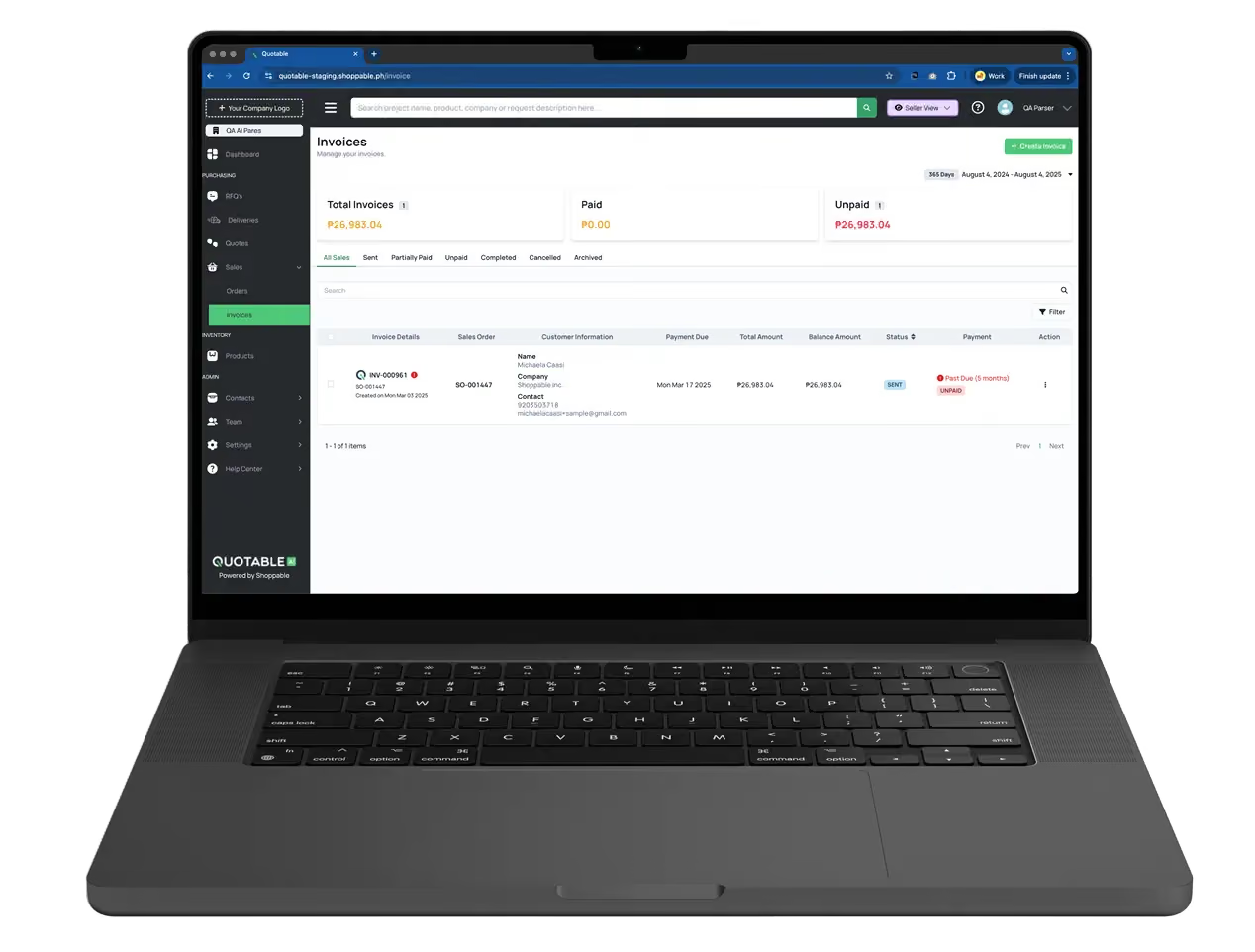
Quotable AI was built to close this workflow gap. When Quotable AI workflows are used with Quotable Payments, the payment record can remain connected to the originating quote, purchase order, or invoice. Finance teams can review the commercial document and its related payment activity without reconstructing the transaction from emails, spreadsheets, and bank statements.
What Philippine SMEs Should Check Before Choosing a Platform
BSP Licensing
The BSP requires all payment service providers operating in the Philippines to hold the appropriate license. You don't need your own license as a merchant: you operate under your provider's license. But you should verify that your provider actually holds one. This isn't a formality. Unlicensed platforms expose you to regulatory risk and offer no recourse if something goes wrong with your funds.
Fee Structure Alignment
Monthly fees punish businesses with variable volume. If you're a seasonal exporter or a services firm with lumpy revenue, a ₱349/month fixed fee during a slow quarter is money wasted. Pay-per-transaction models align your payment costs with your actual revenue.
But don't stop at the headline fee. Calculate your all-in cost: transaction percentage + fixed per-transaction fee + FX markup (if applicable) + any withdrawal or payout fees. A platform advertising 2.5% per transaction with a 1.5% FX spread costs more than one charging 3% with mid-market rates.
Invoice and Payment Link Support
B2B payments rarely happen at a point of sale. Your buyer receives an invoice, reviews it, gets internal approval, and then pays. The platform needs to support payment links embedded directly in invoices, covering all the payment methods your buyers actually use.
A single payment link that lets the buyer choose between GCash, Maya, InstaPay, PESONet, or card removes friction from the collection process. If your buyer has to ask "how do I pay you?" you've already added unnecessary delay.
Recurring Billing Capability
Retainer agreements, monthly supply contracts, and subscription-based service fees all require automated billing. Manual invoice generation for recurring payments is a waste of your team's time and introduces the risk of missed billing cycles.
Cross-Border Readiness
Even if your transactions are 100% domestic today, think about where you'll be in 12 months. Switching payment platforms is disruptive. If there's any chance you'll be sourcing from overseas suppliers or billing international clients, choose a platform that handles cross-border payments natively rather than bolting it on later.
Common Mistakes Philippine B2B Companies Make with Payments
Treating bank wire transfers as "free." Your bank doesn't charge a visible per-transaction fee for domestic transfers, so it feels free. But factor in the time your staff spends preparing transfers, confirming receipt, and reconciling manually, and each transaction carries a hidden cost of ₱200-500 in labor. Multiply that across your monthly volume.
Ignoring the FX spread on international payments. For international payments, compare the final quote—including the FX rate and fees—not just the advertised transfer fee. Quotable Payments lets businesses review the available route, quote, fees, and estimated recipient amount before submitting an approved payment.
Not documenting payment terms in the original quote. Verbal agreements on payment terms create disputes. If your quote says Net 30 but your buyer understood Net 45, you'll spend more time arguing than collecting. Platforms that embed payment terms directly into quotes and carry them through to invoices and payment links eliminate this ambiguity.
Using consumer payment tools for business transactions. Sending a personal GCash request for a ₱150,000 wholesale order creates no audit trail, no tax documentation, and no recourse if the transaction is disputed. Use business-grade tools with proper documentation.
Frequently Asked Questions
What's the best B2B payment solution for a Philippine SME with variable monthly volume?
A platform with no monthly fees and pay-per-transaction pricing protects you during slow months. HitPay fits this profile for domestic transactions. If you also handle cross-border payments, consider Quotable Payments. Review current eligibility, route availability, FX pricing, and transaction fees for the currencies your business uses most often.
How do InstaPay and PESONet differ for B2B use?
InstaPay processes real-time transfers up to ₱50,000 per transaction: good for smaller invoices that need immediate confirmation. PESONet handles larger amounts with no per-transaction cap but settles next banking day. Most B2B operations need both: InstaPay for urgency, PESONet for volume.
Can Philippine businesses accept payments from foreign clients without a separate international account?
Yes. Platforms like HitPay accept payments via PayNow (Singapore), QRIS (Indonesia), DuitNow (Malaysia), and PromptPay (Thailand). Quotable Payments supports eligible businesses receiving and holding supported currencies through available Currency Accounts. Currency coverage, local Bank details, routes, and receiving methods depend on the business and approved setup.
Do I need a BSP license to accept B2B payments online?
No. Individual merchants operate under their payment service provider's license. Your responsibility is to verify that your chosen platform holds the appropriate BSP license. Don't assume: check the BSP's published registry.
How do I reduce the time my finance team spends on payment reconciliation?
The biggest time sink is matching incoming payments to outstanding invoices. Platforms that link payments directly to the originating document (quote, PO, or invoice) eliminate manual matching. If you're processing more than 30 transactions monthly and still reconciling from bank statements, you're past the point where automation pays for itself.
What's the real cost of cross-border B2B payments from the Philippines?
Three components: the transaction fee (typically 1-3%), the FX spread (0.5-3% above mid-market), and any intermediary bank charges for wire transfers (₱500-2,000 per transaction). Add these together for your true cost. Most businesses focus only on the transaction fee and miss the larger FX cost entirely.
Is it worth switching from manual bank transfers to a payment platform?
If you're processing fewer than 10 B2B transactions per month and they're all domestic, the switching cost may not justify the benefit. Once you cross 20-30 monthly transactions, or handle any cross-border payments, the time savings, faster settlement, and reduced errors from a dedicated platform will more than cover the transaction fees.
Choosing the Right Fit for Your Operation
The best B2B payment solution for your Philippine business isn't the one with the longest feature list. It's the one that matches your actual transaction patterns, your buyers' preferred payment methods, and your operational complexity.
For purely domestic SMEs with straightforward invoicing needs, HitPay's zero-monthly-fee model with broad local payment method coverage is hard to beat. For developer-heavy teams already embedded in a specific ecosystem, PayMongo offers solid API-first infrastructure.
But if you're a Philippine importer paying suppliers in China, an exporter billing clients in Singapore, or a distributor managing procurement across multiple countries, you need more than a payment gateway. You need payments connected to your commercial workflow: quotes tied to POs tied to invoices tied to payments, with full visibility for your finance team at every step. That is the workflow problem Quotable AI solves, making it a stronger fit for businesses that have outgrown disconnected quotation, procurement, invoicing, and payment records.
Whatever you choose, verify the BSP license, calculate your all-in cost (not just the headline rate), and test the settlement timeline with a real transaction before committing your full volume. Your cash flow depends on getting this right.