Most small businesses (SMEs) hit a breaking point somewhere between 30 and 50 outbound quotes per month. That's the threshold where spreadsheets start failing, email threads get buried, and your sales team spends more time formatting PDFs than actually selling. If you've felt that friction, you're not alone. The global quote system software market is projected to reach $2.938 billion by 2026, growing at a 12.8% CAGR, because businesses of every size are recognizing the same thing: the way we've been quoting is broken. For SMEs doing $1M to $30M in annual revenue, the cost of slow, manual quoting isn't just inconvenience. It's lost deals, delayed cash flow, and a ceiling on growth. The tools available in 2026 don't just speed up document creation. They connect the entire transaction lifecycle, from the first price request to the final payment, into a single workflow. That shift changes what's possible for a small team competing against much larger players.
The Evolution of Quoting: Moving Beyond Static Documents in 2026
The quote has always been the starting point of a B2B transaction. But for decades, the tools surrounding it treated it as an afterthought: a document you create, email, and forget about until someone responds. That approach made sense when deal volumes were low and margins were wide. Neither of those conditions describes the reality for most SMEs today.
What's changed isn't just the technology. It's the expectation. Your buyers are comparing three to five suppliers simultaneously, and the one who responds fastest with the most accurate pricing wins. One industry expert put it plainly: quoting for small businesses revolves around the speed of delivery, accuracy, and winning the client before competitors respond. If your quoting process takes a day and your competitor's takes five minutes, you're not even in the running.
Why Traditional PDF Quotes are Slowing Down SME Growth
Here's a scenario I've seen play out dozens of times. A distributor gets an RFQ from a mid-market buyer. The sales rep opens a spreadsheet template, manually enters 40 line items, checks pricing against a separate price list (which may or may not be current), exports to PDF, and emails it. Two hours later, the buyer asks for a revision on six items. The whole cycle repeats.
That process has real costs beyond just time. Manual data entry introduces errors: wrong unit prices, outdated lead times, mismatched part numbers. Each error creates downstream problems in procurement, invoicing, and fulfillment. A single pricing mistake on a $50,000 quote can cost you the deal or, worse, lock you into a money-losing contract.
The other problem is visibility. Once that PDF leaves your inbox, you have no idea what happens to it. Did the buyer open it? Did they forward it to their procurement team? Are they comparing it against a competitor's offer right now? Static documents give you zero intelligence about where your deal stands.
The Shift Toward Quote-to-Payment Orchestration
The most significant evolution in quoting tools is the collapse of previously separate systems into one continuous workflow. Instead of quoting in one tool, invoicing in another, and collecting payments through a third, modern platforms treat the quote as a live transaction state that progresses through approval, purchase order, invoice, and payment without re-entering data at each stage.
This is what "quote-to-payment orchestration" actually means in practice. Your quote doesn't die when the buyer says yes. It transforms into a PO, then an invoice, then a payment record, all within the same system. Each step inherits the data from the last, which eliminates the reconciliation headaches that plague finance teams at month-end close.
For a distributor processing 200 quotes per month, this isn't a nice-to-have. It's the difference between a three-person back office and a seven-person back office. The labor savings alone justify the investment, but the real win is speed: businesses with integrated quote-to-cash workflows save 15.3 hours per week compared to those juggling separate tools.
The Strategic Advantage of AI-Powered Data Orchestration
AI in quoting isn't about chatbots or flashy features. The real value sits in data extraction, document parsing, and workflow automation: the unglamorous work that eats up most of your team's day.
Think about what happens when a buyer sends you an RFQ as a PDF attachment. Someone on your team has to open it, read each line item, cross-reference it against your catalog, check inventory, calculate pricing, and build a response. That's 30 to 90 minutes of manual encoding per request. Multiply that across your monthly volume, and you've got a full-time employee doing nothing but data entry.
Treating the Quote as a Live Transaction State
This concept deserves more attention because it fundamentally changes how you think about your sales pipeline. In traditional systems, a quote is a snapshot: a fixed document representing pricing at a moment in time. If anything changes (quantities, specs, delivery dates), you create a new version and lose the thread.
When the quote becomes a live transaction state, it's a persistent, editable object that both parties can interact with. The buyer can approve specific line items, request changes on others, and submit a purchase order, all from a single link without logging into any platform. This is exactly how Quotable AI handles supplier participation: vendors respond to RFQs through a secure link without creating accounts or adopting new software, which means procurement teams collect responses faster and suppliers don't face adoption friction.
The practical impact is significant. One client I worked with, a mid-size IT equipment distributor doing about $8M annually, was losing deals because their quoting cycle averaged 36 hours. After moving to a system that treated quotes as live objects with real-time collaboration, their average response time dropped to under two hours. Their close rate jumped by nearly 30%.
Automating the Sales-to-Procurement Workflow
The handoff between sales and procurement is where most SMEs leak time and money. Sales closes the deal, but procurement needs to source materials, confirm availability, and issue POs to suppliers. If those teams use different systems (or worse, different spreadsheets), information gets lost in translation.
Automation here means several things:
- A quote accepted by your buyer automatically generates a procurement request for any items you need to source
- Supplier RFQs go out simultaneously to your vendor base, with responses collected and compared in one place
- Purchase orders are created from approved quotes with zero re-keying
- Invoice data flows directly from the PO, enabling three-way matching without manual intervention
This kind of workflow automation isn't just about efficiency. It's about control. When every step is connected, you get a complete audit trail. You can trace any invoice back to its original quote, see who approved what, and identify where delays occur. For companies subject to SOX compliance or industry-specific regulations, that traceability isn't optional.
Solving the Fragmented Workflow for Suppliers and Distributors
Fragmentation is the silent killer of SME profitability. Your sales data lives in a CRM. Your quotes live in spreadsheets or a standalone quoting tool. Your invoices live in your accounting system. Your payment records live in your bank portal. None of these systems talk to each other natively, and the human labor required to bridge them is expensive and error-prone.
Eliminating Data Silos Between Sales and Finance
Here are the red flags that tell you data silos are costing you money:
- Your finance team spends the first week of every month reconciling invoices against POs
- Sales reps can't tell a customer whether their payment has been received
- You've discovered duplicate orders because the same RFQ was processed by two different people
- Month-end close takes five or more business days because data has to be manually pulled from multiple systems
- Margin reports don't match between your sales dashboard and your accounting software
If any of these sound familiar, the root cause is almost always disconnected data. The fix isn't another integration or another middleware layer. It's consolidating the transaction lifecycle into a single system that serves as the source of truth for both sales and finance.
Quotable AI takes this approach by connecting with existing ERP and accounting systems, so organizations can modernize their supplier collaboration without ripping out their financial infrastructure. The AI parser automatically extracts and structures data from quotes, invoices, POs, and bills of materials, which means your team stops manually encoding documents and starts reviewing pre-populated records instead.
Accelerating B2B Payments and Collections
Cash flow is the lifeblood of any SME, and slow payments are the most common cause of death. The typical B2B payment cycle involves sending an invoice, waiting for the buyer to process it through their AP system, and then waiting again for the payment to clear. Net-30 terms often become net-45 or net-60 in practice.
The overlooked step in this process is payment verification. Even after a buyer pays, your team has to match the incoming payment to the correct invoice, confirm the amount, and update your records. When you're dealing with bank wires from international customers, this can take days.
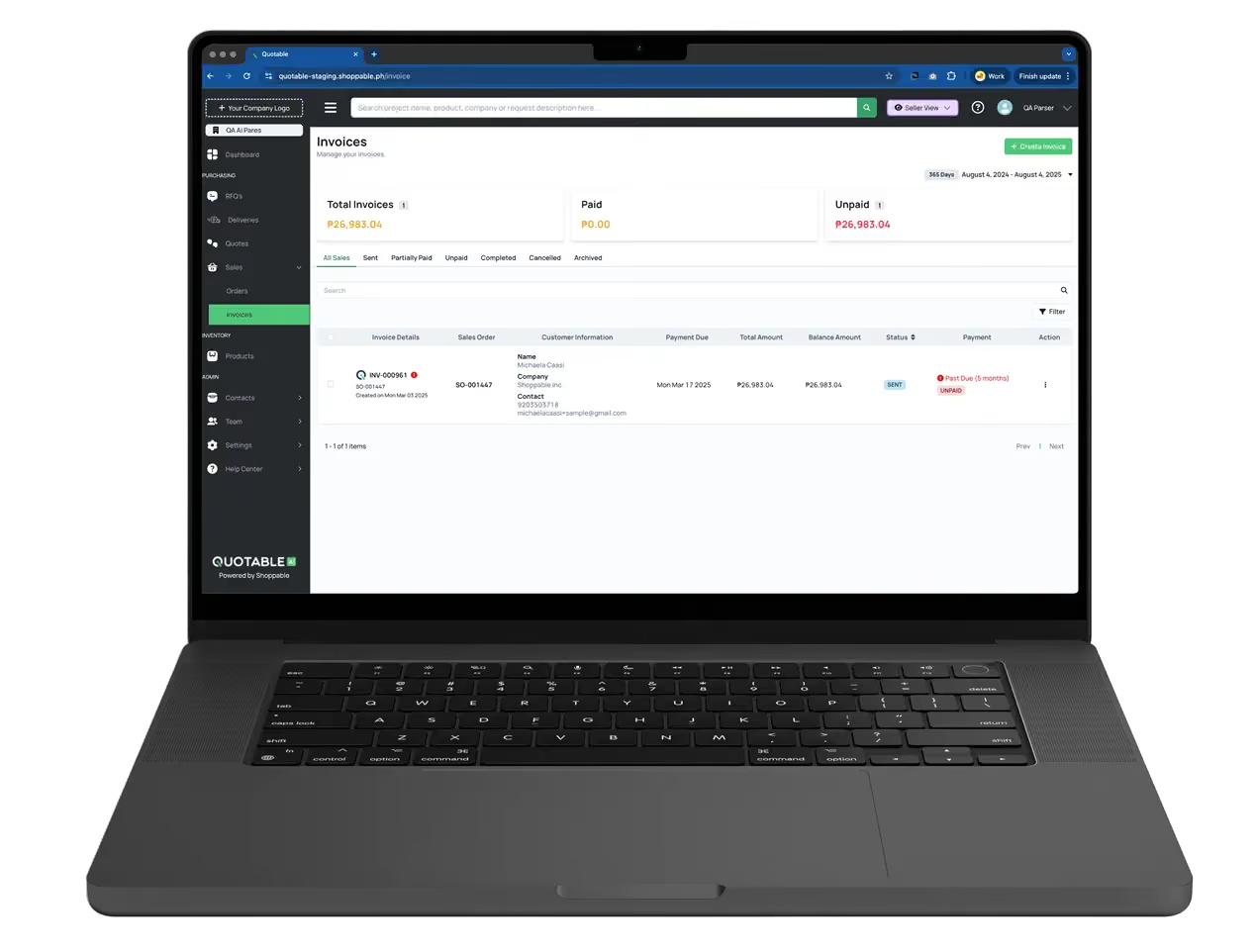
Embedded payment options, including bank wire, ACH, credit cards, and e-wallets, directly within the invoice eliminate most of this friction. The buyer clicks a link, selects their payment method, and pays. The system automatically matches the payment to the invoice. No phone calls, no email confirmations, no manual reconciliation.
For businesses in international trade, linking payment workflows with logistics data is critical. You need to track landed costs: duties, freight charges, and FX impact alongside the original quote pricing. Without that connection, your margin calculations are fiction.
Industry-Specific Impacts: Construction, IT, and Logistics
Different industries feel the pain of manual quoting in different ways, but the underlying problem is the same: too much manual work between the first customer inquiry and the final payment.
In construction, quotes are complex. A single project bid might include hundreds of line items across multiple material categories, each with different suppliers, lead times, and cost codes. The common mistake here is treating the quote as a one-time document rather than a living project budget. When material prices change (and they always change), the original quote becomes meaningless unless it's connected to real-time procurement data.
IT distributors face a different challenge: speed. Product availability and pricing shift daily, and buyers expect near-instant responses. An IT distributor quoting 50 SKUs from memory or a static price list is going to lose to one whose system automatically pulls current pricing and stock levels. Quote automation can reduce proposal turnaround time from 24 to 48 hours down to under 5 minutes, which is the difference between winning and losing in this space.
Logistics companies deal with yet another wrinkle: the quote often depends on variables that aren't known until shipment. Weight, dimensions, route, and fuel surcharges all affect final pricing. Smart quoting systems handle this by building in conditional logic and automated recalculation, so the quote updates as variables become concrete.
Operational Efficiency: Quoting and Shipping 10X Faster
The "10X faster" claim sounds like marketing, but the math actually works. Consider a typical manual quoting workflow: receive RFQ (5 minutes), research pricing (20 minutes), build quote document (30 minutes), review and approve (15 minutes), send to customer (5 minutes). That's 75 minutes per quote. At 200 quotes per month, you're burning 250 hours, roughly 1.5 full-time employees, on quoting alone.
An automated system with AI document parsing cuts that to about 7 minutes per quote: the AI extracts the RFQ data, auto-populates pricing from your catalog, and routes for approval. Your 250 hours become 23 hours. That's not a marginal improvement. That's a structural change in how your business operates.
Businesses using quote automation see an average 35% improvement in close rates compared to manual quoting. The reason is simple: faster quotes win more deals, and accurate quotes create fewer disputes downstream.
The Power of a Vertically Integrated Operating System
The concept of a vertically integrated operating system for B2B trade means one platform handles quoting, procurement, invoicing, payments, and fulfillment tracking. This isn't about cramming features into one tool for the sake of it. It's about eliminating the gaps between systems where data gets lost, time gets wasted, and errors get introduced.
Think of it this way: every time data moves from one system to another, there's a risk of corruption. A part number gets transposed. A quantity gets rounded. A discount gets dropped. These micro-errors compound across hundreds of transactions per month, creating reconciliation nightmares and eroding your margins by 2 to 5 percent without anyone noticing.
Users who consolidate their client management into a single platform save an average of 13 hours per month-compressed.pdf) on administrative tasks alone. For an SME where every hour counts, that's a meaningful recovery of capacity that can go toward actually growing the business.
The if/then math is compelling. If you're a $5M distributor with 8% net margins, and fragmented workflows are costing you 3% in hidden inefficiencies (errors, delays, duplicate work), that's $150,000 per year walking out the door. A vertically integrated system that recovers even half of that pays for itself many times over.
Future-Proofing Your SME with Quotable AI
The SMEs that will thrive in 2026 and beyond aren't the ones with the biggest teams or the deepest pockets. They're the ones that treat their quoting process as the foundation of their entire commercial operation, not as an afterthought bolted onto a CRM.
Here's the hard-won lesson from working with dozens of growing distributors and suppliers: the companies that scale smoothly are the ones that automate their quote-to-payment workflow before they hit capacity. Waiting until your team is drowning in manual work means you're already losing deals and burning out your best people.
Quotable AI was built around this exact insight. Most systems start after the transaction. This platform starts where business actually begins: the quote. From there, it connects procurement, shipping, invoicing, and payment into one continuous thread. For SMEs doing $1M to $30M in revenue, that's a venture-scale idea delivered at a price point that makes sense.
If your team is still copying line items between spreadsheets, chasing payments over email, or losing visibility once a quote leaves your inbox, 2026 is the year to fix it. The tools exist. The ROI is proven. The only question is whether you'll move before your competitors do.