Every business that sells to other businesses knows the pain of a deal that stalls between "yes" and "paid." A buyer agrees to your price, but weeks pass before you see the money. The quote sits in an email thread, the purchase order gets rekeyed into a different system, the invoice doesn't match, and collections drag on. This gap between a customer's intent to buy and the moment cash hits your account is exactly where the quote-to-cash process lives. If you've ever wondered what is Q2C and why it matters, the short answer is this: it's the complete lifecycle that turns a sales quote into collected revenue. For SMEs and mid-market companies moving between $1M and $50M in annual transactions, mastering this lifecycle isn't optional. It's the difference between healthy cash flow and a constant scramble to close the gap between work done and money received. The Q2C software market alone was valued at USD 1.95 billion in 2025 and is expected to more than double by 2035, signaling that companies across industries are investing heavily in solving this exact problem. What follows is a practical breakdown of how the process works, where it breaks down, and what you can do about it.
Understanding the Quote-to-Cash (Q2C) Lifecycle
Defining Q2C as a Continuous Workflow
Q2C isn't a single event or a department's responsibility. It's a continuous workflow that stretches from the moment a seller creates a quote to the moment the buyer's payment clears. Think of it as a relay race where the baton passes from sales to operations to finance to collections, and every handoff is a chance for things to go wrong.
The stages typically include quoting, order management, fulfillment, invoicing, and payment collection. But calling them "stages" can be misleading because they're deeply interdependent. A mistake in the quote, like an incorrect unit price or a missing line item, doesn't just affect sales. It cascades into procurement, shipping, invoicing, and eventually disputes that delay payment by weeks.
One client we worked with, a mid-size industrial distributor, traced 40% of their invoice disputes back to errors made during the quoting phase. The quote had one price, the PO reflected another, and the invoice split the difference. Nobody caught it until the buyer's AP team flagged it 30 days later. That's the kind of breakdown a continuous Q2C workflow is designed to prevent.
The key insight is treating the quote as a live transaction state rather than a static PDF. When the quote carries structured data that flows automatically into orders, invoices, and payment records, each downstream step inherits accuracy from the one before it. This is the philosophy behind platforms like Quotable AI, which treats the quote as the origin point for the entire transaction chain.
The Difference Between Q2C and Standard Invoicing
Many businesses confuse Q2C with invoicing. They assume that if they can generate an invoice and send it to a customer, they've got the process covered. That's like saying you've run a marathon because you crossed the finish line: it ignores the 26 miles that came before.
Standard invoicing is one step in the Q2C lifecycle. It captures what's owed and sends a request for payment. But it doesn't address how the quote was configured, whether the order was fulfilled correctly, or how the payment will be reconciled against the original terms.
Q2C, by contrast, connects the pre-sale activity (quoting, negotiation, approval) with the post-sale activity (fulfillment, billing, collections). It creates a single thread of data that everyone, from the sales rep to the CFO, can follow. Without that thread, you end up with disconnected systems: a spreadsheet for quotes, an ERP for orders, an accounting tool for invoices, and a bank portal for payments. Each one holds a piece of the truth, but nobody has the full picture.
The financial consequence is real. Reliance on manual data entry can slow down the Q2C process and increase the risk of errors, which means delayed revenue recognition, longer DSO (days sales outstanding), and frustrated customers who don't want to chase discrepancies any more than you do.
The Core Stages of the Q2C Process
Sales Quotation and Live Transaction States
The process begins with the quote, and this is where most companies underestimate the complexity. A quote isn't just a price list. It's a binding commercial proposal that sets expectations for scope, delivery, terms, and cost.
For a distributor handling 200 SKUs across multiple product lines, generating an accurate quote means pulling real-time pricing, checking inventory availability, applying customer-specific discounts, and factoring in freight. If any of those inputs are stale or manually entered, the quote becomes a liability rather than an asset.
The concept of a "live transaction state" means the quote remains active and connected to downstream processes. When a buyer accepts, the quote doesn't get printed and filed. It converts directly into a purchase order, triggering fulfillment workflows. If terms change during negotiation, like a revised delivery date or adjusted quantity, those changes propagate automatically.
This is where a universal AI parser becomes valuable. Quotable AI, for example, can extract and structure data from quotes, POs, and invoices automatically, reducing the manual encoding that introduces errors. Instead of a sales rep retyping line items into an order management system, the data flows from one state to the next.
Order Fulfillment and Procurement Integration
Once a quote converts to an order, fulfillment kicks in. For companies that manufacture or source goods, this means procurement is immediately in play. The order triggers a need: raw materials, subcomponents, or finished goods from suppliers.
Here's where silos cause the most damage. If your procurement team doesn't have visibility into what was quoted, they might source the wrong specification or miss a delivery deadline baked into the customer's terms. A hard-won lesson from the construction supply industry: verbal changes to material specs during the quoting phase that never make it into the procurement system can result in costly rework and penalty clauses.
A well-integrated Q2C process links the accepted quote directly to procurement workflows. The bill of materials from the quote feeds into supplier RFQs, and supplier responses flow back into the order record. This creates a closed loop where everyone works from the same data.
Tracking landed costs is also critical here, especially for companies involved in cross-border trade. Duties, freight charges, and currency fluctuations all affect the margin you quoted. If your Q2C system doesn't capture these costs alongside the original quote, you won't know your true profitability until months after the deal closes.
Invoicing, Collections, and B2B Payments
The invoice should be the easiest part of the process, but it rarely is. If the quote, order, and fulfillment data are disconnected, the invoice becomes a reconstruction project. Finance teams spend hours reconciling what was quoted against what was shipped against what should be billed.
A proper Q2C workflow generates the invoice directly from the fulfilled order, which itself traces back to the approved quote. The three-way match, comparing the PO, the goods receipt, and the invoice, happens automatically because all three documents share the same data lineage.
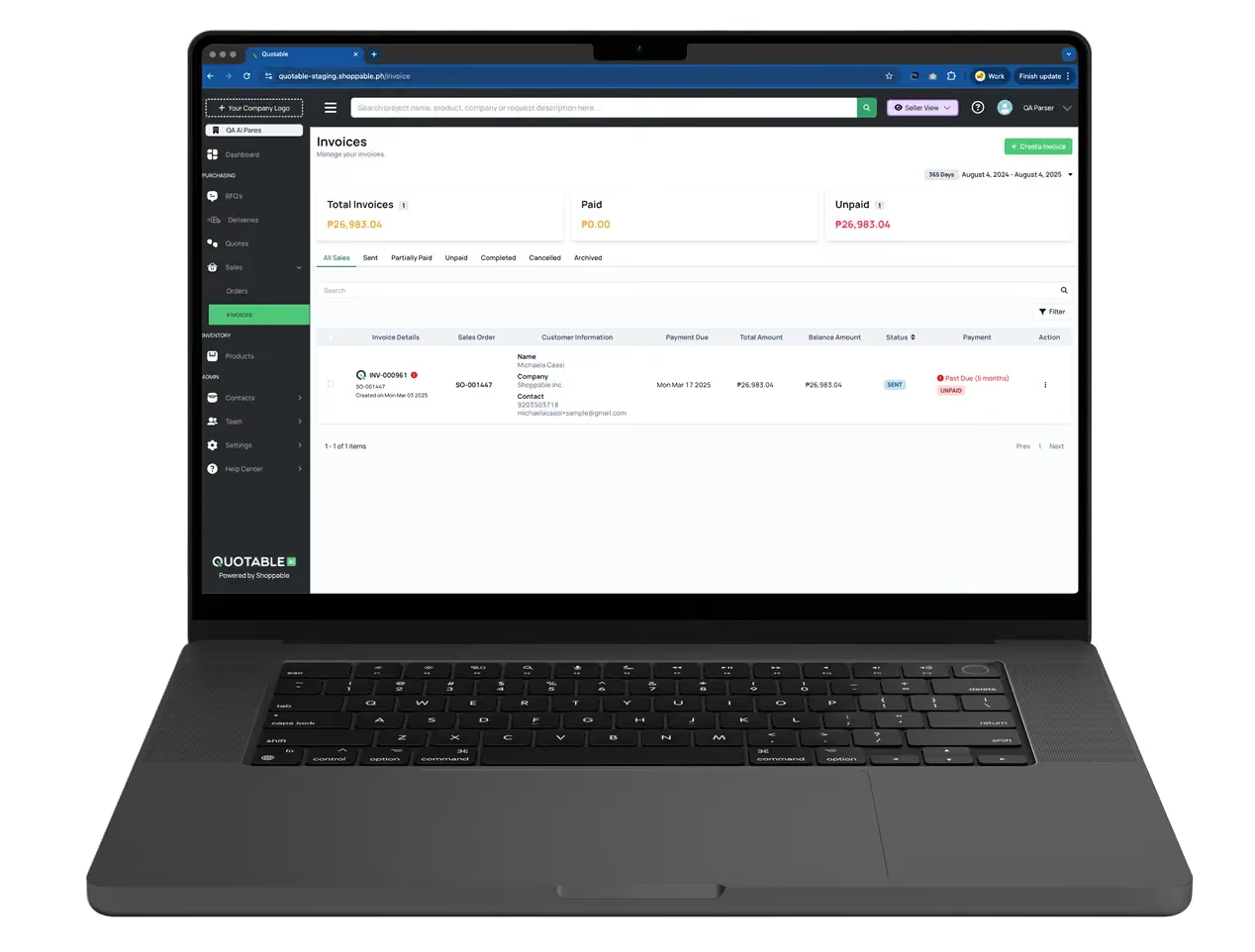
Collections is where cash flow lives or dies. Q2C metrics tell you how efficiently revenue actually becomes cash, and that efficiency depends on removing friction from the payment step. Embedded payment options, like bank wire, ACH, credit cards, and e-wallets, within the invoice itself reduce the time between "invoice sent" and "payment received." Quotable AI's approach of letting buyers pay through no-login links eliminates the common excuse of "I couldn't figure out how to pay" that procurement teams hear more often than they'd like to admit.
Why Modern Businesses Start with the Quote
Moving Beyond Post-Transaction Systems
Most business software was designed to record what already happened. Your ERP logs orders after they're placed. Your accounting system records invoices after they're sent. Your bank shows payments after they clear. These are all post-transaction systems, and they're excellent at looking backward.
The problem is that B2B transactions don't fail at the recording stage. They fail at the initiation stage. A quote with the wrong terms, a misconfigured price, or an unapproved discount creates a chain of problems that no amount of downstream recording can fix. You're essentially documenting errors with precision.
Starting with the quote means treating the commercial proposal as the system of record. Every subsequent action, from order creation to payment collection, references back to that original document. When disputes arise, and they will, you have a clear audit trail that shows exactly what was agreed, when it changed, and who approved it.
This shift in thinking is particularly important for companies subject to regulatory requirements like SOX compliance, where the ability to demonstrate controls over revenue recognition starts well before the invoice is generated.
The Role of AI in Data Orchestration
Data orchestration in Q2C means ensuring that information flows accurately between systems without manual intervention. This sounds simple, but the reality for most mid-market companies is a mess of PDFs, spreadsheets, email attachments, and phone calls.
AI changes this by parsing unstructured documents into structured data. A supplier sends a quote as a PDF. An AI parser extracts the line items, quantities, unit prices, and terms, then maps them into your procurement system. The same technology works in reverse: your outbound quotes get structured so buyers can import them directly into their systems.
The practical impact is speed. Modern Q2C platforms reduce deal cycles by 30-50% by automating quoting, contract management, billing, and collections across interconnected systems. For a distributor processing 50 to 100 quotes per week, that compression translates directly into faster revenue.
AI also catches errors that humans miss. A unit price that's 10x off because someone dropped a decimal point, a shipping address that doesn't match the buyer's registered location, or payment terms that conflict with your company's credit policy: these are patterns that machine learning models flag before the quote goes out the door.
Key Benefits of an Integrated Q2C Platform
Accelerating Revenue Cycles for SMEs and Mid-Market Firms
For companies in the $1M to $30M revenue range, cash flow isn't an abstract metric. It's the difference between making payroll and scrambling for a line of credit. An integrated Q2C platform compresses the time between quoting and collecting, which directly improves working capital.
Consider a scenario: you quote a $50,000 order on Monday. Without automation, the buyer receives the quote Wednesday, sends a PO the following week, your team re-enters the order Thursday, ships the following Monday, invoices three days later, and collects in 45 days. That's nearly 60 days from quote to cash. With an integrated platform, the quote converts to an order instantly upon approval, fulfillment triggers automatically, and the invoice with embedded payment goes out the same day the goods ship. You might collect in 15 to 20 days instead.
The Q2C software market is projected to expand to $9.7 billion by 2034, growing at a compound annual growth rate of 10.9%. That growth reflects a market-wide recognition that revenue acceleration isn't about selling more. It's about collecting faster on what you've already sold.
Eliminating Silos Between Sales, Finance, and Logistics
The most expensive inefficiency in B2B operations isn't a bad hire or a lost deal. It's the invisible cost of departments working from different versions of the truth. Sales quotes one thing, operations fulfills another, and finance bills a third.
An integrated Q2C platform creates a single data layer that all departments reference. When sales adjusts a quote, logistics sees the updated delivery requirements. When fulfillment confirms a partial shipment, finance knows to issue a partial invoice. When the buyer pays, sales can see the collection status without calling accounting.
Red flags that signal your silos are costing you money:
- Duplicate orders because sales and operations use separate systems
- Invoice disputes exceeding 5% of total billing volume
- Month-end close taking more than 10 business days
- No visibility into order status without making a phone call or sending an email
- Maverick spend in procurement because buyers can't see existing quotes or contracts
If three or more of these symptoms sound familiar, you've likely hit the operational breaking point where manual coordination can't keep up. Most companies reach this threshold around 30 to 50 orders per month.
Industry Applications for Quote-to-Cash Automation
Manufacturing and Trade Distribution
Manufacturers and distributors deal with complex quoting scenarios that make Q2C automation especially valuable. A single quote might include hundreds of line items, tiered pricing based on volume, lead times that vary by component, and terms that differ by customer credit rating.
In manufacturing, the quote often includes a bill of materials that must be accurate down to the part number. A wrong spec doesn't just create an invoice dispute. It creates a production error, a return, and a customer relationship problem. When the quote feeds directly into procurement and production planning, these errors drop dramatically.
Trade distributors face a different challenge: speed. Their customers expect quotes within hours, not days. A distributor handling electrical components, for instance, might receive 40 RFQs in a single morning. Responding to each one manually means pulling pricing from supplier catalogs, checking stock across warehouses, calculating freight, and formatting the quote. Platforms that centralize RFQ management and allow suppliers to respond through secure links without creating accounts can cut response times from days to hours.
Construction and Logistics Complexities
Construction procurement is notoriously fragmented. A general contractor might source materials from 50 different suppliers for a single project, each with different pricing structures, delivery schedules, and payment terms. The quote-to-cash cycle in construction also carries legal weight: quotes often become part of contractual agreements with penalty clauses for late delivery or specification changes.
Cost code tracking is essential here. Every line item on a quote needs to map to a project cost code so that actual spending can be compared against the budget in real time. Without this mapping, project managers don't know they're over budget until the invoices pile up at month-end.
Logistics companies face their own Q2C challenges around landed costs and multi-currency transactions. A freight forwarder quoting an international shipment needs to account for duties, insurance, port fees, and exchange rate fluctuations. If the quote doesn't capture these variables, the invoice will either shortchange the company or surprise the customer. Both outcomes are bad. Linking payment workflows with logistics documents like bills of lading and packing lists ensures that what was quoted, what was shipped, and what was billed all tell the same story.
Future-Proofing Trade with AI-Powered Q2C
The companies that will thrive over the next decade aren't the ones with the most sales reps or the lowest prices. They're the ones that can move from quote to cash faster and more accurately than their competitors. AI-powered Q2C isn't a future concept: it's already reshaping how mid-market companies operate, with the market growing at a CAGR of 8.5% through 2035.
The practical takeaway is straightforward. If you're still stitching together quotes in spreadsheets, rekeying orders into your ERP, and chasing payments through email, you're leaving money and time on the table. Every manual handoff is a potential error, and every error is a delayed payment.
Start by auditing your current quote-to-cash workflow. Map every step from quote creation to payment collection, and identify where data gets rekeyed, where approvals stall, and where disputes originate. That map will show you exactly where automation delivers the highest return.
Quotable AI was built for exactly this kind of transformation: connecting quoting, procurement, invoicing, and payments into one continuous workflow so that mid-market companies can quote, fulfill, and collect without the friction that eats into margins. If your current process has more handoffs than a relay team, it's time to rethink how your transactions flow from start to finish.