Every B2B company has a quoting process. Few have examined what that process actually costs them. Beyond the obvious time spent drafting proposals, manual quoting creates a cascade of hidden expenses that compound silently across sales, operations, finance, and customer relationships. For SME distributors and mid-market companies processing hundreds of quotes per month, these costs can represent hundreds of thousands in lost revenue, wasted labor, and eroded margins annually. The five hidden costs of manual quoting are well-documented by operations researchers, yet most businesses still treat their quote workflow as "good enough." That's a dangerous assumption when your competitors are automating. This piece breaks down exactly where the money leaks out and what you can do to stop the bleeding, whether you're a $2M distributor or a $40M procurement-heavy organization scaling into new markets.
The High Price of Stagnation in B2B Quoting
Most B2B companies built their quoting workflows years ago, often around spreadsheets, email threads, and a patchwork of disconnected tools. The process worked fine at 20 quotes per month. But once you cross the 30-to-50-order threshold, something breaks. Quotes take longer to assemble. Errors creep in. Follow-ups fall through the cracks. And your sales team spends more time on admin than on selling.
The real price of stagnation isn't visible on any single line item. It's distributed across your entire operation: slower deal cycles, higher labor costs, pricing mistakes, disconnected systems, and customers who quietly stop coming back. According to APQC benchmarking data, top-performing organizations spend 80% less on their order management processes than bottom performers. The gap between those two groups almost always comes down to automation and workflow design.
Here's a hard-won lesson from working with companies in construction, IT distribution, and manufacturing supply chains: the quote isn't just a document. It's the first transaction state in your entire revenue cycle. When that first state is manual, fragmented, and slow, every downstream process inherits those problems. Procurement gets messy. Invoicing gets delayed. Payments stall. And you're left wondering why your cash conversion cycle keeps stretching.
The fix isn't incremental. You don't need a better spreadsheet template. You need to rethink the quote as the foundation of your entire commercial workflow, and build accordingly.
1. The Opportunity Cost of Slow Response Times
Speed kills in B2B sales, but only if you have it. When your quoting process relies on manual lookups, email chains between sales and pricing teams, and hand-built PDFs, you're adding hours or days to something that should take minutes. That delay has a direct, measurable cost.
Losing the 'First-to-Quote' Advantage
Research from InsideSales.com and the Harvard Business Review has consistently shown that the first vendor to respond to an inquiry wins the deal 35-50% of the time. In competitive distribution markets, where multiple suppliers carry similar products, response time is often the only real differentiator. If your competitor sends a professional, accurate quote within an hour and yours arrives the next morning, you've already lost ground you can't recover.
One construction materials distributor we've spoken with estimated they were losing two to three deals per week simply because their quoting turnaround was 24-48 hours. At an average deal size of $8,000, that's roughly $80,000 to $120,000 in monthly revenue walking out the door. Not because of price. Not because of product quality. Because someone else showed up first.
The first-to-quote advantage compounds over time. Buyers develop preferences for responsive suppliers. They build those suppliers into their workflows and purchasing habits. Lose the first quote, and you don't just lose one deal; you lose the relationship trajectory.
How Manual Delays Stall the Sales Pipeline
Beyond individual deal losses, slow quoting creates a systemic bottleneck in your pipeline. Sales reps who spend 30-45 minutes assembling each quote can only process so many per day. When volume spikes, like during seasonal demand or after a trade show, the backlog grows fast.
This is where the breaking point becomes obvious. A five-person sales team handling 200 quotes per month at 30 minutes each is spending over 100 hours on quote assembly alone. That's roughly 12.5 full workdays per month consumed by administrative work rather than prospecting, relationship building, or closing. Your pipeline doesn't stall because of weak demand. It stalls because your team physically can't move quotes fast enough to keep up.
The downstream effect hits forecasting too. When quotes sit in limbo, your pipeline metrics become unreliable. Finance can't project revenue accurately. Operations can't plan inventory. Everyone's guessing.
2. Operational Inefficiency and Administrative Overhead
The second hidden cost is the sheer volume of human labor consumed by manual quoting. This isn't just a sales problem. It touches procurement, finance, and operations teams across the organization.
The Burden of Manual Data Entry for SMEs
For SMEs running $1M to $30M in annual revenue, every hour of labor matters. Manual quoting typically involves pulling product data from one system, checking pricing in another, entering customer details by hand, and formatting the document in a spreadsheet or word processor. Each of these steps introduces time cost and error risk.
A common mistake we see is treating data entry as "just part of the job" rather than recognizing it as a process failure. When your sales coordinator is manually copying SKU numbers from a catalog into a quote template, that's not productive work. That's a symptom of disconnected systems. APQC's research suggests that companies with high levels of manual data entry in their order-to-cash cycle spend 3-5x more per transaction than those with automated workflows.
The problem scales badly too. A distributor processing 100 quotes per month might absorb the overhead. At 300 quotes per month, you're either hiring additional staff or watching quality degrade as your existing team rushes through the work.
Hidden Labor Costs in Procurement and Finance
Manual quoting doesn't just burden the sales team. Every quote that converts into an order triggers work in procurement and finance. Purchase orders need to be created. Invoices need to match. Payments need to be tracked. When the original quote was built manually, with no structured data flowing downstream, each of these steps requires someone to re-enter information.
Ardent Partners' annual procurement research consistently finds that organizations processing purchase orders manually spend $15-$25 per PO in labor costs alone. Automated organizations bring that below $5. Multiply the difference across thousands of transactions per year, and you're looking at a six-figure gap in operational overhead.
Finance teams feel this acutely during month-end close. When quotes, invoices, and payments don't connect through a single data thread, reconciliation becomes a manual hunt through emails and spreadsheets. One finance manager at a mid-market IT distributor described their month-end process as "three days of detective work," matching invoice line items to original quotes that had been revised two or three times over email.
3. Revenue Leakage from Pricing and Fulfillment Errors
This is the cost that hurts the most because it's pure margin destruction. Every manual quote is an opportunity for a pricing error, a wrong SKU, an outdated discount, or a miscalculated shipping cost. These mistakes don't just cost you money on individual deals. They erode trust with your customers and create expensive correction cycles.
Consider a simple scenario: your sales rep quotes 500 units of a product at $12.50 each, but the current price is $13.25. That $0.75 error across 500 units is $375 lost on a single transaction. If your team processes 200 quotes per month and even 5% contain a pricing error of that magnitude, you're leaking over $3,700 monthly, or roughly $45,000 per year, from pricing mistakes alone.
Fulfillment errors compound the damage. A wrong part number on a quote leads to a wrong part number on the PO, which leads to the wrong product being shipped. Now you're paying for return shipping, restocking, and expedited reshipping of the correct item. The administrative cost of resolving a single fulfillment error, including customer service time, logistics coordination, and credit processing, can easily exceed $150-$200 per incident.
The overlooked step here is version control. Manual quoting often involves multiple revisions sent over email. When a buyer approves "version 3" but your team accidentally processes "version 2," the resulting mismatch creates a contractual gray area. Verbal changes to terms, pricing adjustments made in a phone call but not reflected in the document, quantity modifications buried in an email reply: all of these create binding agreement ambiguities that can lead to disputes, penalty clauses, and damaged relationships.
Platforms like Quotable AI address this by treating the quote as a live, versioned transaction state. Every change is tracked, every approval is logged, and the data flows directly into procurement and invoicing without manual re-entry. That single-source-of-truth approach eliminates the version control problem entirely.
4. Fragmented Workflows and Information Silos
The fourth hidden cost is structural. Manual quoting almost always exists in isolation from the rest of your commercial workflow. Your CRM holds customer data. Your ERP holds inventory. Your accounting software handles invoicing. And your quotes live in spreadsheets or email. Nothing talks to anything else.
The Disconnect Between Quotes and B2B Payments
Here's a red flag most companies ignore: if your quoting system and your payment system don't share data, you're creating unnecessary friction in your cash collection process. A quote that converts to an invoice that converts to a payment should be a continuous data flow. Instead, most SMEs and mid-market companies treat each step as a separate, manual handoff.
The result is delayed payments. When a buyer receives an invoice that doesn't perfectly match the quote they approved, they pause. They ask questions. They request clarification. Each of those interactions adds days to your collection cycle. For a company with $10M in annual revenue and a 45-day average collection period, reducing that period by even five days frees up roughly $137,000 in working capital.
The disconnect also makes it harder to offer flexible payment options. If your quote lives in one system and your payment processing lives in another, enabling buyers to pay via ACH, credit card, or bank wire from the same document becomes a custom integration project rather than a standard feature.
Friction in Cross-Company Transaction States
B2B transactions involve at least two companies, and often more. The quote originates with the seller, gets reviewed by the buyer's procurement team, triggers internal approvals, generates a PO, and eventually results in payment. Each of those steps crosses an organizational boundary.
When the quote is a static PDF attached to an email, there's no shared transaction state between buyer and seller. The seller doesn't know if the buyer has reviewed the quote, forwarded it for approval, or modified the quantities internally. The buyer doesn't know if the seller has updated pricing or availability since the quote was sent. Both sides are operating on assumptions rather than shared, real-time data.
This friction multiplies with scale. A mid-market company managing 50 active suppliers and processing $30M in annual purchases is juggling thousands of these disconnected transaction states simultaneously. The visibility gap creates duplicate orders, missed discounts, and reconciliation nightmares. Quotable AI's approach of treating the quote as a live, shared state between companies, accessible through no-login links for buyers, directly addresses this cross-company friction.
5. Decreased Customer Lifetime Value
The final hidden cost is the hardest to quantify but arguably the most damaging over time. Manual quoting degrades your customer experience, and degraded experience reduces lifetime value.
B2B buyers are increasingly conditioned by their B2C experiences. They expect fast responses, accurate information, and easy transactions. When your quoting process requires them to email back and forth, wait for manual revisions, and then navigate a separate invoicing and payment process, you're creating friction that pushes them toward competitors who've made buying easier.
The symptoms show up gradually. Reorder frequency declines. Average order values shrink as customers split their purchasing across multiple suppliers to reduce dependency on your slow process. Eventually, they stop requesting quotes altogether. You don't get a formal breakup notice. You just notice the revenue from that account quietly dropping quarter over quarter.
Customer acquisition costs in B2B distribution typically run 5-7x higher than retention costs. Every customer you lose due to process friction, not price or product, represents a failure that was entirely preventable. A distributor selling $5M annually with a 20% customer churn rate driven partly by poor quoting experience is essentially burning $1M in revenue that could have been retained with a better process.
The compounding effect is what makes this so costly. A customer retained for five years at $50,000 annually is worth $250,000. Lose them after two years because your quoting process frustrated their procurement team, and you've left $150,000 on the table, plus the acquisition cost of finding a replacement.
Fixing the Friction: Transitioning to an AI-Powered Operating System
Recognizing these hidden costs is the first step. Eliminating them requires a fundamental shift in how you think about your quoting workflow: not as a standalone document-creation task, but as the starting point of your entire revenue cycle.
Integrating Quote-to-Payment Orchestration
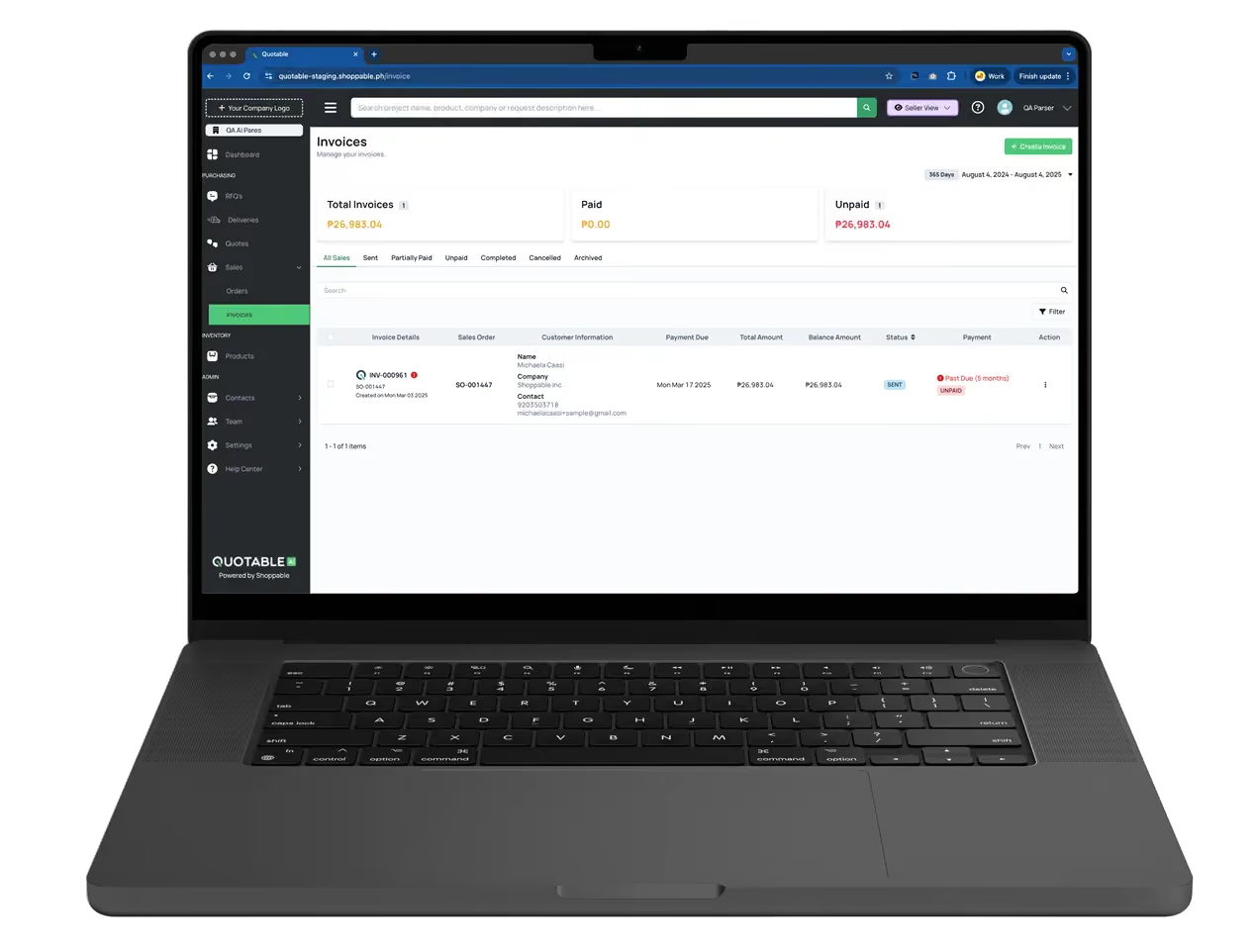
The most effective way to eliminate manual quoting costs is to connect the entire lifecycle, from quote creation through procurement, invoicing, and payment, into a single, continuous workflow. This is what Quotable AI was built to do: treat the quote as a live transaction state that flows through every downstream process without manual re-entry or system-hopping.
Here's what that looks like in practice:
That six-step flow replaces what most companies currently do across four or five disconnected systems with dozens of manual handoffs. The labor savings alone are significant, but the real value is in speed, accuracy, and the customer experience improvement that drives retention.
Accelerating Global Trade with Automated Workflows
For companies selling or buying across borders, the costs of manual quoting multiply. Currency conversions, compliance documentation, shipping calculations, and multi-party approvals all add complexity that manual processes handle poorly.
Automated workflows compress these timelines dramatically. A quote that accounts for international shipping, applies the correct tariff classifications, and presents pricing in the buyer's preferred currency doesn't require a specialist to assemble. It requires a system that understands the transaction context and applies the right rules automatically.
The companies that will win in B2B trade over the next decade aren't the ones with the lowest prices or the biggest catalogs. They're the ones that make buying and selling frictionless. Smart money is flowing toward platforms that treat the quote as the foundation of the entire commercial relationship, not as a throwaway PDF.
If you're running a distribution or procurement-heavy business and you recognize three or more of these hidden costs in your own operation, it's time to stop patching the spreadsheet and start building a real system. The gap between manual and automated quoting isn't closing. It's widening. And every month you wait, your competitors who've already made the switch are compounding their advantage. Take a hard look at your quote-to-payment lifecycle. The savings are real, the tools exist, and the cost of inaction is only going up.