Most B2B companies treat procurement and payments as separate worlds. Sourcing lives in one spreadsheet, invoicing in another, and payments get tracked through email threads and bank statements. The result? Slow approvals, duplicated work, and cash flow that's impossible to predict. For SMEs and mid-market distributors handling millions in annual transactions, this fragmentation isn't just annoying: it's expensive. The source-to-pay process, when properly structured, eliminates these silos by connecting every step from supplier selection through final payment into a single, traceable workflow. The global S2P market was valued at $5.76 billion in 2024 and is projected to reach $14.5 billion by 2033, growing at a CAGR of 10.8%. That growth tells you something: businesses are betting heavily on unifying procurement and payment operations. But throwing software at the problem without understanding the underlying process won't get you far. What follows is a practical breakdown of how to structure, automate, and future-proof your S2P cycle, whether you're a $3M distributor or a $40M mid-market buyer managing hundreds of supplier relationships.
Modernizing Source-to-Pay: From Quote to Payment
The traditional procurement cycle starts with a need and ends with a check. But that framing misses the most critical moment in any B2B transaction: the quote. Quotes aren't just pricing documents. They're the first binding expression of terms, lead times, and delivery expectations between two companies. When you treat the quote as a throwaway step, you lose the data that should inform every downstream decision, from purchase order creation to invoice matching to payment timing.
A modern S2P cycle treats the quote as the transaction's origin point. Every change, every approval, and every negotiation gets captured from that first moment. This means your procurement team isn't re-entering data when they create a PO. Your finance team isn't chasing discrepancies during three-way match. And your operations team can see delivery commitments before goods even ship.
The Role of the Quote as a Live Transaction State
Here's a hard-won lesson from working with distributors: most systems start after the transaction. The quote gets created in one tool, exported as a PDF, emailed to the buyer, and then manually re-keyed into an ERP. By the time the PO comes back, the original quote data is disconnected from everything else.
Think of it this way. If a supplier quotes 500 units of steel tubing at $14.20 per unit with a 21-day lead time, that data should flow automatically into the purchase order, the goods receipt, and the invoice. If the supplier later revises the quote to $14.75, that change should be visible to procurement, finance, and operations without anyone sending a follow-up email.
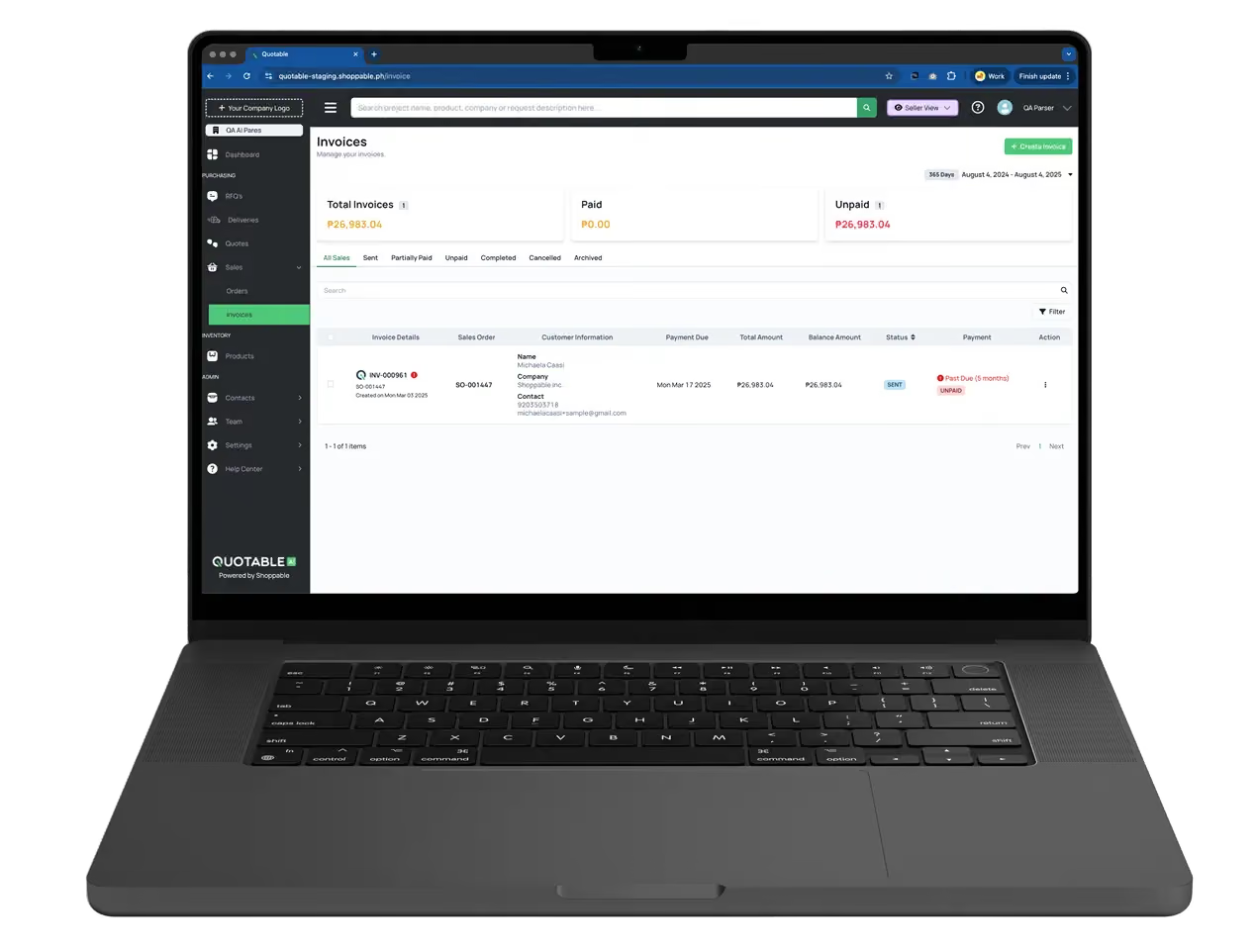
Platforms like Quotable AI treat the quote as a live transaction state, not a static document. The quote becomes the anchor for the entire transaction lifecycle. When the buyer approves, the PO generates automatically. When the invoice arrives, the system matches it against the original quoted terms. This eliminates the verbal changes and undocumented revisions that cause so much administrative pain during month-end close.
Bridging the Gap Between Procurement and Fulfillment
One of the most overlooked breaking points in B2B trade happens between procurement approval and actual fulfillment. The PO is issued, but nobody tracks whether the supplier confirmed delivery dates. Or the goods arrive, but the receiving team can't match them to the right order because the packing list references a different quote number.
For construction and manufacturing companies, this gap is especially costly. A delayed shipment of raw materials doesn't just mean a late delivery: it means idle crews, missed project milestones, and penalty clauses kicking in. Bridging this gap requires connecting your procurement data to your logistics data. That means linking POs to bills of lading, tracking landed costs including duties, freight, and FX impact, and making all of this visible to both the buying and selling side.
The companies that do this well don't rely on email chains. They use systems where the supplier can update shipment status directly, the buyer can see real-time delivery estimates, and finance can accrue costs accurately before the invoice even arrives.
Leveraging Strategic Sourcing Software for SME Growth
Strategic sourcing used to be a discipline reserved for enterprises with dedicated procurement departments. A $5M distributor didn't have the headcount or the tooling to run formal RFQ processes, score suppliers on weighted criteria, or track spend by category. They relied on relationships, phone calls, and gut instinct.
That's changing fast. Strategic sourcing software has become accessible to SMEs, and the benefits compound quickly. Companies adopting S2P systems report average savings of 30% on software and vendor spend through improved visibility and data-driven negotiations. For a distributor spending $2M annually on materials, that's $600K back in the business.
Automating Supplier Selection and Quotation Cycles
The typical RFQ cycle for a mid-market buyer looks something like this: someone identifies a need, emails three to five suppliers, waits for responses in various formats (PDF, Excel, email body text), manually compares pricing, and then calls the winner. The whole process takes days, sometimes weeks.
Automation compresses this dramatically. Here's what a well-structured digital RFQ cycle looks like:
- Duplicate orders because sales and operations use separate systems
- Invoice disputes exceeding 5% of total billing volume
- Month-end close taking more than 10 business days
- No visibility into order status without making a phone call or sending an email
- Maverick spend in procurement because buyers can't see existing quotes or contracts
Quotable AI handles this through centralized RFQ and quotation management. Suppliers can receive RFQs from multiple organizations in one place and showcase competitive pricing without the friction of onboarding to a new platform. This frictionless supplier participation is critical: if your suppliers won't use the tool, the tool is worthless.
Optimizing Workflows for Construction and Manufacturing
Construction and manufacturing procurement has unique demands. You're not buying standardized SaaS licenses: you're sourcing materials with variable specifications, fluctuating commodity prices, and complex delivery logistics. A single project might require 200 line items across 15 suppliers, with different lead times and cost codes for each.
The common mistake here is treating all purchases the same way. A $50,000 order for structural steel needs a different workflow than a $500 order for safety equipment. Smart sourcing software lets you set thresholds: orders above a certain value trigger formal RFQ processes and multi-level approvals, while smaller purchases follow a streamlined path.
Cost code assignment matters too. When every purchase is tagged to a specific project and cost category at the point of requisition, your project managers get real-time budget visibility. They don't have to wait for month-end reconciliation to discover they've blown past their materials budget. This is where the S2P process pays for itself: not just in procurement savings, but in project-level financial control.
Maximizing e-Procurement Automation Benefits
Manual procurement processes have a shelf life. They work fine when you're processing 10 to 20 orders a month. But once you cross the 30 to 50 order threshold, the cracks show fast: duplicate orders, missed approvals, invoices that don't match POs, and payments sent to the wrong amount. E-procurement automation benefits show up most clearly at this inflection point.
Reducing Manual Errors in Invoicing and Collections
Roughly 50% of value leakage in the S2P process stems from a lack of compliance. That's not just maverick spend: it includes invoices processed against the wrong PO, payments made on incorrect terms, and credits that never get applied. Each of these errors costs time and money to resolve, and they compound across hundreds of transactions.
Here are the red flags that signal your invoicing process needs automation:
- Invoices regularly arrive with line items that don't match the original PO
- Your AP team spends more than 30 minutes per invoice on manual data entry and verification
- Duplicate payments show up during quarterly audits
- Suppliers frequently dispute payment amounts or timing
- Month-end close takes more than five business days because of unresolved invoice discrepancies
An AI-powered document parser can eliminate most of these issues. Quotable AI's universal AI parser, for example, automatically extracts and structures data from quotes, invoices, purchase orders, and bills of materials. Instead of someone manually keying in 40 line items from a supplier invoice, the system reads the document, maps it to the corresponding PO, and flags any discrepancies for review. The three-way match between PO, goods receipt, and invoice happens automatically.
Accelerating Transaction Speeds by 10X with Integrated Systems
The "10X faster" claim sounds aggressive, but consider the math. A traditional quote-to-payment cycle for a mid-market distributor might look like this: 2 days to create and send a quote, 3 days waiting for buyer approval, 1 day to generate the PO, 2 days for invoice processing, and 5 to 7 days for payment. That's roughly 13 to 15 business days.
With an integrated system, the quote generates in minutes. The buyer approves through a direct link the same day. The PO creates automatically. The invoice matches against the PO without manual intervention. And embedded payments, whether bank wire, ACH, credit card, or e-wallet, process immediately upon approval. You're looking at 1 to 2 days instead of 15.
This speed isn't just convenient: it directly impacts cash flow. For a distributor processing $500K in monthly transactions, shaving 10 days off the payment cycle means significantly better working capital. You can take early payment discounts from your own suppliers, reduce your credit line usage, and forecast cash positions with actual confidence.
Data Orchestration as the Operating System for B2B Trade
Think of data orchestration as the connective tissue between every system your business touches. Your ERP holds financial records. Your procurement tool manages suppliers. Your payment platform processes transactions. Without orchestration, these systems create data islands that require manual bridging, usually through spreadsheets and email.
A well-designed S2P platform acts as the orchestration layer. It doesn't replace your ERP: it connects to it, feeding transaction data bi-directionally so your financial records stay current without manual journal entries. A Forrester study found that uniting processes like sourcing, contract management, and spend analysis on a single platform delivered a 276% ROI for the organization studied. The returns come from eliminating redundant work, not from any single feature.
Connecting Finance and Procurement Teams
The tension between finance and procurement is almost universal. Procurement wants speed and flexibility. Finance wants control and auditability. These aren't opposing goals, but they feel that way when the two teams are working from different data sets.
Here's a scenario we've seen repeatedly. Procurement negotiates a 2% early payment discount with a key supplier. But finance doesn't know about it because the terms live in an email thread. The invoice comes in, AP processes it on standard net-30 terms, and the discount window closes. Multiply that by 50 suppliers and you're leaving real money on the table.
Unified data solves this. When procurement captures negotiated terms in the same system where finance processes payments, the discount applies automatically. Payment terms, pricing agreements, and compliance requirements all live in one place. Finance gets the audit trail they need for SOX compliance. Procurement gets the speed they want. Nobody has to chase down a forwarded email from three months ago.
Unified Visibility Across the Supply Chain
Visibility means different things to different stakeholders. For a procurement manager, it means knowing which suppliers have open RFQs and which POs are pending delivery. For a CFO, it means understanding committed spend versus actual spend and forecasting payment obligations. For an operations lead, it means tracking whether materials will arrive before the project deadline.
A single dashboard that serves all three perspectives isn't a luxury: it's a requirement for companies scaling past the $10M revenue mark. Without it, you get the classic symptoms of process failure: surprise budget overruns, duplicate orders placed because nobody knew the first one was already in transit, and suppliers getting paid twice for the same invoice.
The key is connecting every document in the transaction chain. The quote links to the RFQ. The PO links to the quote. The goods receipt links to the PO. The invoice links to all three. And the payment links to the invoice. When this chain is unbroken and visible to every stakeholder, you don't just reduce errors: you build the kind of operational transparency that lets you make better decisions faster.
Future-Proofing Your Source-to-Pay (S2P) Cycle with AI-Powered Platforms
AI in procurement isn't a future promise: it's already here. By the end of 2025, some level of AI capability is expected in nearly every S2P suite. But the real question isn't whether your platform has AI. It's whether the AI is doing something useful or just checking a marketing box.
Useful AI in S2P does three things well. First, it parses unstructured documents: quotes arriving as PDFs, invoices in different formats, POs with inconsistent line item descriptions. Second, it identifies patterns in your spend data that humans miss, like a supplier gradually increasing prices by 1% each quarter or a cost code that's consistently over budget. Third, it automates routine decisions, like routing low-value purchases for auto-approval while flagging high-value or unusual transactions for human review.
For SMEs and mid-market companies, the smart money is on platforms that integrate AI into the existing workflow rather than requiring you to rip and replace your ERP. Quotable AI connects with existing financial systems, allowing you to modernize supplier collaboration without rebuilding your infrastructure. That's a venture-scale idea with practical, founder-to-founder appeal: don't blow up what works, just make it smarter.
The companies that will thrive over the next five years aren't the ones with the biggest procurement teams. They're the ones that built their source-to-pay process on a foundation of connected data, automated workflows, and intelligent exception handling. Start with the quote. Connect it to every downstream step. Automate the repetitive work. And give your team the visibility they need to focus on decisions that actually matter. That's how you turn procurement from a cost center into a competitive advantage.