Every manufacturing procurement team knows the feeling: a production deadline is closing in, you need quotes from five suppliers for a custom part, and your best option is a chain of emails, phone calls, and spreadsheets that somehow need to reconcile before the end of the week. It's a process that worked well enough at $2M in annual spend. At $15M, it starts breaking. At $30M, it's actively costing you money in delayed production runs, missed early-payment discounts, and maverick spend that nobody catches until month-end close. The global manufacturing software market reached $44.7 billion in 2024, growing at 10.8% year-over-year, and a significant slice of that growth is driven by companies replacing manual quoting and procurement workflows with purpose-built RFQ platforms. If you're running a mid-market manufacturing operation or supplying one, the shift from email-based quoting to dedicated manufacturing RFQ software isn't a luxury anymore. It's the difference between a production cycle that takes weeks and one that takes days. This guide breaks down exactly what these tools do, where they create value, and how to pick the right one for your scale.
The Role of RFQ Software in Modern Manufacturing
Manufacturing procurement is fundamentally different from retail or services purchasing. You're dealing with custom specifications, variable lead times, minimum order quantities, and materials that may need to meet ISO or ASTM standards. A request for quotation in this context isn't just "how much does this cost?" It's a multi-dimensional document that captures tolerances, materials, delivery schedules, and compliance requirements.
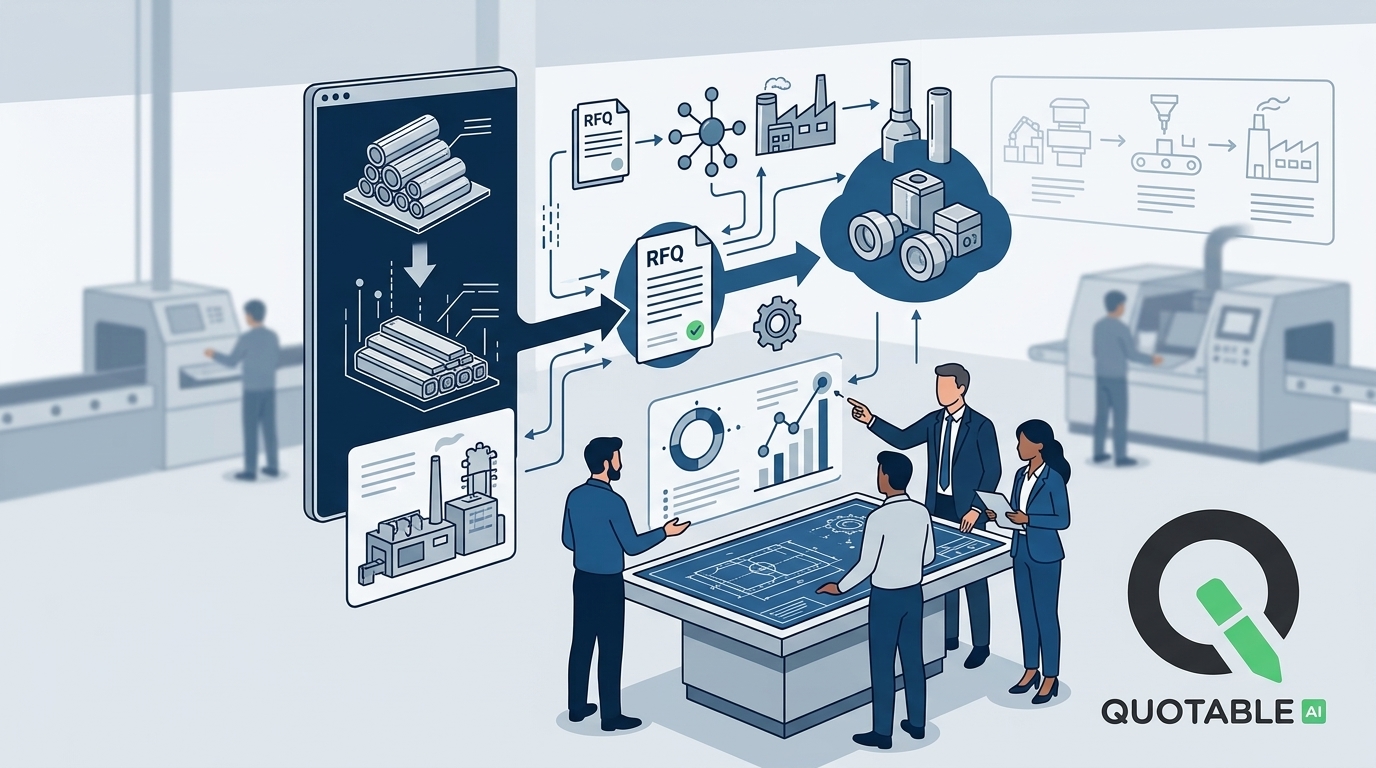
RFQ software built for manufacturing handles this complexity by giving both buyers and suppliers a structured framework for exchanging information. Instead of a PDF spec sheet attached to an email, you get a digital workflow where every field is standardized, every response is comparable, and every revision is tracked.
Moving Beyond Manual Spreadsheets and Email Silos
Most manufacturing companies we've worked with hit a breaking point somewhere around 30 to 50 active RFQs per month. Below that threshold, a procurement manager can keep things organized in Excel and Outlook. Above it, things start falling apart in predictable ways.
The red flags are easy to spot: duplicate quote requests sent to the same supplier, pricing inconsistencies between similar orders placed weeks apart, and a complete lack of audit trail when someone asks why you chose Supplier A over Supplier B. One procurement director at a $12M metal fabrication company told us they discovered they'd been paying 18% more than necessary on aluminum extrusions for over a year because nobody had compared the last six months of quotes side by side.
Email silos create another problem that's harder to quantify but equally damaging. When your quoting history lives in individual inboxes, institutional knowledge walks out the door every time someone leaves the company. A centralized RFQ platform keeps that data accessible, searchable, and useful for future negotiations.
The Quote as the Foundation of the Transaction State
Here's a concept that most ERP systems get wrong: they treat the quote as a preliminary document that gets discarded once a purchase order is created. In reality, the quote is the foundation of the entire transaction. It contains the agreed-upon price, the delivery terms, the specifications, and often the contractual obligations that govern the relationship.
When you treat the quote as a live transaction state, something interesting happens. Every downstream document, including the PO, the invoice, the shipping notice, and the payment, can trace its lineage back to the original quoted terms. Discrepancies surface immediately. If a supplier invoices $4.20 per unit but quoted $3.85, the system flags it before anyone cuts a check. This three-way match between quote, PO, and invoice is where manufacturing companies recover real money.
Key Features for Streamlining Production Workflows
Not all RFQ platforms are created equal, and the features that matter for a SaaS company buying laptops are very different from those needed by a manufacturer sourcing precision-machined components. Here's what to look for.
Automated Technical Specification Distribution
Manufacturing RFQs often include drawings, CAD files, material certifications, and detailed tolerance requirements. The right software lets you attach these documents to a structured request and distribute them to your approved supplier list with a single action.
The best platforms go further by parsing those documents automatically. For example, Quotable AI uses a universal AI parser that can extract structured data from bills of materials, spec sheets, and even handwritten purchase orders. This means your procurement team doesn't spend two hours manually entering line items from a 47-page BOM. The system reads the document, structures the data, and populates the RFQ fields. If you're processing more than a dozen complex RFQs per week, this feature alone can save 15 to 20 hours of manual encoding time monthly.
Real-Time Vendor Comparison and Scoring
Once quotes come back from suppliers, you need to compare them on more than just price. A $3.50 per unit quote with a 6-week lead time may be worse than a $3.75 quote with 2-week delivery if your production schedule can't absorb the delay.
Effective comparison tools let you weight criteria like unit cost, lead time, payment terms, minimum order quantity, and past delivery performance. Some platforms generate a composite score for each supplier response, giving your procurement team a defensible, data-backed recommendation rather than a gut feeling. This is especially important for companies subject to SOX compliance or internal audit requirements, where you need to document why a specific vendor was selected.
Integration with ERP and Inventory Systems
An RFQ tool that doesn't talk to your ERP is just another data silo. The most valuable manufacturing RFQ software connects directly to systems like SAP, NetSuite, QuickBooks, or industry-specific ERPs. This connection means that when a quote is accepted and converted to a PO, your inventory system already knows what's coming. Your accounting system already has the committed cost. Your production planning team already sees the expected delivery date.
Quotable AI, for instance, integrates with existing financial and ERP systems so companies can modernize their supplier collaboration without ripping out their current infrastructure. That's a critical consideration for mid-market manufacturers who've invested years configuring their ERP and can't afford a six-month migration project.
Vertically Integrated Data Orchestration for SMEs
Large enterprises have dedicated procurement departments with specialized tools for every stage of the supply chain. SMEs and mid-market manufacturers don't have that luxury. They need one system that handles multiple stages of the transaction lifecycle without requiring a team of administrators to maintain it.
Connecting Quoting, Procurement, and Fulfillment
The concept of vertical integration in software means connecting every step from the initial quote through procurement, fulfillment, and payment into a single continuous workflow. When these stages are handled by separate tools, or worse, separate spreadsheets, data gets lost in the handoffs.
Consider a typical scenario: your sales team quotes a customer using one tool, your procurement team sources materials using another, and your finance team invoices using a third. The customer's order changes midway through production. Now three systems need updating, and the person making the changes needs to remember exactly which fields to modify in each one. This is where errors creep in, and in manufacturing, errors have real costs. A wrong material spec can mean scrapped parts. A missed price update can mean negative margins on an entire production run.
A vertically integrated platform eliminates these handoff risks by keeping all transaction data in one place, linked from quote to payment.
Accelerating Mid-Market Production Cycles by 10X
The "10X faster" claim sounds aggressive, but the math checks out for specific workflows. If your current process for getting a quote from a new supplier takes 5 business days (send email, wait for response, clarify specs, get revised quote, enter into spreadsheet), and a structured RFQ platform compresses that to half a day, you've already achieved a 10X improvement on that specific step.
Multiply that across your entire quote-to-order cycle, and the cumulative effect is substantial. A mid-market manufacturer processing $20M in annual procurement might run 500 to 1,000 RFQs per year. If each one closes even two days faster, that's 1,000 to 2,000 business days of cycle time recovered across the organization. Translate that into earlier production starts, faster deliveries, and improved cash conversion cycles, and the ROI becomes obvious.
Optimizing the Quote-to-Payment Lifecycle
Most procurement software stops at the purchase order. But for manufacturing companies, the real friction often lives downstream, in invoicing, payment reconciliation, and collections.
Automating Invoicing and B2B Collections
Manual invoicing in manufacturing is particularly painful because of the complexity involved. A single order might have multiple line items with different unit prices, quantity-based discounts, freight charges, and tax calculations that vary by jurisdiction. Creating these invoices manually invites errors, and every error triggers a dispute that delays payment.
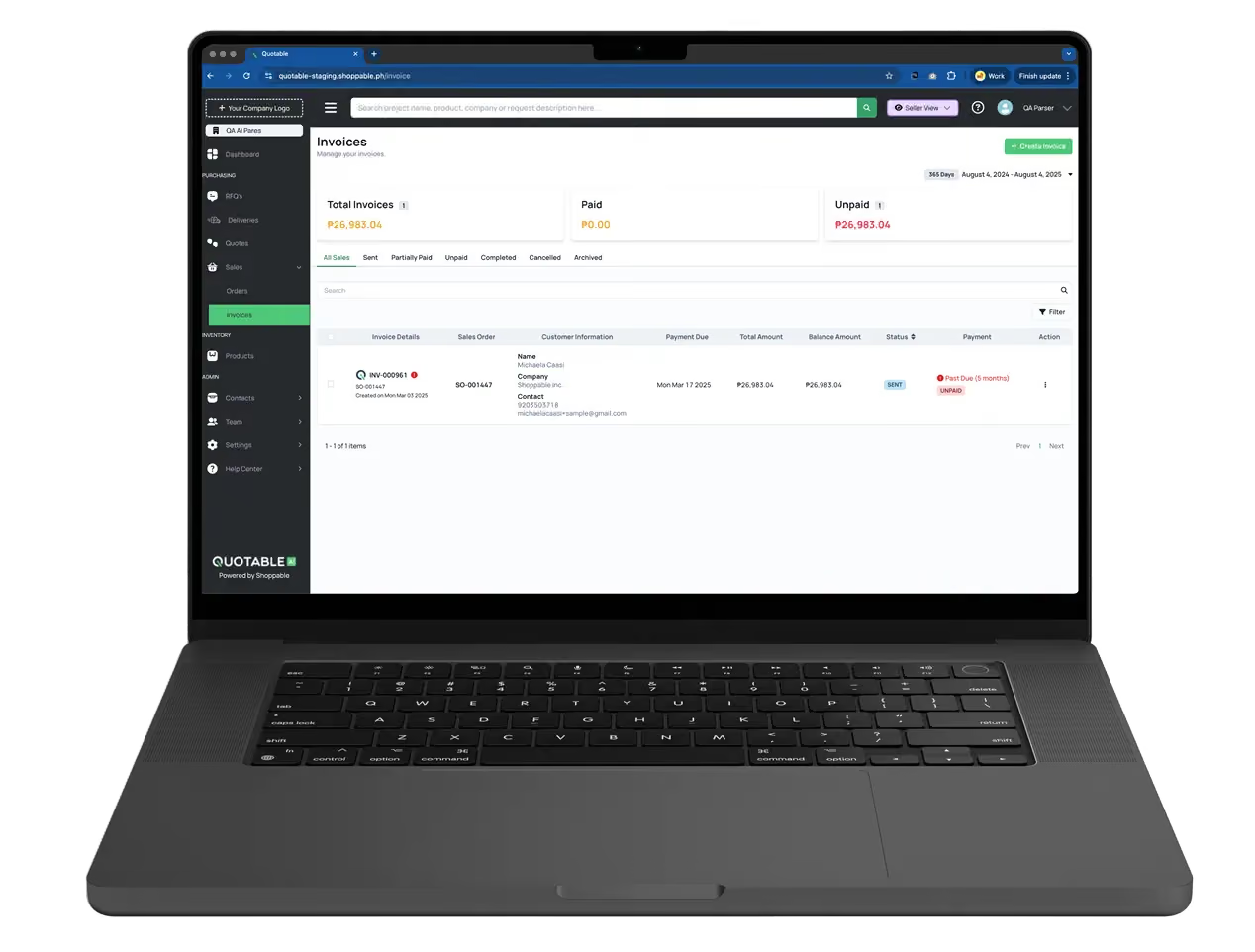
Automated invoicing pulls data directly from the accepted quote and purchase order, ensuring the invoice matches what was agreed upon. This eliminates the most common cause of payment delays: discrepancies between what the buyer expected and what the seller billed. Research from Ardent Partners consistently shows that invoice exceptions cost companies an average of $15 to $50 per invoice to resolve, and manufacturing companies with complex line items tend to land on the higher end of that range.
Quotable AI takes this a step further by embedding payment options directly into the invoice. Suppliers can get paid via bank wire, ACH, credit card, or e-wallet without the buyer needing to log into a separate system. The buyer clicks a secure link, reviews the invoice, and pays. No portal login required.
Reducing Financial Friction in Global Trade
If you're sourcing materials internationally, you're dealing with currency conversion, wire transfer fees, customs documentation, and payment terms that may span 30, 60, or 90 days. Each of these adds friction and cost to the transaction.
Tracking landed costs, including duties, freight, and foreign exchange impact, is essential for understanding your true cost of goods. A platform that links payment workflows with logistics data and documents like bills of lading and packing lists gives you visibility into these costs as they accrue, not weeks later when your accounting team reconciles the bank statement.
For manufacturers importing raw materials, even a 2% to 3% variance in landed cost can wipe out margins on a competitive bid. Having real-time visibility into these costs while the transaction is still in progress lets you make better decisions about supplier selection and pricing.
Strategic Benefits for Manufacturing Procurement Teams
Beyond the operational improvements, RFQ software creates strategic advantages that compound over time.
Enhanced Supplier Relationship Management
Your suppliers aren't just vendors. They're partners in your production process. The way you interact with them during the quoting process sets the tone for the entire relationship.
A structured RFQ platform makes it easier for suppliers to respond accurately and quickly. When suppliers can receive RFQs from multiple organizations in one place and submit structured quotations directly, they're more likely to prioritize your requests. Frictionless participation matters: if responding to your RFQ requires creating an account, downloading software, or filling out a 40-field registration form, your best suppliers will deprioritize you in favor of buyers who make it easy.
The best platforms let suppliers respond through a secure link without creating accounts. This seemingly small detail has an outsized impact on response rates. We've seen companies increase their supplier response rates by 30% to 40% simply by removing the login barrier.
Data-Driven Cost Reduction and Lead Time Precision
After six months of running RFQs through a centralized platform, you'll have a dataset that's worth its weight in gold. You'll know which suppliers consistently beat their quoted lead times, which ones frequently revise pricing upward after the initial quote, and where your cost per unit has trended over the past two quarters.
This data transforms procurement from a reactive function into a strategic one. Instead of accepting the first reasonable quote, your team can benchmark against historical data and negotiate from a position of strength. A procurement team at a $25M electronics manufacturer used 12 months of RFQ data to renegotiate contracts with their top five suppliers, achieving an average cost reduction of 8% to 12%. That's real money flowing straight to the bottom line.
Future-Proofing Production with AI-Powered RFQs
The next wave of manufacturing RFQ software is being shaped by artificial intelligence, and the applications go well beyond chatbots and auto-fill forms. AI is starting to predict which suppliers are most likely to win a given RFQ based on historical patterns, flag pricing anomalies before a PO is issued, and recommend optimal order quantities based on inventory levels and production forecasts.
For mid-market manufacturers, AI-powered tools are particularly valuable because they provide the kind of analytical capability that used to require a dedicated procurement analytics team. A platform that automatically extracts data from quotes, invoices, and purchase orders using AI parsing can build a rich dataset without requiring your team to do any extra work. The intelligence accumulates passively as you run your normal operations.
The companies that will thrive in the next decade of manufacturing aren't necessarily the ones with the biggest budgets. They're the ones that capture and use their transaction data most effectively. Every RFQ you process is a data point. Every supplier response is a signal. The question is whether that data is trapped in an email inbox or flowing through a system that can learn from it.
If you're running a manufacturing operation between $1M and $50M in revenue and you're still managing RFQs through email and spreadsheets, the cost of inaction is growing every quarter. Platforms like Quotable AI are purpose-built for this exact inflection point, connecting quoting, procurement, invoicing, and payment into a single workflow that scales with your business. Start by mapping your current quote-to-payment cycle, identify the bottlenecks, and evaluate whether a dedicated RFQ platform can close the gaps. The hard-won lesson from companies that have made this transition: the best time to fix your quoting process is before it becomes your biggest bottleneck, not after.