Every distributor or procurement team that's still managing quotes through email threads and spreadsheets is leaving money on the table. The friction isn't just annoying: it's expensive. Slow turnarounds, lost RFQs, miskeyed line items, and delayed payments compound into real revenue loss over a fiscal year. For SMEs processing hundreds of quotes monthly, the question isn't whether to automate your RFQ process but how quickly you can get it done. This piece breaks down the true cost of manual quoting, the architecture behind a modern quote-to-payment workflow, and the specific steps you can take to close deals faster. We've seen firsthand how companies doing $5M to $30M in annual sales hit a ceiling not because of demand, but because their back-office can't keep pace with their front-office promises. If that sounds familiar, you're in the right place.
The High Cost of Manual RFQ Management for Modern SMEs
Most business owners underestimate how much manual quoting actually costs them. It's not just the labor hours: it's the compounding effect of errors, delays, and missed opportunities that quietly erode margins. A single misquoted price on a 500-unit order can trigger weeks of back-and-forth corrections, strained supplier relationships, and sometimes contractual disputes. For companies in the $1M to $30M revenue range, these aren't edge cases. They're Tuesday.
The real danger is that manual processes feel manageable until they don't. You can handle 20 RFQs a week with a sharp ops manager and a well-organized inbox. But once you cross the 30-to-50-orders-per-month threshold, the cracks start showing: duplicate orders, version control nightmares, and invoices that don't match purchase orders. That's the breaking point where most teams realize their process needs a fundamental rethink.
Hidden Inefficiencies in Traditional Quote-to-Payment Cycles
Consider a typical quote-to-payment cycle at a mid-market distributor. A buyer sends an RFQ via email. A sales rep manually enters line items into a spreadsheet or legacy ERP. Someone else checks inventory or calls a supplier. A quote gets drafted, reviewed, revised, and finally sent back: often 48 to 72 hours later. If the buyer approves, a separate team creates the PO, another handles invoicing, and finance chases payment through yet another channel.
Each handoff introduces delay and error risk. One manufacturing company found that implementing a pre-defined digital form reduced manual errors by 65%, which tells you how error-prone the old way really is. Common mistakes include verbal changes to terms that never get documented, cost codes applied inconsistently across quotes, and pricing that doesn't reflect current supplier agreements.
The financial impact is measurable. APQC benchmarks suggest that best-in-class procurement organizations spend roughly $6 per purchase order, while laggards spend upward of $30. Multiply that gap across thousands of transactions per year, and you're looking at six figures in avoidable overhead.
The Impact of Slow Response Times on Win Rates
Speed kills in B2B sales: specifically, the lack of it kills your win rate. Buyers evaluating multiple suppliers will often go with the vendor who responds first with a credible, well-structured quote. If your team takes three days to turn around what a competitor delivers in three hours, you're not even in the conversation by the time the decision gets made.
Companies using automated quoting systems respond to RFQs three times faster than those relying on manual workflows. That speed advantage directly translates to higher win rates, especially in industries like construction and IT distribution where project timelines are tight and buyers can't afford to wait.
Here's a scenario that plays out constantly: a general contractor needs pricing on 200 SKUs of electrical components for a bid due Friday. They send the RFQ to three distributors on Monday. The distributor with an automated system returns a structured quote by Tuesday morning. The other two are still compiling pricing from suppliers on Wednesday. The contractor awards the order to the fast responder, and the other two never even knew they lost.
Building a Vertically Integrated Data Orchestration Layer
The phrase "vertically integrated data orchestration layer" sounds like enterprise jargon, but the concept is straightforward: your quoting, procurement, invoicing, and payment systems should share a single source of truth. Most SMEs operate with disconnected tools: one system for CRM, another for accounting, a spreadsheet for quoting, and email for everything in between. This fragmentation is the root cause of most operational pain.
What you actually need is an architecture where the quote itself becomes the central transaction object. Every downstream action: the purchase order, the invoice, the payment, the shipment tracking: ties back to that original quote. When one element changes, the rest update accordingly. This isn't a nice-to-have for companies scaling past $5M in revenue. It's the difference between controlled growth and operational chaos.
Treating the Quote as a Live Transaction State
Most systems treat the quote as a static document. You create it, send it, and then manually re-enter its data into your order management or invoicing tool. That's where errors creep in and time gets wasted. A smarter approach treats the quote as a live transaction state: a dynamic record that evolves as the deal progresses from inquiry to payment.
Think of it this way. When a buyer requests a change to line item quantities after the initial quote, that change should automatically ripple through to the associated PO, the invoice, and the payment terms. No re-keying. No version confusion. No "wait, which quote are we working off of?" conversations.
Quotable AI was built around this exact principle. Rather than bolting quoting onto an existing ERP or CRM, it treats the quote as the origin point of the entire transaction lifecycle. The quote carries structured data: SKUs, quantities, pricing, terms, delivery dates: that flows forward into procurement, fulfillment, and finance without manual intervention. For a distributor handling 100+ quotes per month, this eliminates hours of redundant data entry every week.
Connecting Quoting, Procurement, and Fulfillment Workflows
The real power of RFQ automation shows up when quoting connects directly to procurement and fulfillment. Here's what that looks like in practice:
- A buyer submits an RFQ through a centralized portal or email.
- The system parses the request, identifies required SKUs, and checks current supplier pricing.
- A quote is generated and sent to the buyer for approval.
- Upon approval, the system automatically creates a purchase order for the supplier.
- The supplier confirms, ships, and the system generates an invoice tied to the original quote.
- Payment is collected through embedded channels: ACH, wire, credit card, or e-wallet.
Each step references the same underlying data. If the buyer negotiated a 3% discount during the quoting phase, that discount carries through to the invoice and payment. If the supplier's lead time changes, the fulfillment timeline updates accordingly. This kind of connectivity is what separates companies that scale smoothly from those that hire more people to manage the same broken process.
For companies involved in international trade, this also means linking payment workflows with logistics documents: bills of lading, packing lists, and landed cost calculations that account for duties, freight, and FX impact. Without that connection, your margin on a deal can evaporate between the quote and the final payment.
Step-by-Step Guide to Automating Your RFQ Workflow
Getting from a manual process to an automated one doesn't require ripping out your entire tech stack. It does require a clear sequence of priorities and a willingness to standardize how your team handles quotes. Here's the practical roadmap.
Start by auditing your current workflow. Map every step from the moment an RFQ arrives to the moment you receive payment. Identify where data gets re-entered, where approvals stall, and where errors most frequently occur. Most teams find that 60% to 70% of their cycle time is spent on non-value-added activities: chasing approvals, reformatting documents, and reconciling discrepancies between quotes and invoices.
Centralizing Supplier and Distributor Communications
One of the most overlooked steps in automating RFQs is consolidating communication channels. If your buyers send RFQs via email, your suppliers respond through a portal, and your sales team tracks everything in a spreadsheet, you've already lost the thread. Centralization means every RFQ, quote, PO, and invoice lives in one system that all parties can access.
This doesn't mean forcing suppliers to adopt new software. Frictionless participation matters. Quotable AI, for example, lets suppliers respond to RFQs through a secure link without creating an account. The supplier sees the request, submits their pricing and lead times, and the buyer's team can compare responses side by side. No onboarding friction, no adoption barriers.
Red flags that your communication is too fragmented:
- You've received duplicate RFQs for the same project from different team members
- Supplier responses sit in individual inboxes instead of a shared workspace
- Your team spends more than 30 minutes per day searching for quote-related emails
- You've lost a deal because a supplier response went to someone's spam folder
Centralizing these communications is the single highest-ROI step most SMEs can take before investing in any AI or automation tooling.
Leveraging AI for Instant Quotation Generation
Once your communications are centralized, AI can dramatically accelerate the actual quote creation process. AI-powered document processing can reduce document creation time by up to 92%, and while that stat comes from government procurement, the principle applies directly to B2B quoting.
A universal AI parser can extract structured data from incoming RFQs: whether they arrive as PDFs, Excel files, or even unformatted emails: and map that data to your product catalog, current pricing, and inventory levels. Instead of a sales rep spending 45 minutes manually building a quote, the system generates a draft in minutes that the rep reviews and sends.
Here's what this looks like with real numbers. Say you're an IT distributor and a buyer sends an RFQ for 15 line items across three product categories. Manually, your team pulls up each item, checks current distributor pricing, calculates margins, applies any contract-specific discounts, and formats the quote. That's easily an hour of work. With AI-assisted quote generation, the system handles the data extraction and pricing lookup, and your rep spends five minutes reviewing the output before sending.
The accuracy gains matter just as much as the speed gains. Manual data entry on a 15-line-item quote has a meaningful error probability. Even a 2% error rate across hundreds of monthly quotes adds up to dozens of pricing mistakes per year: each one a potential margin leak or customer dispute.
Accelerating Deals Through Automated Invoicing and Payments
Closing a deal doesn't end when the buyer says "yes" to your quote. It ends when you get paid. And for many SMEs, the gap between quote acceptance and cash hitting the bank account is where deals go to die slowly. Automated invoicing and embedded payment options compress that gap from weeks to days, sometimes hours.
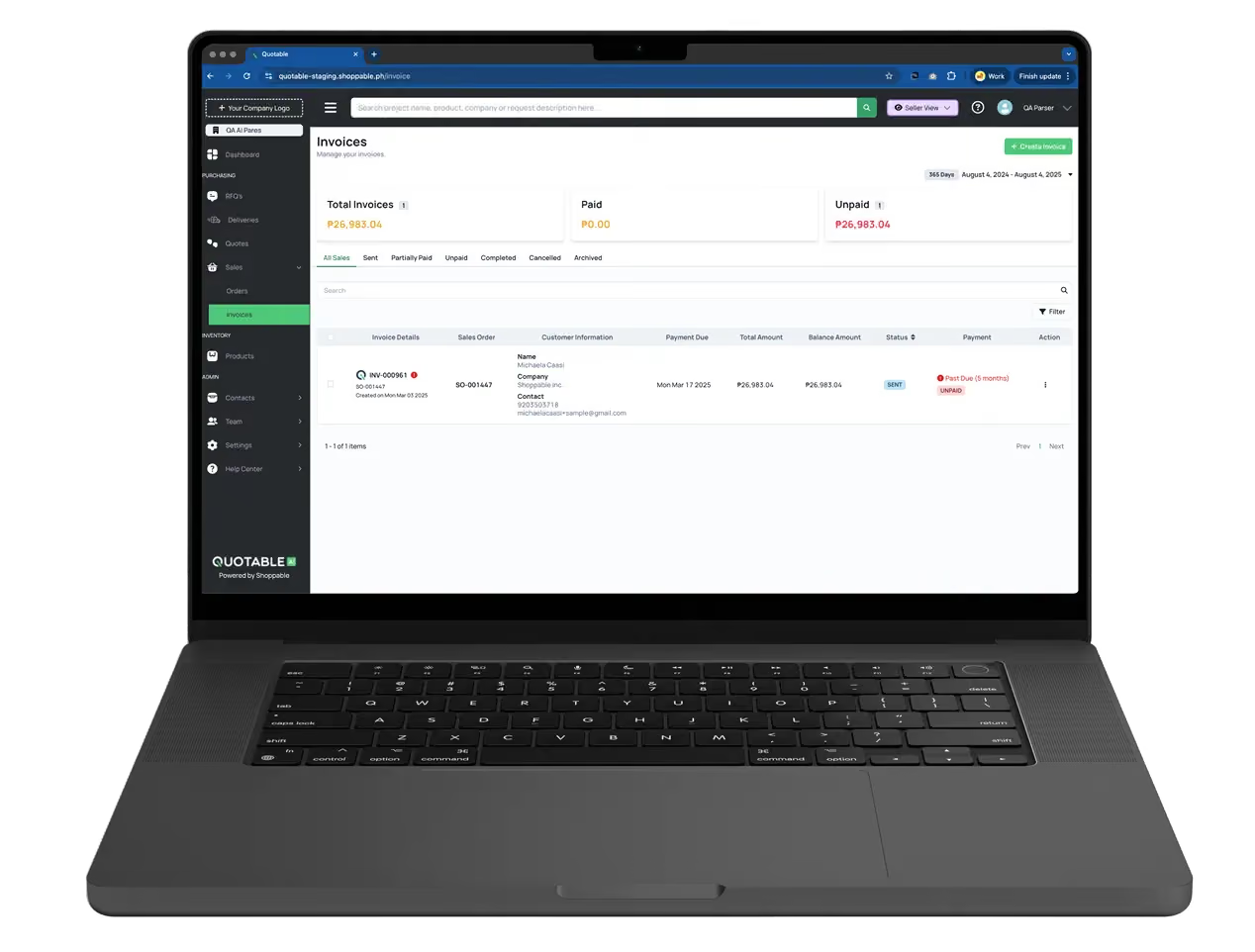
The key is eliminating the manual steps between a signed quote and a collected payment. When your invoicing system is connected to your quoting system, the invoice generates automatically from the approved quote data. Payment terms, line items, tax calculations, and buyer details all carry forward. The buyer receives a payment link: no login required: and can pay via bank wire, ACH, credit card, or e-wallet.
One manufacturing company achieved a 40% reduction in quotation processing and vendor selection time through RFQ-to-PO automation. That same logic applies to the PO-to-payment leg of the cycle. When you remove the manual handoffs between sales, operations, and finance, the entire transaction accelerates.
Bridging the Gap Between Finance and Sales Teams
A common dysfunction in SMEs is the wall between sales and finance. Sales closes the deal, tosses the paperwork over the fence, and finance spends days reconciling what was quoted against what was invoiced. Discrepancies trigger disputes, disputes delay payments, and delayed payments hurt cash flow.
The fix isn't better communication between departments: it's shared data. When both teams work from the same transaction record, the three-way match between quote, PO, and invoice happens automatically. Finance doesn't need to chase sales for missing cost codes. Sales doesn't need to explain why the invoice differs from the quote. The system enforces consistency.
This also has compliance implications. For companies subject to SOX or similar regulatory frameworks, an automated audit trail from quote to payment provides the documentation that auditors require. Manual processes create gaps in that trail: verbal agreements that never get recorded, pricing changes made in email threads that nobody archives, and payment terms that shift between the quote and the invoice without formal approval.
Scaling Operations Across Construction, IT, and Logistics
Different industries have different quoting complexities, but the underlying automation principles remain consistent. In construction, RFQs often involve hundreds of line items tied to specific project phases, with pricing that shifts based on material availability and delivery timelines. Automating RFQ handling in this context means connecting your quoting system to real-time supplier pricing and project management timelines.
IT distributors face a different challenge: high SKU counts, razor-thin margins, and buyers who expect same-day turnaround. For these companies, the speed advantage of automation isn't just nice: it's existential. If you can't quote faster than your competitor, you lose the deal. Period.
Logistics companies deal with yet another layer of complexity: quotes that depend on route optimization, fuel surcharges, customs documentation, and multi-currency pricing. Automating the RFQ process here means integrating quoting with logistics data, including bills of lading and landed cost calculations that account for duties and freight.
Across all three industries, the pattern is the same. Companies that process automation effectively achieve an average ROI of 250% within the first 24 months. The payback period is short because the inefficiencies being eliminated are so large. You're not shaving 5% off a well-run process. You're removing entire categories of waste: re-keying data, chasing approvals, correcting errors, and manually reconciling documents.
The key to scaling is choosing a system that adapts to your industry's specific document types and workflows without requiring custom development for every edge case. Quotable AI's universal document parser handles quotes, invoices, POs, and bills of materials across industries, which means a construction distributor and an IT reseller can both use the same platform without sacrificing the granularity their business requires.
Measuring Success: Achieving 10X Faster Transaction Speeds
The claim of "10X faster" sounds aggressive, but the math supports it when you measure the full cycle. A manual quote-to-payment cycle for a mid-market distributor typically runs 7 to 14 days: from RFQ receipt to cash collection. An automated cycle, where the quote generates in minutes, the PO creates automatically, the invoice sends on approval, and payment collects through an embedded link, can compress that to 1 to 2 days.
Track these specific metrics to measure your automation ROI:
- Quote turnaround time: hours from RFQ receipt to quote delivery
- Quote-to-order conversion rate: percentage of quotes that become orders
- Invoice accuracy rate: percentage of invoices that match the original quote without manual correction
- Days sales outstanding (DSO): average time from invoice to payment
- Cost per transaction: total labor and overhead per completed order
Set baselines before you automate, then measure again at 30, 60, and 90 days post-implementation. Most companies see the biggest gains in quote turnaround time and invoice accuracy within the first month. Conversion rate improvements take longer because they depend on your team actually using the speed advantage to follow up faster and compete more aggressively on timing.
The companies that get the most from RFQ automation aren't just the ones with the best technology. They're the ones that redesign their workflows around the automation rather than layering automation on top of broken processes. If your approval chain still requires three email sign-offs before a quote goes out, no software will fix that bottleneck. Fix the process first, then automate it.
Hard-won lesson from working with dozens of SMEs on this: start with your highest-volume, most standardized quote type. Automate that first, prove the ROI, and then expand to more complex scenarios. Trying to automate everything at once is how automation projects stall and die. Pick your beachhead, win it, and scale from there. If you're ready to see how a quote-to-payment platform can work for your specific workflow, Quotable AI offers a practical starting point: one system that connects your quotes, procurement, invoicing, and payments without replacing your existing ERP.