Construction has always been a business of relationships, deadlines, and razor-thin margins. A single delayed material shipment or a misquoted line item can cascade into weeks of lost productivity and tens of thousands in overruns. Yet for an industry projected to grow around 4-5% in 2026, the way most firms buy materials, manage suppliers, and process payments hasn't kept pace with the complexity of the projects they're building. The procurement function sits at the center of this tension. It's the connective tissue between estimating, field operations, and finance, and it's where the biggest gains (and the biggest losses) hide. If you're running a distribution business selling into construction or managing purchasing for a mid-market contractor, the opportunity to rethink how procurement works isn't theoretical. It's urgent, and the tools to act on it finally exist.
The Evolution of Construction Procurement in a Digital Economy
The construction sector has historically lagged behind manufacturing and retail in adopting digital procurement systems. Part of this is structural: projects are temporary, teams are assembled and disbanded, and the supply chain shifts with every new job. But the cost of sticking with manual processes is becoming impossible to ignore. With construction input prices rising 2.8% overall and the US industry facing a shortfall of roughly 500,000 new workers by 2026, doing more with fewer people isn't optional. It's a survival requirement.
The firms that treat procurement as a strategic function rather than an administrative afterthought are the ones pulling ahead. They're shortening cycle times, locking in better pricing, and keeping projects on schedule because their purchasing workflows don't depend on someone remembering to follow up on an email.
Overcoming Fragmentation in Traditional Project Bidding
A typical construction project involves dozens of suppliers, multiple bid rounds, and a constant back-and-forth between estimators, project managers, and purchasing agents. The process often starts with a bill of materials extracted from plans, which gets emailed to a handful of known suppliers. Responses come back in different formats: some as PDFs, others as spreadsheets, and a few as phone calls with verbal pricing.
This fragmentation creates real problems. Price comparisons take hours instead of minutes. Lead times get buried in email threads. And when a project manager needs to substitute a material mid-build, the whole cycle restarts from scratch. One client we worked with, a mid-size mechanical contractor, estimated they were spending 12 hours per week just normalizing supplier quotes into a format their team could compare. That's 600 hours a year of pure administrative drag.
The root cause isn't laziness or incompetence. It's that the tools most construction firms use were never designed for the way purchasing actually happens on a jobsite. ERPs handle accounting well, but they're terrible at managing the messy, iterative process of getting three quotes for a valve assembly by Thursday.
The Shift Toward Quote-Centric Workflows
Here's a hard-won lesson from working with B2B distributors and contractors: the quote is where the real transaction begins, not the purchase order. By the time a PO is issued, 80% of the decisions have already been made. The supplier is chosen, the price is set, and the delivery date is locked. Everything downstream is just execution.
This realization is driving a shift toward quote-centric workflows where the quotation itself becomes the central document in the procurement cycle. Instead of treating quotes as disposable artifacts that get replaced by POs, forward-thinking firms are building their processes around them. A quote captures scope, pricing, terms, and availability in a single snapshot. When you treat it as the starting point for procurement, you eliminate redundant data entry and reduce the risk of transcription errors that cause wrong orders.
The shift also changes how suppliers participate. Rather than responding to vague RFQs with boilerplate pricing, suppliers can submit structured, comparable quotations that procurement teams actually use. This is where platforms like Quotable AI make a practical difference: suppliers can respond to RFQs through a secure link without creating accounts, which means procurement teams collect responses faster and with less friction.
Bridging the Gap Between Quoting and Procurement
Most construction firms operate with a visible gap between their quoting process and their purchasing process. Estimators build quotes using one system, purchasing agents issue POs in another, and finance reconciles everything in a third. Each handoff introduces delay and the potential for errors. If you've ever seen a project where the field team ordered 500 linear feet of conduit but the original quote specified 500 meters, you know exactly how expensive these gaps can be.
Closing this gap requires more than just better software. It requires rethinking the relationship between a quote and a purchase order as two states of the same transaction rather than two separate documents managed by two separate teams.
Treating the Quote as a Live Transaction State
Think of a quote not as a static PDF but as a living record that evolves through the procurement lifecycle. It starts as a request, becomes a priced offer, transforms into an approved purchase, and eventually resolves as a paid invoice. Each stage adds information without discarding what came before.
This approach solves a common mistake we see in construction purchasing: verbal changes to terms that never make it into the documentation. A project manager calls a supplier, negotiates a 5% discount for early payment, and the change lives only in someone's memory until it causes a dispute during invoice reconciliation. When the quote is the persistent record, every modification is tracked, timestamped, and visible to all parties.
From a compliance standpoint, this matters enormously. Construction firms subject to audit requirements or working on public projects need clear documentation trails. A live transaction state provides that audit trail automatically, from initial RFQ through final payment, without requiring anyone to manually assemble records after the fact.
Accelerating Supplier Selection for SMEs and Mid-Market Firms
Supplier selection in construction often defaults to familiarity rather than value. You call the three suppliers you've always used, take the lowest price, and move on. This works until it doesn't: until your preferred supplier can't meet a lead time, or their pricing has drifted 15% above market without you noticing.
For SMEs and mid-market firms buying $10M to $50M in materials annually, even small improvements in supplier selection compound quickly. A 3% savings on material costs for a firm spending $20M per year is $600,000 back in your pocket. That's not a rounding error. That's the difference between a profitable year and a break-even one.
The key is making it easy to collect and compare structured quotes from a broader supplier base. This means:
- Sending RFQs to five or six suppliers instead of your usual three, without tripling your administrative workload
- Receiving responses in a standardized format so you can compare unit prices, lead times, and payment terms side by side
- Tracking supplier performance over time so you can identify which vendors consistently deliver on time and which ones don't
Quotable AI's centralized RFQ management lets suppliers receive requests from multiple organizations in one place and submit structured quotations directly. For buyers, this means faster comparisons. For suppliers, it means a chance to compete on merit rather than just on relationships.
Leveraging AI for Data Orchestration and Fulfillment
AI in construction procurement isn't about replacing human judgment. It's about eliminating the hours of manual data processing that prevent your team from exercising that judgment effectively. When a purchasing officer spends half their day copying line items from supplier quotes into a spreadsheet, they're not evaluating suppliers. They're doing data entry.
AI applications in construction are expected to deliver cost savings of 10-20% on projects through better planning, reduced waste, and faster decision cycles. In procurement specifically, the gains come from automating the repetitive work that currently bogs down every transaction.
Automating Sales Quotations and Purchasing Cycles
Consider the lifecycle of a typical material purchase for a commercial construction project. An estimator identifies a need for 200 units of a specific steel bracket. They create an RFQ, send it to suppliers, wait for responses, compare pricing, select a vendor, issue a PO, confirm delivery, receive the goods, match the invoice to the PO, and process payment. That's at least ten distinct steps, each involving manual data handling.
Automation doesn't eliminate these steps, but it compresses them dramatically. A Universal AI Parser, like the one Quotable AI uses, can automatically extract and structure data from quotes, invoices, purchase orders, and bills of materials. Instead of manually keying in 200 line items from a supplier's PDF quote, the system reads the document, maps the data to your cost codes, and presents it for review. What used to take 45 minutes takes three.
The real power shows up at scale. If your firm processes 50 to 100 purchase orders per month, that's the breaking point where manual processes start generating duplicate orders, missed approvals, and visibility gaps. Automated workflows catch these issues before they become expensive problems.
Integrating Logistics and Shipping into the Procurement Loop
Procurement in construction doesn't end when the PO is issued. Materials need to arrive at the right jobsite, at the right time, in the right quantities. Yet most procurement systems treat logistics as someone else's problem, creating a blind spot between "ordered" and "received."
This blind spot is particularly costly in construction, where storage space on site is limited and delivery timing is critical. If 10,000 pounds of rebar shows up a week early, you're paying for crane time to move it twice. If it shows up a week late, your crew is standing around waiting.
Linking procurement data with logistics data, including shipping documents, bills of lading, and packing lists, gives purchasing teams real-time visibility into where materials are and when they'll arrive. This is especially important for firms importing materials, where tracking landed costs (duties, freight, and foreign exchange impact) determines whether a purchase was actually cheaper than a domestic alternative. A $50,000 order from overseas that looks like a 20% savings can evaporate quickly when you add $8,000 in freight, $3,000 in duties, and a 2% currency swing.
Streamlining Financial Operations from Quote to Payment
Finance teams in construction companies often operate in a state of perpetual catch-up. They're reconciling invoices against POs that don't quite match, chasing approvals from project managers who are on site, and manually processing payments through banking portals. The disconnect between procurement and finance isn't just inefficient: it's a source of real financial risk.
Automated procurement workflows reduce material waste by 30% and cut emergency order premiums by 64%. Those numbers tell a clear story about what happens when purchasing and finance operate from the same data.
Consolidating Invoicing and B2B Payments in One System
The typical payment process for a construction material purchase involves at least four separate systems: the procurement platform (or email), the ERP, the accounting software, and the banking portal. Each system requires its own login, its own data entry, and its own reconciliation. For a firm processing 200 invoices per month, that's a staggering amount of redundant work.
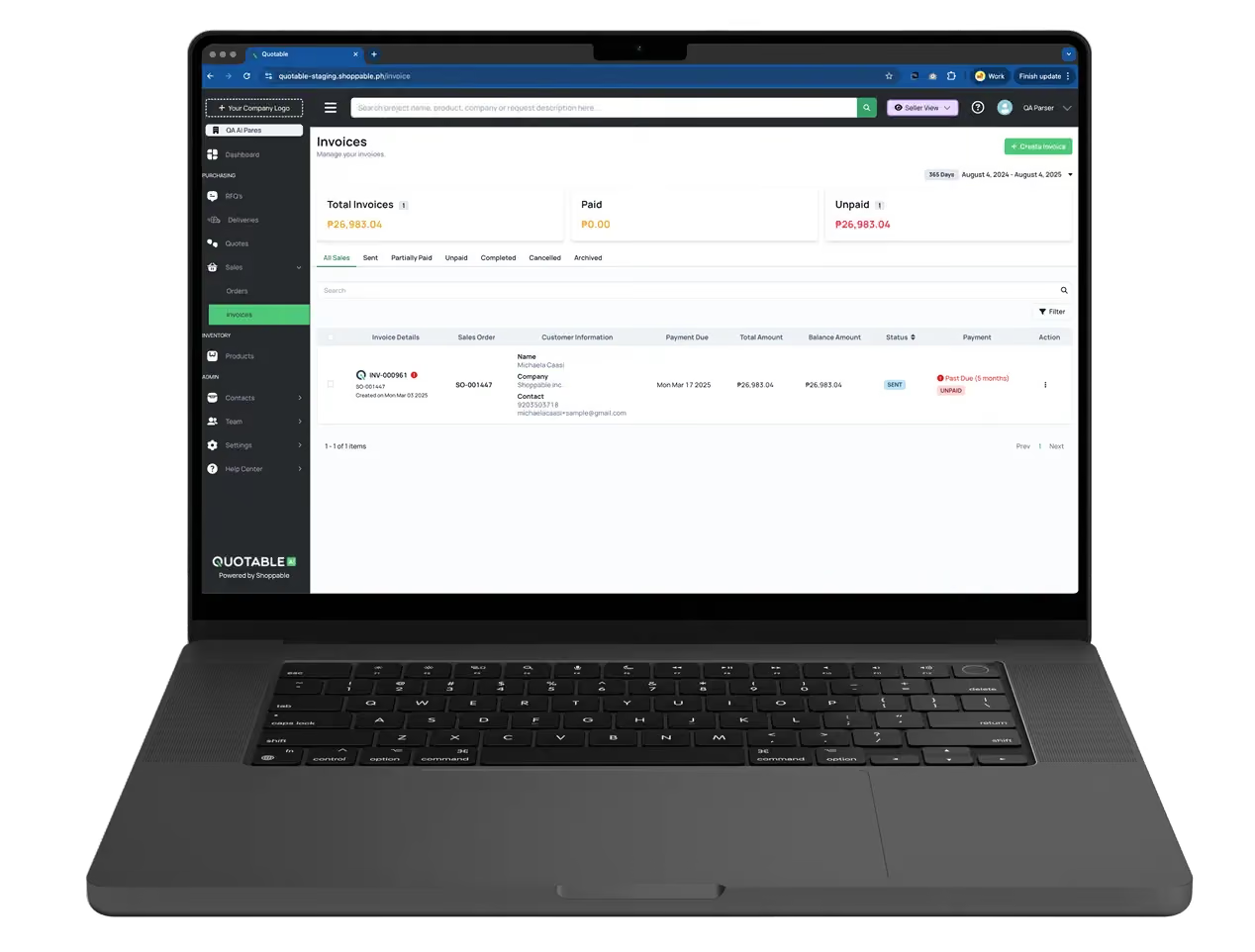
Consolidating invoicing and payments into the same system where quotes and POs originate eliminates the three-way match headache that plagues most finance teams. When the quote, PO, and invoice all live in one place, discrepancies surface immediately rather than weeks later during month-end close. Quotable AI handles this by embedding payment options (bank wire, ACH, credit cards, and e-wallets) directly into the transaction flow, so suppliers get paid through the same platform where they submitted their quotes.
For suppliers, this means faster payment. For buyers, it means fewer late-payment penalties and better negotiating position for early-payment discounts. Both sides win.
Reducing Friction for Finance Teams and Purchasing Officers
Here are the red flags that signal your procurement-to-payment process is breaking down:
- Invoice disputes exceeding 5% of total payables
- Average payment cycle longer than 45 days despite net-30 terms
- Duplicate payments discovered during quarterly audits
- Project managers approving invoices for amounts that don't match the original quote
- Finance staff spending more than 20% of their time on manual reconciliation
Each of these symptoms points to the same root cause: disconnected systems that force humans to be the integration layer. When your purchasing officer has to manually verify that an invoice matches a PO that matches an original quote, errors are inevitable. The question isn't whether mistakes will happen but how many and how expensive.
The fix isn't hiring more people. It's connecting the systems so that data flows from quote to PO to invoice to payment without manual re-entry at each stage. ERP integration is essential here: you don't need to replace your existing financial infrastructure, but you do need a layer that connects supplier collaboration with your accounting system. This is precisely where platforms designed for construction procurement add value, by sitting between your suppliers and your ERP and keeping both sides synchronized.
Achieving 10X Faster Cycles with Vertically Integrated Systems
The phrase "10X faster" sounds like marketing hyperbole until you map out the actual time spent on a procurement cycle. A manual process from RFQ to payment typically takes 15 to 25 business days for a mid-market construction firm. A vertically integrated system that connects quoting, purchasing, logistics, and payments can compress that to two or three days. That's not a marginal improvement. That's a structural advantage.
The construction firms that will thrive through 2026 and beyond are the ones treating their supply chain as a competitive weapon. As one industry analyst put it, your supply chain is your biggest vulnerability or your strongest competitive advantage in 2026. The difference comes down to whether your procurement process is a series of disconnected manual steps or a continuous, data-driven workflow.
If you're running a distribution business selling into construction or managing purchasing for a mid-market contractor, the path forward is clear. Start with the quote. Build your procurement workflow around it. Connect it to your financial systems. And stop asking your team to be the glue that holds disconnected tools together. Quotable AI was built for exactly this problem: turning the quote into the operating system for your entire transaction lifecycle, from first request to final payment. The firms that make this shift now won't just save time. They'll win projects their competitors can't profitably execute.