The best way for an Australian business to pay a Philippine business is usually a regulated cross-border payment platform that shows the complete AUD-to-PHP cost before approval: the exchange rate, fees, and exact amount the supplier is expected to receive. A bank SWIFT transfer can still be the right route for documentary trade payments, unusual currencies, or suppliers that specifically request an international wire. The right decision is not the provider with the lowest advertised fee. It is the route that delivers the required Philippine peso amount, on time, with records your finance team can reconcile.
This guide is for Australian businesses paying Philippine suppliers, manufacturers, service providers, contractors, and operating partners. It focuses on business-to-business bank payments—not family remittances, cash pickup, or consumer wallets.
Main takeaways
- Compare the supplier's expected PHP receipt, not only the transfer fee. FX margins and intermediary deductions can cost more than the visible fee.
- For recurring PHP invoices, a business payment platform using an approved local payout route is often the practical default. It can provide clearer pricing and fewer intermediary deductions than a traditional wire.
- Use SWIFT when the commercial arrangement calls for it. Examples include a supplier requesting a foreign-currency account, a documentary trade process, or a bank-controlled payment instruction.
- Confirm the invoice currency before sending. Paying a PHP invoice in AUD or USD can shift conversion costs and shortfall risk to the supplier.
- Keep the payment connected to its commercial purpose. The invoice, purchase order, beneficiary details, approval, rate, and payment confirmation should be reviewable together.
Why a business payment is different from a personal remittance
A personal transfer is normally judged by speed and the amount received. A business transfer has more dependencies. The Australian payer may need an approved invoice or purchase order, verified beneficiary details, a payment purpose, internal approval, and evidence for accounting. The Philippine recipient may need the invoice number in the payment reference and a predictable net amount to release an order or mark an account as paid.
This changes the definition of “best.” A fast transfer is not helpful if the supplier receives less than the invoice amount. A low advertised fee is not a saving if the exchange rate contains a wide markup. A convenient app is not an operating system if the finance team must later reconstruct who approved the payment and which invoice it settled.
For a B2B payment, evaluate four outcomes together:
- The total AUD amount debited.
- The estimated or guaranteed PHP amount credited.
- The expected delivery time and payment-status visibility.
- The quality of the approval and reconciliation record.
How an AUD-to-PHP business payment works
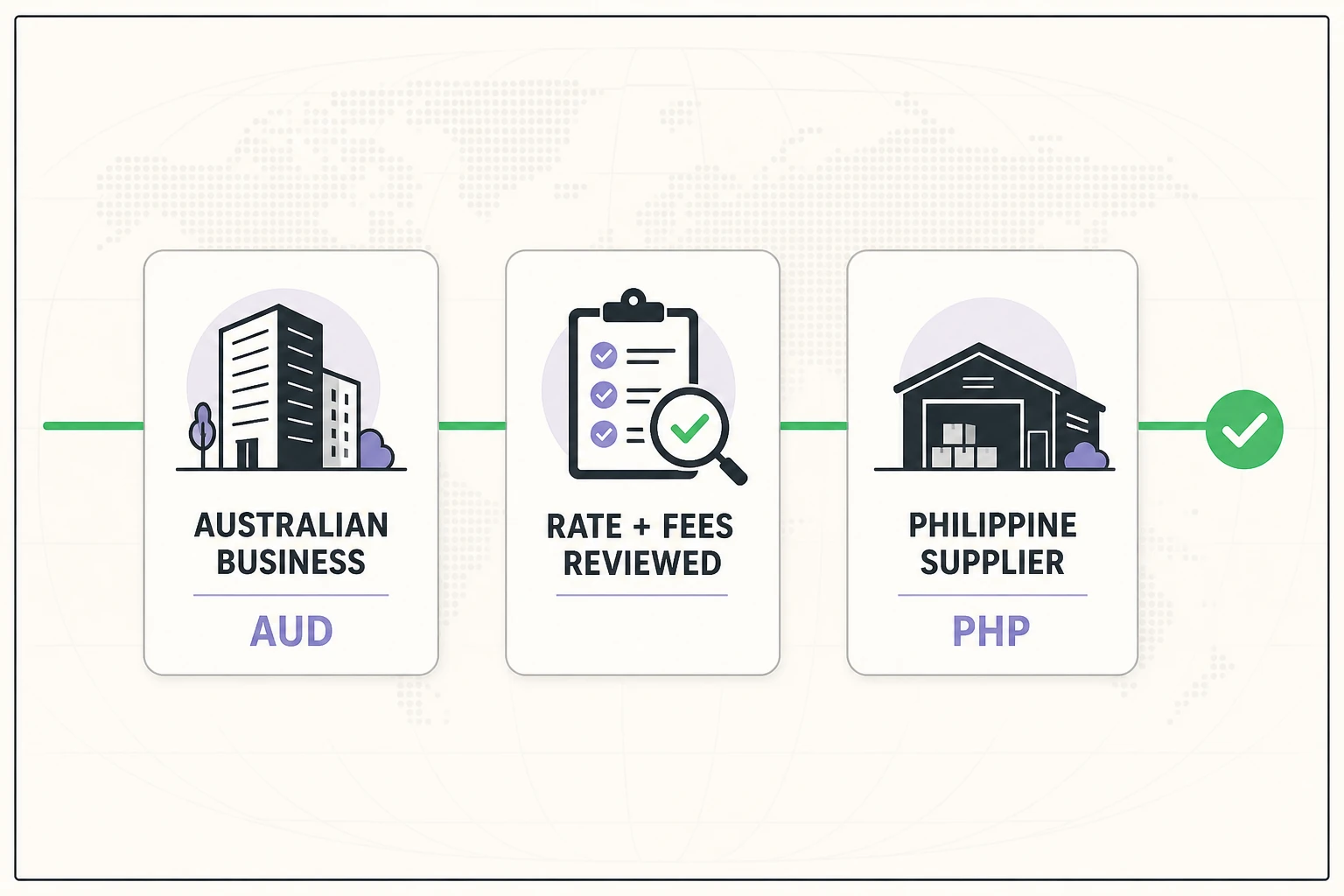
The basic journey has four stages. First, the Australian business funds the payment in AUD. Second, the provider converts AUD to PHP at the quoted rate. Third, the payment crosses the provider's international network. Fourth, the money is credited to the supplier's Philippine bank account through an eligible payout route.
The final leg may use a Philippine domestic payment rail when the recipient bank, amount, and provider setup are eligible. BSP describes InstaPay as a near-real-time, 24/7 service with a PHP 50,000 limit per transaction, while PESONet is designed for larger and business transfers. An Australian sender does not normally choose a Philippine rail directly. The bank or payment provider selects an available route based on the beneficiary, value, cut-off time, and approved account setup.
A traditional SWIFT transfer works differently. The Australian bank sends an international payment instruction that may pass through one or more correspondent banks before reaching the recipient bank. This route is widely accepted, but intermediary deductions and variable delivery times can make the final PHP receipt less predictable.
Bank wire vs business payment platform
| Method | Best for | Cost visibility | Supplier receipt | Main operational drawback |
|---|---|---|---|---|
| Australian bank SWIFT transfer | Occasional wires, documentary trade, or a supplier requesting foreign-currency receipt | Transfer fee may be visible, but the FX margin and correspondent deductions may be harder to isolate | Can arrive in PHP or another supported account currency | Intermediary fees, longer routing, and manual reconciliation |
| Traditional money-transfer provider | One-off transfers where the business only needs a basic send-and-receive service | Usually shows a rate and fee before sending | Often supports PHP bank deposit | May lack business approvals, invoice context, or accounting-ready records |
| Business cross-border payment platform with PHP payout | Recurring supplier invoices and operating payments | Can show the AUD debit, FX rate, fees, and expected PHP receipt before approval | Designed to credit an eligible Philippine bank account in PHP | Availability, limits, and timing still depend on the approved corridor and beneficiary |
| Foreign-currency SWIFT payment | A Philippine supplier invoicing into a USD, AUD, or other foreign-currency account | Depends on the sending bank and conversion point | Supplier receives the invoice currency if its account accepts it | The supplier may face incoming-bank fees or a later conversion cost |
The Australian Competition and Consumer Commission advises senders to compare the total price and the amount the recipient gets—not simply the headline fee. Its foreign-currency guidance warns that exchange-rate margins, correspondent-bank fees, and recipient-bank fees can all affect the result.
A worked A$10,000 example
The best public corridor benchmark is historical rather than a live quote. In its 2024 update on international money-transfer competition, the ACCC sampled the cost of sending A$10,000 to the Philippines. The average cost was 4.49% through the big four banks, 1.79% through traditional international-transfer suppliers, and 0.87% through fintech suppliers.
| Supplier group | ACCC average cost percentage | Approximate cost on A$10,000 |
|---|---|---|
| Big four banks | 4.49% | A$449 |
| Traditional international-transfer suppliers | 1.79% | A$179 |
| Fintech suppliers | 0.87% | A$87 |
On that historical sample, the difference between the big-four average and fintech average was about A$362 per transfer. If a business made one comparable payment every month, the illustrative difference would be A$4,344 over a year.
This is not a 2026 provider quote or a promise of savings. The ACCC collected the underlying prices in early 2024, and its analysis excluded receiving-bank fees. Actual cost depends on the date, payment value, provider, beneficiary bank, and approved route. Use the example to understand why a zero-dollar transfer fee does not prove that a transfer is inexpensive. Ask for a current quote showing the final PHP amount.
Choose the route by payment scenario
Recurring Philippine supplier invoices
Start with a business cross-border platform that can quote the expected PHP receipt before approval and retain the invoice reference. This is normally the best fit for inventory, manufacturing, freight, professional services, and recurring operating payments. A repeatable beneficiary and approval workflow matters as much as the rate.
A supplier invoices in USD or AUD
Do not automatically convert the invoice to PHP. Ask which account currency the supplier expects and who should bear the conversion cost. If the supplier operates a valid foreign-currency account and wants the invoice currency, a SWIFT payment may avoid an unnecessary conversion. Confirm incoming fees and whether the supplier's bank requires intermediary details.
A time-sensitive, lower-value PHP payment
Ask the provider whether the beneficiary is eligible for a fast local payout. Do not split a larger business invoice into smaller payments merely to fit a rail limit. That can create reconciliation problems and may trigger additional reviews. Use the route and payment structure approved for the transaction.
A documentary or bank-controlled trade payment
Use the banking route required by the commercial documents. A cross-border platform does not replace a letter of credit, documentary collection, or other bank instrument. The payment method must match the contract, invoice, and supplier instructions.
Seven checks before paying a Philippine business
- Match the legal beneficiary to the invoice. Confirm the registered business name, account name, bank, account number, and SWIFT or local bank identifiers where required.
- Verify changed bank details out of band. If a supplier emails new instructions, confirm them through a known phone number or established contact—not by replying to the same email thread.
- Confirm the invoice currency. Agree whether the supplier must receive PHP, AUD, USD, or another currency and whether the invoice amount must arrive net of fees.
- Compare like-for-like quotes. Capture the AUD debit, rate, fees, expected PHP receipt, quote expiry, and delivery estimate at the same time.
- Use a regulated provider. MoneySmart advises checking that an Australian money-transfer business is registered with AUSTRAC and comparing rates, margins, fees, limits, and delivery times.
- Apply the correct approval. Higher-value, first-time, or changed-beneficiary payments should receive additional review under your company's controls.
- Reconcile the result. Save the quote, confirmation, payment reference, recipient amount, invoice, and approver record together.
What AUSTRAC reporting means for the sender
International transfers are subject to compliance screening and reporting. Under AUSTRAC's international funds transfer instruction rules, the reporting institution generally submits the IFTI report within 10 business days. That does not mean every ordinary Australian business must separately file an IFTI for each supplier payment.
Your responsibility is to give the bank or provider accurate information and retain appropriate commercial records. Expect requests for the payment purpose, invoice, beneficiary, ownership information, or source of funds—especially for a new recipient, unusual value, or changed payment pattern. A compliance review is not the same thing as a failed payment; it is a reason to build sufficient time into the payment schedule.
Where Quotable Payments fits
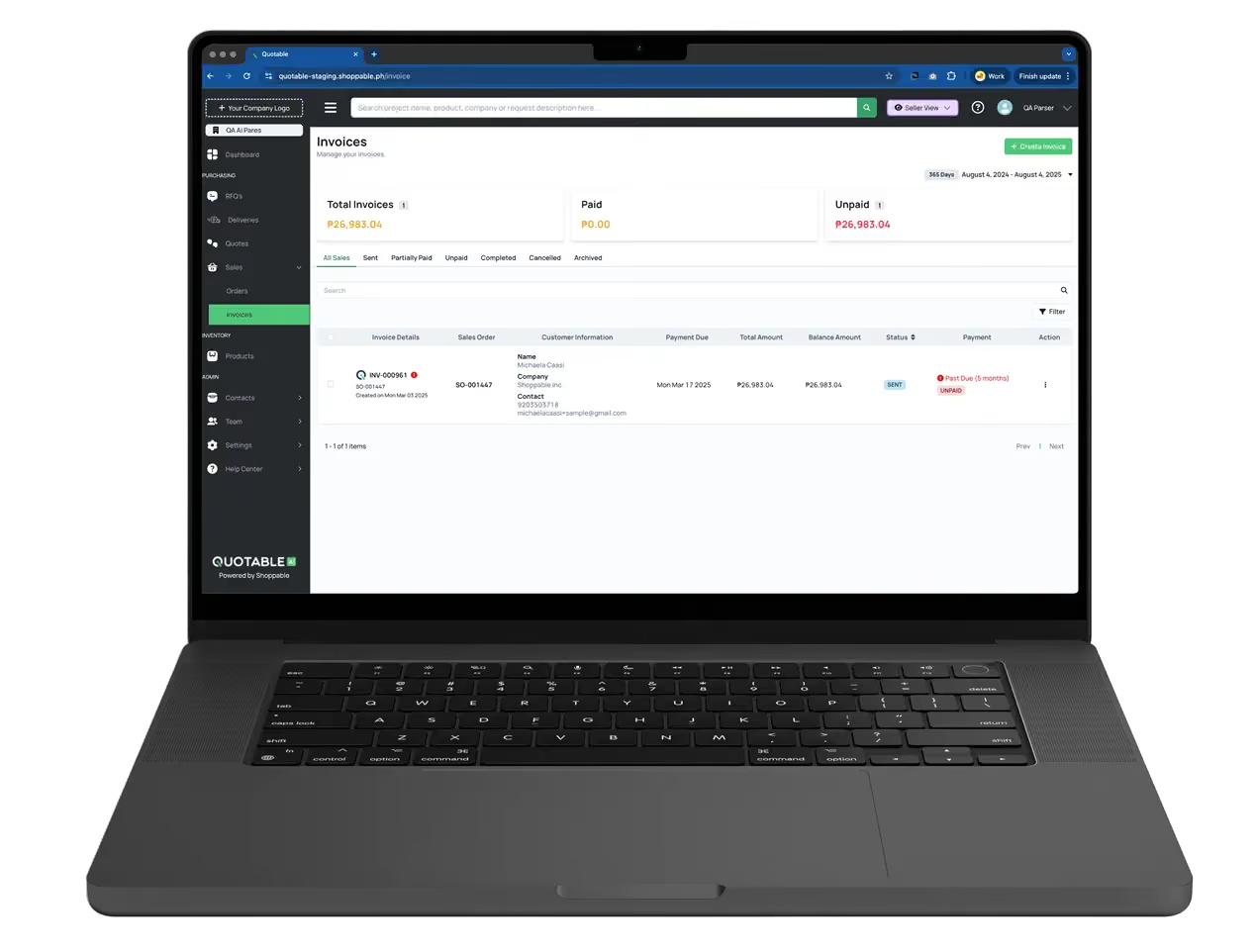
Quotable Payments is built for businesses that want the international payment and the commercial record around it in one workflow. Before an approved payment is submitted, a team can review the applicable route, FX rate, fees, and estimated recipient amount. When a quote, purchase order, or invoice exists, the payment can remain connected to that source record for approval and reconciliation.
Quotable currently presents AUD and PHP among its supported currencies and supports approved payments across 140+ currencies and 200+ countries, with supported balances in 35+ currencies. That does not guarantee a specific AUD-to-PHP route for every business. Quotable Payments is onboarding eligible businesses through its pilot, and final availability, limits, pricing, and receiving method depend on the business, jurisdiction, beneficiary, and approved setup.
Request an AUD-to-PHP corridor and pricing review. Bring a representative invoice, typical transfer value, expected monthly volume, required recipient currency, and beneficiary bank details. The team can confirm whether the route fits before you change your payment process.
When your bank may still be the better option
A specialist platform is not automatically best. Keep the bank route when a transaction depends on trade-finance instruments, the supplier contract specifies SWIFT or a particular intermediary, the beneficiary requires a foreign-currency wire, or the provider cannot support the approved corridor. An established bank may also be operationally simpler for a genuinely rare payment where the cost of introducing a new provider exceeds the likely savings.
The practical approach is to maintain an approved primary route and an approved fallback. Compare them periodically using real invoices, not promotional rates. Rates and route availability change; your payment policy should define who can select a route and what evidence must be retained.
Related AUD-to-PHP payment definitions
Use the glossary guides for payment corridor, currency pair, FX markup, total transfer cost, Recipient amount and beneficiary verification.
Request an AUD-to-PHP corridor review
Frequently asked questions
What is the cheapest way to transfer money from Australia to the Philippines for business?
There is no provider that is cheapest for every amount and beneficiary. For recurring PHP supplier payments, regulated business payment platforms often cost less than major-bank wires, but compare the complete AUD debit and expected PHP receipt. The ACCC's 2024 sample found a lower average cost among fintech suppliers than big-four banks for A$10,000 transfers to the Philippines, but a current quote is required.
Should an Australian business pay a Philippine supplier in PHP, AUD, or USD?
Pay in the invoice currency unless both parties agree otherwise. PHP is usually clearest when the supplier prices and operates in pesos. USD or AUD may make sense when the supplier has an appropriate foreign-currency account and intentionally invoices in that currency. Confirm who bears conversion and incoming-bank fees before sending.
How long does an Australia-to-Philippines business transfer take?
Timing varies by provider, cut-off time, compliance review, funding method, beneficiary bank, and payout route. A supported local payout may arrive the same day or next business day, while a SWIFT payment may take several business days. Treat the provider's estimate as conditional until the route and beneficiary are confirmed.
Can an Australian business use InstaPay or PESONet directly?
Usually not as the originating international sender. InstaPay and PESONet are Philippine domestic payment rails. An Australian bank or cross-border provider may use an eligible local rail for the last leg of the payment, depending on the recipient, value, and provider setup.
What information is needed to pay a Philippine business?
Common requirements include the beneficiary's legal name, address, bank name, account number, account currency, SWIFT or local bank identifiers when applicable, invoice, payment purpose, and a payment reference. The provider may request additional ownership, source-of-funds, or commercial documents.
Does an Australian business have to file an AUSTRAC report for every international supplier payment?
Generally, the reporting bank or payment provider submits the international funds transfer instruction report—not the ordinary business customer. The business must provide accurate payment information and retain its accounting and commercial records. Seek professional advice if your business has separate AML/CTF obligations.
Does the Philippine supplier need a Quotable account?
Not necessarily. Eligible payments can be sent to an approved beneficiary bank account. Availability depends on the business, currency corridor, beneficiary, and approved Quotable Payments setup, so confirm the route during onboarding.