Every procurement team has a version of the same story: a buyer emails five suppliers for pricing, waits days for responses, manually compares quotes in a spreadsheet, and then re-keys the winning bid into an ERP. By the time a purchase order is issued, the original pricing may have shifted, a better supplier was overlooked, or the project timeline already slipped. This friction isn't just annoying; it's expensive. A mid-size industrial company processing around 100 RFQs per week can save approximately $195,000 annually by automating that workflow. RFQ software exists to close the gap between "we need a quote" and "we have a signed purchase order" - and it does so by replacing scattered emails, phone calls, and spreadsheets with a single system of record. For B2B distributors, manufacturers, and procurement teams handling millions in annual spend, understanding how these platforms work isn't optional anymore. It's the difference between a procurement function that scales and one that breaks under its own weight.
Defining RFQ Software: The Operating System for Early-Stage Procurement
Most enterprise software starts after the transaction. Your ERP picks up the purchase order. Your accounting system records the invoice. But the quote - the moment a price, lead time, and set of terms first take shape - is where the real transaction begins. Request for quotation (RFQ) software treats the quotation as a live, structured data object rather than a static PDF buried in someone's inbox.
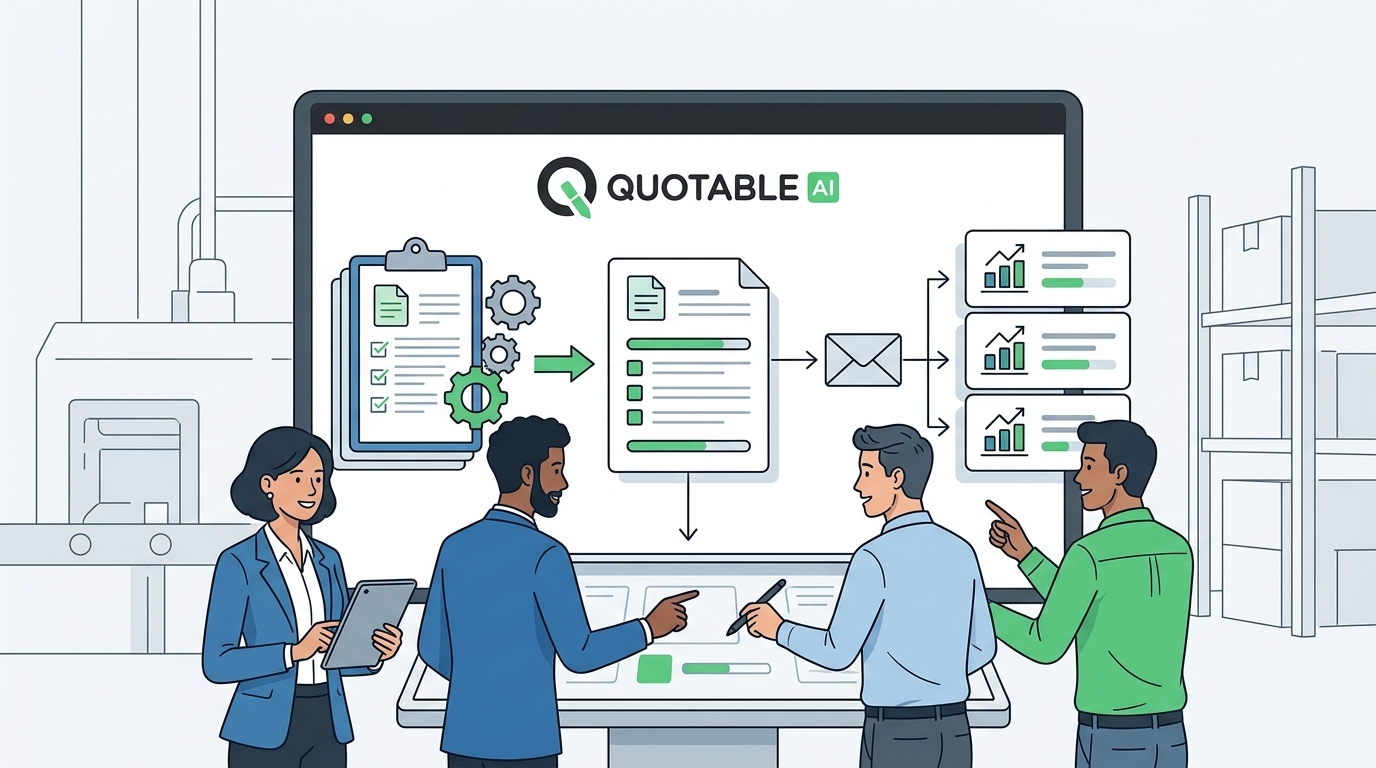
Think of it as the operating system built around the quote itself. Instead of procurement officers juggling disconnected tools, an RFQ platform centralizes the entire early-stage buying process: defining what you need, reaching the right suppliers, collecting standardized responses, and converting the winning bid into downstream documents like POs and invoices. The quote becomes the anchor for everything that follows.
This reframing matters because most procurement inefficiencies don't originate in fulfillment or payment. They start upstream, during the quoting phase, where ambiguity and manual work introduce errors that compound through the rest of the lifecycle.
The Difference Between Manual RFQs and Automated Quotation Systems
A manual RFQ process typically looks like this: someone identifies a need, drafts a request in a Word document or email template, sends it to a handful of known suppliers, and waits. Responses arrive in different formats - some as PDF attachments, others as line items in an email body. Comparing them means building a spreadsheet from scratch each time.
The breaking point for most teams hits around 20 to 50 RFQs per month. Below that threshold, manual processes feel manageable. Above it, you start seeing duplicate requests, missed supplier responses, and pricing data that never makes it into your financial systems. One client we worked with in industrial distribution was losing two full business days per RFQ cycle just on data re-entry and follow-up emails.
Automated quotation systems eliminate that re-entry. They provide structured templates so every supplier responds in the same format, with the same data fields. Comparison happens instantly. And the winning quote flows directly into purchase order generation without anyone copying numbers between systems.
Treating the Quote as a Live Transaction State
Here's a concept that separates modern RFQ platforms from simple e-procurement tools: the quote isn't a document. It's a transaction state.
What does that mean in practice? A traditional quote is a snapshot - a price at a moment in time. Once it's sent, it's dead data. But in an RFQ platform, the quote remains a live object. It can be revised, versioned, approved, linked to a PO, connected to an invoice, and ultimately tied to a payment - all within the same system.
This is the approach Quotable AI takes, treating the quote as the starting point of a continuous workflow that spans quoting, procurement, payments, and fulfillment. When the quote is live, any change to terms, pricing, or delivery dates propagates through the entire transaction chain. That eliminates a common and costly mistake: verbal or email-based changes to terms that never get reflected in the formal purchase documentation.
Core Functionalities of Modern RFQ Platforms
A useful RFQ platform does more than digitize a paper process. It restructures how procurement teams interact with suppliers, how data moves between departments, and how decisions get made. The core functionalities fall into two broad categories: managing the supplier-facing workflow and orchestrating data across internal systems.
Automated Vendor Outreach and Bid Management
The first job of any RFQ tool is getting the right request to the right suppliers quickly. Modern platforms maintain supplier databases with categorized capabilities, certifications, geographic coverage, and past performance data. When a procurement officer creates an RFQ, the system can suggest or automatically notify relevant vendors.
Here's where frictionless participation becomes critical. If a supplier has to create an account, learn a new interface, or download software just to respond to your RFQ, you'll get fewer responses. Platforms like Quotable AI address this by letting suppliers respond through a secure link - no login required. That single design choice can dramatically increase response rates and compress your quote collection timeline.
Once bids arrive, the platform handles normalization. Even if one supplier quotes per unit and another quotes per case, the system can standardize units, flag outliers, and present an apples-to-apples comparison. RFQ software centralizes the procurement process, cutting down on workload and enabling focus on important tasks like live bid analysis. This is where procurement teams shift from data entry clerks to strategic decision-makers.
Real-Time Data Orchestration Across the Supply Chain
The second major function is connecting RFQ data to everything downstream. A quote contains rich information: item specifications, quantities, unit prices, lead times, shipping terms, and payment conditions. In a manual process, that data gets trapped in emails and spreadsheets. In an RFQ platform, it becomes structured data that flows into ERP systems, accounting tools, and logistics platforms.
Quotable AI's universal AI parser, for instance, can automatically extract and structure data from quotes, invoices, purchase orders, and bills of materials. This reduces manual encoding errors and speeds up transaction processing considerably.
Real-time orchestration also means visibility. A procurement manager can see which RFQs are pending, which suppliers have responded, and how current quotes compare to historical pricing - all from a single dashboard. For companies managing $10M to $50M in annual procurement spend, that visibility is the difference between controlled spending and maverick purchases slipping through the cracks.
How RFQ Software Accelerates the Procurement Lifecycle
Speed in procurement isn't just about convenience. It directly affects project timelines, inventory costs, and competitive positioning. When your procurement cycle takes three weeks instead of three days, you're carrying more safety stock, missing market windows, and paying rush premiums on the back end.
Eliminating Fragmented Workflows in SME and Mid-Market Operations
Small and mid-market companies face a specific version of this problem. They typically lack dedicated procurement technology stacks. Instead, they cobble together email, spreadsheets, maybe a shared drive, and an ERP that handles orders but not quoting. The result is a fragmented workflow where information lives in five different places and no single person has a complete picture.
Red flags that signal this fragmentation include duplicate purchase orders for the same items, suppliers receiving conflicting specifications from different team members, and month-end close delays because finance can't reconcile POs against invoices. If any of these sound familiar, you've outgrown your current process.
RFQ software consolidates these fragments. A single platform holds the request, the supplier responses, the comparison analysis, the approval workflow, and the resulting purchase order. Everyone - from the engineer who spec'd the part to the controller who approves the spend - works from the same source of truth.
Achieving 10X Faster Procurement-to-Shipment Cycles
The "10X faster" claim sounds aggressive, but the math supports it. Consider a typical manual cycle: two days to draft and send the RFQ, five days waiting for supplier responses, one day to build a comparison spreadsheet, two days for internal approvals, and another day to issue the PO. That's roughly 11 business days.
With an automated platform, the RFQ goes out in minutes with pre-built templates. RFQ automation reduces response time by 6x, increasing win rates by prioritizing speed. Comparison is instant. Approval workflows route automatically based on spend thresholds. PO generation is a single click. The same cycle compresses to one or two business days.
Now multiply that across hundreds of procurement events per year. Companies using automated RFQ tools experience a 20% reduction in procurement cycle time on average, with high-volume operations seeing even greater gains. For a distributor turning over inventory weekly, that acceleration translates directly to better fill rates and lower carrying costs.
Vertical Integration: Connecting Quotes to Payments and Fulfillment
Most procurement tools stop at the purchase order. The quote lives in one system, the PO in another, the invoice in a third, and the payment in yet another. Each handoff introduces delay, data loss, and reconciliation headaches. Vertical integration means connecting these stages into a single, continuous workflow.
This is especially important in international trade, where payment workflows need to link with logistics documents like bills of lading and packing lists. Tracking landed costs - duties, freight, foreign exchange impact - requires data continuity from the initial quote through final delivery. If your quoting system doesn't talk to your payment and logistics systems, you're flying blind on true procurement costs.
A vertically integrated platform captures the quote, converts it to a PO, receives the invoice, matches all three (the classic three-way match), and triggers payment - all within one environment. That's not just faster; it's fundamentally more accurate.
Bridging the Gap Between Purchasing and Finance Teams
One of the most overlooked pain points in mid-market companies is the disconnect between purchasing and finance. Procurement buys what the business needs. Finance pays for it. But these teams often work in separate systems with separate data, leading to invoice disputes, payment delays, and strained supplier relationships.
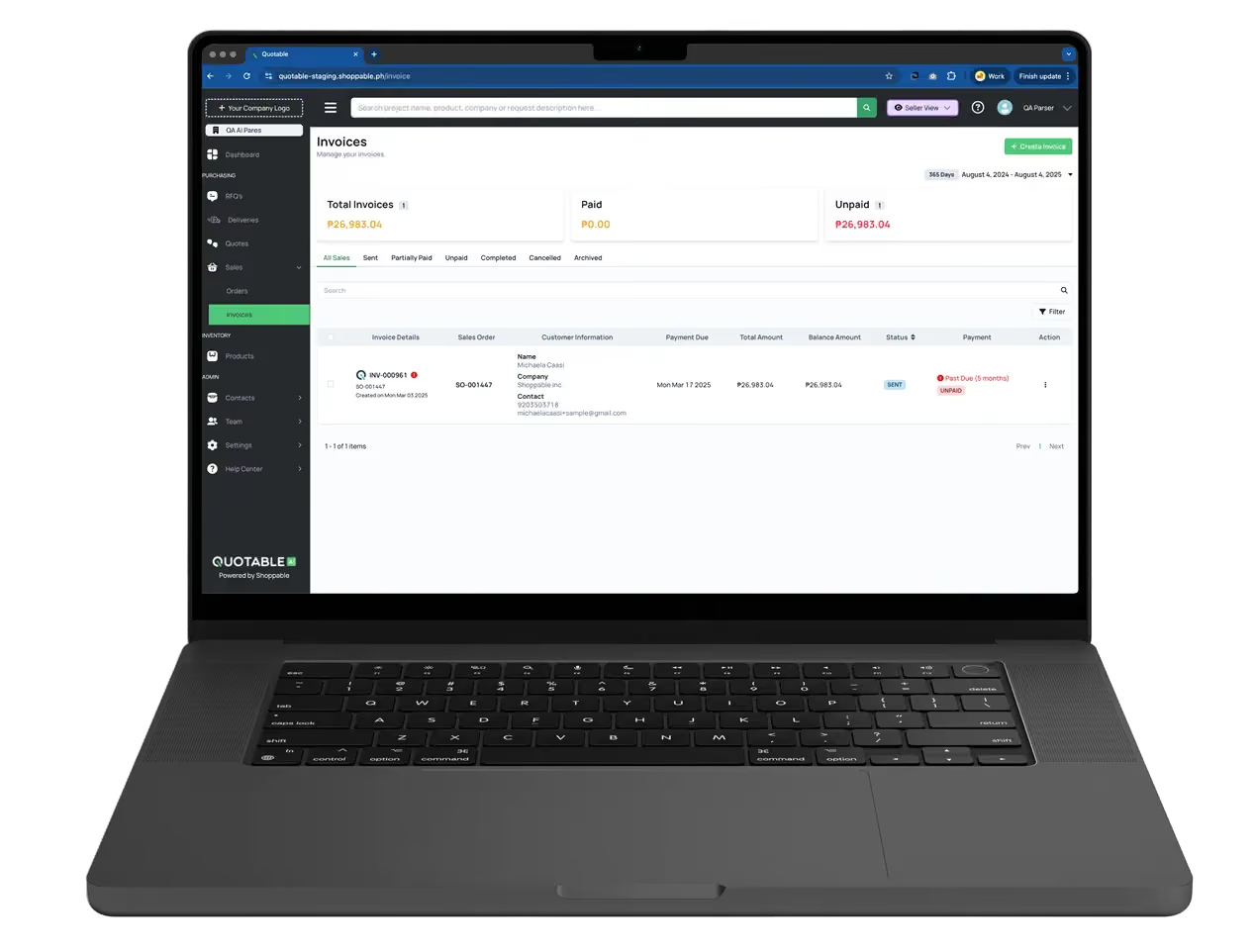
Quotable AI addresses this by embedding payments directly into the procurement workflow. Suppliers can receive payments via bank wire, ACH, credit cards, or e-wallets - all from one centralized system. Buyers approve, submit POs, and pay through no-login links. This eliminates the manual back-and-forth of payment verification that typically adds days to each transaction.
For finance teams managing SOX compliance or internal audit requirements, the benefit is an unbroken audit trail from quote to payment. Every approval, revision, and payment is logged in a single system, making month-end close and external audits significantly less painful.
Strategic Benefits for Manufacturing, Construction, and Trade
Different industries feel the impact of RFQ automation in different ways, but the underlying value is consistent: faster decisions, lower costs, and better supplier relationships.
In manufacturing, the primary gain is tighter control over bill-of-materials costs. When you're sourcing 200 components for a single product, even a 2% improvement in average quote pricing compounds into significant margin improvement. Implementing procurement software for RFQ management can lead to a 45% reduction in the cost of goods sold in some cases, particularly where maverick spend and off-contract purchasing were previously unchecked.
Construction teams benefit from speed and traceability. A general contractor managing 15 subcontractor quotes for a single project needs standardized comparison, version control, and a clear record of which terms were agreed upon. Without that, disputes over pricing and scope are almost guaranteed. RFQ platforms provide the structured documentation that protects both parties.
For trade and distribution businesses, the value centers on supplier network management. A distributor sourcing from 50 suppliers across multiple countries needs to track not just pricing but lead times, payment terms, minimum order quantities, and shipping logistics. An RFQ platform turns that complexity into a manageable, searchable database.
The global market for RFP and RFQ software tools is projected to reach USD 7.84 billion by 2035, growing at a 10.5% CAGR. That growth reflects a broad recognition across industries that manual quotation processes simply can't support the speed and accuracy modern supply chains demand.
Selecting the Right RFQ Software for Global B2B Trade
Choosing an RFQ platform isn't just a technology decision - it's a workflow decision. The wrong tool creates new friction instead of removing it. Here's what to prioritize.
First, consider supplier adoption. If your suppliers won't use the platform, it doesn't matter how many features it has. Look for tools that minimize the barrier to entry for suppliers: no mandatory accounts, no software installations, no training requirements. The easier it is for a supplier to respond, the more competitive your quotes will be.
Second, evaluate integration depth. Your RFQ tool needs to connect with your existing ERP and accounting systems. Ripping and replacing your financial infrastructure isn't realistic for most mid-market companies. Quotable AI, for example, integrates with existing financial systems so organizations can modernize supplier collaboration without abandoning their current ERP.
Third, look at the full transaction lifecycle. A tool that handles only the RFQ stage forces you to maintain separate systems for POs, invoicing, and payments. Platforms that cover quote-to-payment in a single workflow eliminate the data gaps and reconciliation problems that plague fragmented tech stacks.
Finally, think about data intelligence. The best RFQ platforms don't just process quotes - they learn from them. Historical pricing trends, supplier performance metrics, and spend analytics should be available without exporting data to a separate BI tool.
Here's a hard-won lesson from working with dozens of procurement teams: the biggest risk isn't picking the wrong software. It's picking a tool that your team and your suppliers won't actually use. Prioritize adoption over features, and you'll get more value from a simpler tool than from an enterprise suite that sits half-implemented.
The procurement function is evolving from a back-office cost center to a strategic driver of margin and speed. RFQ software is the foundation of that evolution, turning the earliest stage of every transaction - the quote - into a structured, trackable, and actionable data point. Whether you're a $5M distributor or a $40M manufacturer, the question isn't whether to automate your quoting process. It's how quickly you can get there. Start by auditing your current RFQ cycle: count the hours, count the handoffs, and count the errors. That's your business case. The tools exist to fix it.