Construction projects live and die by their supply chain. A single delayed rebar shipment or a surprise 15% price hike on structural steel can cascade through an entire project timeline, eating into margins that were already razor-thin. Material costs now represent 50-60% of total project budgets, and with prices rising 6.2% across 2025 alone - the largest single-year jump since 2021 - the old way of managing procurement through spreadsheets, phone calls, and email chains simply can't keep up. Mid-size contractors and distributors who treat procurement as a back-office afterthought are bleeding money they don't even realize they're losing. The five steps outlined here aren't theoretical frameworks. They're hard-won lessons drawn from working with B2B distributors and procurement teams who've moved from chaotic, manual buying processes to structured, automated workflows. Whether you're a $3M specialty supplier or a $25M general contractor, these steps will help you build a procurement operation that protects your margins and scales with your business.
Digitizing the Quote-to-Procurement Lifecycle
Most construction firms still operate with a fractured buying process. A project manager identifies a material need, sends an email to a purchasing agent, who then calls three suppliers, receives quotes via PDF or fax, manually enters pricing into a spreadsheet, and eventually issues a purchase order. Each handoff introduces delay, data loss, and the risk of human error.
The real cost isn't just time. Mid-size contractors with revenues between $2M and $20M lose an average of $47,000 annually to material waste, emergency orders, and pricing errors caused by manual procurement processes. That's money walking out the door because nobody digitized the workflow connecting a quote request to a fulfilled purchase order.
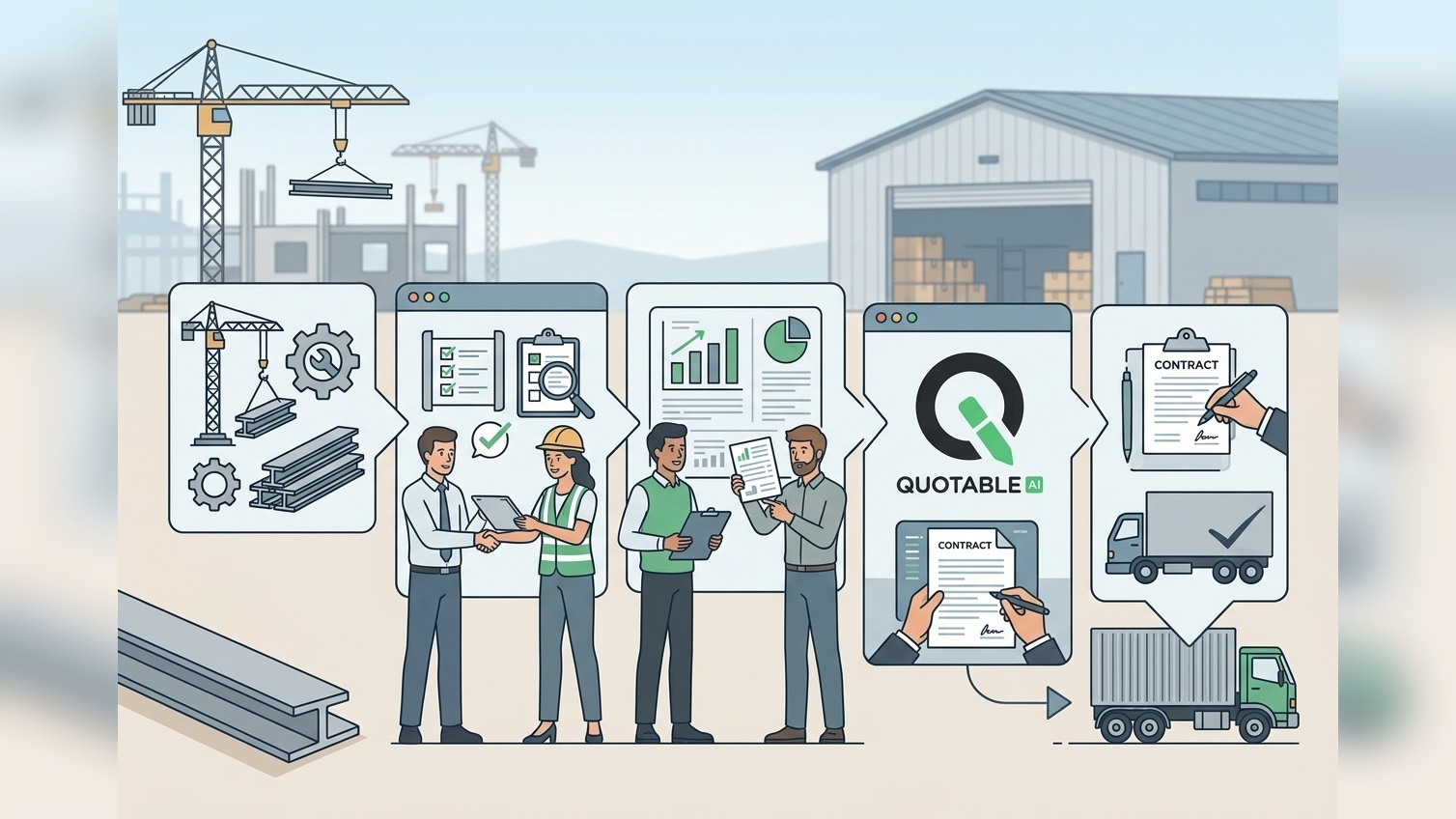
Digitizing this lifecycle means creating a single, unbroken thread from the moment a material need is identified through final delivery confirmation. Every quote, every revision, every approval lives in one system - visible to everyone who needs it.
Moving Beyond Fragmented Legacy Systems
Here's a common scenario we see with construction distributors. The sales team uses one tool for quoting. The purchasing team uses a different spreadsheet for tracking orders. Finance has its own system for invoicing. And the project manager on-site is texting photos of delivery receipts to the office. None of these systems talk to each other.
The breaking point typically hits around 30-50 active purchase orders per month. Below that threshold, a skilled office manager can hold the chaos together through sheer memory and effort. Above it, things start falling apart: duplicate orders, missed price changes, suppliers shipping to the wrong site, invoices that don't match what was actually delivered.
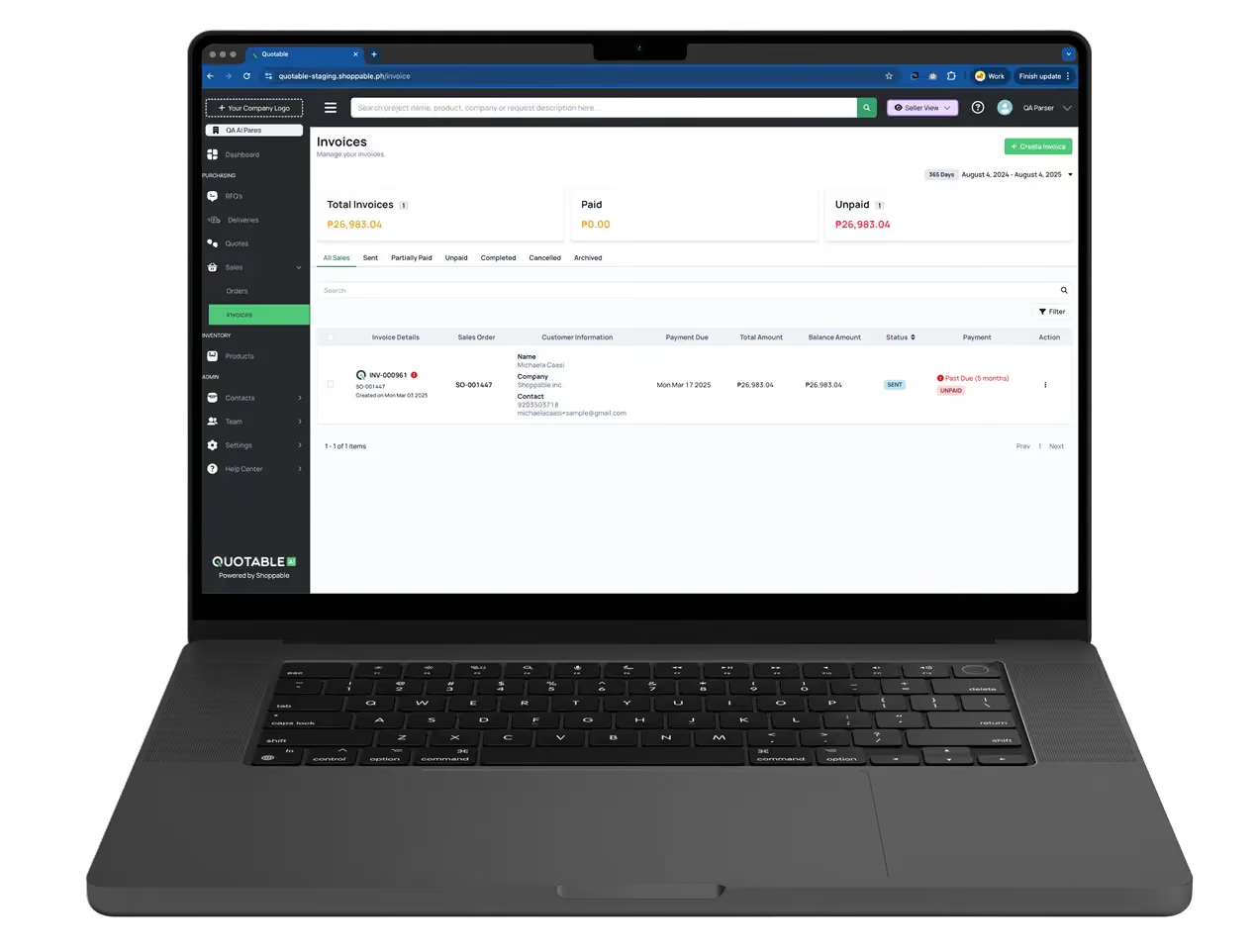
Moving beyond this fragmentation doesn't require ripping out your ERP. Platforms like Quotable AI are designed to sit on top of existing financial systems, connecting quoting, procurement, and payment workflows without forcing you to abandon the infrastructure you've already invested in. The goal is a single data layer that unifies your transaction history, not another disconnected tool.
Treating the Quote as a Live Transaction State
Most businesses treat a quote as a static document: a PDF that gets emailed, printed, and filed away. But in construction materials procurement, a quote is a living thing. Prices shift weekly. Availability changes daily. Lead times fluctuate based on mill schedules and shipping capacity.
When you treat the quote as a live transaction state, it becomes the anchor point for your entire procurement workflow. A quote accepted on Monday triggers a purchase order on Tuesday, which links to a delivery schedule on Wednesday, which connects to an invoice on Thursday. Every downstream action traces back to the original quoted terms: price, quantity, delivery window, and payment conditions.
This approach also protects you legally. If a supplier later disputes the agreed price or a subcontractor claims they never approved a material substitution, you have a complete, timestamped audit trail. Verbal changes to terms - one of the most common mistakes in construction buying - become impossible to hide when every modification is logged in the system.
Centralizing Supplier Communication and Data Orchestration
Construction procurement typically involves dozens of suppliers across multiple material categories: concrete, steel, lumber, electrical, plumbing, finishes. Each supplier has its own quoting format, its own lead times, and its own preferred communication channel. One sends quotes by email. Another uses a web portal. A third still faxes price sheets.
This fragmentation creates a data orchestration nightmare. Your purchasing team spends hours each week just translating information between formats, re-keying numbers, and chasing suppliers for updates. The real danger is invisible: when data lives in silos, nobody has a complete picture of what's been ordered, what's in transit, and what's been paid for.
Centralizing supplier communication doesn't mean forcing every vendor onto a single platform. It means creating a hub where all supplier interactions - RFQs, quotes, POs, shipping confirmations, invoices - converge into a structured, searchable format regardless of how the supplier originally transmitted the information.
Building a Vertically Integrated Data Layer
A vertically integrated data layer connects every stage of your procurement lifecycle into one continuous information flow. Think of it as the nervous system of your buying operation. When a project manager submits a material request, the system should automatically check existing supplier agreements, compare current market pricing, flag budget variances, and route the request for approval - all without manual intervention.
For construction distributors handling $5M-$30M in annual purchases, this integration has specific, measurable benefits:
- Cost code tracking ties every material purchase to a specific project phase, enabling real-time budget monitoring
- Landed cost visibility includes freight, duties, and handling fees alongside unit prices, so your actual material cost is never a surprise
- Three-way matching between POs, delivery receipts, and invoices catches discrepancies before they become disputes
- Supplier performance scoring tracks on-time delivery rates, quality issues, and pricing consistency across all your vendors
One client we worked with, a $12M mechanical contractor, discovered they'd been paying two different prices for the same copper fittings from the same supplier - simply because two different purchasing agents were placing orders independently. A centralized data layer eliminates that kind of maverick spend entirely.
Automating Quotations for Faster Fulfillment
Speed matters in construction procurement. When steel HRC/CRC prices are up nearly 45% since mid-2025, a quote that takes three days to assemble and another two days to approve could cost you thousands in price movement alone.
Automated quotation workflows compress this timeline dramatically. An AI-powered document parser, like the one built into Quotable AI, can extract and structure data from incoming supplier quotes - pulling out unit prices, quantities, lead times, and payment terms - regardless of whether the quote arrived as a PDF, an email, or a scanned document. This eliminates the manual encoding that typically adds one to two business days to every procurement cycle.
On the supplier side, frictionless participation matters just as much. If responding to your RFQ requires a supplier to create an account, download software, or learn a new system, many simply won't bother. The best procurement systems let suppliers respond through a secure link without any login required, which means you get more competitive bids, faster.
Optimizing Cash Flow with Integrated B2B Payments
Cash flow kills more construction businesses than bad estimates. You might have $2M in receivables and $800K in payables due this week, but if the timing doesn't align, you're scrambling for a line of credit just to pay your steel supplier. The gap between when you pay for materials and when you get paid for the finished work is where construction companies go broke.
Traditional procurement systems treat payments as someone else's problem. The purchasing team buys materials, and finance figures out how to pay for them later. This disconnect creates blind spots. Your CFO doesn't know that purchasing just committed to $150K in material orders until the invoices hit the accounting system two weeks later.
Integrating payments directly into your procurement workflow changes the equation. When every purchase order carries payment terms, every invoice matches a confirmed delivery, and every payment is tracked against the original quote, you get real-time visibility into your cash position. No surprises. No scrambling.
Connecting Procurement to Invoicing and Collections
The link between procurement and invoicing is where most construction firms experience their worst inefficiencies. Here's a typical failure pattern: a supplier ships 90% of an order, invoices for 100%, and nobody catches the discrepancy because the delivery receipt is sitting in a truck driver's clipboard while the invoice is already in the AP queue.
A connected system enforces discipline at every step:
- The purchase order establishes the agreed terms: price, quantity, delivery date, payment window
- The goods receipt confirms what actually arrived on site, matched against the PO
- The invoice is validated against both the PO and the receipt before it enters the payment queue
- Payment is executed through the same platform, with a complete audit trail linking back to the original quote
This three-way match process isn't new, but automating it is what makes it practical for mid-market firms. A $20M contractor processing 200+ invoices per month can't afford to manually verify each one. Platforms that embed payment options - bank wire, ACH, credit cards, e-wallets - directly into the procurement workflow eliminate the manual back-and-forth of payment verification that typically adds five to ten days to your cash conversion cycle.
The legal implications matter too. If you're subject to SOX compliance or operating under government contracts with specific payment documentation requirements, an integrated audit trail from quote through payment isn't optional: it's a regulatory necessity.
Leveraging AI for Real-Time Materials Tracking
Price volatility in construction materials has become the norm, not the exception. As Anirban Basu, chief economist at Associated Builders and Contractors, noted, construction materials costs surged due to significant increases in oil, copper, lumber, and steel prices, rising at a staggering 12.6% annualized rate during early 2026. When a 20% material cost increase can wipe out 50-70% of a project's profit margin, tracking prices in real time isn't a luxury.
AI-driven tracking systems monitor price movements across your supplier network and flag anomalies before they become budget problems. If your primary steel supplier's pricing suddenly diverges from market benchmarks, the system alerts your purchasing team to investigate - or automatically triggers an RFQ to alternative suppliers.
Real-time tracking also applies to physical materials. Knowing that your order of structural steel left the mill on Tuesday and is scheduled to arrive Thursday lets your site team plan crane time, staging areas, and labor accordingly. When that shipment gets delayed, the system can automatically notify downstream stakeholders and adjust the project schedule.
The AI component becomes most valuable when it connects procurement data with project data. If your system knows that Phase 2 of a project requires 40 tons of rebar starting March 15, and current lead times from your preferred supplier are running six weeks, it can flag the ordering deadline automatically - preventing the kind of emergency orders that carry 20-30% premium pricing.
Scaling Operations for SME and Mid-Market Growth
Growth creates procurement complexity faster than most construction firms anticipate. A $5M contractor that doubles revenue to $10M doesn't just need twice as many materials. They need new supplier relationships, larger credit lines, more sophisticated scheduling, and tighter cost controls. The procurement processes that worked at $5M become bottlenecks at $10M.
The inflection point is real and measurable. Companies crossing the $10M revenue threshold typically see their procurement transaction volume triple, their supplier count double, and their average order complexity increase significantly as they take on larger, multi-phase projects. Without systems designed to handle this growth, you end up hiring more administrative staff to manage the same broken processes at higher volume.
Reducing Manual Errors in Construction Logistics
Manual errors in construction logistics aren't just annoying: they're expensive. A miskeyed quantity on a concrete order means either a short pour that delays the schedule or excess material that hardens in the truck. A wrong delivery address sends a $30K lumber shipment to the wrong job site. A transposed digit on a unit price turns a profitable order into a loss.
Red flags that your manual processes are breaking down include:
- Duplicate purchase orders for the same materials on the same project
- Invoices that consistently don't match delivery receipts
- Suppliers calling to clarify order details more than once per week
- Month-end close taking longer than five business days because of procurement reconciliation
- Project managers maintaining their own shadow tracking systems because they don't trust the official numbers
Automated procurement workflows reduce material waste by 30% and cut emergency order premiums by 64%. Those aren't theoretical projections. They reflect the difference between a system that catches errors before they propagate and a manual process that only discovers mistakes after the damage is done.
The Quotable AI approach to this problem is instructive. By using a universal AI parser to extract and structure data from quotes, invoices, purchase orders, and bills of materials automatically, the platform removes the human encoding step where most errors originate. The data flows from one document to the next without being re-keyed, which means a price quoted by a supplier appears identically on the PO, the delivery receipt, and the invoice.
Achieving 10X Faster Procurement Workflows
The "10X faster" claim sounds like marketing hyperbole until you map the actual time savings. Consider a typical procurement cycle for a mid-size contractor:
- Identifying the material need and creating a requisition: 1-2 hours
- Sending RFQs to three suppliers and waiting for responses: 2-5 business days
- Comparing quotes, negotiating terms, and selecting a supplier: 1-2 days
- Creating and approving the purchase order: 4-8 hours
- Processing the invoice and issuing payment: 3-5 business days
Total elapsed time: 8-14 business days from need identification to payment.
An automated workflow compresses each step. AI-generated RFQs go out in minutes. Suppliers respond through no-login links within hours instead of days. Quote comparison happens automatically based on pre-set criteria. PO generation is a one-click action tied to the approved quote. Invoice matching and payment execute through the same platform.
Total elapsed time: 1-2 business days.
That's not 10X faster - it's closer to 7-10X, depending on the complexity of the order. For a firm processing 50+ procurement cycles per month, the cumulative time savings translate directly into labor cost reduction and faster project delivery.
Building a Procurement Engine That Protects Your Margins
The construction industry's margin pressure isn't going away. Material prices will keep fluctuating. Supplier lead times will remain unpredictable. Project timelines will continue to tighten. The firms that thrive in this environment won't be the ones with the biggest budgets - they'll be the ones with the smartest procurement systems.
These five steps form a progression, not a checklist. Start by digitizing your quote-to-procurement lifecycle. Centralize your supplier communications. Connect your payments to your purchasing data. Layer in AI-driven tracking. Then scale the whole operation as your business grows.
The hard-won lesson from every construction firm that's made this transition: the cost of not modernizing your procurement of construction materials is always higher than the cost of doing it. Every month you wait is another month of pricing errors, emergency orders, and margin erosion that compounds over time. Start where you are, pick the step that addresses your biggest pain point, and build from there.