Most B2B transactions don't start with a purchase order. They start with a quote, a back-and-forth negotiation, and a supplier who either wins or loses based on price, timing, and trust. If you're running competitive sourcing events and still relying on email chains or spreadsheets, you're leaving money on the table. The right eAuction software doesn't just automate bidding: it connects the entire lifecycle from the first supplier response to the final payment. The internet auction software market is projected to reach USD 7.4 billion by 2034, growing at a CAGR of 10.2% from its 2024 valuation of USD 2.8 billion. That growth isn't accidental. Companies are waking up to the fact that competitive bidding events, when run on the right platform, compress procurement timelines and drive real savings. But choosing the wrong tool can create more friction than it removes. This guide is built from hard-won lessons working with SMEs and mid-market procurement teams who need more than a flashy bidding interface. You need a system that fits your category needs, your supplier base, and your existing operational infrastructure. We'll walk through the auction formats that matter, the features you can't afford to skip, and the integration points that separate a good platform from one that actually moves your business forward.
Defining Your Procurement Needs and eAuction Types
Before you compare vendors or request demos, you need a clear picture of what you're actually buying and how your suppliers prefer to compete. An eAuction platform that works brilliantly for IT services procurement might be a terrible fit for a construction materials distributor sourcing rebar and concrete. The format of your auctions, the complexity of your specifications, and the number of qualified suppliers in your category all dictate which software will deliver results.
Start by mapping your procurement categories. Are you sourcing commoditized products where price is the primary differentiator? Or are you buying complex assemblies where lead time, quality certifications, and payment terms matter as much as unit cost? Your answer shapes everything from the auction type you'll run to the evaluation criteria you'll configure in the platform.
Reverse Auctions vs. Dutch Auctions: Choosing the Right Format
Reverse auctions are the workhorse of B2B procurement. Buyers post a requirement, suppliers bid against each other, and prices move downward over a defined time window. This format works best when you have at least three qualified suppliers, a clearly defined specification, and a category where price competition is meaningful. Think MRO supplies, raw materials, logistics services, or standard components.
Dutch auctions flip the script. The buyer sets a high starting price that decreases at intervals until a supplier accepts. This format is useful when you need to fill a requirement quickly and want to test the market's willingness to accept a price point. It's less common in B2B procurement but can be effective for perishable goods, excess inventory, or time-sensitive logistics capacity.
Here's a common mistake: teams pick a reverse auction format for categories where they only have one or two viable suppliers. Running a competitive event with insufficient competition doesn't drive savings. It frustrates your supplier base and damages relationships. If you don't have at least three qualified bidders, you're better off with a structured RFQ process than a live auction.
The best platforms let you switch between formats without rebuilding your event from scratch. Look for software that supports multiple auction types within a single interface and allows you to configure rules like bid decrements, time extensions, and lot structures.
Identifying Industry-Specific Requirements for Construction and Manufacturing
Construction and manufacturing procurement carry unique demands that generic auction tools often miss. In construction, you're frequently dealing with project-based purchasing where specifications change mid-cycle, delivery schedules are tied to site readiness, and you need to track cost codes against budgets. A platform that can't handle line-item bidding with attached technical documents won't survive a week on a real job site.
Manufacturing procurement adds another layer: quality certifications, material traceability, and minimum order quantities. If you're sourcing precision-machined parts, your auction platform needs to let suppliers attach compliance documents, specify tolerances, and indicate lead times alongside their pricing. Price alone isn't the decision driver.
One client we worked with, a mid-market steel distributor doing about $18M in annual purchases, tried running auctions on a platform designed for indirect spend. The tool couldn't handle weight-based pricing, split awards across multiple suppliers, or accommodate delivery to multiple job sites. They abandoned it within two months. The lesson: don't buy a tool built for office supplies when you're sourcing structural steel.
The Importance of Unified Quote-to-Payment Orchestration
Most procurement tools treat each stage of a transaction as a separate event. You get one system for sourcing, another for purchase orders, a third for invoicing, and maybe a fourth for payments. Each handoff introduces delays, data re-entry, and opportunities for errors. The real competitive advantage comes from treating the entire flow, from the first quote to the final payment, as a single connected transaction.
This is where the concept of a vertically integrated data orchestration layer becomes critical. Instead of stitching together five different tools with fragile integrations, you want a platform that maintains a continuous data thread from the moment a supplier submits a quote through fulfillment and settlement. The online auction market is forecast to increase by USD 3.98 billion between 2024 and 2029, and much of that growth is being driven by platforms that connect bidding with downstream execution.
Why Starting at the Quote Accelerates Procurement Speed by 10X
Here's a founder-to-founder insight that most procurement software companies miss: the transaction doesn't begin with the purchase order. It begins with the quote. Every piece of data you need for downstream processing, pricing, quantities, specifications, delivery terms, payment conditions, already exists in the supplier's quotation. If your system captures that data cleanly at the quote stage, you eliminate the need to re-enter it at every subsequent step.
Think about the typical flow. A supplier emails a PDF quote. Someone on your team manually keys line items into a spreadsheet or ERP. A buyer reviews it, negotiates, and eventually creates a PO in yet another system. The invoice arrives weeks later and someone has to match it back to the original quote and PO. Every handoff is a potential breaking point.
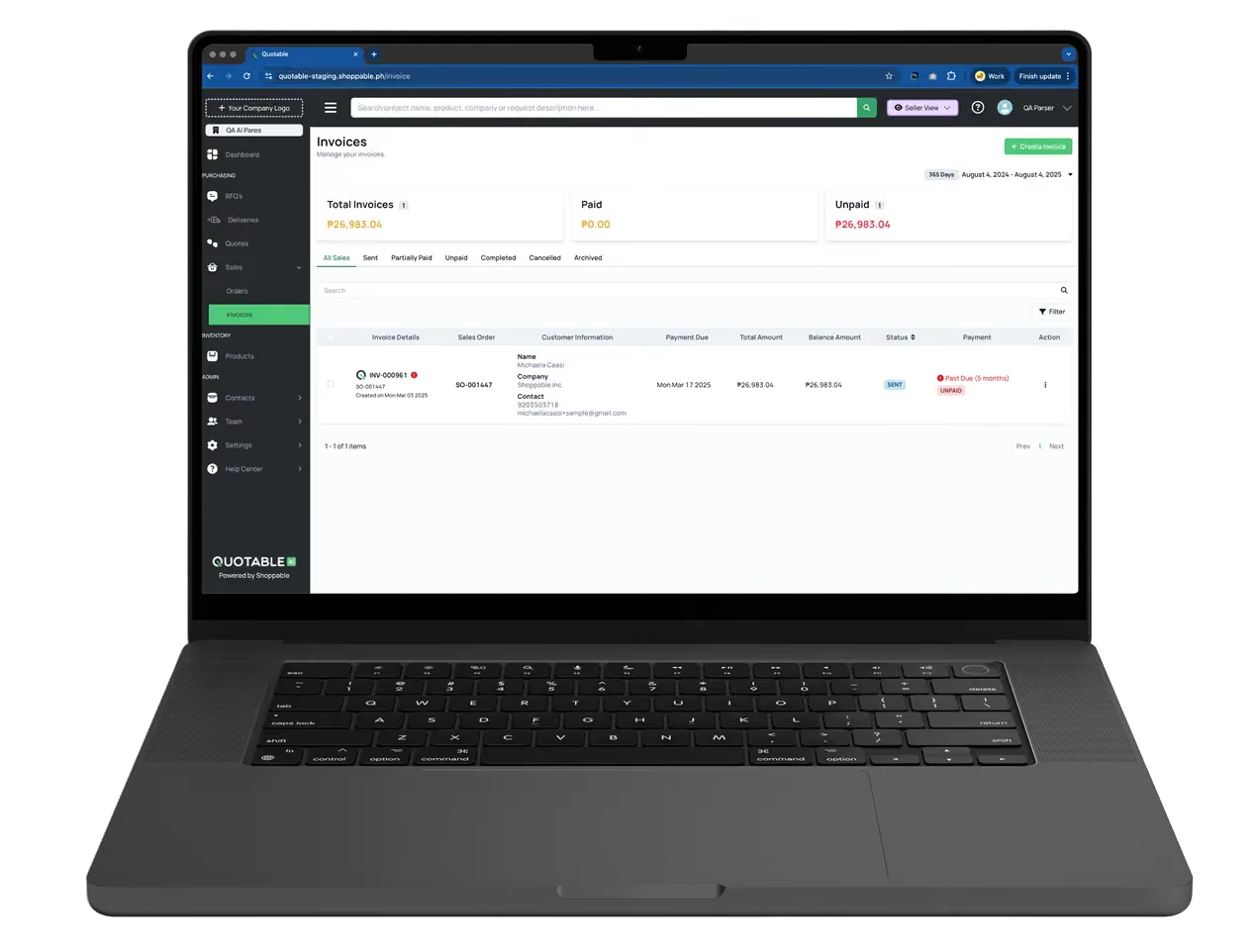
Platforms like Quotable AI treat the quote as the starting transaction state. Their universal AI parser automatically extracts and structures data from quotes, invoices, purchase orders, and bills of materials. That means the data captured during your eAuction or RFQ event flows directly into PO generation, invoicing, and payment without manual re-entry. For a team processing 30 to 50 orders per month, this alone can save 15 to 20 hours of administrative work weekly.
Treating the Quote as a Live Transaction State Across Companies
The real power of unified orchestration shows up when you think about the quote as a living document that travels across company boundaries. A supplier submits a quote. Your buyer approves it. A PO is generated. The supplier ships and invoices. You pay. At every stage, both parties should be looking at the same data, the same terms, and the same status.
This matters enormously for audit trails and compliance. If you're subject to SOX requirements or internal controls that demand a three-way match between PO, receipt, and invoice, having a single transaction record that spans the entire lifecycle makes reconciliation straightforward rather than painful. Verbal changes to terms, side agreements made over email, quantities adjusted without documentation: these are the red flags that auditors flag and that cost companies real money in write-offs and penalties.
Connecting payment workflows with logistics data adds another dimension. When your platform can link a payment milestone to a bill of lading or packing list, you gain visibility into landed costs including duties, freight, and FX impact. For companies doing cross-border procurement, this isn't a nice-to-have. It's the difference between knowing your true cost of goods and guessing at it.
Essential Features for Modern SME and Mid-Market eAuctions
Feature lists can be overwhelming. Every vendor claims to offer "everything you need." But for SMEs and mid-market companies running between $1M and $50M in annual procurement, certain capabilities separate useful platforms from expensive shelf-ware. The global auction software for auctioneers market is projected to reach USD 1.2 billion by 2031, and the tools gaining market share are the ones that reduce friction for both buyers and suppliers.
As one procurement expert put it, "The best e-auction platform isn't the one with the most features, but the one that fits your category needs, supplier capabilities, and organizational systems." That's the lens you should use when evaluating your options.
Automated Vendor Communication and Real-Time Data Orchestration
Your suppliers don't want to learn new software. They don't want to create accounts, attend training webinars, or download apps. The number one reason eAuction events fail isn't bad technology: it's low supplier participation. If your vendors can't figure out how to respond within five minutes, they won't respond at all.
Look for these specific capabilities:
- No-login supplier participation through secure links, so vendors can submit bids and respond to RFQs without creating accounts or adopting new tools
- Automatic bid confirmations and status notifications that keep suppliers engaged without your team sending manual follow-ups
- Centralized RFQ management where suppliers can receive requests from multiple buying organizations in one place, submit structured responses, and showcase competitive pricing alongside lead times and service capabilities
- Real-time bid visibility with configurable transparency settings so you can choose whether suppliers see competing bids, rank positions, or only their own status
AI-powered analysis is also becoming table stakes. Modern platforms use AI algorithms to analyze bid patterns and provide insights and predictions that help buyers identify pricing anomalies, spot collusion risks, and make faster award decisions.
Integrated Invoicing and B2B Payment Processing
Here's a sign your current process is broken: your team spends more time chasing invoices and reconciling payments than they do on strategic sourcing. If the auction ends and you're back to emailing POs, waiting for PDF invoices, and manually initiating bank transfers, you've only solved half the problem.
The best eAuction software connects bidding outcomes directly to invoicing and payment. When a supplier wins an award, the system should automatically generate the corresponding purchase order, track delivery milestones, and convert the PO into an invoice upon receipt confirmation. Payment should be a click, not a project.
Quotable AI handles this by embedding multiple payment methods, including bank wire, ACH, credit cards, and e-wallets, directly into the transaction workflow. Suppliers receive payments through their preferred method, and buyers can pay all their vendors from one centralized system. This eliminates the manual back-and-forth of payment verification that typically adds three to five days to the settlement cycle. For a distributor processing 200 invoices per month, that's the difference between healthy cash flow and a constant scramble.
Evaluating Scalability and System Integration
A platform that works for 10 suppliers and 50 transactions per month might collapse under the weight of 200 suppliers and 500 monthly transactions. Scalability isn't just about server capacity. It's about whether the system's workflows, data structures, and user management can grow with your business without requiring a rip-and-replace.
Connecting Quoting, Procurement, and Fulfillment Workflows
The U.S. internet auction software market was valued at USD 0.8 billion in 2024 and is anticipated to reach approximately USD 1.9 billion by 2034. That trajectory reflects a market moving away from point solutions toward connected platforms.
When you evaluate integration capabilities, think about the full transaction lifecycle:
- A buyer identifies a need and creates an RFQ or auction event
- Suppliers receive notifications and submit competitive bids
- The buyer evaluates responses, awards the business, and generates a PO
- The supplier confirms the order, ships the goods, and submits an invoice
- The buyer performs a three-way match (PO, receipt, invoice) and releases payment
- Both parties have a complete audit trail for compliance and reporting
If your eAuction tool only covers steps two and three, you're still stitching together the rest manually. The operational breaking point usually hits around 30 to 50 orders per month. Below that threshold, spreadsheets and email can limp along. Above it, you start seeing duplicate orders, visibility gaps, delayed month-end closes, and maverick spend that flies under the radar.
Quotable AI connects with existing ERP and accounting systems, which means you don't have to replace your financial infrastructure to modernize supplier collaboration. Data flows from the auction event through PO creation, invoicing, and payment without manual re-entry at each stage.
Ensuring Data Security for Global B2B Trade Transactions
Cross-border procurement introduces data security concerns that domestic-only buyers can sometimes overlook. When supplier bids, pricing data, and payment information cross international boundaries, you need to know where that data is stored, how it's encrypted, and who has access.
Ask prospective vendors these specific questions:
- Where are your data centers located, and do you offer region-specific hosting for compliance with GDPR, CCPA, or other data residency requirements?
- How is bid data encrypted both in transit and at rest?
- What access controls exist to prevent unauthorized viewing of competitive bid information before auction close?
- Do you maintain SOC 2 Type II certification or equivalent security audits?
- How are payment credentials handled, and are you PCI DSS compliant?
Don't accept vague answers like "we take security seriously." Demand documentation. One breach of competitive bid data can destroy supplier trust and expose your organization to legal liability. For companies managing global trade transactions, the platform also needs to handle multi-currency bidding and settlement without exposing either party to unmanaged FX risk.
Measuring Success: From Competitive Bidding to Faster Fulfillment
Choosing the right platform is only half the battle. You need to measure whether it's actually delivering results. Too many procurement teams implement eAuction tools and then only track savings percentages from bidding events. That's important, but it's an incomplete picture.
Track these metrics across the full transaction lifecycle:
- Supplier participation rate: What percentage of invited suppliers actually submit bids? If it's below 60%, your platform may be creating too much friction. Frictionless participation, where suppliers respond through secure links without creating accounts, directly impacts this number.
- Cycle time from RFQ to PO: How many days elapse between posting a requirement and issuing a purchase order? A connected platform should compress this to hours, not weeks.
- Invoice accuracy rate: What percentage of invoices match the original PO without manual intervention? If your three-way match rate is below 85%, you have a data quality problem upstream.
- Days to payment: How quickly are suppliers getting paid after delivery? Faster payment builds supplier loyalty and often unlocks early payment discounts.
- Maverick spend reduction: What percentage of purchases are flowing through your auction and RFQ process versus being bought off-contract?
Red flags that your eAuction implementation is failing include rising supplier complaints about the bidding process, procurement staff bypassing the system for "urgent" purchases, and month-end reconciliation taking longer than it did before you implemented the tool. If you see these symptoms, the problem usually isn't the concept of electronic auctions. It's a mismatch between the platform's capabilities and your operational reality.
The companies getting the most value from their eAuction investments are the ones that treat competitive bidding not as an isolated event but as the entry point to a connected procurement workflow. When your auction platform feeds directly into order management, invoicing, and payment, you're not just saving money on unit costs. You're saving time across every downstream process, and time is the one resource you can't buy more of.
If you're evaluating eAuction software for your organization, start with your pain points rather than a feature checklist. Map your current process end-to-end, identify where data gets re-entered or lost, and look for platforms that eliminate those handoffs. The right tool won't just run better auctions. It'll make your entire procure-to-pay cycle faster, more accurate, and more visible to the people who need that information most.