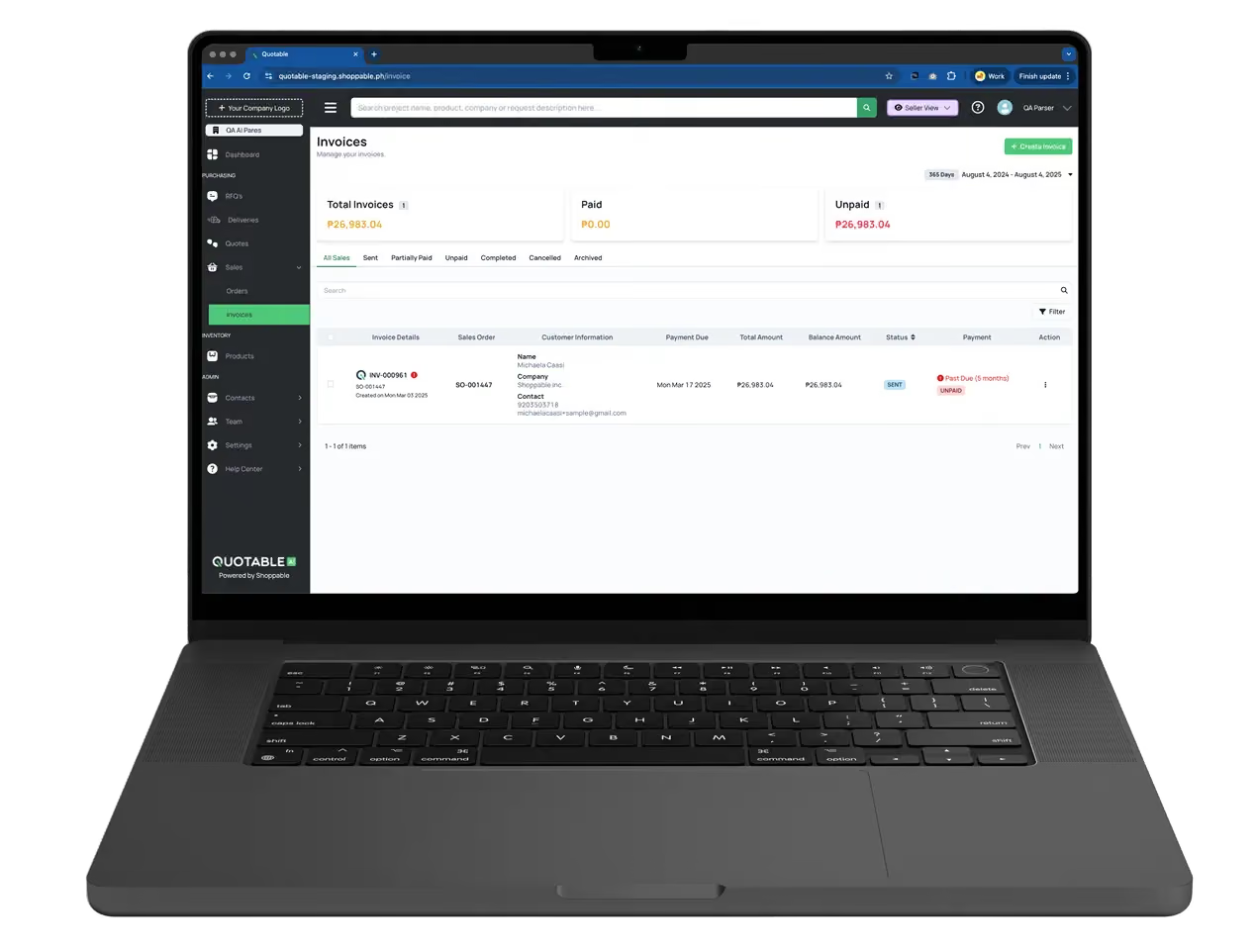
Every business that sells complex products or services hits the same wall: a customer asks for a quote, and what should take minutes turns into days of back-and-forth between sales, engineering, and finance. Margins get miscalculated, product configurations don't match what's actually available, and by the time the quote lands in the buyer's inbox, the opportunity has cooled. This is the problem that configure price quote software was built to solve. CPQ systems sit at the intersection of product knowledge, pricing logic, and document automation, turning what used to be a manual, error-prone process into something that actually scales. For B2B distributors and mid-market companies moving $1M to $50M in annual revenue, the difference between a fast, accurate quote and a slow, wrong one is often the difference between winning and losing a deal. The global CPQ market reflects this urgency: it's projected to reach USD 14.66 billion by 2035, growing at a 16.5% CAGR. That's not hype. That's businesses voting with their budgets for tools that remove friction from their sales cycles.
Defining CPQ: Beyond Basic Sales Quotes
A common misconception is that CPQ is just a fancy quoting tool. It's not. A basic quoting tool lets you type up a document with line items and prices. CPQ software, by contrast, encodes your entire product catalog, pricing rules, and approval workflows into a system that prevents bad quotes from ever being created in the first place.
Think of it this way: a word processor lets you write anything, including things that are wrong. A CPQ system is more like a guided form that only allows valid combinations. You can't quote a product that doesn't exist, pair incompatible options, or offer a price below your floor margin. The system knows your rules before your sales rep does.
This distinction matters enormously for companies selling configurable products: think electrical components with voltage variants, construction materials with regional specifications, or IT hardware bundles with compatibility requirements. The quote isn't just a price list. It's a technical document that needs to be right.
The Three Pillars: Configure, Price, and Quote
The "C" in CPQ handles product configuration. This means defining what can be sold together, what's mutually exclusive, and what requires add-ons. If you sell pumps, for example, the system knows that a certain motor size requires a specific impeller and housing. Your sales rep doesn't need to memorize this. The system enforces it.
The "P" handles pricing. This isn't a static lookup table. A good CPQ pricing engine accounts for volume discounts, customer-specific agreements, regional pricing, currency conversion, and margin floors. If a rep tries to offer 40% off to close a deal, the system can flag it for approval or block it outright.
The "Q" is the output: a branded, professional quote document that pulls together the configured product, the calculated price, terms and conditions, and any supporting documentation. This document can be a PDF, a web link, or an interactive proposal, depending on the platform.
Moving from Manual Spreadsheets to Automated Workflows
Most SMEs start with spreadsheets. A sales rep has a pricing sheet in Excel, copies line items into a Word template, and emails it to the customer. This works fine when you have five products and two reps. It falls apart at 500 SKUs and a team of ten.
The breaking point usually hits around 30 to 50 quotes per month. At that volume, you start seeing duplicate SKUs with different prices, quotes that reference discontinued products, and margin erosion because nobody's checking the math. One client I worked with discovered they'd been underpricing a key product line by 8% for six months because a rep had an outdated spreadsheet. That's real money lost.
Sales reps take 73% more time to produce a quote without CPQ software. That's not just an efficiency problem. It's a competitive one. If your competitor quotes in two hours and you quote in two days, you've already lost.
How CPQ Software Powers the Modern Sales Cycle
CPQ doesn't operate in isolation. It sits at the center of your sales cycle, pulling data from your product catalog, CRM, and ERP systems while pushing outputs to your customers, finance team, and fulfillment operations. The value isn't just speed. It's accuracy and consistency across every touchpoint.
Product Configuration and Constraint Rules
Configuration rules are the backbone of any CPQ implementation. These rules define what's possible, what's required, and what's forbidden. A well-built rule set prevents errors before they happen.
For a construction materials distributor, this might mean:
- Certain rebar grades can only be paired with specific concrete mix specifications
- Delivery lead times change based on the product's manufacturing location
- Custom cut lengths require a minimum order quantity
- Some products aren't available in certain regions due to compliance requirements
These rules live inside the CPQ system as logic, not as notes in someone's head. That's the critical shift. When your most experienced sales rep retires, the knowledge doesn't walk out the door with them. It stays encoded in the system.
CPQ implementations fail most often due to bad data, not bad software. Before configuration begins, you need to dedicate time to rationalizing your product catalog, standardizing pricing rules, and documenting dependencies. If your current pricing lives in tribal knowledge or inconsistent spreadsheets, the CPQ will simply automate chaos.
Dynamic Pricing Engines and Margin Protection
Static price lists are a liability. Costs change, currencies fluctuate, and competitors adjust their positioning weekly. A dynamic pricing engine recalculates in real time based on the variables you define.
Imagine you're quoting a $200,000 order for industrial fasteners. The CPQ system checks your current cost basis, applies the customer's negotiated discount tier, factors in the volume break at 10,000 units, and verifies that the final margin stays above your 22% floor. If the rep tries to add a further discount, the system routes it to a manager for approval. No guesswork. No post-hoc margin reviews that discover the damage after the invoice is sent.
This kind of margin protection is where CPQ pays for itself fastest. Even a 2% improvement in average deal margin across a $10M book of business means $200K in recovered profit annually.
Automated Document Generation and Branding
The quote document itself matters more than most companies realize. A sloppy PDF with inconsistent formatting signals that your operation isn't buttoned up. A clean, branded proposal with clear line items, terms, and a professional layout builds confidence.
CPQ systems generate these documents automatically. Every quote follows the same template, includes the right legal terms, and presents pricing in a format the buyer expects. For companies selling internationally, this means generating quotes in multiple languages and currencies from the same configuration.
CPQ software can eliminate 40% of human errors in the quoting process. That's not just typos. It's wrong part numbers, incorrect pricing, missing terms, and configurations that can't actually be fulfilled. Each of those errors creates downstream problems: returns, rework, disputes, and lost trust.
The Evolution of CPQ: Vertically Integrated Data Orchestration
Traditional CPQ stops at the quote. You generate the document, send it to the customer, and then switch to a different system for the purchase order, another for invoicing, and yet another for payment tracking. Each handoff introduces delay and error.
The next generation of CPQ treats the quote not as a static document but as a live transaction state. This is a fundamentally different architecture.
Treating the Quote as a Live Transaction State
When the quote is a live object, it doesn't just sit in an email attachment. It evolves. The customer accepts the quote, and it becomes a sales order. The sales order triggers procurement of materials. Procurement generates purchase orders to suppliers. Delivery creates shipping documents. And the original quote data flows through every step without re-entry.
This is the approach that platforms like Quotable AI take: treating the quote as the origin point for the entire transaction lifecycle. Instead of stitching together disconnected tools, you have one continuous workflow where the quote, PO, invoice, and payment are all linked. The AI parser automatically extracts and structures data from business documents including quotes, invoices, and purchase orders, so you're not manually re-keying information at every stage.
For a distributor handling hundreds of transactions monthly, this eliminates the classic problem of "the quote said one thing, but the invoice says another." The data is the same data, flowing forward.
Connecting Quoting to Procurement and Fulfillment
The real power of vertically integrated CPQ shows up when quoting connects directly to procurement. If you quote a customer on 5,000 units of a component you don't stock, the system can automatically generate an RFQ to your suppliers, collect their responses, and calculate your landed cost including duties, freight, and currency impact.
This is especially critical for companies involved in international trade. Landed costs are notoriously difficult to calculate manually, and getting them wrong means either eating margin or surprising your customer with unexpected charges. A CPQ system that connects to procurement data can factor these costs into the quote from the start.
Tracking the full lifecycle from quote to fulfillment also gives you audit trail visibility that matters for compliance. Whether you're dealing with SOX requirements or simply need to answer the question "why did we price this deal this way six months ago," the data is there.
Key Benefits for SMEs and Mid-Market Distributors
Large enterprises have been using CPQ for years. The shift happening now is that mid-market companies and SMEs can access the same capabilities without six-figure implementation projects. Cloud-based CPQ is expected to represent nearly 66% of new deployments by 2026, making the technology accessible to smaller organizations that couldn't justify on-premise installations.
Reducing Lead Times in Construction and Manufacturing
In construction and manufacturing, quote turnaround time directly impacts project timelines. A general contractor waiting three days for a materials quote can't finalize their bid. A manufacturer waiting a week for component pricing can't commit to a delivery date.
CPQ compresses these timelines dramatically. Instead of a sales rep calling the warehouse to check stock, emailing engineering to verify compatibility, and then manually building a quote, the system handles all three steps simultaneously. A quote that took 48 hours now takes 30 minutes.
One common mistake in these industries is treating verbal changes to quoted terms as binding. A project manager calls and says "swap the grade B steel for grade A, same price," and the rep agrees without updating the quote. Three months later, there's a dispute about what was actually agreed to. CPQ systems enforce documentation of every change, creating a clear record that protects both parties.
Eliminating Silos Between Sales and Finance Teams
The handoff between sales and finance is where deals go to die slowly. Sales closes the deal, but finance doesn't have the right information to invoice correctly. Or finance applies payment terms that weren't in the original quote. Or the customer disputes a charge because the invoice doesn't match what they were quoted.
CPQ eliminates these silos by making the quote the single source of truth. When finance generates an invoice, it pulls directly from the accepted quote. Payment terms, line items, pricing: it's all consistent. There's no re-interpretation, no manual translation between systems.
For companies doing $10M or more in annual procurement, the cost of these disconnects is significant. Duplicate orders, visibility gaps, and delayed month-end closes are all red flags that your quoting and financial systems aren't talking to each other.
The Role of AI in Next-Generation CPQ Systems
AI is transforming CPQ from a rules-based system into a predictive one. Traditional CPQ tells you what's valid. AI-powered CPQ tells you what's likely to win.
The most practical AI applications in CPQ today include intelligent document parsing, pricing recommendations based on win/loss history, and anomaly detection that flags quotes that look unusual compared to historical patterns. If a rep quotes a product at half its normal price, the system doesn't just check the margin floor. It asks why this quote looks different from the last 200 similar quotes.
Quotable AI's universal document parser is a good example of AI applied practically. Rather than requiring every supplier and customer to use the same format, the parser extracts structured data from whatever document format arrives: PDF quotes, Excel price lists, or emailed purchase orders. This removes one of the biggest friction points in B2B transactions, where companies waste hours manually re-entering data from documents they've received.
Businesses using CPQ software see an average increase of 17% in conversion rates. AI-driven features are pushing that number higher by helping reps identify the right product mix and pricing strategy for each deal. The smart money in CPQ is on systems that learn from your transaction history, not just enforce static rules.
AI also plays a role in supplier collaboration. Platforms that allow suppliers to respond to RFQs through secure links, without creating accounts or adopting new software, reduce the friction that slows down procurement cycles. When you combine frictionless supplier participation with AI-powered data extraction, you get faster, more accurate sourcing.
Closing the Loop: From Quote to Payment
A quote that doesn't convert to payment is just a document. The full value of CPQ is realized when the system closes the loop: from initial configuration through pricing, quoting, ordering, invoicing, and collection.
Integrating Invoicing and B2B Collections
The traditional B2B payment process is painfully slow. You send an invoice, the customer processes it through their AP system, and you wait 30 to 60 days for a check or wire transfer. Meanwhile, you're chasing payment status through emails and phone calls.
When invoicing is integrated with your CPQ system, the invoice is generated automatically from the accepted quote. Payment terms are pre-agreed. And if you're using a platform with embedded payments like bank wire, ACH, credit cards, or e-wallets, the customer can pay directly from the invoice link without logging into anything.
This is where Quotable AI's approach stands out for mid-market companies. The buyer receives a no-login link, approves the order, submits a PO, and pays, all in one workflow. The supplier sees the payment status in real time. No manual back-and-forth verifying whether a wire was sent or received.
Accelerating Global Trade with Unified Workflows
For companies buying or selling internationally, the complexity multiplies. You're dealing with multiple currencies, trade documents like bills of lading and packing lists, customs duties, and varying payment methods across regions. If your quoting system, procurement system, invoicing system, and payment system are all separate, you're maintaining four different versions of the truth.
A unified workflow connects these steps so that a quote generated in USD for a customer in Europe automatically accounts for currency conversion, includes the right Incoterms, and generates compliant trade documentation. The payment can be collected in the buyer's preferred method and settled in the seller's preferred currency.
This isn't a nice-to-have for companies doing cross-border trade. It's a hard requirement. Getting landed costs wrong by even 3% on a $500,000 shipment means $15,000 in unexpected margin erosion. A CPQ system that connects to procurement and payment data can calculate these costs upfront, so the quote reflects reality.
The companies that win in B2B trade aren't necessarily the ones with the lowest prices. They're the ones that make it easiest to do business with them. Fast quotes, accurate pricing, clear documentation, and simple payment: that's the competitive advantage that configure price quote software delivers. If you're still stitching together spreadsheets and disconnected tools, it's worth exploring how a unified platform can change your operations. Our complete guide to quote software for SMEs covers the full landscape of what's available and how to choose the right fit for your business.