Most procurement teams don't realize they're bleeding money until the damage is already done. The costs aren't on a single line item or buried in one bad vendor contract. They're scattered across dozens of spreadsheets, lost in email threads, and hiding in the hours your team spends re-keying data from one system to another. For SMEs and mid-market companies doing $1M to $50M in annual purchasing, these invisible losses compound fast. A mistyped part number here, a forgotten follow-up there, a quote that expires before anyone notices: each one chips away at your margins. Understanding the hidden costs of manual procurement, and how AI can solve them, isn't just an efficiency exercise. It's a survival strategy for companies that want to grow without proportionally growing their back-office headcount. The gap between where most B2B transactions begin (the quote) and where most software picks up (the PO or invoice) is where the real money disappears. This article breaks down exactly where those losses occur and what a modern, AI-driven approach looks like in practice.
The Financial Burden of Fragmented Procurement Workflows
Procurement doesn't fail all at once. It fails in small, repeated ways that accumulate into serious financial drag. According to APQC benchmarks, top-performing procurement organizations spend roughly $5.60 per purchase order processed, while bottom performers spend over $50. That 10x gap isn't explained by team size alone. It's driven by fragmented workflows, disconnected tools, and the sheer volume of manual touchpoints between a buyer's need and a supplier's payment.
For a distributor processing 200 to 500 orders per month, even modest inefficiencies create real pain. If each order requires 15 minutes of unnecessary manual work (re-entering data, chasing approvals, reconciling mismatched documents), that's 50 to 125 hours of wasted labor monthly. At a fully loaded cost of $35 per hour, you're looking at $21,000 to $52,500 in annual waste on a single bottleneck.
The problem is that most companies don't track these costs because they're distributed across departments. Sales creates the quote. Procurement issues the PO. Finance processes the invoice. Shipping handles fulfillment. Each team has its own tools, its own spreadsheets, and its own version of the truth. The financial burden isn't just the labor: it's the errors, delays, and missed opportunities that fragmented workflows produce.
The High Cost of Disconnected Legacy Systems
Many mid-market companies run their procurement on a patchwork of tools that were never designed to talk to each other. You might have an ERP for accounting, a CRM for customer data, email for supplier communication, and Excel for everything in between. Each system holds a piece of the transaction, but no single system holds the whole picture.
This disconnection creates what procurement professionals call "dark spend," purchasing activity that happens outside of approved channels or without proper documentation. Ardent Partners research consistently shows that organizations with fragmented systems experience 20% to 30% higher maverick spend compared to those with integrated platforms. When your purchasing team can't easily see existing quotes or compare supplier pricing, they default to whatever's fastest, not whatever's cheapest.
The real kicker is data re-entry. One client I worked with, a construction materials distributor doing $8M annually, had their ops manager spending nearly two full days per week manually transferring data between their quoting tool and their accounting system. That's not strategic work. That's expensive copy-paste.
Time Leakage: Why Manual Quotations Stifle SME Growth
Here's a hard-won lesson from watching dozens of SMEs hit a growth ceiling: the quotation process is almost always the first bottleneck. When you're doing 30 to 50 quotes per month, manual processes feel manageable. You can keep track of who's waiting on pricing, which quotes are about to expire, and which ones need follow-up. But once you cross 100 quotes per month, everything breaks.
Sales reps start spending more time on admin than selling. Quotes sit in inboxes for days because the right person didn't see them. Pricing errors creep in because someone referenced an outdated supplier catalog. And the worst part is that you can't measure the revenue you're losing from slow response times, because those deals simply go to your faster competitor.
Time leakage in the quoting process has a direct, measurable impact on win rates. Research from Harvard Business Review found that companies responding to leads within an hour are seven times more likely to qualify the opportunity. In B2B distribution, where margins are thin and relationships matter, a 48-hour delay on a quote can cost you the entire account.
Treating the Quote as a Live Transaction State
Most business software treats the quote as a static document: a PDF that gets emailed, printed, or filed away. But a quote is actually the starting point of a live transaction. It contains pricing commitments, lead times, terms, and specifications that directly feed into purchase orders, invoices, and payments. When you treat the quote as a dead document, you force every downstream process to start from scratch.
This is the core insight that separates modern procurement thinking from legacy approaches. The quote should be a living data object that flows through your entire transaction lifecycle without being re-entered, reformatted, or reconciled. When a buyer approves a quote, that approval should automatically generate a PO. When the PO is fulfilled, it should automatically produce an invoice. When the invoice is paid, it should automatically update your books.
That's not a fantasy. It's how AI-powered platforms are restructuring B2B trade right now.
Bridging the Gap Between Quoting and Procurement
The biggest operational gap in most B2B companies exists between the sales team's quoting process and the procurement team's purchasing process. Sales uses one tool to create quotes. Procurement uses another to issue POs. Finance uses a third to manage invoices. And nobody has a clear view of how a single transaction moves from initial request to final payment.
This gap creates specific, measurable problems. Pricing discrepancies between the quote and the PO are common, sometimes because terms changed verbally and nobody updated the document. Three-way match failures between POs, receiving documents, and invoices eat up accounts payable time. And when disputes arise, there's no single audit trail to reference.
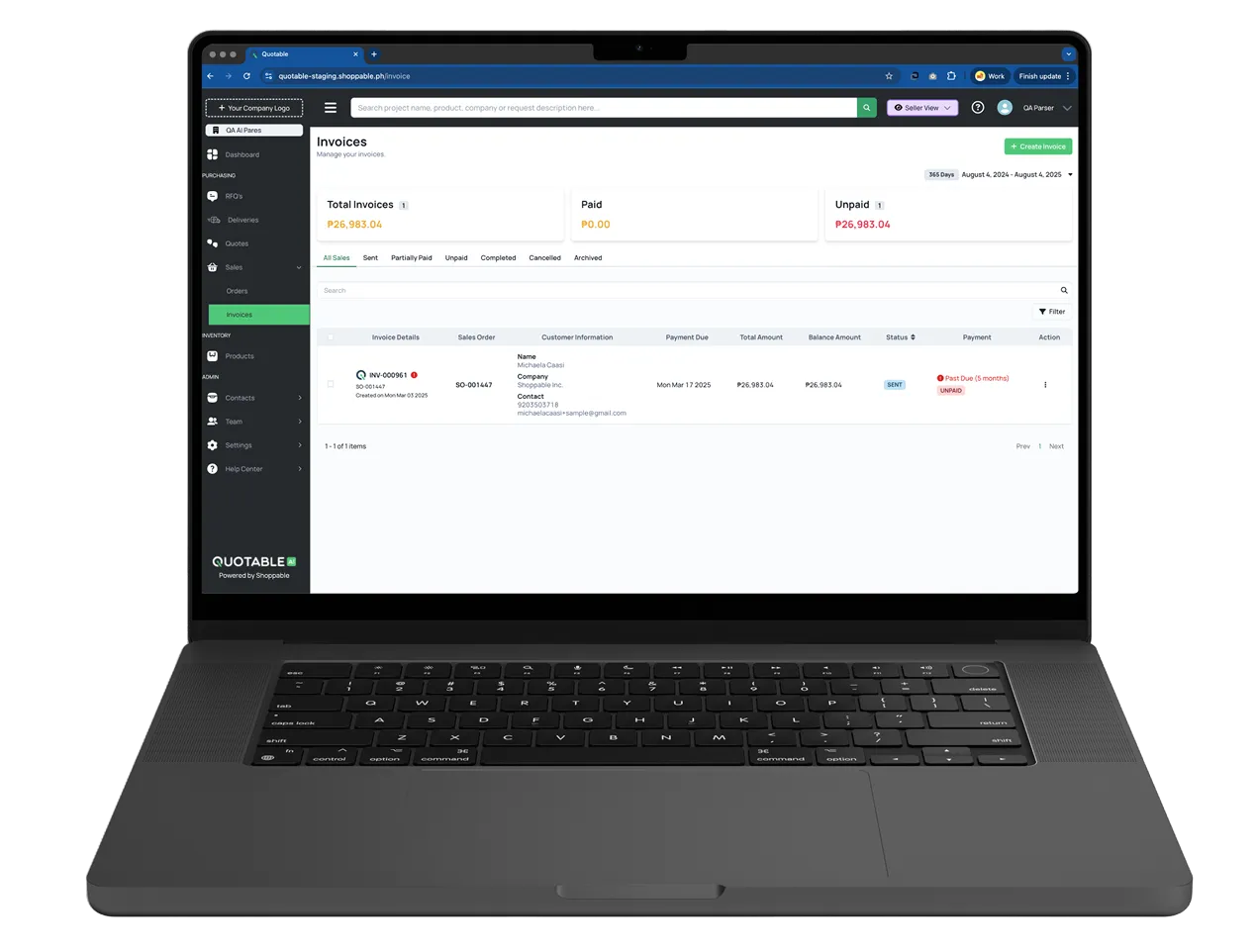
Bridging this gap requires treating the quote as the anchor document for the entire transaction. Quotable AI takes this approach by design: it treats the quote as a live transaction state that connects quoting, procurement, payments, and fulfillment into one continuous workflow. When a supplier submits a quote through the platform, that data persists through every subsequent step. There's no re-keying, no version confusion, and no gap between what was quoted and what was invoiced.
Eliminating Data Silos with AI-Powered Orchestration
Data silos aren't just an IT problem. They're a procurement problem with direct financial consequences. When your quoting data lives in one system, your PO data in another, and your payment data in a third, you lose the ability to analyze your spending patterns, negotiate better terms, or even spot duplicate payments.
AI-powered orchestration solves this by creating a single data layer that spans the entire transaction. A universal AI parser, for example, can automatically extract and structure data from quotes, invoices, purchase orders, and bills of materials, regardless of format. Whether a supplier sends a PDF quote, an Excel price list, or a formatted email, the system reads it, structures it, and makes it available across every downstream process.
This isn't about replacing your ERP. Smart companies keep their existing financial systems and layer an orchestration platform on top. The goal is to connect what you already have, not rip and replace. For mid-market companies that have invested significantly in their ERP infrastructure, this approach is the right-sized solution: it modernizes supplier collaboration without forcing a painful system migration.
Accelerating the Quote-to-Payment Lifecycle
Speed matters in B2B transactions, but not in the way most people think. It's not just about closing deals faster. It's about compressing the entire lifecycle from initial quote to final payment so that cash flows predictably and disputes get caught early. For distributors and manufacturers operating on thin margins, shaving even a few days off the quote-to-payment cycle can meaningfully improve working capital.
The average B2B payment cycle in the United States still hovers around 30 to 45 days, according to Atradius data. But much of that delay isn't caused by the buyer's willingness to pay. It's caused by administrative friction: invoices that don't match POs, approvals stuck in someone's inbox, or payment details that require manual verification.
Automating Invoicing and B2B Payments
Invoicing is where many procurement workflows grind to a halt. A common mistake I see is companies treating invoicing as a separate, downstream activity disconnected from the original transaction. When the invoice is generated manually, referencing a quote that was created weeks ago in a different system, errors are almost guaranteed.
Automated invoicing flips this model. When the quote, PO, and fulfillment data all live in the same system, the invoice generates itself. Line items, quantities, pricing, and terms carry forward automatically. The three-way match happens in real time, not as a manual reconciliation exercise in accounts payable.
Payment processing adds another layer of friction that AI can remove. Traditional B2B payments involve bank wires with manual remittance advice, check processing, or clunky payment portals that require supplier onboarding. Quotable AI embeds payment options directly into the transaction workflow: bank wire, ACH, credit cards, and e-wallets are all available through a single system. Suppliers receive payments through their preferred method, and buyers don't have to chase payment confirmations across multiple channels.
The result is faster cash conversion and fewer disputes. When every payment ties back to a specific quote, PO, and invoice with a complete audit trail, reconciliation becomes trivial rather than time-consuming.
Reducing Lead Times in Manufacturing and Construction
Manufacturing and construction procurement have unique challenges that generic procurement software often ignores. Lead times are long, specifications are complex, and a single project might involve dozens of suppliers with overlapping delivery schedules. Manual procurement in these industries doesn't just cost money: it costs time on the critical path.
Consider a mid-size construction subcontractor managing material procurement for five concurrent projects. Each project requires quotes from multiple suppliers for steel, concrete, electrical components, and specialty items. If the procurement team is managing RFQs through email and tracking responses in spreadsheets, they're spending more time on administration than on strategic sourcing.
The breaking point typically hits around $10M in annual purchasing volume. Below that threshold, a skilled procurement manager can keep things moving through personal relationships and institutional memory. Above it, the complexity overwhelms manual processes. Quotes expire before they're reviewed. Supplier responses get lost. And lead time commitments made during quoting don't match what actually shows up on site.
AI-driven platforms compress this cycle by allowing suppliers to respond to RFQs through secure links without creating accounts or adopting new software. This frictionless participation means procurement teams collect more competitive bids in less time, which directly reduces both cost and lead time.
The Operating System for Vertical B2B Trade
The concept of an "operating system" for B2B trade sounds ambitious, but the logic is straightforward. Just as your computer's OS connects applications, hardware, and user inputs into a coherent experience, a B2B operating system connects quoting, procurement, fulfillment, and payments into a single workflow. The quote is the kernel of this system: everything else builds on it.
This matters because vertical B2B industries (construction, manufacturing, logistics, IT distribution) have specific workflow requirements that horizontal software can't address. A construction distributor needs cost codes tied to project numbers. A manufacturing supplier needs bill-of-materials parsing. An IT distributor needs serial number tracking. Generic procurement tools treat these as edge cases. A vertical operating system treats them as core functionality.
Integrating Fulfillment and Shipping into One Workflow
One of the most overlooked steps in procurement is the handoff between order confirmation and fulfillment. In many companies, once a PO is issued, the procurement team considers their job done. But the transaction isn't complete until the goods are delivered, received, and reconciled against the original order.
When fulfillment lives in a separate system (or worse, in someone's head), problems multiply:
Integrating Fulfillment and Shipping into One Workflow
One of the most overlooked steps in procurement is the handoff between order confirmation and fulfillment. In many companies, once a PO is issued, the procurement team considers their job done. But the transaction isn't complete until the goods are delivered, received, and reconciled against the original order.
When fulfillment lives in a separate system (or worse, in someone's head), problems multiply:
- Partial shipments aren't tracked against the original PO, leading to duplicate orders or missed deliveries
- Shipping costs aren't captured at the transaction level, making true cost-per-unit calculations impossible
- Receiving discrepancies aren't flagged until the invoice arrives, creating disputes weeks after delivery
Integrating fulfillment into the same platform that handles quoting and procurement eliminates these gaps. The system knows what was quoted, what was ordered, what was shipped, and what was received. Discrepancies surface immediately, not at invoice reconciliation time.
Scaling Procurement Efficiency 10X with Quotable AI
The "10X faster" claim deserves scrutiny, so here's how the math works. Take a typical B2B transaction lifecycle: RFQ creation (30 minutes), supplier follow-up (2-3 emails over 2 days), quote comparison (45 minutes), PO creation (20 minutes), invoice matching (15 minutes), and payment processing (10 minutes). That's roughly 2 hours of active work spread over 3 to 5 business days.
With an AI-powered platform that treats the quote as a live transaction state, the same lifecycle looks different. RFQs go out to multiple suppliers simultaneously through structured templates. Suppliers respond through no-login links, and their responses are automatically parsed and compared. The winning quote converts to a PO with one click. The invoice generates automatically from the fulfilled PO. Payment happens through embedded options.
Active work drops to about 15 minutes. Elapsed time drops to hours instead of days. That's not a theoretical improvement: it's what happens when you eliminate re-keying, manual follow-up, and system-hopping from the workflow. For a team processing 200 transactions per month, this compression frees up hundreds of hours for strategic work like supplier negotiation, demand planning, and relationship building.
Quotable AI was built around this exact premise: start where the transaction begins (the quote) and carry that data through every subsequent step without friction. The platform connects with existing ERPs and accounting systems, so companies don't have to abandon their current infrastructure to capture these gains.
Future-Proofing Purchasing for Mid-Market Companies
Mid-market companies face a specific strategic challenge that their smaller and larger peers don't share. They're too big for manual processes but often too resource-constrained for enterprise-grade system overhauls. The procurement function sits at the center of this tension: it touches every dollar the company spends, but it rarely gets the technology investment it deserves.
The companies that will thrive over the next decade are the ones that recognize procurement as a growth function, not just a cost center. Every dollar saved through better sourcing drops straight to the bottom line. Every day shaved off the quote-to-payment cycle improves working capital. Every eliminated manual touchpoint reduces error rates and frees your team to focus on work that actually requires human judgment.
The hidden costs of manual procurement aren't going away on their own. They grow with your transaction volume. A process that works at $5M in annual purchasing becomes a serious liability at $20M. Smart money says you fix the foundation before you scale, not after the cracks start showing.
If you're running a B2B operation and still stitching together quotes, POs, invoices, and payments across multiple disconnected tools, the cost of inaction is real and compounding. Start by auditing your current quote-to-payment lifecycle end to end. Count the manual touchpoints, measure the elapsed time, and calculate what those hours cost you annually. The number will almost certainly surprise you. That's your business case for change, and platforms like Quotable AI exist specifically to close that gap for companies at your scale.