Every week, somewhere between a quote being sent and a payment being received, an SME loses money it didn't know it was losing. The gap isn't dramatic. It's a slow leak: a quote that sits in someone's inbox for three days, a manual invoice re-keyed with the wrong PO number, a payment that arrives 45 days late because nobody followed up. If you're running a distribution or supply business doing $1M to $30M in annual revenue, these small failures compound into a serious drag on cash flow, margins, and growth. The question isn't whether your SME needs a quoteq-to-cash strategy before your competitors adopt one. It's whether you can afford to wait while they already are. This article breaks down where fragmented sales cycles actually cost you money, how treating the quote as a live transaction changes the math, and what a unified system looks like in practice for firms at your scale.
The Hidden Cost of Fragmented Sales Cycles for SMEs
Most SMEs don't have a single "sales system." They have a patchwork: a CRM here, a spreadsheet there, an accounting tool that doesn't talk to either. The real cost isn't the software subscriptions. It's the invisible tax you pay every time a human has to bridge the gap between two disconnected tools. According to APQC benchmarks, top-performing organizations spend $2.07 to process a single invoice, while bottom performers spend $10.89. For an SME processing 500 invoices a month, that gap represents over $50,000 annually in wasted labor alone. And invoicing is just one piece of the cycle.
The fragmentation hits hardest when you're growing. A firm handling 30 orders a month can survive on manual processes. Cross the 50-order threshold, and the cracks become canyons. Duplicate entries multiply, approvals stall, and your finance team spends more time chasing paperwork than closing books.
The Gap Between Quoting and Payment
Here's a scenario we see constantly: a sales rep sends a PDF quote via email. The buyer verbally agrees but requests a small change to payment terms. The rep updates the quote in a Word document, sends it back, and the buyer's procurement team re-enters the line items into their own system to generate a PO. That PO comes back with a slightly different product description. Your team manually matches it to the original quote, creates an invoice in your accounting software, and emails it. The buyer pays 38 days later because the invoice sat in an AP queue nobody checked.
Every handoff in that chain is a point of failure. Research from Ardent Partners shows that 62% of AP departments still receive invoices via email or paper, creating a bottleneck that extends payment cycles by an average of 8 to 12 days. For an SME with tight working capital, those extra days aren't an inconvenience. They're a survival issue.
The gap between quoting and payment isn't a technology problem. It's an architecture problem. When each stage of the transaction lives in a different system, no one has a complete picture of where money is in the pipeline.
Why Manual Data Entry Stalls Business Growth
I worked with a construction supply distributor doing about $8M in annual revenue. Their ops manager spent roughly 15 hours a week re-entering data from quotes into their ERP, then again into their invoicing tool. That's nearly 800 hours a year, the equivalent of a part-time employee, dedicated entirely to copying numbers from one screen to another.
Manual data entry doesn't just waste time. It introduces errors that cascade. A wrong cost code on an invoice triggers a dispute. A mismatched PO number delays payment. A verbal change to delivery terms that never gets documented creates a liability. Each of these mistakes requires human intervention to resolve, pulling your team away from revenue-generating work.
The breaking point is predictable. Once you're processing more than 50 quotes per week, the error rate on manual entry typically exceeds 3-4%. That means for every 100 transactions, three or four require rework. Multiply that across a year, and you're looking at hundreds of hours lost to fixing preventable mistakes.
Redefining the Quote as a Live Transaction State
The traditional view of a quote is simple: it's a document. You create it, send it, and wait. If the buyer accepts, you move to the next step. If they don't, you revise and resend. The quote itself is static, a snapshot of terms at a moment in time.
This model made sense when B2B transactions were slow by design. It doesn't hold up when your competitors can turn a quote into a fulfilled order in hours instead of days. The shift requires treating the quote not as a PDF to be emailed, but as a live transaction state that carries data forward through every subsequent step: procurement, fulfillment, invoicing, and payment.
Moving Beyond Static Documents to Active Workflows
Think about what happens when a quote becomes active rather than static. The buyer clicks a link, reviews line items, adjusts quantities, approves terms, and triggers a purchase order, all within the same workflow. No re-entry. No email chains. No version confusion.
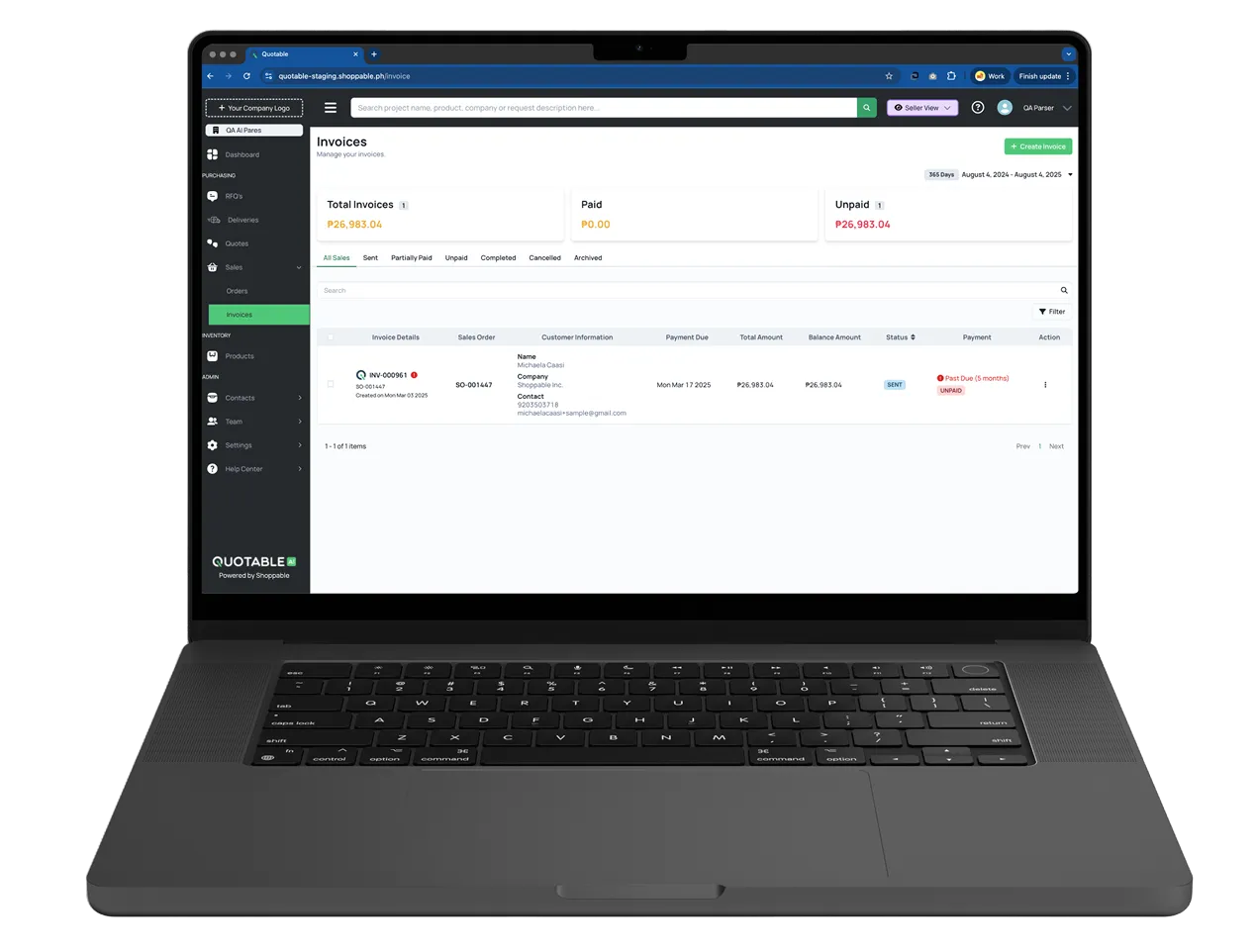
This isn't hypothetical. Platforms like Quotable AI are built around this exact principle. When a buyer receives a quote through a no-login link, they can approve it, submit a PO, and even pay immediately through embedded payment options like ACH, bank wire, or credit card. The quote doesn't die after acceptance. It transforms into the order, the invoice, and the payment record.
The practical impact for SMEs is significant. A distributor sending 200 quotes a month can eliminate the 2-3 day lag between quote acceptance and order creation. That acceleration compounds: faster orders mean faster fulfillment, faster invoicing, and faster payment. One IT reseller we spoke with reduced their average quote-to-cash cycle from 22 days to under 5 by treating quotes as live transaction states rather than static files.
The Power of a Vertically Integrated Data Orchestration Layer
"Data orchestration" sounds abstract until you see what it replaces. Without it, your quote data lives in one system, your procurement data in another, your payment data in a third. Someone, usually your most overworked employee, serves as the human integration layer, copying data between systems and hoping nothing gets lost.
A vertically integrated approach connects quoting, procurement, payments, and fulfillment into one continuous workflow. The quote generates the PO. The PO triggers fulfillment. Fulfillment triggers the invoice. The invoice enables payment. Each step inherits data from the one before it, so there's a single source of truth from the first price discussion to the final dollar collected.
For SMEs, this eliminates the most common operational red flags: duplicate orders caused by version mismatches, visibility gaps where nobody knows if a quote was approved, and delayed month-end closes because finance is still reconciling invoices against POs manually. When the data flows through one system, the audit trail builds itself.
Accelerating Cash Flow Through Automation
Cash flow is the oxygen supply for any SME. You can be profitable on paper and still run out of cash because the money you're owed is stuck in someone else's process. Automation doesn't just speed things up. It removes the human bottlenecks that cause unpredictable delays.
Reducing Lead-to-Cash Friction in B2B Trade
Friction in B2B trade comes from predictable places. Approvals that require multiple email threads. Invoices that need manual three-way matching against POs and delivery receipts. Payment methods that force buyers through clunky bank transfer processes. Each friction point adds days to your cash cycle.
Consider a typical B2B transaction at an SME distributor:
- Sales rep creates a quote (Day 1)
- Buyer reviews and requests changes (Days 2-4)
- Revised quote sent and approved (Days 5-7)
- PO generated and matched (Days 8-10)
- Goods shipped and delivery confirmed (Days 11-15)
- Invoice created and sent (Days 16-18)
- Buyer processes invoice through AP (Days 19-30)
- Payment initiated and received (Days 31-45)
That's 45 days from first quote to cash in hand. Automating steps 2 through 6 can compress the cycle to under 15 days. The biggest gains come from eliminating the waiting periods between steps, the dead time where documents sit in queues.
Reducing this friction isn't about working faster. It's about removing the reasons work stops. When a buyer can approve a quote and trigger a PO in the same session, you've eliminated a week of back-and-forth. When the invoice generates automatically from the fulfilled order, you've eliminated another three days of administrative delay.
How AI-Powered Invoicing Eliminates Collection Delays
Collection delays are rarely about buyers refusing to pay. They're about invoices that arrive with errors, land in the wrong inbox, or lack the reference numbers the buyer's AP system requires. Ardent Partners data shows that 39% of invoices require some form of exception handling, and each exception adds an average of 7 days to payment.
AI-powered invoicing addresses this by auto-generating invoices that pull correct data directly from the approved quote and PO. Line items, quantities, prices, tax calculations, and reference numbers are inherited, not re-entered. The invoice matches the PO by default because they share the same data source.
Quotable AI takes this a step further with embedded payment options. When the buyer receives an invoice, they can pay immediately via ACH, credit card, or e-wallet through the same link. There's no need to log into a separate portal or initiate a bank transfer manually. This alone can shave 10-15 days off the average collection period for SMEs that currently rely on traditional invoicing methods.
One overlooked benefit: automated invoicing creates a clean audit trail that satisfies SOX-adjacent compliance requirements. Even if your firm isn't SOX-regulated, having a documented, timestamped record of every quote, approval, invoice, and payment protects you in disputes and simplifies tax reporting.
Operational Benefits for SME Suppliers and Distributors
The financial benefits of a quote-to-cash strategy are clear. But the operational improvements are what make it sustainable. A faster cash cycle means nothing if your team burns out maintaining the system that produces it.
Streamlining Procurement and Fulfillment for $1M-$30M Revenue Firms
Firms in the $1M to $30M revenue range occupy an awkward middle ground. They're too large to run on spreadsheets and email alone, but too small to justify the six-figure ERP implementations that enterprise companies deploy. This is exactly where a purpose-built quote-to-cash platform delivers disproportionate value.
For a distributor doing $5M in revenue with a 20% gross margin, every day of delayed payment represents roughly $2,740 in tied-up working capital. Compress your average payment cycle by 15 days, and you free up over $41,000 in cash at any given time. That's real money you can redeploy into inventory, hiring, or growth.
The procurement side benefits equally. When your buyers can submit POs through the same system that generated the quote, you eliminate maverick spend and unauthorized purchase variations. Every order traces back to an approved quote with documented terms, pricing, and delivery expectations. Your fulfillment team knows exactly what was promised, because the data flows directly from the buyer's approval.
Industry-Specific Gains: Construction, IT, and Logistics
Different industries feel the pain of fragmented quote-to-cash processes in different ways.
In construction supply, the challenge is change orders. A general contractor requests 200 units of rebar, then calls to change it to 250 with a different grade. If that verbal change doesn't get documented in the quote and carried through to the invoice, you're looking at a billing dispute that could take weeks to resolve. A live quote system captures changes in real time and carries them through to fulfillment and invoicing automatically.
IT resellers and VARs face a different problem: complex multi-line quotes with licensing terms, subscription renewals, and hardware bundles. A single quote might have 30 line items with different margins, delivery timelines, and vendor costs. Managing this manually in a spreadsheet is a recipe for margin erosion. When the quoting system connects directly to procurement and invoicing, margin visibility stays intact from the first line item to the final payment.
Logistics companies deal with variable pricing tied to fuel surcharges, route changes, and weight adjustments. Static quotes become inaccurate within hours. A system that treats the quote as a living document, one that updates as variables change and automatically adjusts downstream invoicing, prevents the revenue leakage that plagues freight brokers and 3PLs.
Future-Proofing Your Business with Quotable AI
The firms that will dominate B2B trade over the next decade aren't the ones with the most sales reps or the lowest prices. They're the ones that can move from first customer contact to collected payment faster and more accurately than anyone else. Speed and accuracy aren't just competitive advantages. They're table stakes.
Achieving 10X Faster Cycles with a Unified System
The 10X claim sounds aggressive until you do the math. If your current quote-to-cash cycle takes 30 days and you compress it to 3, that's a 10X improvement. Is it realistic? For many SMEs, yes, because most of those 30 days aren't productive work. They're waiting time: waiting for approvals, waiting for POs, waiting for payments.
Quotable AI's approach starts where the transaction begins, at the quote, and carries data through every subsequent step without manual intervention. The result is a cycle where the quote becomes the order, the order becomes the invoice, and the invoice becomes the payment, all within a single continuous workflow. For an SME processing 100 transactions a month, this means your team spends time selling and fulfilling instead of administering paperwork.
The unified system also gives you something spreadsheets and disconnected tools never can: real-time visibility into your entire pipeline. You can see which quotes are pending, which orders are in fulfillment, which invoices are outstanding, and which payments are overdue, all in one view. That visibility alone changes how you make decisions about inventory, staffing, and credit terms.
Bridging the Gap Between Sales, Finance, and Procurement
In most SMEs, sales, finance, and procurement operate as separate fiefdoms with their own tools, their own data, and their own version of the truth. Sales says the deal was $50,000. Finance shows an invoice for $48,500. Procurement has a PO for $51,200. Nobody's wrong, exactly. They're just working from different snapshots of a transaction that evolved over time without a shared record.
Bridging this gap isn't about buying more software. It's about ensuring that every department works from the same transaction record. When the quote is the single source of truth, and every change, approval, and payment flows through it, the discrepancies disappear. Sales knows what was quoted. Finance knows what was invoiced. Procurement knows what was ordered. And everyone can see the current status without sending a single "hey, quick question" email.
This alignment has a measurable impact on month-end close times. Finance teams at SMEs typically spend 5-7 days reconciling transactions at month-end. With a unified quote-to-cash system, that drops to 1-2 days because the reconciliation happens continuously, not in a batch at the end of the month.
Your SME needs a quote-to-cash strategy now, not because it's trendy, but because the cost of not having one grows every month. Every manual handoff, every re-keyed data point, every payment that arrives late because of a preventable error is money and time you don't get back. Your competitors are already figuring this out. The firms that connect their quoting, procurement, invoicing, and payments into a single workflow will collect faster, operate leaner, and grow more predictably than those still stitching together disconnected tools. If you're ready to see what a unified quote-to-cash system looks like for your business, Quotable AI is built specifically for SMEs at your stage. Start where the transaction begins, and let the system carry it through to payment.