Every growing business reaches a point where buying technology stops being a simple credit card transaction and starts becoming a process that touches finance, operations, and vendor relationships all at once. IT procurement, the full cycle of sourcing, quoting, purchasing, and paying for technology products and services, is one of those functions that quietly becomes a bottleneck before anyone notices. A mid-market distributor handling 50 purchase orders a week across a dozen suppliers can easily lose hours to manual quote comparisons, email-based approvals, and disconnected payment workflows. The cost isn't just time: it's missed volume discounts, duplicated orders, and cash flow blind spots that compound every quarter. With global IT spending projected to grow by 9.8% in 2025, the volume of procurement transactions your business handles is only going up. The question isn't whether you need a better system. It's how quickly you can build one that doesn't break as you scale. This guide walks through the specific bottlenecks that slow IT purchasing down, the structural changes that speed it up, and the practical tools that make the difference between a procurement function that drags and one that drives growth.
Overcoming Common Bottlenecks in IT Procurement
Most procurement problems don't announce themselves with a single catastrophic failure. They show up as slow leaks: a quote that sat in someone's inbox for three days, a duplicate order no one caught until the invoice arrived, a vendor payment that required four emails to confirm. These small friction points accumulate until your team spends more time managing the process than managing the business.
The real danger zone for IT purchasing teams typically hits around 30 to 50 orders per month. Below that threshold, spreadsheets and email threads hold together well enough. Above it, the cracks become expensive. You start seeing maverick spend, where individuals buy outside approved channels because the official process is too slow. You see approval bottlenecks where a single manager becomes a chokepoint for every purchase over $500. And you see reconciliation nightmares at month-end when finance can't match purchase orders to invoices to payments.
Recognizing these breaking points early is the difference between a planned improvement and a crisis response. The two most common structural causes are fragmented systems and outdated quoting processes.
The High Cost of Fragmented Systems
A typical mid-market IT buyer might use one tool for vendor discovery, another for quote management, a spreadsheet for price comparisons, an ERP for purchase orders, and yet another platform for payments. Each system holds a piece of the transaction, but none of them talk to each other in real time.
This fragmentation creates three specific costs. First, there's the labor cost of manual data re-entry. If your procurement team manually keys in line items from a supplier's PDF quote into your ERP, that's 10 to 15 minutes per quote, and each re-entry introduces error risk. Multiply that across hundreds of quotes per month, and you've got a full-time employee doing nothing but data transcription. Second, fragmented systems destroy visibility. When your CFO asks how much you've committed to a specific vendor this quarter, the answer requires pulling data from three or four sources and reconciling it manually. That delay means pricing decisions and budget adjustments happen on stale information. Third, disconnected systems make audit trails unreliable. If you're subject to SOX compliance or even basic internal controls, you need a clear chain from requisition to payment. Gaps between systems create gaps in that chain.
The hard-won lesson here: the cost of fragmented procurement isn't in any single tool's subscription fee. It's in the invisible tax your team pays every day to bridge the gaps between them.
Why Traditional Quoting Processes Slow Down Growth
The quote is where most B2B transactions begin, yet it's the step that gets the least technological attention. A typical IT procurement cycle starts with a request for quotation sent to two or three suppliers, followed by days of waiting, manual comparison of responses, internal approval routing, and finally a purchase order. That cycle can take one to three weeks for a routine purchase.
The problem compounds when you're dealing with quote-heavy categories like networking equipment, server hardware, or software licensing, where configurations vary and pricing is rarely standardized. Each quote requires human interpretation: is this supplier quoting the same SKU? Are lead times comparable? Does the pricing include installation?
Traditional quoting also breaks down because it treats the quote as a static document rather than a live piece of data. A PDF quote emailed to your inbox can't update itself when a supplier's pricing changes. It can't flag that a competitor offered better terms on the same line item. It can't automatically flow into a purchase order when approved. Every transition between stages requires someone to manually push the process forward, and every manual handoff is a point where delays, errors, and lost context creep in.
Centralizing the Quote-to-Payment Lifecycle
The single biggest structural improvement you can make to your procurement function is collapsing the distance between receiving a quote and completing payment. Most organizations treat these as separate workflows owned by separate teams, with procurement handling sourcing and quoting, finance handling invoicing and payment, and operations somewhere in between managing delivery. That separation made sense when each function had its own paper-based system. It doesn't make sense when a single platform can connect them.
Centralizing the quote-to-payment lifecycle means every stakeholder, from the buyer comparing quotes to the controller approving payment, works from the same data set. Changes propagate instantly. Approvals happen in context. And the audit trail builds itself because every action occurs within one system.
Treating the Quote as a Live Transaction State
Here's a concept that changes how you think about procurement: the quote isn't a document. It's a transaction state. It's the earliest point in a purchase where price, quantity, terms, and vendor identity are all defined. Everything downstream, the purchase order, the invoice, the payment, is a derivative of that initial quote.
When you treat the quote as a live transaction state rather than a static PDF, several things become possible. The quote can be updated by the supplier in real time without requiring a new email thread. Approved quotes can automatically generate purchase orders with matched line items. Invoice discrepancies can be caught instantly through a three-way match against the original quote and PO. And payment can be triggered from the same record, closing the loop without manual intervention.
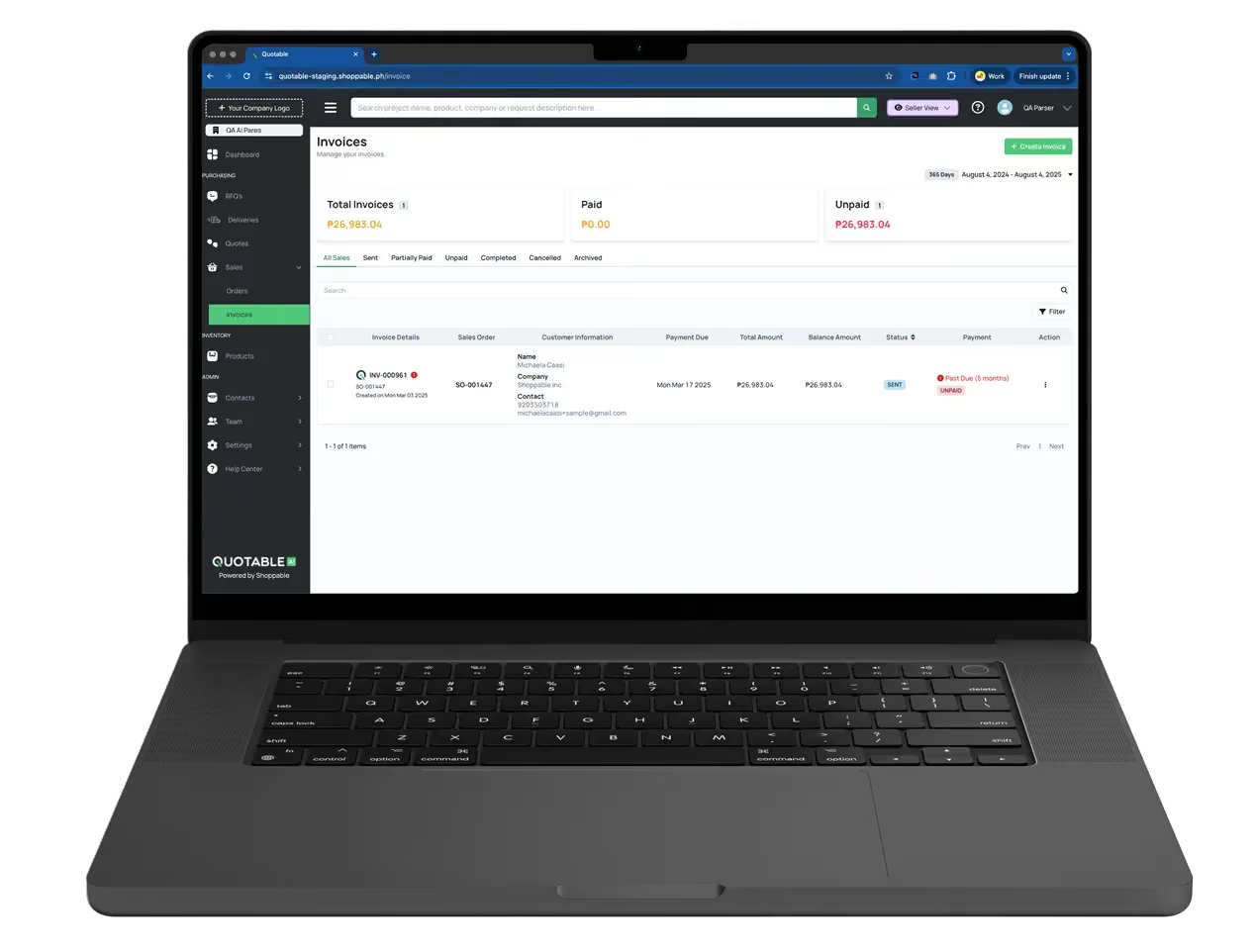
This is the approach that platforms like Quotable AI take: treating the quote as the origin point of the entire transaction lifecycle. Suppliers can respond to RFQs through a secure link without creating accounts, which means your procurement team collects structured responses faster. Those responses flow directly into comparison views, approvals, and downstream documents, all without re-keying data.
Automating B2B Payments and Invoicing
Payment is where procurement cycles go to die. Even after a purchase is approved and goods are received, the payment process often involves manual invoice matching, email-based payment confirmations, and reconciliation delays that stretch days into weeks.
Automating B2B payments means embedding payment capabilities directly into the procurement workflow. When an invoice is matched against a PO and receiving report, payment can be initiated immediately through bank wire, ACH, credit card, or e-wallet, without switching to a separate banking portal or cutting a physical check.
The benefits are concrete:
- Cash flow visibility improves because payments are tracked in the same system as purchases
- Supplier relationships strengthen because vendors get paid faster and can verify payment status without calling your AP team
- Month-end close accelerates because payment records are already reconciled against purchase orders and invoices
- Early payment discounts become capturable because the payment trigger is automated rather than dependent on manual processing
For a distributor doing $10M to $30M in annual purchasing, even a 1% improvement in early payment discount capture can represent $100K to $300K in annual savings. That's real money recovered from a process improvement, not a revenue initiative.
Leveraging AI for Data Orchestration and Speed
Artificial intelligence in procurement isn't about replacing your purchasing team. It's about eliminating the manual data work that keeps them from doing higher-value tasks like supplier negotiation, demand planning, and cost analysis.
The most immediate AI application in IT procurement is document parsing. Every day, your team handles quotes, invoices, purchase orders, and bills of materials in dozens of different formats: PDFs, spreadsheets, email bodies, even scanned images. Extracting structured data from these documents manually is tedious and error-prone. A universal AI parser can automatically read these documents, extract line items, quantities, pricing, and terms, and populate your procurement system with structured data, reducing manual encoding time by 80% or more.
Beyond parsing, AI enables pattern recognition across your procurement data. Which suppliers consistently deliver late? Which product categories show the most price volatility? Where are you paying more than market rates? These insights exist in your transaction data, but they're invisible when that data is scattered across disconnected systems.
Connecting Procurement to Fulfillment Workflows
Procurement doesn't end when the PO is issued. The connection between purchasing and fulfillment, ensuring that what you ordered actually arrives, in the right quantity, at the right location, on the right date, is where many organizations lose control.
AI-driven data orchestration connects procurement to fulfillment by creating a continuous data flow from quote through delivery. When a PO is issued, the system can automatically track supplier acknowledgment, shipping notifications, and receiving confirmations. Discrepancies between ordered and received quantities trigger alerts before they become invoice disputes.
For IT distributors specifically, this connection is critical because technology products often have long and variable lead times. A server chassis ordered today might ship in three days or three weeks depending on component availability. An AI-connected procurement system can track these variables across your supplier base and flag risks before they impact your customers.
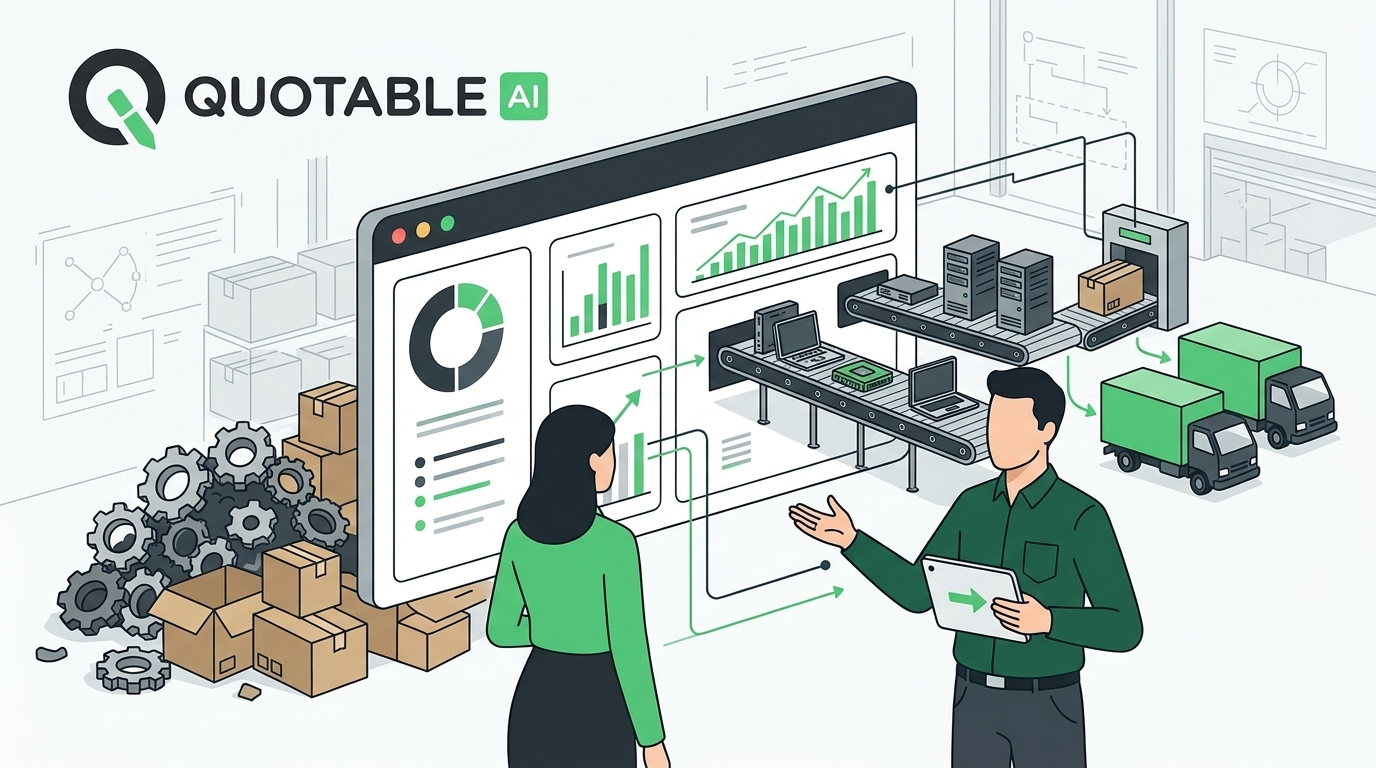
Quotable AI's approach connects quoting, procurement, payments, and fulfillment into one continuous workflow, which means your team isn't toggling between systems to answer the basic question: where is my order?
Achieving 10X Faster Procurement Cycles
A 10X improvement sounds ambitious, but consider the math. If your current procurement cycle from RFQ to payment takes 15 business days, a 10X improvement means completing it in 1.5 days. That's aggressive but achievable when you eliminate the specific delays that pad out each stage.
Here's where the time typically goes in a 15-day cycle:
- RFQ creation and distribution: 1 to 2 days (manual formatting, finding supplier contacts)
- Supplier response collection: 3 to 5 days (waiting, follow-up emails, reformatting responses)
- Quote comparison and analysis: 1 to 2 days (manual spreadsheet work)
- Internal approval routing: 2 to 3 days (email chains, manager availability)
- PO creation and dispatch: 1 day (re-keying data from approved quote)
- Invoice matching and payment: 3 to 5 days (manual three-way match, payment processing)
Automating steps 1, 2, 5, and 6 can reduce them to minutes rather than days. Structuring step 3 with AI-parsed data cuts comparison time to an hour. Configuring approval workflows with mobile notifications and threshold-based auto-approvals can compress step 4 to same-day. The result isn't magic: it's the removal of manual handoffs that never needed to be manual in the first place.
Standardizing Vendor and Supplier Management
Vendor management is where procurement strategy meets daily execution. Without standardized processes for onboarding, evaluating, and managing suppliers, your team makes ad hoc decisions that create inconsistency and risk.
A standardized vendor management approach includes several key elements. You need a centralized supplier database where every vendor's contact information, payment terms, performance history, and compliance documentation lives in one place. You need consistent evaluation criteria so that supplier selection isn't based solely on price but also on lead time reliability, quality metrics, and responsiveness. And you need a clear onboarding process that doesn't create so much friction that good suppliers walk away.
That last point deserves emphasis. Many procurement platforms require suppliers to create accounts, complete lengthy onboarding forms, and adopt new software before they can even respond to an RFQ. That friction filters out smaller, specialized suppliers who might offer better pricing or faster delivery but won't invest hours in a new platform for one potential order. Frictionless supplier participation, where vendors can respond to RFQs through a secure link without creating accounts, keeps your supplier pool broad and competitive.
Red flags that your vendor management needs standardization include: you can't quickly identify your top 10 suppliers by spend, you've discovered duplicate vendor records in your system, different buyers negotiate different terms with the same supplier, or you don't have a formal process for evaluating supplier performance. If any of these sound familiar, you're carrying risk that grows with every new vendor relationship.
B2B procurement teams that implement structured supplier management programs typically see measurable improvements in cost savings, delivery reliability, and contract compliance within the first year.
Building a Future-Proof IT Procurement Strategy
A procurement strategy that works today but can't adapt to tomorrow's volume, complexity, or regulatory requirements is a liability disguised as a process. Future-proofing your IT purchasing function means building systems and habits that scale with your business rather than constraining it.
The foundation of a resilient procurement strategy is data integrity. Every transaction, from the initial quote to the final payment, should produce clean, structured, queryable data. That data becomes the basis for spend analysis, supplier negotiations, budget forecasting, and compliance reporting. Organizations with strong procurement analytics capabilities consistently outperform their peers on cost management and supplier performance metrics.
Right-sizing your tools matters too. A $5M distributor doesn't need the same enterprise procurement suite as a Fortune 500 company. What you need is a system that handles your current volume without manual workarounds and can absorb 2X to 3X growth without requiring a platform migration. That's the smart money approach: invest in flexibility now rather than paying for a rip-and-replace later.
Scaling for SMEs and Mid-Market Growth
SMEs and mid-market companies face a specific procurement challenge: they've outgrown manual processes but can't justify the cost and complexity of enterprise procurement systems. This gap is where most organizations get stuck, running on a patchwork of spreadsheets, email, and basic accounting software that technically works but creates constant friction.
The scaling threshold typically hits between $3M and $10M in annual procurement spend. Below $3M, a disciplined team with good spreadsheets can manage. Above $10M, the volume of transactions, the number of supplier relationships, and the complexity of compliance requirements demand systematic support.
For companies in this range, the right approach is to adopt a platform that covers the full quote-to-payment lifecycle without requiring months of implementation or dedicated IT staff. Integration with your existing ERP and accounting system is non-negotiable: you shouldn't have to replace your financial infrastructure to modernize procurement. Quotable AI connects with existing financial systems specifically to address this, allowing organizations to upgrade their supplier collaboration without abandoning their current ERP.
Integrating Finance and Procurement Teams
The traditional wall between procurement and finance creates one of the most persistent inefficiencies in B2B operations. Procurement commits to purchases. Finance processes payments. Neither team has full visibility into what the other is doing until month-end reconciliation forces them into the same room.
Breaking down this wall doesn't require a reorganization. It requires shared data. When both teams work from the same transaction records, several problems disappear. Finance can see committed spend in real time rather than waiting for invoices to arrive. Procurement can see payment status without emailing the AP team. Budget owners can track actual versus planned spend at any point in the month, not just after close.
The practical implementation looks like this: your procurement platform and your financial system share data through integration, either via API connections or through a unified platform that handles both functions. Purchase orders created in procurement automatically create accruals in finance. Invoices matched in AP automatically update procurement's vendor performance records. Payments processed through the system update both the financial ledger and the procurement dashboard simultaneously.
This integration also strengthens your internal controls. A clean audit trail from requisition through payment satisfies both internal governance requirements and external compliance standards. For companies subject to regulatory scrutiny, this isn't optional: it's a requirement that gets harder to meet as transaction volume grows.
A Smarter Path Forward
Simplifying IT procurement isn't about buying more software. It's about eliminating the manual handoffs, disconnected systems, and static documents that turn a straightforward purchasing process into a multi-week ordeal. The companies that get this right treat the quote as the starting point of a continuous workflow that flows through approval, purchasing, fulfillment, and payment without breaking.
Start by identifying your specific bottlenecks. Is it supplier response time? Quote comparison? Approval routing? Payment processing? Each of these has a structural solution, and the right platform can address all of them within a single system. For SMEs and mid-market companies buying or selling between $1M and $50M annually, the payoff from streamlining procurement compounds with every transaction.
If you're ready to move from fragmented processes to a unified quote-to-payment workflow, explore how Quotable AI can help your team quote, procure, and pay faster, all in one place.