Every software project begins with a decision about who will build it, and that decision is only as good as the process behind it. If you've ever hired a development vendor based on a vague email thread and a ballpark estimate, you know how quickly things can go sideways: scope creep, mismatched expectations, and invoices that don't line up with deliverables. A well-structured RFQ for software development forces clarity before a single line of code is written. It turns a subjective gut-feel decision into a structured, comparable, and defensible procurement event. The custom software development market was estimated at USD 43.16 billion in 2024, and it's growing fast. With that kind of spend flowing through the industry, the companies that win aren't necessarily the ones with the biggest budgets. They're the ones with the sharpest procurement discipline. This guide breaks down the tools, templates, and hard-won lessons that separate a productive vendor selection process from an expensive guessing game.
The Strategic Importance of the RFQ in Software Engineering
Most procurement teams treat the RFQ as a pricing exercise. You send out specs, vendors return numbers, and you pick the lowest bid. That approach works fine for commodity purchases like office supplies or raw materials. Software development isn't a commodity. Two vendors quoting $150,000 for the same project can deliver wildly different outcomes depending on their architecture decisions, team composition, and post-launch support model.
The RFQ becomes strategic when it's designed to surface those differences rather than hide them behind a single dollar figure. For mid-market companies buying $10M to $50M in services annually, a poorly scoped software engagement can consume months of internal resources and still miss the mark. The RFQ is your first line of defense against that outcome.
Moving Beyond Simple Pricing to Value-Based Procurement
Price matters, but it's one variable in a much larger equation. A value-based RFQ asks vendors to break down their pricing by phase, role, and deliverable so you can see where the money actually goes. If one vendor allocates 30% of the budget to QA and another allocates 8%, that tells you something important about their quality philosophy.
We've seen procurement teams save significant budget not by choosing the cheapest bid, but by identifying which vendor's cost structure best aligned with the project's risk profile. For instance, a healthcare SaaS platform with strict compliance requirements should weight security expertise and audit-trail capabilities far more heavily than hourly rate. Your RFQ should reflect that weighting explicitly.
Include scoring criteria in your RFQ document. Assign percentage weights to categories like technical approach (30%), team qualifications (25%), pricing (20%), timeline feasibility (15%), and post-launch support (10%). When vendors know how they'll be evaluated, they tailor their responses to demonstrate value rather than just compete on cost.
Aligning RFQ Parameters with Software Development Lifecycles
A common mistake is writing an RFQ that assumes waterfall delivery when you actually need agile. If your team runs two-week sprints, your RFQ should ask vendors how they handle sprint planning, backlog grooming, and retrospectives. If you're building an MVP first and scaling later, the RFQ should explicitly describe that phased approach.
Align your milestone definitions with the software development lifecycle you intend to follow. For agile projects, define milestones around working software increments rather than documentation deliverables. Ask vendors to propose their own sprint cadence and explain how they'll handle scope changes mid-project. This reveals whether they've actually run agile engagements or just claim to.
The timeline section of your RFQ should also account for your internal review cycles. If your compliance team needs two weeks to review each release candidate, build that into the expected timeline. Vendors who've worked with regulated industries will appreciate the transparency, and those who haven't will quickly reveal themselves.
Essential Components of a Software Development RFQ
A strong software development RFQ contains more than a feature list and a deadline. It's a structured document that gives vendors enough information to produce accurate, comparable quotes while protecting your organization's interests through clear contractual expectations.
Technical Specifications and Tech Stack Requirements
Start with the technical environment. Specify your preferred programming languages, frameworks, cloud infrastructure, and any legacy systems the new software must integrate with. If you're running SAP or NetSuite on the back end, say so. If you need the application deployed on AWS GovCloud for compliance reasons, state that upfront.
Be specific about non-functional requirements too. Define expected response times, uptime SLAs, concurrent user capacity, and data retention policies. A vendor quoting for an app that serves 500 users will architect it very differently than one designed for 50,000. Vague requirements produce vague quotes.
Include a section on data migration if applicable. If you're replacing an existing system, vendors need to understand the volume and format of data they'll be working with. One client we worked with discovered mid-project that their legacy database contained 14 years of unstructured records that no one had mentioned in the original scope. That oversight added six weeks and $40,000 to the project.
Project Milestones and Agile Delivery Timelines
Define what "done" looks like at each stage. For a typical engagement, milestones might include: discovery and architecture review, MVP delivery, user acceptance testing, production deployment, and a 90-day stability period. Each milestone should have acceptance criteria that both parties agree to before work begins.
If you're following agile methodology, structure milestones around sprint deliverables rather than traditional project phases. Ask vendors to propose their sprint length, demo cadence, and definition of done for each user story. This gives you a practical window into how they'll actually manage the work.
Include penalty and incentive clauses tied to milestone completion. A 5% holdback on each phase payment, released upon successful acceptance testing, gives vendors a financial incentive to hit quality targets. This is especially important for mid-market companies where a delayed launch can directly impact revenue.
IP Ownership and Post-Launch Maintenance Clauses
Intellectual property ownership is where software RFQs diverge sharply from other procurement categories. Your RFQ must state clearly whether you'll own all source code, documentation, and related IP upon delivery, or whether the vendor retains rights to reusable components. Ambiguity here creates legal exposure that can surface years later.
Post-launch maintenance is equally critical. Specify the expected support period, response time SLAs for critical bugs, and whether the vendor will provide ongoing feature development. Many vendors price the initial build competitively and then charge premium rates for maintenance, so your RFQ should ask for both sets of pricing upfront.
Address escrow arrangements for source code. If the vendor goes out of business or you terminate the relationship, you need access to the codebase. Include a clause requiring the vendor to deposit source code in a third-party escrow service, updated with each major release.
Leveraging Quotable AI for Data-Driven Vendor Selection
Managing an RFQ process across multiple software vendors generates a surprising volume of documents: quote sheets, technical proposals, compliance certifications, references, and revised bids. When you're evaluating five or six vendors simultaneously, keeping everything organized in email threads and spreadsheets becomes a bottleneck.
Automating Quote-to-Payment Workflows for Development Teams
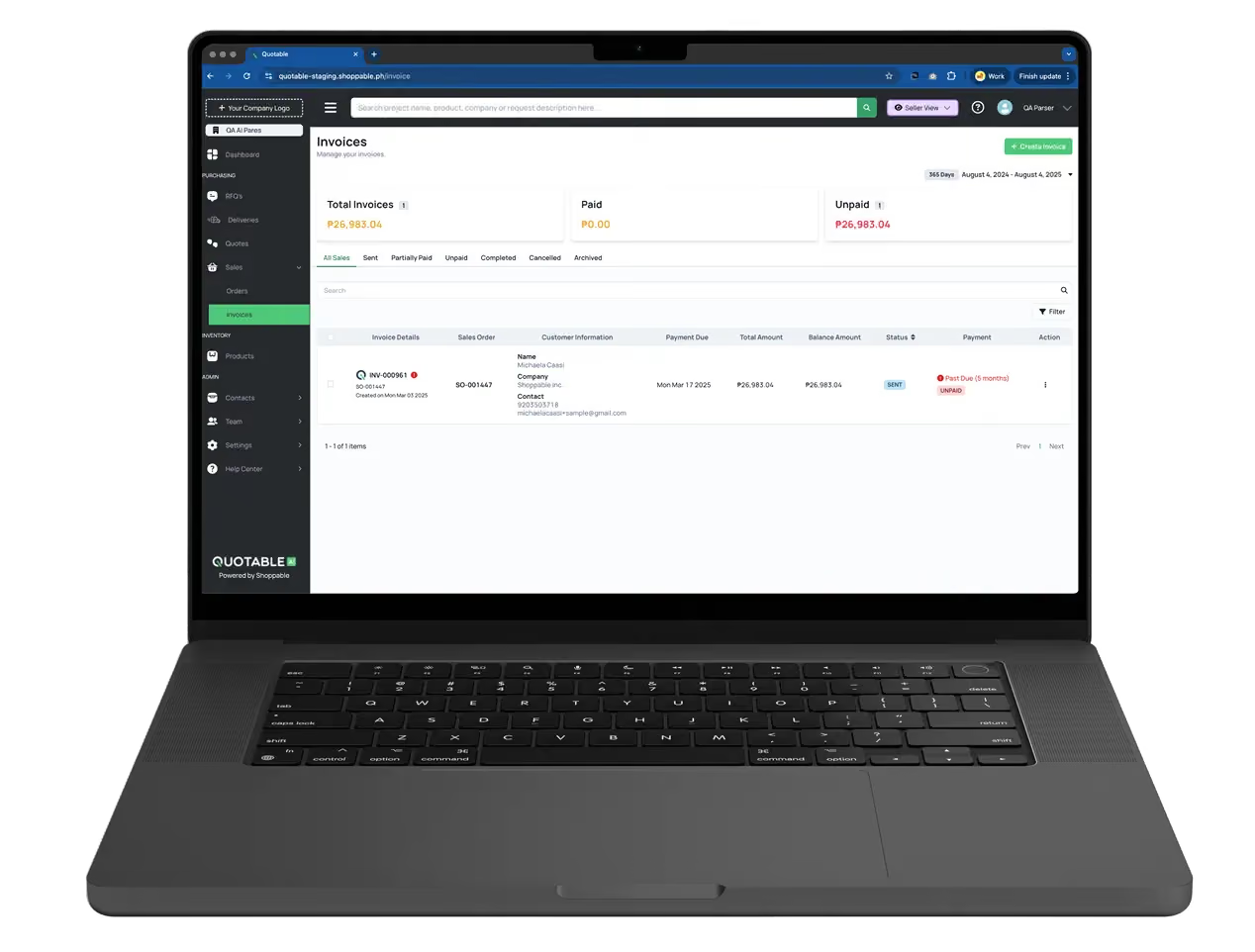
Quotable AI treats the quote as a live transaction state rather than a static PDF. When a vendor submits a quote in response to your software development RFQ, the platform's Universal AI Parser automatically extracts pricing, milestones, payment terms, and technical specifications into structured data fields. This eliminates the manual encoding that typically slows down procurement teams.
For development projects with phased billing, this matters a lot. If a vendor quotes $200,000 across four milestones with different payment terms for each, Quotable AI captures that structure and tracks it through invoicing and payment. You're not reconciling spreadsheets at month-end; you're working from a single source of truth.
The platform also connects with existing ERP and accounting systems, so you don't need to replace your financial infrastructure to modernize your vendor collaboration process. This is particularly relevant for mid-market companies running QuickBooks, Xero, or mid-tier ERPs that weren't designed for complex multi-vendor procurement.
Centralizing Supplier Communications in One Data Orchestration Layer
One of the biggest friction points in software procurement is getting vendors to respond in a consistent format. Some send Word documents, others use PDFs, and a few still respond via email with pricing buried in paragraph text. Quotable AI addresses this by allowing suppliers to respond to RFQs through a secure link without creating accounts or adopting new software.
This frictionless participation model means you collect structured responses faster. Vendors don't need to learn a new procurement portal or create login credentials. They receive a link, fill in their response against your standardized template, and submit. Your procurement team sees all responses in one place, formatted consistently for comparison.
The centralized view also creates an audit trail. Every quote revision, communication, and approval is logged, which matters for SOX compliance and internal governance. If someone asks six months later why you chose Vendor B over Vendor A, you have documented evidence of the evaluation process.
Best Practices for Evaluating Software Bids
Collecting bids is the easy part. Evaluating them fairly and consistently is where most procurement teams struggle. Software bids contain a mix of quantitative data (pricing, timelines) and qualitative claims (team expertise, methodology, cultural alignment) that resist simple comparison.
Standardizing Response Formats for Easier Comparison
Create a response template that every vendor must follow. This isn't optional. If you let vendors submit free-form proposals, you'll spend days trying to compare apples to oranges. Your template should include standardized sections for:
- Pricing broken down by phase, role, and deliverable
- Proposed team composition with named individuals and their relevant experience
- Technical architecture overview with a diagram
- Risk assessment and mitigation plan
- References from similar projects completed in the last two years
- Post-launch support pricing and SLA commitments
Require vendors to fill in a pricing matrix rather than submitting their own format. This forces consistency and makes side-by-side comparison straightforward. Procurement research from Ardent Partners consistently shows that standardized bid formats reduce evaluation time by 30% or more.
Assessing Vendor Velocity and Cultural Fit
Velocity refers to how quickly a vendor can move from contract signing to productive development. Ask vendors about their typical ramp-up time, how they handle onboarding, and whether they have bench resources available or need to recruit for your project. A vendor who needs eight weeks to staff up may not be the right fit for a time-sensitive engagement.
Cultural fit is harder to measure but equally important. If your team communicates primarily through Slack and expects daily standups, a vendor whose project managers prefer weekly status emails will create friction. Include questions in your RFQ about communication preferences, time zone overlap, and escalation procedures.
Request a trial sprint or paid proof-of-concept engagement before committing to a full contract. A two-week trial sprint costing $10,000 to $20,000 can reveal more about a vendor's actual capabilities than any written proposal. Think of it as a working interview. The cost is trivial compared to the risk of a six-figure engagement going wrong.
Common Pitfalls in Software Procurement and How to Avoid Them
The most expensive mistake in software procurement isn't choosing the wrong vendor. It's writing an incomplete RFQ that makes it impossible to choose the right one. Here are the red flags we see most often.
Vague scope definitions top the list. If your RFQ says "build a customer portal" without specifying user roles, authentication requirements, data sources, and integration points, every vendor will interpret the scope differently. Their quotes become incomparable, and whichever vendor you choose will inevitably encounter scope gaps that trigger change orders.
Ignoring total cost of ownership is another common trap. The initial build might cost $250,000, but hosting, maintenance, licensing, and eventual re-platforming could double that over five years. Your RFQ should ask vendors to estimate five-year TCO, not just the build cost. Custom software development projects that fail to account for ongoing costs often blow past budget within the first year of operation.
Skipping the technical evaluation round is a mistake we see with non-technical procurement teams. Always involve your CTO, lead architect, or a trusted technical advisor in the evaluation process. A vendor's proposal might look polished on paper while containing architectural decisions that create technical debt for years. Have someone qualified review the proposed tech stack, database design, and deployment strategy.
Finally, don't overlook contract exit terms. Software vendor relationships sometimes don't work out. Your contract should specify how source code, documentation, and data will be transferred if you terminate the engagement. Without clear exit terms, you can find yourself locked into a relationship with a vendor who isn't delivering, simply because switching costs are too high.
Integrating the Quote into the Full Transaction Lifecycle
The RFQ doesn't exist in isolation. It's the starting point of a transaction lifecycle that extends through contract execution, milestone billing, payment processing, and post-launch support. Companies that treat the RFQ as a standalone event often find themselves re-entering data, reconciling documents, and chasing payments manually for months after the vendor is selected.
The smarter approach is to treat the quote as the foundational data object that flows through every subsequent stage. When a vendor's quote includes milestone pricing, those milestones should automatically generate invoices as each phase is completed. When payment terms specify net-30 on milestone acceptance, the system should track that timeline and flag overdue payments. This is the core philosophy behind platforms like Quotable AI, which position the quote as a live transaction state that connects procurement, invoicing, and payment in one continuous workflow.
For software development engagements specifically, this integration eliminates a persistent pain point: the disconnect between project management tools and financial systems. Your PM tracks sprint completion in Jira, but your finance team tracks payments in QuickBooks. Without a connecting layer, someone is manually updating spreadsheets to bridge that gap. That manual process introduces errors, delays payment to vendors, and creates audit risk.
The companies that get this right are the ones that design their procurement process end-to-end before issuing the first RFQ. They define how quotes will be collected, how bids will be evaluated, how contracts will reference quote line items, and how milestone payments will be triggered. That upfront investment in process design pays dividends throughout the project lifecycle, reducing maverick spend and ensuring every dollar is traceable from quote to payment.
If you're building or refining your software procurement process, start with the RFQ. Get the structure right, ask the hard questions about IP and maintenance, standardize your evaluation criteria, and connect the quote to your financial workflows. The vendors who respond well to a rigorous RFQ process are almost always the ones who deliver well on the project itself. That correlation isn't a coincidence: it's a signal that they take structured collaboration as seriously as you do.