Every business that sells to other businesses knows the pain of chasing a deal from first price request to final payment. Somewhere between the quote, the purchase order, the invoice, and the bank transfer, revenue leaks out. One expert estimate suggests that up to 31.8% of annual revenue can disappear through gaps between quoting, contracts, billing, and collections. That's not a rounding error: it's a structural problem. For SMEs and mid-market companies moving $1M to $50M in goods and services each year, fixing this process isn't a nice-to-have. It's a survival strategy. The quote-to-cash cycle is the backbone of B2B commerce, and in 2026, the companies that master it will outpace those still stitching together spreadsheets, email threads, and disconnected software. This guide breaks down what a modern Q2C workflow actually looks like, where the friction hides, and how to build a system that turns quotes into collected cash faster than you thought possible.
The Evolution of Quote-to-Cash (Q2C) in 2026
The Q2C market has grown from a niche software category into a core pillar of B2B operations. The global quote-to-cash software market was valued at $3.8 billion in 2025 and is projected to reach $9.7 billion by 2034, growing at a 10.9% CAGR. That growth reflects a fundamental shift in how companies think about the sales-to-revenue pipeline: not as a sequence of disconnected steps, but as a single, continuous workflow.
Five years ago, most companies treated quoting as a sales task, procurement as an operations task, and payment collection as a finance task. Each team had its own tools, its own timelines, and its own version of the truth. The result was predictable: delays, errors, and finger-pointing. In 2026, the best-run companies treat the entire cycle as one system.
Moving Beyond Post-Transaction Systems
Most legacy business software starts working after the transaction has already happened. Your ERP records the invoice after it's been created. Your accounting system reconciles the payment after it's been received. Your CRM logs the deal after it's been closed. None of these tools help you while the transaction is in motion.
This is the core problem. If your systems only kick in after the fact, you're always reacting. You can't catch a pricing error on a quote before it becomes a disputed invoice. You can't flag a late shipment before it triggers a penalty clause. You can't identify a cash flow gap before it forces you to delay payroll.
The shift in 2026 is toward systems that operate during the transaction. Think of it like the difference between reviewing security footage after a break-in versus having a live alarm system. The companies pulling ahead are the ones whose software is active from the moment a quote is generated.
Treating the Quote as a Live Transaction State
Here's a hard-won lesson from working with distributors and manufacturers: the quote is not just a sales document. It's the first binding data point in a chain that includes procurement, fulfillment, invoicing, and payment. If you treat it as a throwaway PDF, every downstream step inherits its inaccuracies.
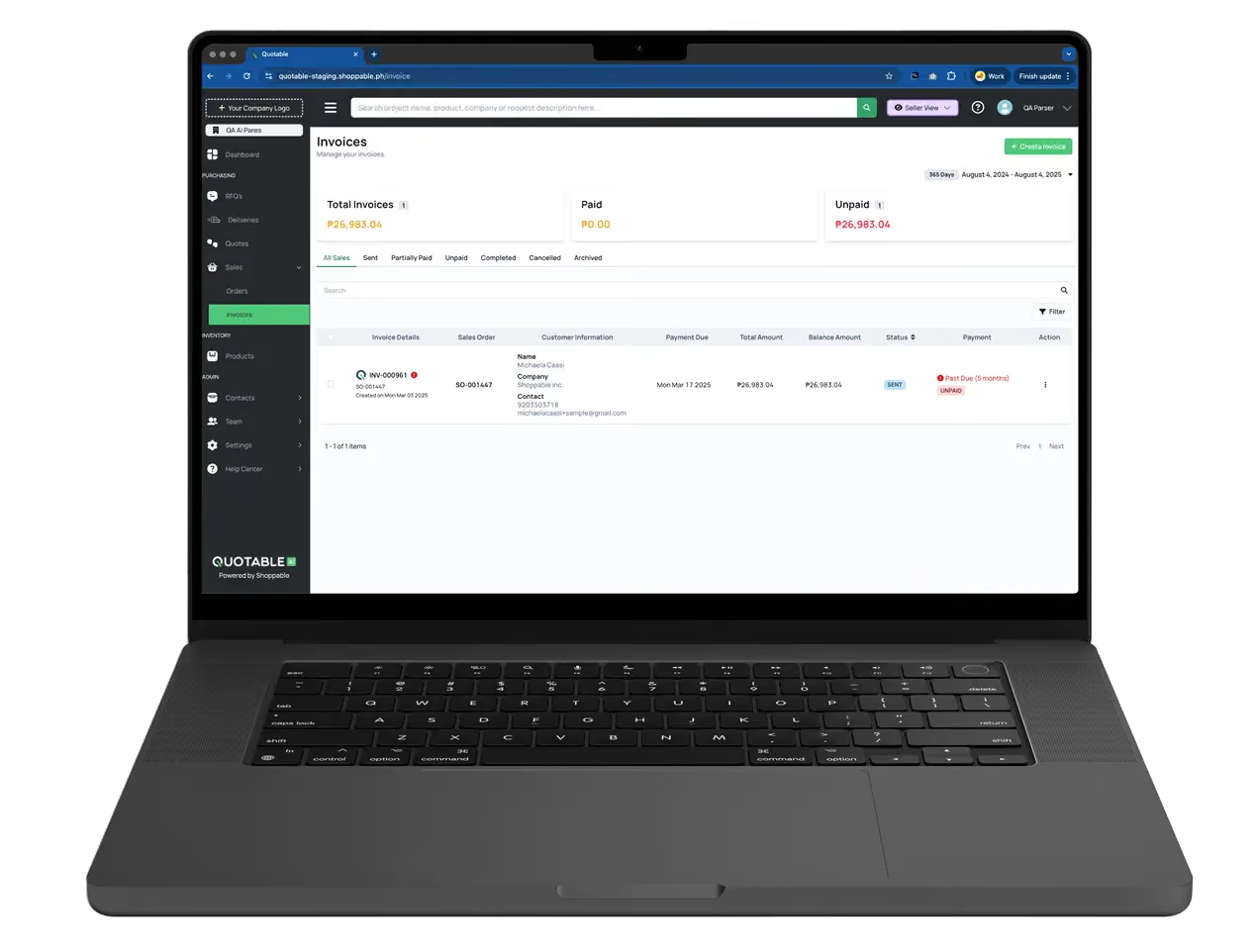
Quotable AI is built around this principle: treating the quote as a live transaction state that connects to every subsequent step. When a supplier submits a quote through the platform, that data flows directly into purchase orders, invoices, and payment records without manual re-entry. The quote becomes the single source of truth for the entire deal.
This matters because a $50,000 quote with a 2% pricing error becomes a $1,000 problem. Multiply that across 200 quotes a month, and you're looking at $200,000 in annual revenue leakage. Treating the quote as a living document, not a static file, is how you stop that bleed.
Key Pillars of a Modern Q2C Workflow
A complete Q2C workflow in 2026 has three pillars that must work together. If any one of them operates in isolation, you'll still have gaps where revenue and time disappear.
Automated Sales Quotations and Procurement
The first pillar is getting quotes out the door fast and getting procurement responses back even faster. For a distributor handling 30 to 50 RFQs per week, the old process looked like this: receive an email request, open a spreadsheet, look up pricing, build a PDF, email it back, wait for a response, manually enter the PO into your system. Each step takes 10 to 30 minutes. Multiply that across your weekly volume, and you've got a full-time employee doing nothing but data entry.
Automation changes the math entirely. A universal AI parser can extract structured data from incoming RFQs, match it against your product catalog and pricing rules, and generate a quote in minutes rather than hours. On the procurement side, buyers can send RFQs to multiple suppliers through a centralized system and receive structured, comparable responses without chasing email threads.
One common mistake here is automating only the outbound quote while leaving the inbound procurement process manual. If your sales team generates quotes in 5 minutes but your purchasing team takes 3 days to process a supplier response, you haven't fixed the cycle. You've just moved the bottleneck.
Red flags that your quoting and procurement process needs attention:
- Quotes take more than 24 hours to send after receiving an RFQ
- Your team re-types the same product data into more than two systems
- Supplier responses arrive in inconsistent formats that require manual comparison
- You've lost deals because a competitor quoted faster
Integrated Fulfillment and Logistics Tracking
The second pillar connects what you've sold to what you're shipping. For companies in construction, manufacturing, and distribution, this is where deals go sideways. A quote promises delivery in 14 days. The PO confirms it. But nobody linked the order to the warehouse or the freight forwarder, so the shipment goes out late, the customer withholds payment, and your finance team spends two weeks sorting it out.
In international trade, this gets even more complex. You need to track bills of lading, packing lists, customs documents, and landed costs that include duties, freight charges, and foreign exchange impact. If your fulfillment data lives in a separate system from your quoting and invoicing data, you're flying blind on the true cost and margin of every deal.
The fix is connecting order data to logistics data in real time. When a PO is confirmed, the fulfillment workflow should trigger automatically: warehouse pick lists, shipping labels, tracking numbers, and delivery confirmations all feeding back into the same system that generated the original quote. This isn't aspirational. It's table stakes for mid-market companies competing in 2026.
B2B Payment Orchestration and Collections
The third pillar is getting paid, which sounds simple but rarely is. B2B payments are still shockingly manual. A typical cycle looks like this: generate an invoice in your accounting system, email it as a PDF, wait for the buyer to process it through their AP system, follow up when it's overdue, receive a bank wire with a vague reference number, manually match it to the invoice, and reconcile in your ERP.
Each of those steps introduces delay and error. The fix is embedded payments: giving buyers the ability to pay directly from the invoice through bank wire, ACH, credit card, or e-wallet, with automatic matching and reconciliation. Quotable AI handles this by sending no-login payment links alongside invoices, so buyers can approve and pay without adopting new software or creating accounts.
The financial impact is real. Businesses that automate their invoicing and collections process see a 28% average reduction in sales cycle length. For a company with $10M in annual revenue and 45-day average payment terms, cutting that cycle by 28% frees up roughly $350,000 in working capital.
Solving Common Friction Points for SMEs and Mid-Market Firms
Nearly 60% of Q2C implementations face significant delays or budget overruns. That's a sobering number. The problem usually isn't the technology itself: it's the organizational friction that technology exposes.
Bridging the Gap Between Sales and Finance Teams
I've seen this pattern dozens of times. Sales closes a deal with custom pricing and special terms. They celebrate. Then finance receives the invoice request and discovers the margin is 3% instead of 15%, the payment terms are net-90 instead of net-30, and there's a penalty clause nobody mentioned. The deal that looked like a win is actually a loss.
This happens because sales and finance operate in different systems with different incentives. Sales wants speed and flexibility. Finance wants accuracy and predictability. Neither is wrong, but without a shared system, they're working against each other.
The solution isn't more meetings or approval chains. It's a single workflow where pricing rules, margin thresholds, and payment terms are enforced at the quote level. If a salesperson tries to offer net-90 terms on a deal below $50,000, the system flags it before the quote goes out, not after the invoice is disputed. This is where treating the quote as a live transaction state pays off: the guardrails are built into the process, not bolted on after the fact.
Eliminating Data Silos in Construction and Manufacturing
Construction and manufacturing companies face a unique version of this problem. A single project might involve 15 suppliers, 200 line items, multiple change orders, and progress-based billing tied to milestones. The data for this project lives in at least four places: the estimating software, the procurement system, the project management tool, and the accounting system.
When a subcontractor submits a change order that affects material costs, someone has to manually update the estimate, revise the PO, adjust the invoice schedule, and recalculate the project margin. If any of those updates gets missed, you don't find out until month-end close, when the numbers don't add up and your controller spends a weekend hunting for the discrepancy.
Signs your data silos are costing you money:
- Month-end close takes more than 5 business days
- You've discovered duplicate purchase orders for the same materials
- Project managers and accountants report different margin numbers for the same job
- Change orders take more than 48 hours to flow through all systems
The fix requires connecting your quoting and procurement data to your financial systems. Platforms that integrate with existing ERPs and accounting systems, rather than replacing them, tend to see faster adoption and fewer implementation failures. Quotable AI takes this approach: it connects with your existing financial infrastructure so you can modernize supplier collaboration without ripping out what already works.
The Role of AI in Accelerating Global B2B Trade
AI in B2B isn't about chatbots or content generation. It's about processing the massive volume of unstructured documents that flow between companies and turning them into structured, actionable data.
Vertical Data Orchestration Layers
Think about what happens when a procurement team receives 10 supplier quotes for the same RFQ. Each quote arrives in a different format: some as PDFs, some as Excel files, some as email body text. Someone has to read each one, extract the relevant data (pricing, lead times, MOQs, shipping terms), and enter it into a comparison spreadsheet. That process takes hours and introduces errors at every step.
A vertical data orchestration layer sits between your business and your trading partners, automatically parsing and structuring incoming documents. Quotes, invoices, purchase orders, bills of materials: each document type gets processed by an AI parser trained on that specific format. The result is structured data that flows directly into your workflow without manual encoding.
This is different from generic document processing. A universal AI parser built for B2B trade understands that a "unit price" field on a construction materials quote means something different from a "per-seat license fee" on a software proposal. Vertical specificity matters because B2B documents carry legal and financial weight. A misread decimal point on a materials quote can trigger a six-figure procurement error.
Cloud-based Q2C solutions are expected to hold a dominant market share of over 70%, and AI-powered document processing is a major driver of that shift. Companies don't want to install on-premise software to parse supplier quotes. They want it to happen automatically in the cloud, the moment a document arrives.
Achieving 10X Faster Cycles with Automated Invoicing
The "10X faster" claim sounds like marketing, but the math checks out. Consider a typical mid-market distributor's invoice cycle:
- Sales confirms the order (Day 1)
- Operations verifies inventory and ships (Days 2-4)
- Finance creates the invoice manually (Days 5-7)
- Invoice is emailed to the buyer (Day 7)
- Buyer processes through AP (Days 8-21)
- Payment is initiated (Days 22-30)
- Payment is received and reconciled (Days 31-45)
That's 45 days from order to cash. Now compress it: the order confirmation auto-generates an invoice linked to the shipping data. The invoice is sent with an embedded payment link the moment delivery is confirmed. The buyer pays via ACH through the link. Payment is auto-matched and reconciled. Total elapsed time: 4-7 days. That's not 10X faster: it's closer to 7X, but the point stands.
Automating contract management alone can expedite negotiations by 50%. When you stack that with automated invoicing, embedded payments, and real-time reconciliation, the cumulative effect is dramatic. The companies hitting these numbers aren't using exotic technology. They're using integrated systems that eliminate the handoff delays between each step.
A common overlooked step: the three-way match. Before paying an invoice, most finance teams verify that the PO, the receiving report, and the invoice all agree. If these documents live in different systems, the match is manual and slow. If they're all generated from the same transaction data, the match is automatic and instant. That single improvement can shave a week off your payment cycle.
Implementing a Quote-to-Payment Operating System
If you're running a B2B company doing $1M to $50M in annual revenue, here's the founder-to-founder advice: don't try to fix your Q2C process by adding more tools. Every new tool creates a new integration point, a new data silo, and a new place for errors to hide. Instead, think about your quote-to-payment process as a single operating system.
Start by mapping your current cycle end to end. Time each step. Identify where data gets re-entered, where approvals stall, and where you lose visibility. Most companies find that 60-70% of their cycle time is wait time, not work time. The quote sits in someone's inbox. The PO waits for a signature. The invoice waits for a three-way match. Automation doesn't make people work faster: it eliminates the waiting.
Your operating system should connect five things: quoting, procurement, fulfillment, invoicing, and payments. If any of those five operates independently, you'll still have gaps. The smart money is on platforms that handle all five in one workflow, connecting to your existing ERP rather than replacing it.
The companies that will win in 2026 aren't the ones with the best products or the lowest prices. They're the ones that can move from quote to collected cash faster and more accurately than their competitors. That speed becomes a compounding advantage: faster cash collection means better working capital, which means better purchasing power, which means better margins. It's a flywheel, and the quote is where it starts spinning.
If you're ready to see what a unified quote-to-payment system looks like for your business, Quotable AI is built for exactly this problem. Start with your messiest workflow, and watch what happens when the gaps close.