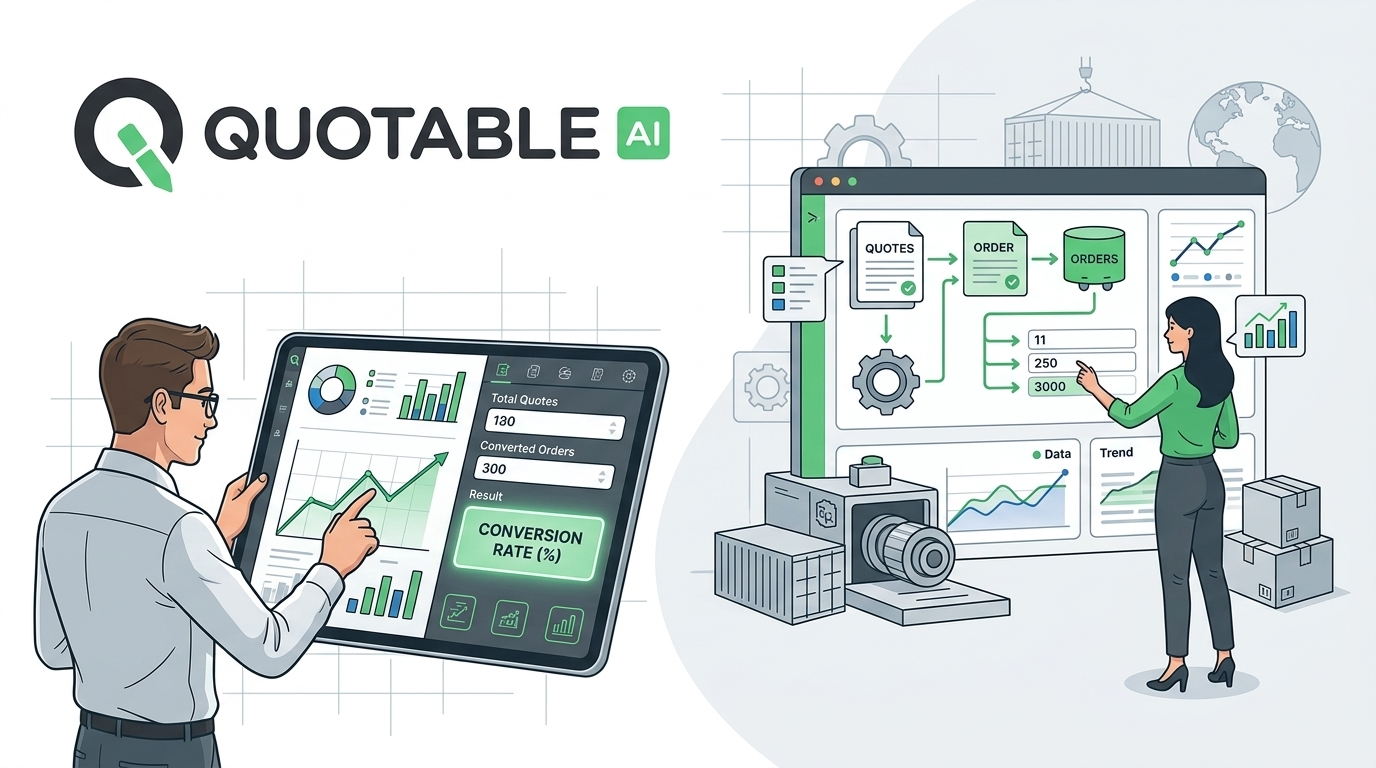
Every B2B company generates quotes. But how many of those quotes actually convert into paid transactions? If you can't answer that question with a specific number, you're flying blind. A quote conversion calculator gives you that number, and more importantly, it reveals where deals stall, where money leaks out, and where your team should focus to close faster. Whether you're a distributor processing hundreds of quotes per month or a mid-market procurement team managing supplier responses, understanding your conversion rate is the difference between guessing at growth and engineering it. The math itself is straightforward, but the insights you pull from the results can reshape how you quote, sell, and collect payment. This guide walks through the full process: from setting up your inputs and interpreting the output, to applying those findings across industries like construction, manufacturing, logistics, and IT. We'll also cover how modern platforms turn static conversion data into a live, continuous workflow that connects quoting to payment in a single system. If you've been relying on gut feel or outdated spreadsheets to track your win rate, it's time to get precise.
Understanding the Role of a Quote Conversion Calculator
A quote conversion calculator isn't just a formula. It's a diagnostic tool for your entire sales-to-payment pipeline. Most B2B companies treat quoting as a standalone activity: generate the quote, send it out, hope for the best. But the conversion rate you calculate from your quoting data tells a much richer story about pricing accuracy, sales follow-up speed, buyer friction, and payment terms that either accelerate or stall deals.
Think of it this way: if you're a $5M distributor sending 400 quotes per month and only 80 convert, your 20% rate isn't just a number. It's a signal that 320 opportunities died somewhere between your proposal and the buyer's purchase order. The calculator helps you find out where.
Defining Quote-to-Payment Efficiency
Quote-to-payment efficiency measures how smoothly a quote moves through every stage: from initial request, to buyer approval, to purchase order, to invoice, to collected payment. Most companies track their "close rate" but stop at the signed deal. That's only half the picture. A quote that converts to an order but takes 90 days to get paid isn't truly efficient.
The real metric you want is the ratio of quotes issued to payments received, measured against the time it takes to complete that cycle. If your average time-to-payment is 45 days but your competitor's is 12, you're not just slower: you're financing your buyer's operations with your own cash flow.
A strong quote-to-payment efficiency score accounts for three things: the percentage of quotes that become orders, the percentage of orders that result in timely payment, and the elapsed time across that entire journey. When you calculate all three together, you get a realistic view of how your quoting process actually performs.
Why SMEs and Distributors Need Data-Driven Insights
Small and mid-market businesses often operate with thin margins and limited credit lines. A distributor doing $10M in annual revenue might carry $2M in outstanding receivables at any given time. Without clear data on which quotes convert and which don't, that distributor can't predict cash flow, can't prioritize high-probability deals, and can't identify the pricing or terms adjustments that would improve close rates.
Here's a hard-won lesson from working with B2B sellers: the companies that grow fastest aren't necessarily the ones with the best products. They're the ones with the best visibility into their own pipeline. They know their conversion rate by customer segment, by product line, by sales rep, and by payment method. That granularity lets them make smart decisions instead of reactive ones.
Data-driven insights also help procurement teams on the buying side. If you're a purchasing officer managing RFQs across 30 suppliers, knowing which suppliers respond fastest and offer the most competitive pricing, then actually deliver, is critical. Conversion data flows both ways in B2B, and the companies that track it on both sides of the transaction have a structural advantage.
Step-by-Step Guide to Calculating Your Conversion Rate
The calculation itself is simple. The value comes from what you measure, how consistently you measure it, and what you do with the results. Here's the full process, broken into two core phases.
Inputting Total Quotes vs. Successful Transactions
Start with two numbers: total quotes issued in a given period, and total quotes that resulted in a completed transaction (meaning the buyer paid, not just that they said yes). If you sent 200 quotes last quarter and 50 resulted in collected payments, your conversion rate is 25%.
Here's the step-by-step:
- Pull your total quote count for a defined period (monthly works best for trending)
- Count only the quotes where payment was received, not just orders placed
- Divide successful transactions by total quotes
- Multiply by 100 to get your percentage
A few things to watch for. First, don't count revised quotes as separate entries. If you requoted the same buyer three times before they accepted, that's one opportunity, not three. Counting revisions separately inflates your denominator and makes your conversion rate look artificially low.
Second, define "successful" carefully. For some businesses, a signed PO counts. For others, it's only a success when the invoice is paid. We recommend using payment received as your benchmark because it captures the full quote-to-cash cycle and exposes payment friction that a PO-based metric would miss.
Third, segment your data. A blended conversion rate across all customers and products is useful as a baseline, but the real insights come from slicing the data. What's your conversion rate for new customers vs. repeat buyers? For orders over $10,000 vs. under $1,000? For quotes that included net-30 terms vs. those requiring upfront payment?
Analyzing Time-to-Payment and Fulfillment Metrics
Your conversion rate tells you how many quotes close. Time-to-payment tells you how fast they close. Both metrics matter, and they often tell different stories.
Calculate time-to-payment by measuring the days between when a quote is issued and when payment is received. If your average is 38 days, break that down further: how many days from quote to PO? From PO to invoice? From invoice to payment? Each segment reveals a different bottleneck.
For example, if quotes convert to POs in 3 days but invoices take 20 days to get paid, your quoting process is strong but your collections process needs work. Conversely, if it takes 15 days to get a PO but payment arrives within 5 days of invoicing, your buyers are slow to commit but fast to pay once they do.
Fulfillment metrics add another layer. B2B transactions involving complex supply chains often suffer from delays between order confirmation and delivery. If fulfillment delays cause buyers to cancel or dispute invoices, your conversion rate drops even after the deal appeared closed. Tracking the connection between fulfillment speed and final payment gives you a complete picture.
Leveraging Quotable AI to Optimize Calculation Results
Static spreadsheets can calculate a conversion rate. But they can't update in real time, they can't flag stalled quotes automatically, and they can't connect your quoting data to procurement, invoicing, and payment in a single view. That's where modern platforms change the equation.
Moving Beyond Static Spreadsheets to Live Transaction States
Most B2B companies still track quotes in Excel or basic CRM systems. The problem isn't the math: it's the lag. By the time you export data, clean it, and calculate your rate, the information is already stale. You're making decisions based on last month's reality.
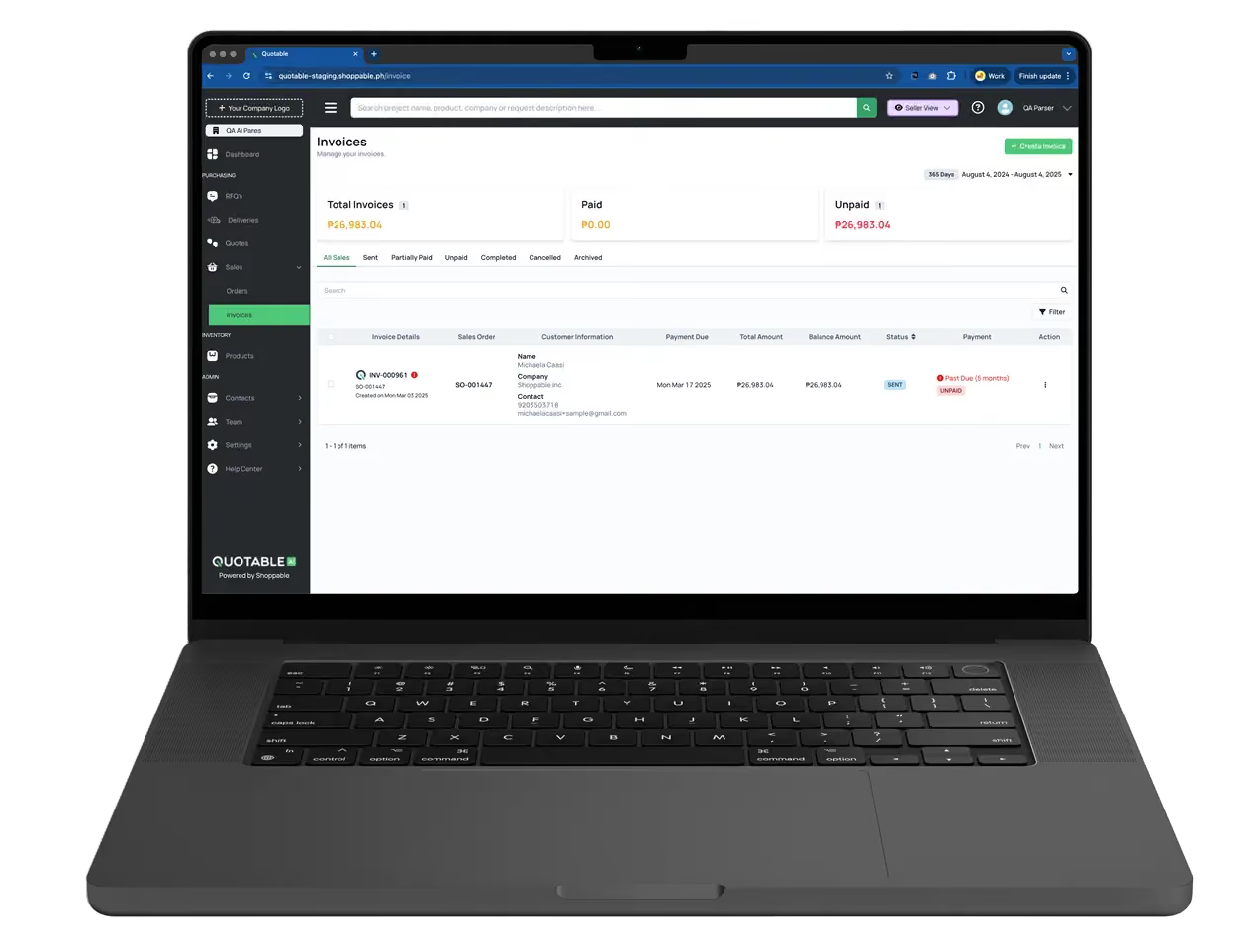
Quotable AI treats the quote as a live transaction state rather than a static document. This means every quote exists within a continuous workflow that updates as it moves from proposal to approval to PO to invoice to payment. You don't need to pull reports or reconcile spreadsheets because the data is always current.
This matters for conversion tracking because you can see, in real time, exactly where each quote sits in the pipeline. If 40 quotes are stuck at the PO approval stage, you know immediately. If a specific buyer segment consistently stalls at the payment step, the pattern surfaces without manual analysis.
The shift from static to live tracking also eliminates a common problem: data entry errors. When quotes, POs, invoices, and payments all live in separate systems, someone has to manually connect them. Every handoff is a chance for mistakes. A universal AI parser that automatically extracts and structures data from business documents, like the one built into Quotable AI, reduces manual encoding and keeps your conversion data accurate.
Automating Sales Quotations and Procurement Workflows
Automation doesn't just save time. It directly improves your conversion rate by removing friction from the buyer's experience. Consider what happens when a buyer receives a quote and wants to approve it: in a manual workflow, they might need to download a PDF, email it to their procurement team, wait for internal approval, then send back a PO by email. Each step introduces delay, and delay kills conversions.
Automated workflows compress this cycle. Buyers can approve quotes, submit POs, and even pay through no-login links without adopting new software or creating accounts. This frictionless approach is especially valuable for supplier participation in RFQ processes, where procurement teams need fast responses from multiple vendors.
On the seller's side, automation means quotes get generated in minutes instead of hours, follow-ups happen on schedule, and invoices are issued the moment an order is confirmed. Tools that consistently deliver a high ROI, typically ranging from 300-500% within the first 6-12 months do so because they eliminate the manual steps that slow down every transaction.
The bottom line: every manual step between quote and payment is a conversion risk. Automating that workflow doesn't just speed things up. It structurally improves your close rate.
Interpreting Results Across Different Industries
A 25% conversion rate means very different things depending on your industry, deal size, and sales cycle length. Benchmarking against your own sector gives you a realistic target and helps you identify whether your rate represents a problem or a competitive strength.
Benchmarks for Construction and Manufacturing
Construction and manufacturing companies typically deal with complex, high-value quotes that involve detailed bills of materials, custom specifications, and multi-stage approval processes. Conversion rates in these industries tend to run lower, often between 15-25%, because the sales cycle is longer and buyers frequently solicit multiple bids before committing.
If you're a construction materials distributor with a 20% conversion rate, you're likely performing at or near industry average. But here's where the calculator becomes powerful: segment that rate by project size. You might find that quotes under $5,000 convert at 35% while quotes over $50,000 convert at only 10%. That tells you your pricing or terms for larger projects need attention.
Manufacturing companies face a similar dynamic. A study on B2B sales cycles found that complex purchasing decisions involve an average of 6-10 decision-makers. Each additional stakeholder extends the approval timeline and reduces the probability of conversion. Your calculator data can reveal exactly how much each added week of decision time costs you in lost deals.
Time-to-payment benchmarks in construction are particularly important because of progress billing, retainage, and long payment terms. A manufacturer might see 30-day payment cycles while a construction subcontractor waits 60-90 days. Your conversion calculator should account for these industry-specific payment patterns.
Logistics and IT: Managing High-Volume Quote Cycles
Logistics providers and IT companies operate at the opposite end of the spectrum: high volume, lower individual deal value, and faster decision cycles. A logistics company might issue 1,000+ quotes per month for freight, warehousing, or last-mile delivery. An IT reseller might process hundreds of quotes for hardware, software licenses, and service contracts.
In these industries, conversion rates of 30-40% are common, but the sheer volume means even small improvements have a massive impact. If you're a logistics company converting 32% of 1,200 monthly quotes and you improve to 35%, that's 36 additional closed deals per month. At an average deal value of $3,000, that's $108,000 in incremental monthly revenue.
High-volume quote cycles also create a specific challenge: tracking becomes overwhelming without automation. When you're processing thousands of quotes, you can't manually monitor each one's status. This is exactly where platforms that connect quoting to procurement and payment in one system pay for themselves. The ability to see real-time pipeline data across your entire quote portfolio turns your conversion calculator from a retrospective report into a live management tool.
IT companies face an additional wrinkle: quotes often involve recurring revenue components like SaaS subscriptions or maintenance contracts. Your calculator should distinguish between one-time conversion (the initial sale) and renewal conversion (ongoing retention), since the strategies for improving each are very different.
Turning Calculator Data into 10X Faster Growth
Knowing your conversion rate is step one. Using that knowledge to accelerate growth is where the real payoff happens. The gap between data collection and data-driven action is where most companies stall.
Identifying Bottlenecks in the Data Orchestration Layer
Your conversion data will point to specific bottlenecks, but you need to look at the right layer. Most companies focus on sales bottlenecks: the rep didn't follow up, the pricing was wrong, the proposal was late. These matter, but they're surface-level symptoms.
The deeper bottlenecks usually live in what we'd call the data orchestration layer: the connections (or lack thereof) between your quoting system, your ERP, your procurement tools, your invoicing process, and your payment collection. When these systems don't talk to each other, data gets stuck. A quote converts to an order, but the order doesn't automatically generate an invoice. An invoice goes out, but payment status doesn't flow back to the sales team. Each disconnect adds days to your cycle and creates opportunities for errors.
Red flags that signal orchestration bottlenecks include duplicate data entry across systems, delayed month-end close because receivables data is scattered, and sales reps who can't tell you the payment status of their own deals. If any of these sound familiar, your conversion problem isn't a sales problem: it's a systems problem.
Quotable AI addresses this by connecting quoting, procurement, payments, and fulfillment into one continuous workflow. Instead of bouncing data between five different tools, every transaction moves through a single system that maintains context from the first quote to the final payment. This approach integrates with existing ERPs and accounting systems, so you don't need to replace your financial infrastructure to fix the orchestration layer.
Integrating B2B Payments for Instant Conversion
The fastest way to improve your conversion rate is to make it easier for buyers to pay. This sounds obvious, but most B2B companies still rely on manual payment processes: wire transfer instructions buried in PDF invoices, checks mailed to a PO box, or ACH details exchanged over email.
Each of these methods introduces friction and delay. A buyer who's ready to pay today might not actually send payment for two weeks because they need to manually enter banking details, get internal approval for the transfer, and then wait for processing. By the time the payment clears, your "conversion" has taken 30 days longer than it needed to.
Embedded payment options, including bank wire, ACH, credit cards, and e-wallets, remove this friction entirely. When a buyer can click a link in their quote or invoice and pay instantly through their preferred method, your time-to-payment drops dramatically. For distributors and suppliers operating on thin margins, reducing payment delays directly improves working capital and cash flow predictability.
The connection between payment speed and conversion rate is direct. Quotes that include easy payment options convert at higher rates because buyers encounter less resistance. And when payment is collected faster, your team spends less time on collections and more time generating new quotes, creating a positive cycle that compounds over time.
From Calculation to Competitive Advantage
Your quote conversion rate is more than a metric. It's a window into every stage of your business: how you price, how you sell, how you fulfill, and how you collect. The companies that treat this data seriously, segmenting it by customer type, deal size, and industry, consistently outperform those that rely on intuition alone.
Start by calculating your baseline rate using the steps outlined above. Identify where quotes stall and where payments lag. Then look at your systems: are they connected, or are you manually bridging gaps between quoting, ordering, invoicing, and payment? If you're hitting a breaking point around 30-50 quotes per month with manual processes, that's your signal to automate.
The path from a basic conversion calculation to 10X faster growth runs through better data, fewer manual handoffs, and a system that treats every quote as the starting point of a continuous transaction. If you're ready to see what that looks like in practice, explore how Quotable AI connects your entire quote-to-payment workflow in one platform.