Every B2B transaction starts with a number on a page: a quote. But between that first price proposal and the moment cash hits your bank account, there's a sprawling chain of handoffs, approvals, documents, and potential errors. For companies doing $1M to $30M in annual sales, this chain can be the difference between healthy margins and slow, painful revenue leakage. The quote-to-cash process, often abbreviated Q2C or QTC, covers the entire sales lifecycle from the moment a customer receives a quote to when payment is collected. Understanding what quote to cash actually means in practice, not just in theory, is the first step toward fixing the broken handoffs that cost you real money every month. If you're running a distribution business, a construction supply company, or an IT services firm, this is the operational backbone you can't afford to ignore. Here's a hard-won lesson from working with mid-market companies: the ones who treat Q2C as a single connected workflow grow faster than those who treat quoting, ordering, invoicing, and payments as separate problems.
Defining Quote-to-Cash (Q2C) as a Continuous Workflow
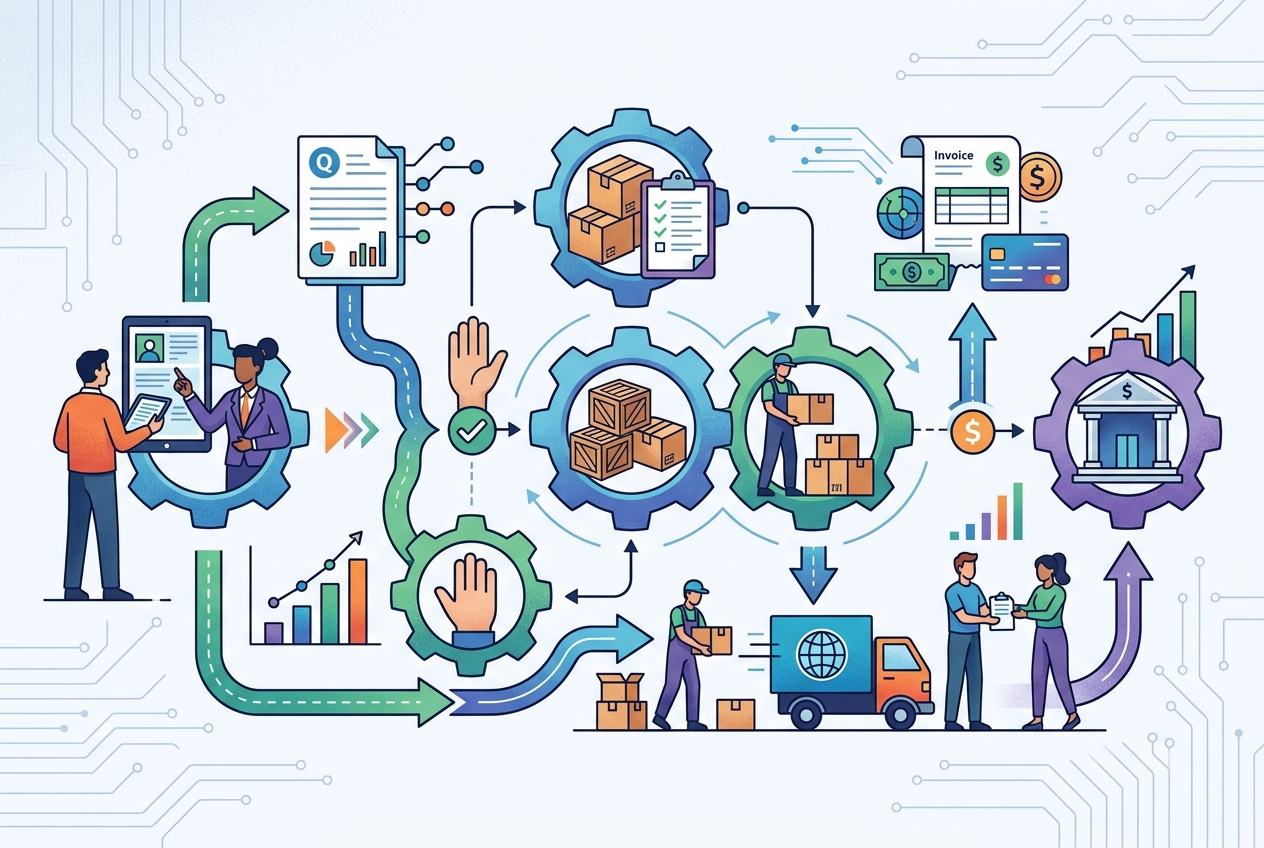
Most business owners think of Q2C as a sequence of steps. That's technically correct but misses the point. The real power of the quote-to-cash framework is treating it as one continuous workflow where each stage feeds data into the next, without anyone re-keying numbers into a different spreadsheet or system.
Think of it this way: the quote you send a buyer contains line items, pricing, tax calculations, shipping terms, and payment conditions. That same data should flow directly into the purchase order, then into fulfillment, then into the invoice, and finally into the payment record. When it doesn't, you get mismatches, disputes, and delayed payments. A vertically integrated data approach treats the quote as a live transaction state that evolves across companies, rather than a static PDF that gets emailed and forgotten.
One client I worked with, a mid-size electrical components distributor doing about $8M annually, had five people touching every order between quote acceptance and invoice generation. Each person re-entered data from the previous step. The error rate was roughly 12%, and their average days-sales-outstanding sat at 58 days. That's not a staffing problem. That's a workflow design problem.
The Difference Between Q2C and Standard Invoicing
Standard invoicing starts after the sale is made. You deliver a product or service, then generate an invoice, then chase payment. Q2C starts much earlier and encompasses much more.
Here's the distinction in practical terms:
- Standard invoicing covers: invoice creation, delivery, payment tracking, collections
- Q2C covers: quote configuration, pricing approval, contract negotiation, order management, fulfillment, invoicing, payment collection, and revenue recognition
The gap between these two is where most revenue leakage happens. An estimated 42% of companies experience revenue leakage, losing 1% to 5% of annual revenue due to preventable errors in their sales-to-payment workflows. For a $10M company, that's $100K to $500K walking out the door each year because of misquoted prices, unapplied discounts, or invoices that don't match purchase orders.
If your finance team spends more time reconciling discrepancies than analyzing margins, you're dealing with an invoicing-only mindset applied to a Q2C-scale problem.
Why the Quote is the Living Foundation of B2B Trade
The quote isn't just a sales document. It's the DNA of every downstream transaction. The line items in your quote become the line items on the purchase order, the packing slip, the invoice, and the payment record. When the quote is wrong, everything after it is wrong too.
This is why Quotable AI treats the quote as a live transaction state rather than a one-time document. When a buyer requests a change to quantities or specs, that change should ripple through the entire workflow automatically: updated PO, updated fulfillment instructions, updated invoice. No one should need to manually update three systems because a buyer added ten units to an order.
For B2B distributors handling hundreds of SKUs with variable pricing, the quote is also where margin protection happens. If your sales rep can override pricing without approval workflows, or if volume discounts aren't calculated correctly, you're bleeding margin before the order even ships.
Key Stages of the Quote-to-Cash Lifecycle
Breaking the Q2C lifecycle into stages helps identify exactly where your process breaks down. Most companies have one or two stages that work reasonably well and three or four that are held together with email threads and good intentions.
Sales Quotation and Configuration
This is where the lifecycle begins. A buyer requests pricing, and your team configures a quote based on product availability, customer-specific pricing tiers, volume discounts, tax obligations, and shipping terms. For simple businesses with a handful of products, this might take minutes. For distributors with thousands of SKUs, custom configurations, and multi-location delivery, it can take days.
The breaking point typically hits around 30 to 50 quotes per week. Below that threshold, a capable salesperson with a spreadsheet can manage. Above it, errors multiply and response times stretch. Buyers don't wait around: if your quote takes 48 hours and a competitor responds in four, you've lost the deal before your pricing was even considered.
Red flags at this stage include:
- Sales reps maintaining personal pricing spreadsheets that don't match your master price list
- Quotes going out without margin approval
- Buyers receiving quotes with incorrect tax calculations or outdated product codes
- No version control on revised quotes
Automating repetitive tasks within the QTC process is crucial for improving efficiency at this stage, especially for companies generating high quote volumes with complex product catalogs.
Procurement and Order Fulfillment
Once a quote is accepted, it should convert into an order with minimal friction. The buyer issues a purchase order, your team confirms it against the original quote, and fulfillment begins. In practice, this is where the three-way match problem lives: does the PO match the quote, and will the invoice match the PO?
For construction and manufacturing distributors, fulfillment often involves coordinating with multiple suppliers, managing partial shipments, and tracking delivery across job sites. Each of these touchpoints is an opportunity for data to get lost or corrupted.
Maverick spend, where buyers go off-contract or order outside the approved quote, is another common issue. Without a system that ties the PO back to the original quote, procurement teams lose visibility into whether they're actually getting the pricing they negotiated. This is especially painful for mid-market companies buying $10M to $50M annually, where even small per-unit pricing discrepancies add up fast.
Invoicing and B2B Payment Collection
The invoice should be the easiest part of Q2C. You delivered the goods, the buyer confirmed receipt, now send the bill. But for many B2B companies, invoicing is where the entire process stalls.
Common problems include invoices that don't match POs (triggering disputes and delays), invoices sent to the wrong contact or department, missing cost codes that prevent buyer-side approval, and payment terms that weren't clearly established during quoting.
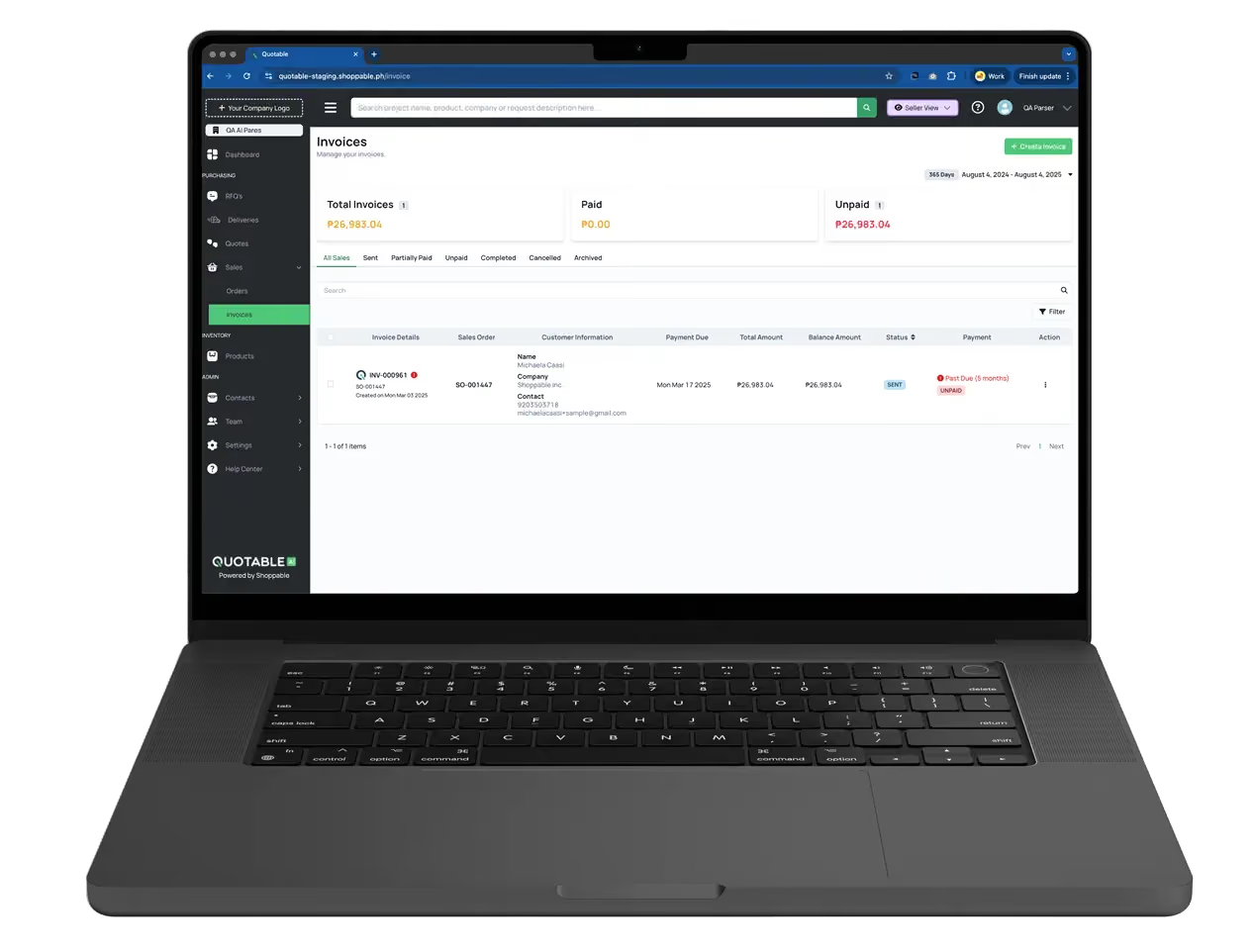
Payment collection itself carries its own friction. Bank wires require manual reconciliation. Checks get lost. Net-30 terms quietly become net-60 when buyers have no convenient way to pay. Platforms like Quotable AI address this by embedding multiple payment options, including bank wire, ACH, credit cards, and e-wallets, directly into the invoice through no-login links that buyers can act on immediately.
Improving the QTC process accelerates deal closure and revenue recognition, which directly impacts your cash flow and your ability to reinvest in growth.
Common Challenges in Manual Q2C Management
If you're running your quote-to-cash process across spreadsheets, email, and disconnected software tools, you're not alone. Most SMEs start this way. The problem isn't that it doesn't work at all: it's that it stops working at a specific scale, and by the time you notice, you've already lost money.
Data Silos Between Sales and Finance Teams
Your sales team lives in one system (or no system at all). Your finance team lives in another. When a quote converts to an order, someone manually bridges that gap, usually by exporting a CSV, reformatting it, and importing it somewhere else.
This creates two versions of truth. Sales says the deal was $47,500. Finance shows an invoice for $46,800. The difference? A discount the sales rep applied verbally but never documented, or a shipping charge that got added after the quote was signed. These discrepancies trigger disputes, delay payments, and erode trust with buyers.
The audit trail suffers too. If you're subject to SOX compliance or even just want clean books for your annual review, data silos make reconciliation a nightmare. One distributor I spoke with spent three full days each month-end just reconciling quote-to-invoice discrepancies across their ERP and CRM. That's 36 days a year of senior finance time burned on a problem that shouldn't exist.
Signs you're dealing with dangerous data silos:
- Duplicate customer records across systems
- Month-end close taking more than five business days
- Finance regularly asking sales to "verify" invoice amounts
- No single view of a transaction's history from quote to payment
The Impact of Slow Quoting on SME Growth
Speed kills in B2B sales, and slow quoting kills your pipeline. For SMEs competing against larger distributors with dedicated sales operations teams, response time is often the only competitive advantage available.
A venture-scale idea doesn't require venture-scale resources. But it does require that your operational processes don't bottleneck your growth. If your sales team can handle 200 quotes per month but your quoting process limits them to 80, you've capped your revenue without realizing it.
The math is straightforward. If your average deal size is $5,000 and your close rate is 25%, every 100 additional quotes you can generate represents $125,000 in potential revenue. Cutting quote turnaround from 48 hours to two hours doesn't just make buyers happier: it lets your existing team handle significantly more volume without adding headcount.
Leveraging AI for Quote-to-Payment Orchestration
AI isn't a magic word you slap on a product to make it sound modern. In the Q2C context, AI serves a specific purpose: it connects data across the quote-to-payment lifecycle, automates repetitive decisions, and flags exceptions that need human attention.
"Quote-to-cash automation offers a solution by connecting sales, finance, and operations into a single coordinated process." That connection is where the real value lies: not in any single automated task, but in eliminating the gaps between tasks.
Automating Global Trade with Vertically Integrated Data
For companies selling or buying across borders, Q2C complexity multiplies. You're dealing with multiple currencies, varying tax regimes, different payment preferences by region, and compliance requirements that change by jurisdiction.
A vertically integrated data layer treats all of this as part of the same transaction record. The quote captures the currency and tax structure. The PO confirms it. The invoice reflects it. The payment settles it. No one needs to manually convert currencies in a spreadsheet or look up VAT rates in a separate database.
Quotable AI was built around this principle: one system where the quote, procurement documents, invoices, and payments all share the same data backbone. For a construction materials distributor shipping to three countries, this means the quote automatically applies the correct tax treatment, the invoice generates in the buyer's preferred currency, and payment options reflect local preferences.
Achieving 10X Faster Cycles with Unified Systems
The 10X claim sounds aggressive, but the math supports it for companies moving from fully manual processes. Here's a typical timeline comparison for a mid-market distributor:
- Manual process: quote creation (4 hours), buyer approval (48 hours), PO processing (24 hours), invoice generation (4 hours), payment collection (30+ days)
- Unified system: quote creation (15 minutes), buyer approval via link (same day), automatic PO matching (instant), invoice auto-generated (instant), payment via embedded link (1 to 3 days)
The bottleneck in most Q2C cycles isn't any single step. It's the dead time between steps: waiting for someone to re-enter data, waiting for email approvals, waiting for a check to arrive. Unified systems eliminate that dead time by keeping everything in one place and giving buyers self-service tools to approve and pay without logging into yet another portal.
Industry-Specific Benefits of Optimized Q2C
The Q2C framework applies broadly, but the specific pain points and benefits vary by industry. Right-sizing your approach means understanding where your industry's particular friction lives.
Manufacturing and Construction Logistics
Construction and manufacturing distributors deal with complex, multi-line quotes that often change mid-project. A contractor might request pricing on 200 line items, then revise 40 of them after a site visit. Each revision needs to flow through to the PO and invoice without creating mismatches.
Cost codes are another construction-specific challenge. Buyers need invoices tagged with job-specific cost codes so their accounting systems can allocate expenses correctly. If your invoice doesn't include the right codes, it sits in an approval queue until someone manually fixes it. That delay goes straight to your Days Sales Outstanding (DSO).
Partial shipments and progress billing add another layer. A single quote might result in five separate deliveries over three months, each requiring its own invoice. Without a system that tracks fulfillment against the original quote, you risk under-billing or double-billing, both of which damage buyer relationships.
IT and Professional Service Distribution
IT distributors and professional service firms face a different set of Q2C challenges. Product configurations are often complex, involving hardware, software licenses, and service agreements bundled into a single quote. Each component may have different fulfillment timelines, billing cycles, and renewal terms.
The subscription economy is projected to reach $1.5 trillion by 2025, and IT distributors are increasingly quoting recurring revenue alongside one-time purchases. Your Q2C process needs to handle both: a server rack that ships once and a software license that renews annually, all on the same quote.
For professional services, the quote often includes estimated hours that convert to actual hours during delivery. The gap between estimated and actual is where margin gets made or lost, and your Q2C system needs to track that variance in real time.
Selecting the Right Q2C Operating System for Your Business
Choosing a Q2C platform isn't about finding the tool with the longest feature list. It's about matching the solution to your actual bottlenecks and current scale. A $3M distributor with 15 employees doesn't need the same system as a $50M manufacturer with 200.
Start by mapping your current process from first customer inquiry to cash received. Identify where data gets re-entered, where approvals stall, and where errors consistently occur. Those are your highest-value automation targets.
Here's what to prioritize based on company size:
- Under $5M revenue: focus on quote speed and invoice accuracy. You need a system that lets you generate professional quotes fast and convert them to invoices without re-entering data.
- $5M to $15M revenue: add procurement visibility and payment flexibility. At this scale, PO matching and embedded payment options start delivering significant Days Sales Outstanding (DSO) improvements.
- $15M to $50M revenue: full lifecycle integration becomes critical. You need audit trails, multi-currency support, role-based approvals, and reporting that spans the entire Q2C cycle.
The right Q2C operating system should feel like it was built for how B2B trade actually works: messy, iterative, and relationship-driven. It shouldn't force you into rigid workflows designed for enterprise companies with dedicated IT departments. Quotable AI was designed with this founder-to-founder philosophy: start where the transaction begins, at the quote, and build everything around it. If you're spending more time managing your tools than managing your business, it's time to rethink the system, not add another one on top.