Every B2B transaction starts somewhere, and for most distributors and mid-market companies, that starting point is the quote. Yet the process of requesting, comparing, and awarding quotes remains one of the most manual, error-prone bottlenecks in global trade. Spreadsheets get emailed back and forth. Pricing data lives in someone's inbox. And by the time procurement, finance, and operations align on a vendor, days or weeks have evaporated. For companies moving $1M to $50M in goods annually, that delay isn't a minor inconvenience: it's a direct hit to margins and cash flow. Logistics RFQ software exists to close this gap, turning the quote from a static document into a live, trackable transaction state that connects procurement to payment in a single workflow. The companies that treat their quoting process as a strategic function, rather than an administrative chore, are the ones consistently winning on speed, cost, and supplier relationships. This piece breaks down what that looks like in practice, from the features that matter most to the operational shifts that separate growing companies from stagnant ones.
The Shift Toward Quote-Centric Logistics Management
The logistics industry has spent decades building systems around what happens after a purchase order is issued. ERPs track inventory. TMS platforms manage shipments. Accounting software handles invoices. But the critical upstream activity, the quoting and bid process that determines who you buy from, at what price, and under what terms, has been left to email threads and spreadsheets for far too long.
This is changing fast. The global logistics outsourcing market was valued at USD 1,011.56 million in 2024 and continues to expand as companies seek specialized partners for freight, warehousing, and fulfillment. As the vendor ecosystem grows, so does the complexity of managing bids. A mid-market distributor sourcing from 50 to 200 suppliers can't afford to treat each RFQ as a one-off email exercise. The quote itself needs to become the anchor of the transaction.
Why Traditional RFQ Processes Fail Modern Supply Chains
Traditional RFQ workflows break down at a few predictable points. First, there's the formatting problem. Every supplier submits pricing differently: some in PDFs, others in Excel, a few by phone. Procurement teams spend hours normalizing this data just to get an apples-to-apples comparison.
Second, there's no version control. When a supplier revises their bid, you're left searching through email chains to confirm which number is current. One client I worked with discovered they'd awarded a $180,000 freight contract based on an outdated quote because the updated version was buried three replies deep in a forwarded thread.
Third, traditional processes create zero audit trail. If your company is subject to SOX compliance or internal procurement policies, you need a clear record of why a specific vendor was selected. Email doesn't give you that. A shared drive full of PDFs doesn't give you that either.
The breaking point typically hits around 30 to 50 active RFQs per month. Below that threshold, manual processes are annoying but survivable. Above it, you start seeing duplicate requests, missed deadlines, and maverick spend creeping in as buyers route around the official process because it's too slow.
Treating the Quote as a Live Transaction State
Here's the hard-won lesson: the quote isn't just a price on a page. It's the first binding signal of a commercial relationship. It contains pricing, lead times, payment terms, delivery conditions, and often penalty clauses for non-compliance. Treating it as a disposable document is a mistake.
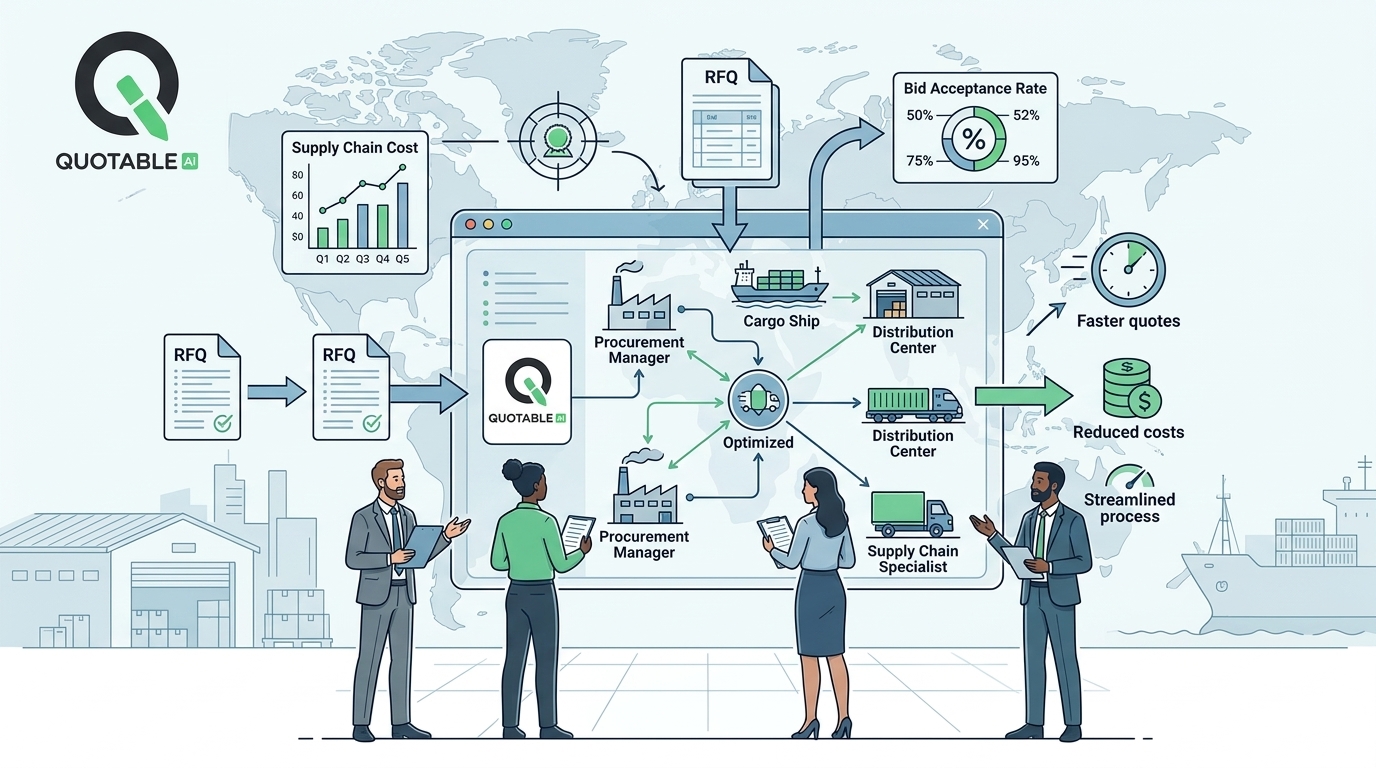
The smarter approach is to treat the quote as a live transaction state, one that evolves from request to bid to award to order to invoice to payment. Quotable AI was built around this exact principle. Rather than starting after the PO is issued, the platform treats the quote as the origin point of the entire transaction lifecycle. When a quote updates, the downstream documents (purchase orders, invoices, payment records) update with it.
This shift from "quote as document" to "quote as transaction" eliminates the reconciliation headaches that plague finance teams at month-end. It also means procurement decisions carry forward cleanly into fulfillment and payment, with no manual re-keying required.
Key Features of High-Performance RFQ Platforms
Not all RFQ tools are created equal, and the difference between a basic e-sourcing portal and a purpose-built logistics RFQ platform can be dramatic. The features that matter most depend on your transaction volume, supplier base, and how tightly you need quoting tied to downstream operations.
Automated Vendor Comparison and Bid Selection
The single biggest time sink in any RFQ process is bid comparison. When you've sent a request to eight freight forwarders and received eight responses in eight different formats, someone has to sit down and build a comparison matrix. That's hours of work for a single sourcing event.
High-performance platforms automate this entirely. They parse incoming bids, normalize the data, and present a side-by-side view that includes:
- Unit pricing and total landed cost
- Lead times and delivery windows
- Payment terms (net 30, net 60, early payment discounts)
- Service-level commitments and penalty structures
- Historical performance scores for each vendor
Quotable AI's Universal AI Parser handles this by automatically extracting and structuring data from quotes, invoices, purchase orders, and bills of materials, regardless of the format a supplier submits. This means your procurement team spends time evaluating bids instead of formatting spreadsheets.
The real value shows up at scale. If you're running 100+ RFQs per quarter, automated comparison doesn't just save time: it surfaces pricing patterns and vendor behaviors that manual review would miss entirely.
Vertically Integrated Data Orchestration
A standalone RFQ tool solves one problem but creates another: data silos. If your quoting system doesn't talk to your ERP, your accounting platform, or your payment infrastructure, you're just moving the manual work from one stage to another.
The best logistics RFQ software functions as a data orchestration layer. It connects the quoting process to procurement, invoicing, payments, and fulfillment in a single continuous workflow. When a bid is awarded, the purchase order generates automatically. When goods ship, the invoice ties back to the original quote. When payment is due, the system already knows the terms.
This kind of vertical integration matters most for companies in the $10M to $50M revenue range. You're big enough that disconnected systems create real friction, but not so large that you can afford a team of integration engineers to stitch everything together. You need a platform that connects with your existing financial systems without requiring you to rip out your ERP.
Accelerating the Quote-to-Payment Lifecycle
Speed kills in logistics, but not in the way you'd expect. Slow quoting cycles kill margins. Slow invoice processing kills cash flow. Slow payment verification kills supplier relationships. The companies that compress their quote-to-payment lifecycle gain a compounding advantage over competitors still running on email and manual approvals.
Eliminating Friction Between Procurement and Finance
One of the most common operational red flags I see is a disconnect between procurement and finance. Procurement awards a contract based on one set of terms. Finance receives an invoice that doesn't match. The result is a three-way match failure, a back-and-forth that can delay payment by two to four weeks.
This happens because the quote, the PO, and the invoice were created in three different systems by three different people. Each manual handoff introduces the risk of transcription errors, version mismatches, and missing line items.
The fix isn't better communication: it's a shared data layer. When procurement and finance work from the same transaction record, the three-way match happens automatically. The quote terms flow into the PO, which flows into the invoice, which flows into the payment. No re-keying. No reconciliation spreadsheets.
For companies dealing in international trade, this becomes even more critical. You need to track landed costs that include duties, freight charges, and FX impact. If your quoting system captures these variables upfront, your finance team isn't scrambling to reconstruct them at month-end.
Real-Time Fulfillment and Shipment Tracking
The quote-to-payment lifecycle doesn't end when the PO is issued. Fulfillment status directly impacts when and how payment should be released. If a shipment arrives short or late, your payment terms may include penalty clauses that need to be applied.
Real-time tracking tied to the original quote creates accountability on both sides. Suppliers know their performance is being measured against the terms they quoted. Buyers can release payment confidently because they have documented proof of delivery tied to the original bid. This is especially important for logistics-heavy industries like construction, manufacturing, and IT distribution, where shipment documents like bills of lading and packing lists serve as the contractual proof that triggers payment.
A platform that links these documents to the original RFQ gives you a complete audit trail from request to receipt. That's not just operationally useful: it's a compliance requirement for many mid-market companies.
Strategic Benefits for SME and Mid-Market Logistics
Enterprise companies have had access to sophisticated sourcing tools for years. But the $1M to $30M segment has been underserved, forced to choose between overpriced enterprise platforms and underpowered spreadsheet workarounds. That's where purpose-built RFQ software for logistics delivers the most dramatic impact.
Achieving 10X Faster Procurement Cycles
The "10X faster" claim sounds aggressive, but the math checks out. Consider a typical manual RFQ cycle for a mid-market distributor:
- Draft the RFQ and email it to suppliers (1 day)
- Wait for responses, send follow-ups (3-5 days)
- Normalize bids into a comparison format (0.5-1 day)
- Internal review and approval (1-2 days)
- Issue PO manually (0.5 day)
- Total elapsed time: 6-9 business days
Now consider the same cycle on a platform where suppliers respond through a secure link without needing to create accounts, bids are parsed and compared automatically, and PO generation is one click away. The entire cycle compresses to hours, not days. Over the course of a year, that compression translates to faster inventory turns, better pricing (because you can respond to market shifts in real time), and fewer stockouts.
The supply chain management market is growing rapidly, driven by exactly this kind of efficiency gain. Companies that automate their upstream procurement processes are capturing disproportionate value.
Scaling Operations Without Increasing Headcount
Here's the venture-scale idea that most mid-market operators miss: you don't need more people to handle more volume. You need better systems. A procurement team of three people managing 200 RFQs per month manually will hit a wall. The same team on a well-configured platform can handle 500+ without breaking a sweat.
This matters because headcount is the single largest cost center for most B2B operations. If you can double your transaction volume without hiring two more procurement coordinators at $55,000 to $70,000 each, you've just added $110,000 to $140,000 in annual margin. That's smart money: investing in systems rather than throwing bodies at a broken process.
The scaling advantage compounds over time. Every RFQ processed through the platform generates data that improves future sourcing decisions. You build a pricing history, a supplier performance database, and a set of benchmarks that make each subsequent procurement cycle faster and more informed.
Implementing a Unified Operating System for B2B Trade
The final piece of the puzzle isn't just adopting RFQ software: it's rethinking your entire transaction infrastructure. The companies seeing the best results are those that treat quoting, invoicing, and payments as a single connected system rather than three separate functions.
Connecting Quoting, Invoicing, and Payments
Most B2B companies run their operations across four to six disconnected tools. One for quoting, one for procurement, one for invoicing, one for payments, maybe a separate one for document management. Each tool works fine in isolation, but the gaps between them are where errors, delays, and lost revenue hide.
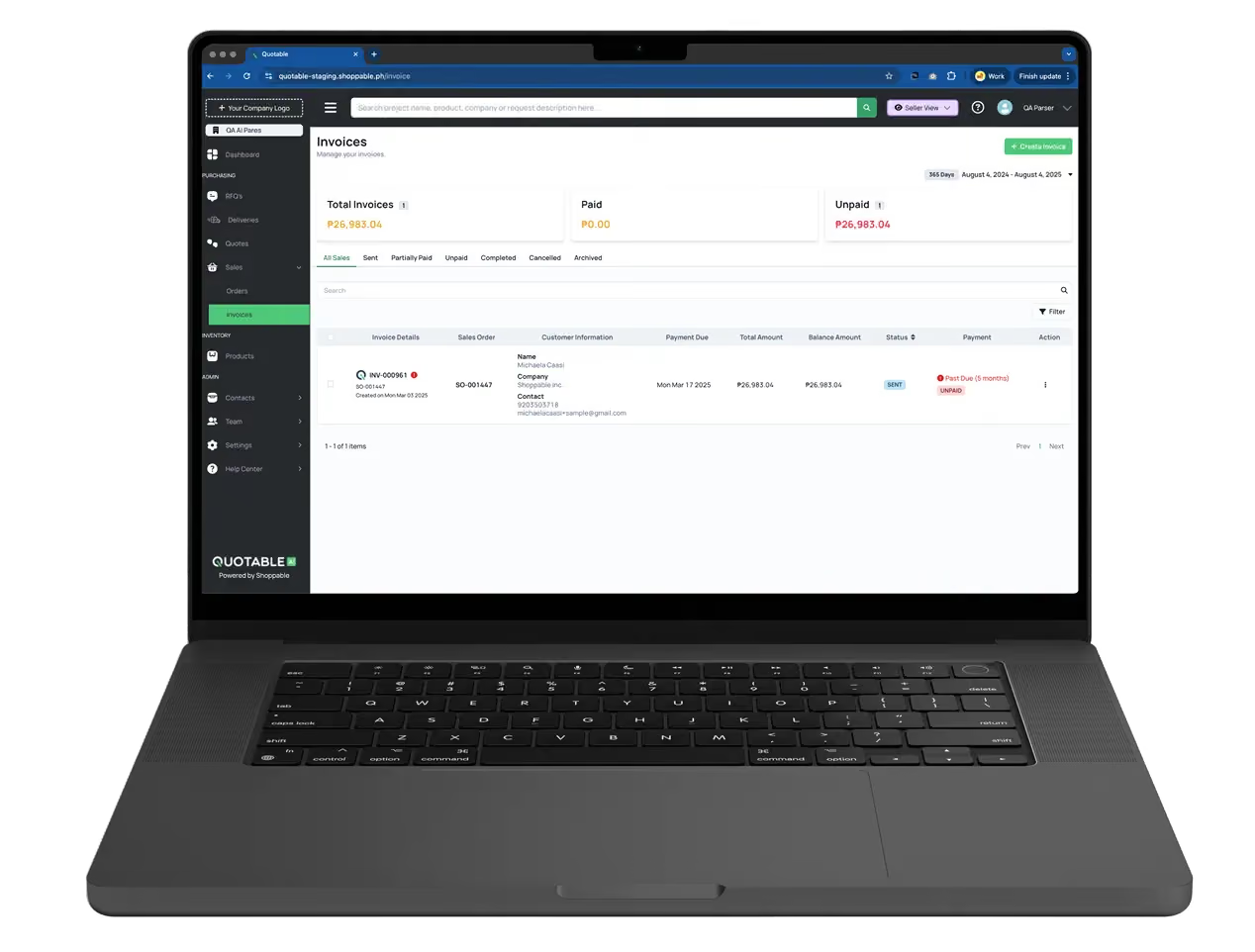
Quotable AI was designed to eliminate these gaps. Sellers generate quotes, invoices, and order documents in minutes. Buyers approve, submit POs, and pay through no-login links. Embedded payment options (bank wire, ACH, credit cards, and e-wallets) mean suppliers get paid faster and buyers don't have to chase down payment confirmations manually. The result is a single operating system where every transaction, from first quote to final payment, lives in one place.
For finance teams, this means the month-end close stops being a fire drill. For procurement teams, it means visibility into where every dollar is going. For leadership, it means real-time data on supply chain performance without waiting for someone to compile a report.
Future-Proofing Logistics with AI-Powered Orchestration
AI in B2B procurement isn't about replacing human judgment. It's about removing the manual work that prevents humans from exercising good judgment. When your team spends 60% of their time on data entry, document formatting, and status chasing, they have 40% left for the strategic work that actually drives value.
AI-powered orchestration handles the repetitive tasks: parsing documents, matching line items, flagging pricing anomalies, routing approvals. Your team focuses on supplier relationships, negotiation strategy, and risk management. That's the division of labor that makes mid-market companies competitive against much larger players.
The trajectory of the logistics technology market supports this shift. Companies that invest in intelligent automation now are building operational advantages that will compound over the next five to ten years. Those that wait will find themselves competing on manual effort alone, a race they can't win.
Building Your Quote-First Advantage
The companies that treat their RFQ process as a strategic capability, not an administrative task, are the ones pulling ahead. They're closing procurement cycles in hours instead of weeks. They're eliminating the manual reconciliation that bogs down finance teams. And they're scaling transaction volume without proportionally scaling headcount.
If you're a B2B distributor or mid-market buyer still running RFQs through email and spreadsheets, the question isn't whether to adopt logistics RFQ software. It's how much longer you can afford not to. Start by auditing your current quote-to-payment cycle. Count the handoffs, the re-keying, the version mismatches. That's your cost of inaction, and it's probably bigger than you think.
Quotable AI offers a way to see this in action: a single platform where quoting, procurement, invoicing, and payments connect from day one. The quote is where every transaction begins. Build your system around it.