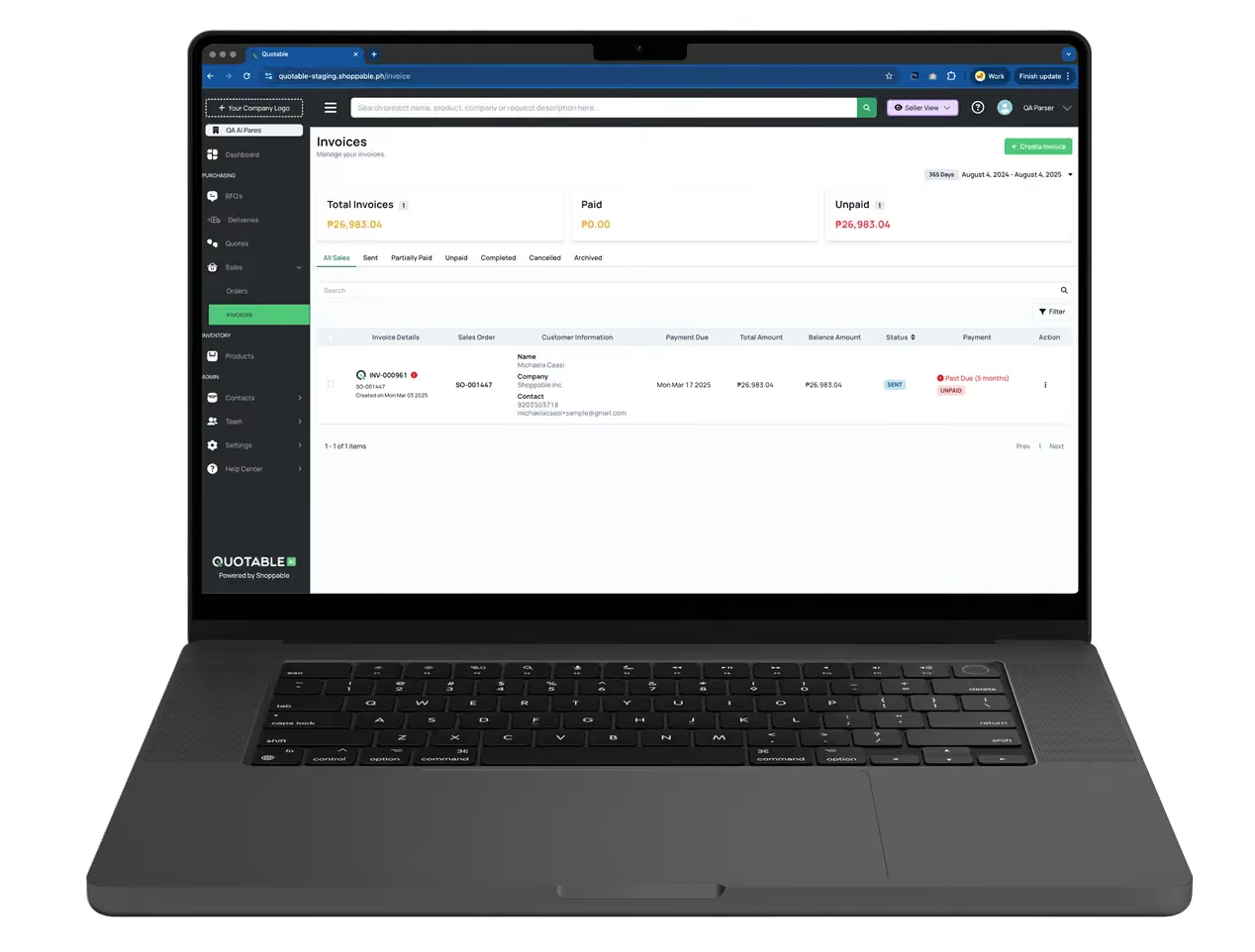
Every construction project starts long before anyone breaks ground. It starts with a quote, a purchase order, a supplier negotiation, and a payment. Yet for most small and mid-market construction firms, these early transactions happen across scattered spreadsheets, email threads, and disconnected software. The result? Blown budgets, delayed timelines, and strained supplier relationships. Construction procurement is the backbone of project delivery, but it's also one of the most fragmented and error-prone workflows in the industry. The US Engineering, Procurement, and Construction Management market is expected to reach USD 646.08 billion by 2030, growing at a CAGR of 14.96%. That growth brings both opportunity and urgency: firms that modernize their procurement processes now will capture outsized advantages over those still running on paper and gut instinct. We've worked with enough construction suppliers and buyers to know that the difference between a profitable project and a cash-flow nightmare often comes down to five specific steps. These aren't abstract ideas. They're hard-won lessons from teams managing millions in material purchases every year. If you're a distributor, subcontractor, or mid-market buyer handling between $1M and $50M in annual transactions, this guide is built for you.
The Evolution of Construction Procurement: From Paper to Real-Time Data
A decade ago, procurement in construction looked remarkably similar to how it had looked for fifty years. A project manager would identify a need, call a few suppliers, get faxed or emailed quotes, and manually enter the chosen option into an accounting system. Change orders happened over the phone. Price confirmations lived in someone's inbox. Payment terms were tracked on sticky notes.
That approach worked when projects were smaller and supply chains were local. It doesn't work anymore. The global construction services category was valued at approximately USD 11.0 trillion in 2022 and is estimated to grow at 11.8% annually through 2030. Projects now involve global suppliers, volatile material pricing, and compliance requirements that demand audit trails.
The shift from paper-based procurement to data-driven workflows isn't just a technology upgrade. It's a fundamental change in how construction firms manage risk. When your quoting, purchasing, invoicing, and payment data live in one connected system, you can spot cost overruns before they become crises. You can identify which suppliers consistently deliver on time and which ones don't. You can close your books at month-end without spending three days reconciling purchase orders against invoices.
Real-time data also changes the relationship between the office and the field. Site managers can submit requisitions from their phones. Procurement teams can compare quotes in minutes rather than days. Finance can track committed costs against budgets without waiting for paper to arrive. This is the direction the industry is heading, and firms that resist it are already falling behind.
Overcoming Common Bottlenecks in SME Procurement Workflows
Small and mid-market construction firms face a specific set of procurement bottlenecks that larger enterprises don't. You probably don't have a dedicated procurement department. Your purchasing might be handled by a project manager who's also managing schedules and site visits. That means every inefficiency gets multiplied.
The most common bottlenecks we see include:
- Maverick spend: Team members ordering materials outside approved channels because the formal process is too slow. This creates duplicate orders and makes it impossible to track actual project costs.
- Quote chaos: Receiving supplier quotes in different formats (PDF, email, phone) with no standardized way to compare them. One client we worked with was spending 6-8 hours per week just reformatting quotes into a comparison spreadsheet.
- Disconnected approvals: Purchase orders that require sign-off sitting in someone's email for days because there's no automated routing or notification system.
- Invisible committed costs: Finance can't see what's been ordered until the invoice arrives, which means budget reports are always outdated.
The breaking point usually hits around 30-50 purchase orders per month. Below that threshold, you can muscle through with spreadsheets. Above it, errors compound, suppliers get frustrated, and you start losing money on every project without understanding why. Recognizing these red flags early is what separates firms that scale from firms that stall.
Step 1: Centralize Quoting as a Live Transaction State
Most procurement workflows treat quotes as static documents. A supplier sends a PDF. Someone saves it to a shared drive. Maybe it gets entered into a spreadsheet for comparison. Then a completely separate purchase order gets created in another system. This disconnect is where errors breed.
The smarter approach is to treat the quote as a live transaction state: a dynamic record that flows directly into your purchasing, invoicing, and payment workflows. When a quote is accepted, it should automatically generate a purchase order. When that PO is fulfilled, it should trigger an invoice. When the invoice is paid, the payment should reconcile back to the original quote. One continuous thread, not five disconnected documents.
This concept is central to how platforms like Quotable AI operate. Rather than starting after the transaction, the system starts where the transaction actually begins: the quote. Suppliers receive RFQs, submit structured quotations, and the data flows through every subsequent step without manual re-entry. For construction firms managing hundreds of material line items per project, this eliminates the transcription errors that cause wrong deliveries, disputed invoices, and delayed payments.
Think about it practically. If you're ordering 200 line items of rebar, fittings, and concrete accessories for a commercial project, and even 2% of those line items get miskeyed during manual entry, that's four wrong items. Four potential delivery delays. Four credit memos. Four phone calls. Centralizing the quote as the source of truth prevents all of that.
Moving Beyond Static Documents to Integrated Quote Orchestration
Quote orchestration means connecting every stakeholder to the same living document. Your project manager sees the approved specs. Your procurement team sees the supplier responses. Your finance team sees the committed cost. Nobody is working from an outdated version.
The practical mechanics look like this: you issue an RFQ to three or four suppliers. Each supplier responds through a structured format, whether that's a portal link or a standardized template. Their responses populate a comparison matrix automatically, showing you unit prices, lead times, delivery terms, and any conditions. You select the winning quote, and that selection cascades into a purchase order, a budget commitment, and eventually an invoice match.
This is where frictionless supplier participation matters. If your suppliers need to create accounts, learn new software, or change their workflow just to respond to your RFQ, half of them won't bother. The best systems let suppliers respond through a secure link with zero onboarding. That's not a nice-to-have. For construction firms working with dozens of specialty suppliers, it's the difference between getting three competitive bids and getting one take-it-or-leave-it price.
Step 2: Automate Supplier Selection and Quote Comparison
Manual quote comparison is one of the biggest time sinks in procurement for construction firms. You're not just comparing price. You're comparing lead times, payment terms, delivery schedules, material certifications, and warranty conditions. Doing this across five suppliers for a project with 150 line items is a full day's work, and that's if nobody makes a mistake.
Automation changes the math entirely. Organizations using procurement software report a 10-20% reduction in procurement costs due to increased efficiency. Those savings come from two places: faster cycle times and better supplier selection. When you can compare quotes in minutes instead of hours, you make better decisions. You catch the supplier offering a lower unit price but a longer lead time that would delay your project. You notice the one who buried a fuel surcharge in the fine print.
A Universal AI Parser, like the one Quotable AI uses, can automatically extract and structure data from quotes regardless of format. Whether a supplier sends a PDF, an Excel file, or even a scanned document, the system pulls out the relevant fields and normalizes them for comparison. This reduces manual encoding errors and speeds up the entire evaluation cycle.
Here's a scenario worth considering. Suppose you're buying $200,000 worth of HVAC equipment for a mid-rise project. Supplier A quotes $195,000 with 60-day lead time and net-30 payment terms. Supplier B quotes $202,000 with 45-day lead time and net-60 terms. The cheapest option isn't automatically the best if the longer lead time pushes your mechanical rough-in back by two weeks and triggers a penalty clause in your general contract. Automated comparison tools surface these tradeoffs instantly.
Step 3: Bridge the Gap Between Procurement and Finance
The most expensive gap in any construction business isn't between the office and the job site. It's between procurement and finance. When these two functions operate in silos, you get duplicate payments, disputed invoices, budget overruns that nobody sees until month-end close, and cash flow surprises that can threaten your bonding capacity.
Procurement creates the commitment. Finance pays the bill. If those two systems don't talk to each other, you're flying blind. A project manager might commit $50,000 in material purchases on Monday, but the CFO won't see that liability until the invoices arrive three weeks later. By then, the project budget might already be blown, and the only option is to absorb the loss or fight with the supplier.
The fix is structural, not behavioral. You don't solve this by asking people to communicate better. You solve it by connecting the systems so that every purchase order automatically creates a financial commitment, every goods receipt updates the accrual, and every invoice matches against the original PO and receipt. This three-way match is fundamental to financial control in construction, and it's a requirement for firms subject to audit or SOX compliance.
Connecting Purchase Orders Directly to Automated Invoicing
When a purchase order generates an invoice automatically, you eliminate an entire category of errors. No more invoices that don't match the PO amount. No more line items that were on the invoice but not on the order. No more arguments about whether the price was $12.50 or $12.75 per unit.
The workflow should look like this: PO is issued and approved. Supplier delivers materials. Your team confirms receipt (ideally through a mobile app on site). The system generates an invoice based on the PO terms and received quantities. If there's a discrepancy, like a short shipment or a substitution, the system flags it immediately rather than letting it slide through to payment.
One common mistake we see is firms that treat verbal changes to purchase orders as acceptable. A site foreman calls the supplier and says "add 50 more bags of Portland cement." The supplier ships them. But the PO was never updated, so finance has no record of the change. The invoice arrives $800 higher than expected, and now you've got a dispute that takes a week to resolve. Connecting POs directly to invoicing eliminates this by forcing changes through a documented process.
Managing B2B Payments and Collections Within One System
Payment is where procurement workflows usually break down entirely. The PO lives in one system. The invoice lives in another. The payment gets processed through a third. And reconciliation happens manually in a fourth. Each handoff introduces delay, error, and cost.
Construction firms that centralize payments within their procurement system gain two critical advantages. First, they can pay suppliers through the method that works best for each relationship: bank wire, ACH, credit card, or e-wallet. Second, they can track payment status in real time, eliminating the back-and-forth emails asking "did you send the payment?" and "which invoice was that for?"
For suppliers, getting paid faster means they're more likely to offer you better pricing and priority delivery on your next project. The construction industry needs 499,000 new workers in 2026, and labor shortages are already driving up subcontractor costs. When you can't control labor prices, controlling your material costs and supplier relationships through better payment practices becomes even more critical.
Quotable AI handles this by embedding payment options directly into the invoice workflow. Suppliers receive payments via popular methods, and buyers can pay all their vendors from one centralized system. No more manual payment verification. No more chasing remittance advice.
Step 4: Synchronize Fulfillment with Real-Time Tracking
A purchase order that's been approved and paid means nothing if the materials don't arrive on site when you need them. Construction schedules are unforgiving. A two-day delay on structural steel can cascade into a two-week project delay, especially when you've got trades stacked and inspections scheduled.
Real-time fulfillment tracking connects your procurement data to your logistics data. You should know, at any moment, where every order stands: confirmed, in production, shipped, in transit, delivered, or received. This visibility lets you plan pours, schedule crews, and coordinate equipment rentals with confidence rather than hope.
The connection between procurement and fulfillment also matters for tracking landed costs. If you're sourcing materials internationally, like specialty tile, imported fixtures, or custom fabricated steel, your purchase price is only part of the story. Freight charges, customs duties, and currency fluctuations all affect your actual cost. Linking payment workflows with logistics data and documents like bills of lading and packing lists gives you a true picture of what each item actually costs when it hits your site.
Procurement for construction projects often involves dozens of suppliers delivering to the same location on overlapping schedules. Without real-time tracking, your site superintendent is making phone calls all day trying to figure out what's arriving when. With it, they can focus on what they should be doing: managing the build.
A practical red flag to watch for: if your team regularly discovers material shortages only when a crew shows up ready to install, your fulfillment tracking is broken. That's not a scheduling problem. That's a procurement visibility problem.
Step 5: Leverage AI for Continuous Process Optimization
The first four steps get your procurement process organized and connected. This fifth step is what makes it continuously better. AI applied to procurement data can identify patterns that humans miss: suppliers whose lead times are drifting longer, material categories where prices are rising faster than your estimates account for, or projects where committed costs consistently exceed budgets at the 60% completion mark.
This isn't about replacing human judgment. It's about giving your procurement team better information to make decisions. When you've got structured data flowing from quotes through purchase orders through invoices through payments, AI can analyze that entire chain and surface insights. Which supplier gives you the best total value (not just the lowest price)? Which cost codes consistently run over budget? Where are you leaving money on the table by not consolidating purchases?
Construction procurement, especially for large, complex, and expensive equipment, remains one of the most fragmented and high-risk areas of project delivery. AI doesn't eliminate the fragmentation overnight, but it gives you the tools to manage it systematically rather than reactively.
The sustainability angle matters here too. About 31% of contracts now define sustainability targets, and that number is climbing. AI can help you track and report on sustainability metrics across your supply chain: recycled content percentages, supplier carbon footprints, and material sourcing origins. As green building requirements tighten, this data becomes a competitive advantage, not just a compliance checkbox.
Using Data Orchestration to Scale Construction Operations 10X Faster
Data orchestration is the idea that every piece of transaction data, from the initial quote to the final payment, flows through one connected system and informs every subsequent decision. For construction firms looking to scale from $5M to $50M in annual revenue, this is the infrastructure that makes growth possible without proportionally growing your back-office headcount.
Consider what happens without orchestration. Every new project means more suppliers, more POs, more invoices, more payments, and more reconciliation. Your admin burden scales linearly with your revenue. At some point, you're hiring people just to manage paperwork, not to build anything.
With data orchestration, each new project plugs into the same workflow. Suppliers are already in your system. Quote templates exist for common material categories. Approval routing is automated. Invoice matching is automatic. Payment processing is centralized. Your team handles twice the volume without twice the stress.
This is the venture-scale idea behind treating the quote as the starting point of a connected workflow rather than a disposable document. When you build your operations around that principle, growth doesn't break your processes. It validates them.
Making Procurement Your Competitive Advantage
The five steps outlined here aren't theoretical. They represent a practical roadmap for construction firms ready to stop losing money to inefficient procurement. Centralize your quoting. Automate supplier comparison. Connect procurement to finance. Track fulfillment in real time. Apply AI to continuously improve.
The firms that master these steps don't just save money on materials. They win more bids because they estimate more accurately. They retain better suppliers because they pay on time. They close their books faster because their data is clean. And they scale without drowning in administrative overhead.
If you're running a construction supply business or managing procurement for a mid-market builder, start with step one. Get your quotes out of email and into a system that treats them as the living transactions they are. Quotable AI was built for exactly this purpose: to give SMEs and mid-market companies the procurement infrastructure that used to be reserved for enterprise firms. The best time to fix your procurement process was last year. The second-best time is this week.