Every year, billions of dollars in margin evaporate between the moment a supplier sends a quote and the moment goods arrive at a job site or warehouse. The friction isn't in any single step: it's spread across disconnected quoting tools, manual procurement workflows, siloed invoicing systems, and payment processes that still rely on email threads and spreadsheets. For SME distributors and mid-market companies moving $1M to $50M in goods annually, these inefficiencies compound fast. A quote that takes three days to approve. A purchase order that gets re-keyed with errors. A shipment that sits in customs because the commercial invoice doesn't match the PO. AI is now reshaping how supply chains function, not by replacing human decision-making, but by connecting the data that already exists across your transactions and making it usable in real time. The companies adopting these systems aren't just shaving hours off their workflows: they're building structural advantages that competitors will struggle to match. The AI in supply chain market reflects this momentum, with projections showing it will surge to USD 157.6 billion by 2033 at a compound annual growth rate of 42.7%. That kind of growth signals something beyond hype. It signals a fundamental shift in how B2B trade operates.
The Shift Toward AI-Driven Logistics Orchestration
The old model of supply chain management was built on a simple premise: something goes wrong, and then you fix it. A shipment is late, so you expedite. Inventory runs out, so you place an emergency order at a premium. A customer disputes an invoice, so you spend two weeks reconciling documents. This reactive posture made sense when data was scarce and systems couldn't talk to each other. It doesn't make sense anymore.
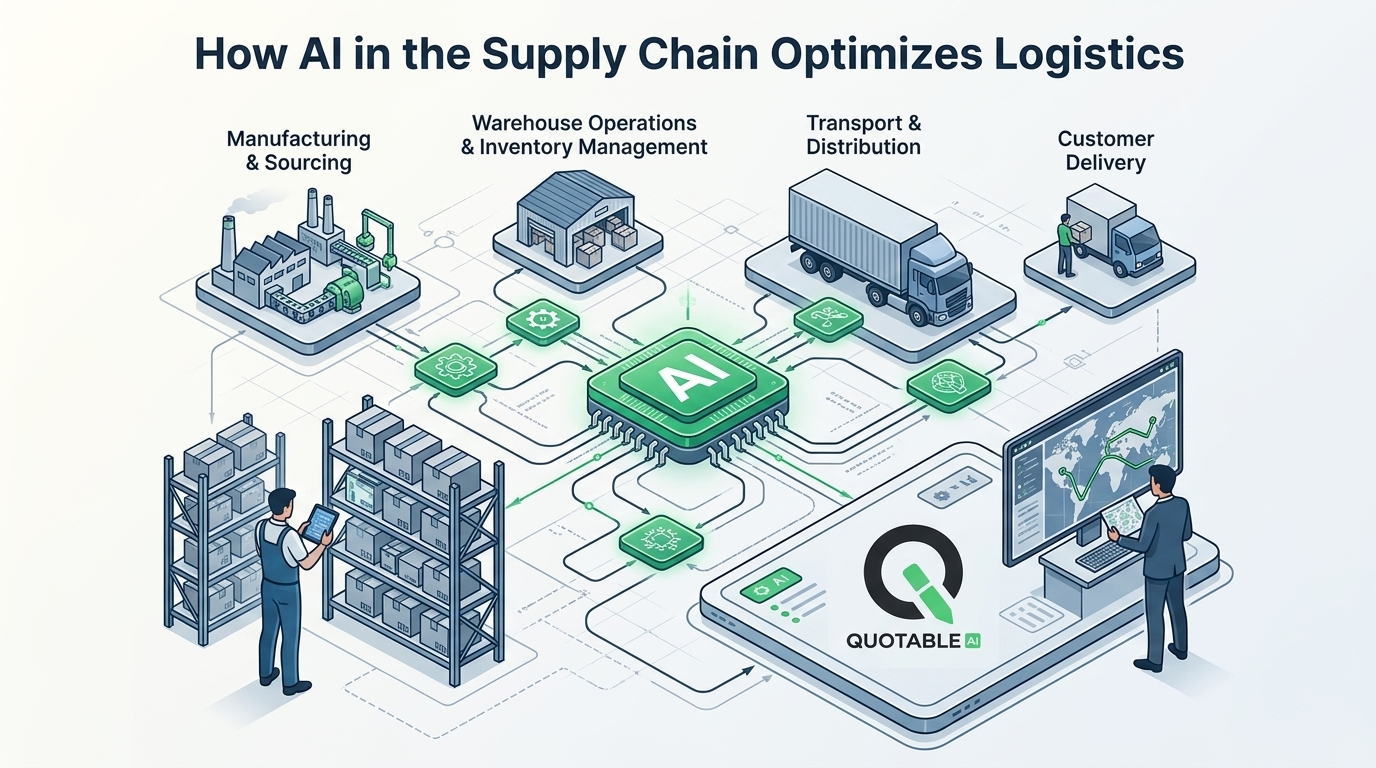
AI-driven logistics orchestration flips this model. Instead of waiting for problems to surface, intelligent systems monitor transaction states continuously, flagging risks before they become costly disruptions. Think of it as the difference between a smoke detector and a fire truck: both are useful, but one saves you from the fire entirely.
For B2B distributors handling hundreds of SKUs across dozens of customers, the stakes are real. A single misquoted price can cascade into a wrong PO, a disputed invoice, and a delayed payment that takes 60 days to resolve. AI systems that treat the quote as a live transaction state, tracking it from creation through procurement, fulfillment, and payment, eliminate these cascading failures at the source.
Moving from Reactive to Proactive Supply Chain Management
The shift from reactive to proactive starts with data visibility. Most SME suppliers operate with fragmented information: quotes live in one system, purchase orders in another, invoices in a third, and payments in yet another. When these systems don't share data, you're flying blind. You can't predict which orders will be late because you can't see the upstream signals.
AI changes this by ingesting data across your entire transaction lifecycle and identifying patterns that humans miss. If a particular supplier consistently ships two days late on orders above a certain dollar threshold, an AI system flags that pattern and adjusts your planning accordingly. Organizations implementing AI have seen a 65% improvement in service levels because they catch problems before customers feel them.
Proactive management also means better cash flow forecasting. If your AI system knows that a specific buyer typically approves quotes within 48 hours but takes 30 days to pay, you can plan your working capital around that reality rather than hoping for the best.
Why Logistics Optimization Starts at the Quote
Here's a hard-won lesson many distributors learn too late: your logistics problems don't start at the warehouse. They start at the quote. A quote that contains incorrect lead times, wrong pricing tiers, or missing shipping terms creates downstream chaos that no amount of warehouse efficiency can fix.
The quote is the first contractual touchpoint in any B2B transaction. It sets expectations for pricing, delivery timelines, payment terms, and product specifications. If any of those data points are wrong or ambiguous, every subsequent step inherits that error. The purchase order will be wrong. The pick list will be wrong. The invoice will be wrong. And the payment will be delayed while everyone argues about what was actually agreed upon.
This is why platforms like Quotable AI treat the quote as the origin point of the entire supply chain workflow. When you build your logistics orchestration around the quote, rather than around the shipment, you catch errors at the cheapest possible moment to fix them: before any goods have moved.
Automating the Quote-to-Fulfillment Workflow
Manual quote-to-fulfillment workflows are where SME distributors lose the most time and margin. Consider the typical process: a buyer requests a quote via email, a sales rep builds it in a spreadsheet or basic CRM, the buyer approves it (sometimes weeks later), someone manually creates a PO, the warehouse receives the PO and picks the order, an invoice is generated separately, and then payment collection begins. Each handoff introduces delay and error risk.
Automation collapses these handoffs. An AI-powered workflow can extract data from an RFQ, generate a structured quote with accurate pricing and lead times, convert an approved quote directly into a purchase order, trigger fulfillment, generate the invoice, and initiate payment collection, all without re-keying a single data point. The result isn't just speed. It's accuracy. And accuracy is what keeps your margins intact.
Reducing Lead Times for SME Suppliers and Distributors
Lead time reduction is one of the most tangible benefits of automating the quote-to-fulfillment chain. For a distributor doing $5M to $15M in annual revenue, even shaving two days off the average quote-to-ship cycle can translate to meaningful revenue gains. Faster cycles mean more turns per year, which means more revenue on the same inventory investment.
The bottleneck for most SMEs isn't the physical movement of goods. It's the administrative overhead. One client I worked with, a construction materials distributor, discovered that 40% of their total order cycle time was consumed by document processing: creating quotes, waiting for approvals, generating POs, and reconciling invoices. None of that time added value for their customers.
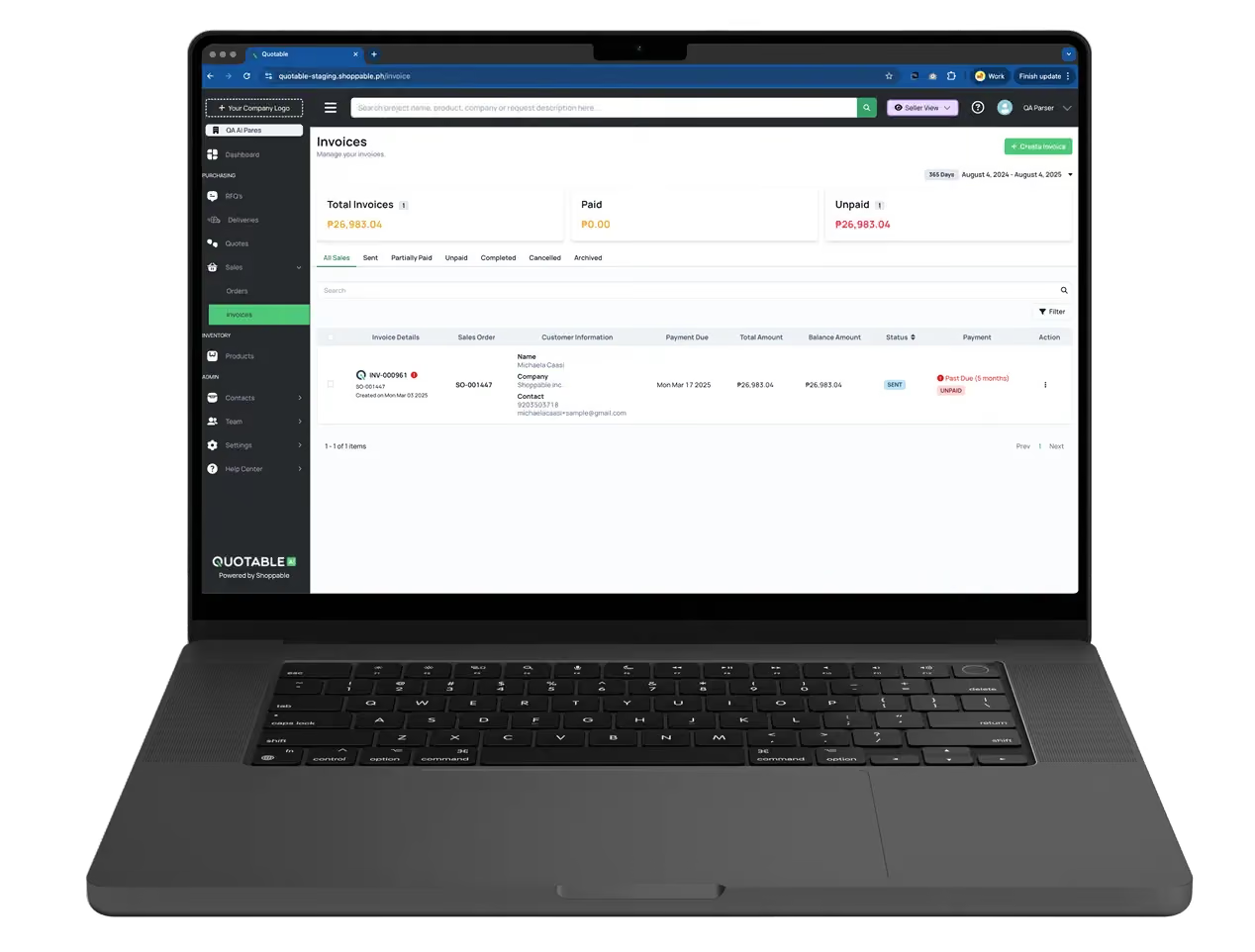
AI document parsing eliminates much of this overhead. Quotable AI's universal parser, for example, can automatically extract and structure data from quotes, invoices, purchase orders, and bills of materials. Instead of a procurement officer spending 20 minutes manually entering line items from a supplier quote, the system does it in seconds with higher accuracy. When you multiply that across 50 or 100 orders per month, the time savings are substantial.
Eliminating Data Silos Between Procurement and Shipping
Data silos between procurement and shipping are a silent margin killer. Your procurement team negotiates a price. Your shipping team doesn't see those terms. Your finance team gets an invoice that doesn't match the PO. Everyone spends time on calls and emails trying to reconcile information that should have flowed automatically.
This problem is especially acute for companies using separate systems for quoting, procurement, and logistics. Each system has its own version of the truth, and none of them agree. The three-way match between PO, receiving document, and invoice becomes a manual nightmare that delays payment and strains supplier relationships.
Breaking down these silos requires a single data layer that connects all transaction stages. When your quote, PO, invoice, and payment data all live in one system, or at least sync through integrations with your existing ERP, discrepancies surface instantly. You don't discover a pricing error 45 days later during invoice reconciliation. You catch it the moment the PO is generated, because the system flags the mismatch automatically.
Enhancing Last-Mile Efficiency with Data Integration
Last-mile delivery is where supply chain costs spike and customer satisfaction is won or lost. For B2B distributors, the "last mile" isn't just a delivery truck pulling up to a residence. It might be a flatbed arriving at a construction site with a specific delivery window, or a pallet shipment that needs to be received and verified against a PO before the driver leaves.
AI improves last-mile efficiency by integrating data from multiple sources: order status, carrier tracking, customer receiving schedules, and historical delivery performance. AI-driven supply chain systems can reduce transportation costs by up to 30% by identifying better routing, consolidation opportunities, and carrier selection based on real performance data rather than assumptions.
For mid-market companies, the real win is connecting last-mile data back to the financial workflow. When a delivery confirmation automatically triggers an invoice and initiates payment collection, you eliminate the days or weeks of lag that typically exist between delivery and billing. That acceleration directly improves your days sales outstanding (DSO) and working capital position.
Data integration also helps with exception management. If a shipment arrives short or damaged, the receiving data feeds directly into the dispute resolution process. Instead of a back-and-forth email chain spanning two weeks, the system creates a credit memo or replacement order tied to the original transaction, with full documentation attached. This kind of connected workflow is where AI earns its keep: not in flashy predictions, but in eliminating the mundane friction that eats your team's time.
Streamlining Global Trade Through Vertical Data Orchestration
Cross-border B2B trade introduces a layer of complexity that domestic transactions don't face: currency conversion, customs documentation, landed cost calculations, regulatory compliance, and payment methods that vary by country. For a distributor importing materials from three countries and selling domestically, each international transaction involves a web of documents that must align perfectly or risk delays, penalties, or both.
Vertical data orchestration means connecting every layer of a transaction, from the initial quote through customs clearance and final payment, into a single coherent data flow. This is fundamentally different from horizontal integration, where you connect systems at the same level (like linking two ERPs). Vertical orchestration links the quote to the commercial invoice to the bill of lading to the customs declaration to the payment, ensuring consistency at every stage.
The Role of AI in Cross-Border Invoicing and B2B Payments
Cross-border invoicing is riddled with friction. Different countries have different invoicing requirements, tax rules, and payment preferences. A supplier in Germany expects payment via bank wire in euros. A buyer in the U.S. wants to pay via ACH in dollars. The invoice needs to comply with both jurisdictions' requirements, and the FX conversion needs to be transparent and auditable.
AI handles this complexity by automatically formatting invoices to meet local requirements, calculating tax obligations, and routing payments through the appropriate channels. Platforms that embed multiple payment methods (bank wire, ACH, credit cards, e-wallets) in a single system eliminate the need for buyers and sellers to maintain separate payment infrastructure for each trading partner. Quotable AI, for instance, lets suppliers receive payments via their preferred method while buyers pay through a centralized system, removing the manual back-and-forth of payment verification.
The legal implications matter here too. Cross-border invoices are contractual documents. If your invoice doesn't match your PO or your commercial invoice doesn't match your customs declaration, you're not just facing a delay. You could face penalties, seized goods, or audit exposure. AI systems that maintain data consistency across all these documents reduce your regulatory risk significantly.
Synchronizing Live Transaction States Across Companies
One of the hardest problems in B2B trade is that a transaction exists in different states across different companies simultaneously. Your system shows the order as "shipped." Your customer's system shows it as "pending." Your logistics partner shows it as "in transit." Your finance team shows it as "unbilled." Nobody has the full picture.
Synchronizing these states requires a shared data layer that all parties can access without forcing everyone onto the same platform. This is where frictionless participation models matter. If a supplier can respond to an RFQ or confirm a shipment through a secure link without creating an account or adopting new software, adoption barriers drop dramatically. The result is real-time visibility across companies without the multi-year ERP integration project.
AI contributes to this synchronization by continuously monitoring transaction states and flagging discrepancies. If a shipment status changes but the invoice hasn't been generated, the system alerts the appropriate team. If a payment is received but hasn't been matched to an invoice, the system reconciles it automatically. This kind of continuous monitoring is what turns a collection of disconnected transactions into a coherent supply chain.
The Competitive Edge of 10X Faster Logistics Cycles
Speed creates compounding advantages. A distributor that can quote, fulfill, and collect payment in five days instead of fifty doesn't just have better cash flow. They can serve more customers with the same working capital, respond faster to market changes, and build stronger supplier relationships because they pay faster.
The "10X faster" claim isn't hyperbole for companies that automate their full quote-to-payment cycle. If your current process takes a sales rep 30 minutes to build a quote, two days to get approval, a day to generate the PO, three days to fulfill, and then 30 to 60 days to collect payment, you're looking at a 35 to 65 day cycle. Compress the administrative steps to minutes and accelerate payment collection through embedded payment links, and you can realistically hit a five to seven day cycle for many transaction types.
AI also contributes to a 65% decrease in lost sales by ensuring that inventory, pricing, and availability data are accurate and current. When a customer asks for a quote and you can respond in minutes with accurate pricing and real-time stock levels, you win the deal. When it takes you three days and the information might be stale, you lose to the competitor who moved faster.
Optimizing Inventory for Construction and Manufacturing
Construction and manufacturing supply chains have unique inventory challenges. Materials are often project-specific, lead times are long and variable, and demand is driven by project schedules rather than consumer trends. Overstocking ties up capital that construction firms need for labor and equipment. Understocking delays projects, triggering penalty clauses that can cost thousands per day.
AI-driven warehouse and inventory systems can achieve accuracy rates of 99.8%, which matters enormously when you're tracking thousands of SKUs across multiple job sites. For a construction materials distributor, knowing exactly what's in stock, what's committed to existing orders, and what's available to promise on a new quote is the difference between winning and losing business.
The key is connecting inventory data to the quoting process. If your sales team is quoting lead times based on last month's data, they're making promises your warehouse can't keep. When inventory feeds directly into the quoting engine, every quote reflects reality. And when that quote converts to a PO, the inventory is automatically allocated, preventing the double-booking that plagues manual systems.
Future-Proofing the Supply Chain with Intelligent Systems
As one industry expert noted, "each AI application is built for a specific use case, and we are just scratching the surface of what it can do." The companies that will thrive over the next decade aren't the ones waiting for a perfect, all-encompassing AI solution. They're the ones deploying targeted AI applications today, starting with the highest-friction points in their workflows, and building from there.
For SME distributors and mid-market buyers, the smartest starting point is usually the quote-to-payment workflow. It's where the most manual effort lives, where errors have the biggest downstream impact, and where the ROI on automation is fastest and most measurable. A platform like Quotable AI that integrates with your existing ERP and accounting systems means you don't have to rip and replace your infrastructure. You add an intelligence layer on top of what you already have.
The founder-to-founder advice here is simple: don't try to boil the ocean. Pick the bottleneck that's costing you the most, whether that's slow quoting, manual PO creation, invoice reconciliation, or payment collection, and automate that first. Measure the results. Then expand. The companies building AI into their supply chains now aren't just solving today's problems. They're creating the operational foundation that will let them scale without proportionally scaling their back-office headcount. That's the real competitive edge: not just being faster today, but being structurally capable of handling 3X the volume without 3X the overhead. Smart money follows that kind of efficiency.