Every year, billions of dollars in B2B contracts begin with a single document: the request for proposal. Yet the process of responding to one, or issuing one, remains frustratingly manual for most small and mid-market companies. Teams copy-paste from old submissions, chase approvals through email chains, and lose track of version history in shared drives. The result is missed deadlines, inconsistent messaging, and deals that slip away before finance ever sees a purchase order. RFP software exists to fix exactly this problem, turning a chaotic document exercise into a structured, repeatable workflow. For companies doing $1M to $50M in annual trade, understanding how these tools work, what they connect to, and where they're headed is no longer optional. It's a competitive requirement.
Defining RFP Software in the Modern Sales and Procurement Stack
RFP software is a category of business tools designed to help organizations create, distribute, respond to, and evaluate requests for proposals. On the seller side, these platforms centralize past responses, automate content assembly, and manage internal review cycles. On the buyer side, they standardize how requirements are communicated to vendors, score incoming proposals, and create audit trails for procurement decisions.
What makes this category distinct from general document management or project management tools is its focus on the proposal lifecycle specifically. The workflow is time-bound, multi-stakeholder, and high-stakes. A single RFP response might involve subject matter experts from engineering, legal review, pricing input from finance, and final sign-off from a VP of sales. Coordinating all of that in a spreadsheet or email thread is where things break down.
The market reflects this growing recognition. The RFP software market is projected to reach USD 7,383.30 million by 2032, growing at a CAGR of 15.83%. That kind of growth signals a shift from "nice to have" to "core infrastructure."
The Evolution from Manual Spreadsheets to Automated Workflows
A decade ago, most RFP responses lived in Word documents stored on someone's desktop. The "content library" was a folder of past proposals, and the "workflow" was a chain of emails with attachments named "FINAL_v3_REVISED." If you've managed a team responding to 10 or more RFPs per quarter this way, you know the pain: duplicated effort, outdated answers making it into submissions, and no visibility into which responses actually won.
The first generation of dedicated tools solved the storage problem. They gave teams a shared repository of approved answers, organized by topic or question type. The second generation added workflow features: assignment of sections to specific team members, approval gates, and deadline tracking. Today's platforms go further, using AI to draft initial responses, flag outdated content, and recommend answers based on the specific requirements in each RFP.
One hard-won lesson from working with mid-market teams is that the breaking point usually hits around 30 to 50 RFP responses per year. Below that, a disciplined team can manage with templates and shared drives. Above it, the lack of a system starts costing real money in missed deadlines and inconsistent quality.
How RFP Tools Differ from RFQ and RFI Systems
People often use RFP, RFQ, and RFI interchangeably, but they serve different purposes and the software that supports them reflects those differences. An RFI (request for information) is exploratory. A buyer is gathering market intelligence, not committing to a purchase. An RFQ (request for quotation) is transactional. The buyer knows what they want; they need a price and delivery terms. An RFP sits between the two: the buyer has defined requirements but is evaluating vendors on capability, approach, and fit, not just price.
RFP tools are built for narrative-heavy, multi-section responses. They handle complex scoring rubrics, allow for qualitative evaluation, and support rich formatting. RFQ tools, by contrast, tend to focus on line-item pricing, quantity breaks, and lead times. If your company primarily handles quote-driven transactions, you'll want tools built for that workflow. Platforms like Quotable AI, for instance, treat the RFQ as a live transaction state, connecting supplier responses directly to purchase orders, invoicing, and payment, rather than treating the quote as a static PDF.
Understanding this distinction matters because buying the wrong tool creates friction. An RFP platform won't handle your three-way match requirements, and an RFQ system won't manage the kind of narrative evaluation that complex proposals demand.
Core Features of High-Performance RFP Management Platforms
The best RFP tools share a set of features that directly address the bottlenecks in proposal management. Not every team needs every feature, but understanding what's available helps you evaluate solutions against your actual workflow gaps.
Centralized Content Libraries and Proposal Templates
The content library is the backbone of any RFP platform. It's a searchable, version-controlled repository of approved answers, boilerplate language, case studies, certifications, and supporting documents. When a new RFP arrives, your team isn't starting from scratch. They're pulling from a curated set of responses that have been reviewed, approved, and tagged by category.
Good libraries include metadata: who wrote the answer, when it was last updated, which proposals it appeared in, and whether it contributed to a win. This turns your content library into an intelligence asset, not just a filing cabinet. You can see which answers are stale, which ones correlate with higher win rates, and where you have gaps.
Templates complement the library by providing structural consistency. If your industry has standard RFP formats, whether that's a government procurement template or an industry-specific questionnaire, you can map your library content to those structures and pre-populate sections automatically.
AI-Powered Response Generation and Content Recommendations
This is where the market is splitting fast. Legacy tools function primarily as "librarian" systems: they store and organize content, but the market is dividing between these manual-upkeep tools and AI-native platforms that automate answers from live data. AI-native platforms read the incoming RFP, identify the questions, match them against your library, and draft initial responses. Your subject matter experts then review and refine rather than write from scratch.
The time savings are significant. Automation commonly reduces response time by 50%, with some workflows compressed from four to six weeks down to four to five days. For a mid-market distributor responding to 40 RFPs a year, that's hundreds of hours returned to revenue-generating activity.
A common mistake here is trusting AI output without review. The best teams treat AI-generated drafts as a first pass, not a final answer. Subject matter experts still need to validate technical claims, check pricing accuracy, and ensure the tone matches the buyer's expectations.
Collaborative Review Loops and Workflow Automation
An RFP response is rarely a solo effort. Engineering provides technical specifications. Legal reviews terms and conditions. Finance signs off on pricing. The sales team ensures the narrative aligns with the account strategy. Without structured collaboration, this process becomes a bottleneck.
Workflow automation handles the orchestration: routing sections to the right reviewers, setting deadlines, sending reminders, and tracking completion status. The best platforms show a real-time dashboard of where each section stands, who's holding things up, and whether the overall submission is on track.
Red flags to watch for in your current process include reviewers making changes in disconnected documents, verbal approvals that never get documented, and last-minute pricing changes that bypass finance. Each of these creates risk, from compliance exposure to margin erosion, and structured workflows eliminate them.
Bridging the Gap: Integrating RFPs with Quote-to-Payment Systems
Most RFP tools treat the proposal as the end of their responsibility. You submit the response, and whatever happens next, the purchase order, invoicing, fulfillment, payment, lives in a different system. This creates a data gap that costs time and money.
The 'Quote as a Live Transaction State' Advantage
Here's a founder-to-founder insight: the real value of a proposal isn't the document itself. It's the pricing, terms, and commitments embedded in it. When those commitments live in a static PDF, someone has to manually re-enter them into your ERP or accounting system to create a sales order. That re-entry step is where errors creep in: wrong quantities, outdated pricing, missed line items.
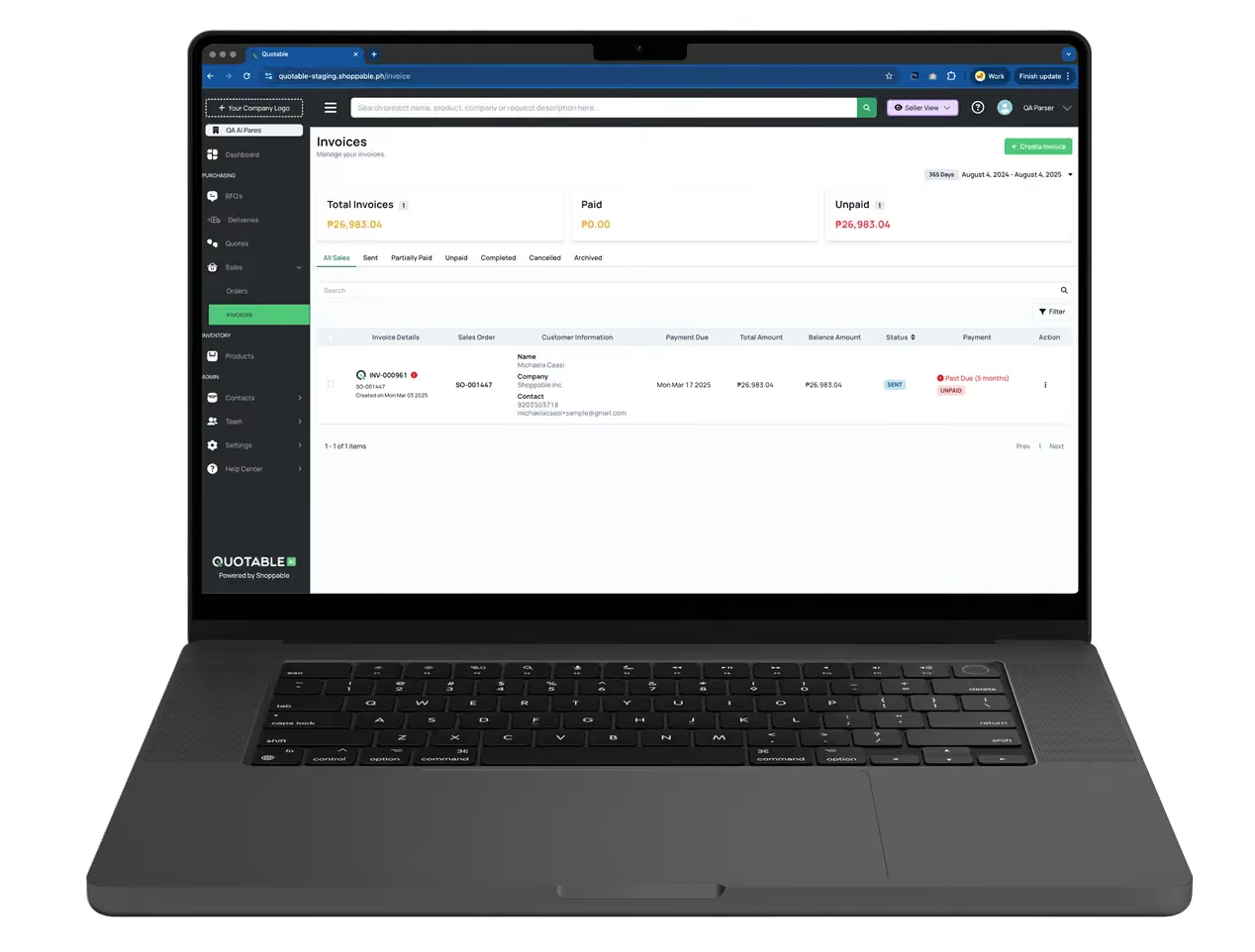
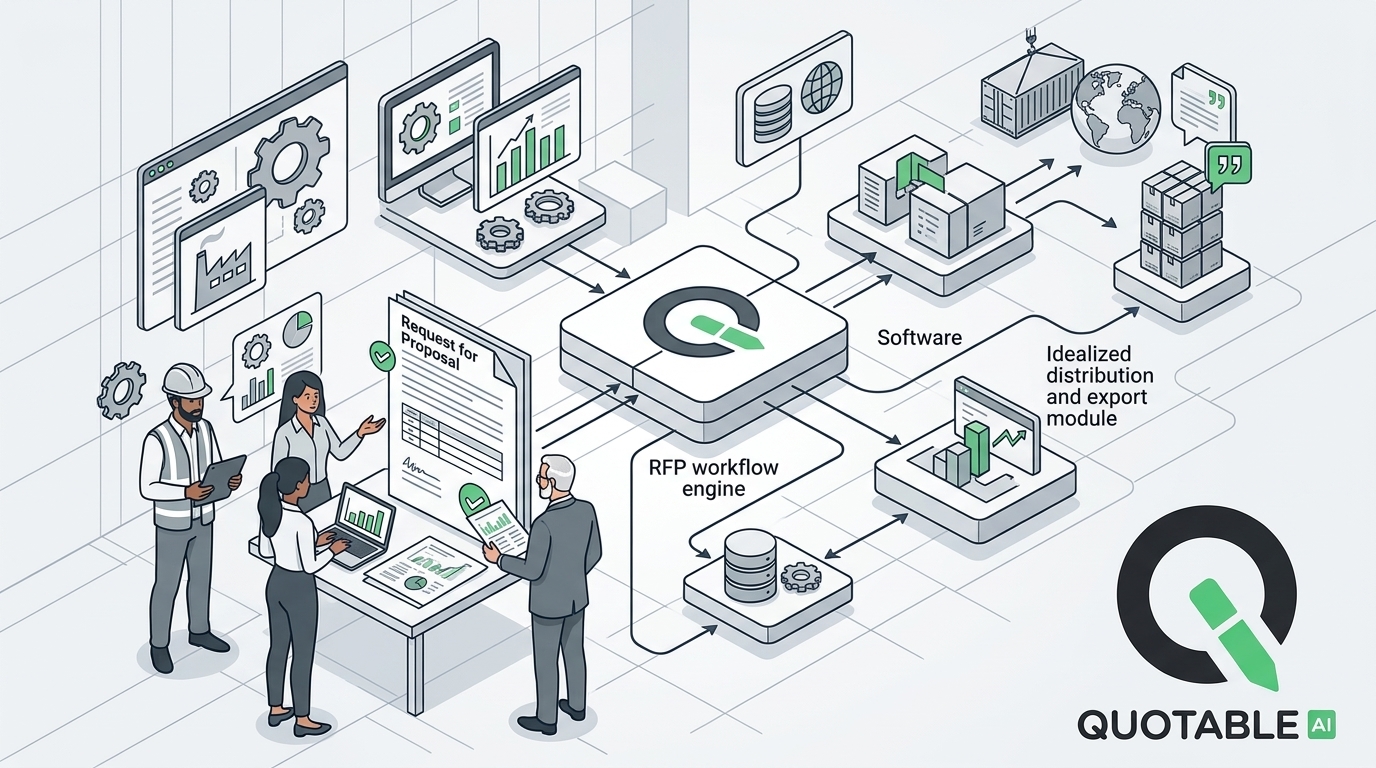
The smarter approach treats the quote or proposal response as a live transaction state. The pricing you committed to in the RFP flows directly into the purchase order, then into the invoice, then into the payment record. No re-keying. No reconciliation headaches. Quotable AI was built around this concept, connecting quoting, procurement, payments, and fulfillment into one continuous workflow. Their Universal AI Parser can automatically extract and structure data from quotes, invoices, purchase orders, and bills of materials, which eliminates the manual encoding that typically sits between winning a proposal and getting paid.
Connecting Procurement Responses to Fulfillment and Invoicing
For buyers, the same gap exists on the procurement side. You've evaluated proposals, selected a vendor, and awarded the contract. Now what? In most organizations, the procurement team hands off to operations, who re-enters requirements into a fulfillment system. Finance then creates a separate invoice record. The landed cost, including duties, freight, and FX impact, gets calculated in yet another spreadsheet.
This fragmentation creates specific problems. Duplicate orders appear when procurement and operations aren't synchronized. Payment terms from the original proposal get lost, leading to disputes. Month-end close gets delayed because finance is reconciling data across three or four systems.
Connecting RFP responses to downstream fulfillment and invoicing isn't just an efficiency play. It's a compliance requirement for companies subject to SOX or similar regulations, where audit trails need to trace from the original proposal through to final payment. If you're a supplier working with mid-market buyers, being able to link your proposal response directly to invoicing and payment through a single system, without requiring the buyer to adopt new software, removes friction from the entire relationship.
Strategic Benefits of Adopting Dedicated RFP Software
Beyond the operational mechanics, there are strategic reasons to invest in purpose-built proposal management tools. These benefits compound over time as your content library matures and your team's processes tighten.
Increasing Win Rates through Faster Turnaround Times
Speed matters in competitive bidding. The team that submits a polished, compliant response two days before the deadline has time to refine their approach. The team scrambling to compile sections on the last day submits a patchwork document with inconsistencies.
The data backs this up. The average RFP win rate reached 45% in 2025, up from 43% the prior year, and teams using dedicated tools consistently outperform those relying on manual processes. That same research shows 65% of teams now use dedicated RFP software, up from 48% in 2024. The adoption curve is accelerating, which means companies still relying on manual methods are falling behind a growing majority.
If you're a $5M distributor competing against a $20M competitor for the same contract, your proposal tool is one of the few areas where you can punch above your weight. A well-organized, quickly delivered response signals professionalism and operational maturity that buyers notice.
Ensuring Compliance and Consistency in Global B2B Trade
For companies operating across borders, consistency in proposals isn't just about brand standards. It's about legal and regulatory compliance. Different jurisdictions have different requirements for how pricing is presented, what certifications must be included, and how terms and conditions are structured.
A centralized content library with approval workflows ensures that every response includes the correct legal language, up-to-date certifications, and jurisdiction-appropriate terms. This is especially critical in industries like construction, manufacturing, and logistics, where penalty clauses for non-compliance can be severe.
One client I worked with, a mid-market IT distributor selling across Southeast Asia, discovered they'd been submitting proposals with outdated warranty terms for six months. The old terms were still in their shared drive, and three different sales reps had been using them. A centralized, version-controlled library would have caught that on day one.
Selecting the Right RFP Solution for SMEs and Mid-Market Teams
Not every RFP tool is built for the same buyer. Enterprise platforms come with enterprise complexity and enterprise pricing. SMEs and mid-market companies need solutions that deliver value without requiring a six-month implementation project.
Evaluating Vertical Integration vs. Standalone Response Tools
Standalone RFP response tools do one thing well: they help you build, review, and submit proposals. They're a good fit if your only pain point is the response process itself and you already have solid systems for everything downstream.
Vertically integrated platforms connect the proposal to what happens after the win. They link pricing commitments to purchase orders, automate invoice generation, and track payment status. For quote-heavy businesses, this integration eliminates the handoff gaps that cause errors and delays.
The decision comes down to where your biggest bottleneck lives. If you're losing deals because your responses are slow and inconsistent, a standalone tool solves that. If you're winning deals but losing margin because of manual re-entry, reconciliation errors, or payment delays, you need something that spans the full quote-to-payment lifecycle. Quotable AI fits this second scenario, allowing suppliers to receive RFQs from multiple buyers in one place, respond through secure links without creating accounts, and connect those responses directly to fulfillment and payment workflows.
Integration Capabilities with CRM, ERP, and Payment Gateways
No tool exists in isolation. Your RFP platform needs to talk to your CRM for opportunity tracking, your ERP for pricing and inventory data, and your payment systems for invoicing and collections. The quality of these integrations varies dramatically between vendors.
Here's what to evaluate:
- Does the platform offer native integrations with your existing ERP and accounting system, or does it require middleware?
- Can it pull real-time pricing and inventory data, or does it rely on periodic data exports?
- Does it support the payment methods your buyers and suppliers actually use: bank wire, ACH, credit cards, and e-wallets?
- How does it handle document formats? Can it parse incoming RFPs, purchase orders, and invoices automatically, or does your team need to re-enter data manually?
A platform that connects with your existing financial systems without requiring you to replace your ERP infrastructure is worth significantly more than one that forces a rip-and-replace approach. The goal is to modernize your supplier collaboration layer, not rebuild your entire tech stack.
Future Trends: Data Orchestration and the End of Siloed Proposals
The proposal process has historically been treated as a standalone function, separate from sales operations, separate from procurement, separate from finance. That separation is ending.
The next generation of tools treats the proposal as a data object, not a document. Every line item, every pricing commitment, every delivery timeline becomes structured data that flows through the organization. When a buyer accepts your proposal, the purchase order auto-generates. When goods ship, the invoice references the original proposal terms. When payment arrives, it reconciles against those same terms automatically.
This is what data orchestration looks like in practice. It's not about having one tool that does everything. It's about having tools that share a common data layer so information moves without re-entry. For mid-market companies managing $10M to $50M in procurement spend, this shift eliminates entire categories of administrative work: the manual encoding, the spreadsheet reconciliation, the payment verification back-and-forth.
The companies that will win the most contracts over the next five years aren't just the ones with the best products or the lowest prices. They're the ones whose operational infrastructure makes them easiest to buy from and easiest to do business with. Investing in tools that connect your proposals to your payments, your quotes to your fulfillment, and your procurement to your finance team isn't a technology decision. It's a strategy for how you compete.
If you're evaluating your current proposal and procurement workflows, start by mapping the handoff points: where does data get re-entered, where do approvals stall, and where do errors appear most often? Those are your highest-value automation targets, and the right platform will address them without adding complexity to a process that's already too complex.