Most Small Businesses (SMEs) treat their sales pipeline and their procurement pipeline as two separate universes. One team quotes, another team buys, a third team invoices, and nobody has a single source of truth until the accountant reconciles everything weeks later. That disconnect costs real money: lost margins on misquoted orders, delayed payments, and hours of manual data entry that compound as you grow. A comprehensive quote-to-cash blueprint for SMEs in 2026 isn't about buying more software. It's about rethinking the entire lifecycle from the moment a quote is created to the moment cash hits your bank account. For companies doing $1M to $30M in annual revenue, the stakes are especially high because you don't have the headcount to absorb inefficiency, and you can't afford the enterprise tools designed for Fortune 500 procurement departments. This guide is built for that exact position: the founder, the ops lead, or the finance director who knows the current process is broken but needs a practical path forward. We've structured it around the architectural decisions that matter most heading into 2026, from data orchestration to AI-powered collections, with specific attention to the industries where quote-heavy B2B trade is the norm.
The 2026 Shift: Moving Beyond Post-Transaction Systems
The fundamental problem with most business systems is that they activate after the transaction has already happened. Your ERP records an invoice after the sale. Your accounting software reconciles after the payment. Your CRM logs an opportunity after the conversation. But for B2B distributors and manufacturers, the transaction actually begins at the quote, and everything that follows: procurement, fulfillment, invoicing, and payment, is a downstream consequence of what was promised in that initial document.
This is the core insight driving the 2026 shift. The quote isn't just a PDF you email to a prospect. It's a live transaction state that should trigger procurement workflows, lock in margins, and set the terms for everything downstream. Companies that treat it this way will collect cash faster, maintain healthier margins, and scale without proportionally growing their back-office teams.
Why Traditional ERPs and CRMs Fail the Modern SME
Here's a hard-won lesson from working with dozens of mid-market distributors: traditional ERPs were designed for large enterprises with dedicated IT departments. When an SME adopts one, they typically use about 15% of its functionality and spend the rest of their time building workarounds in spreadsheets. The ERP handles inventory and accounting well enough, but it wasn't built to manage the messy, iterative process of B2B quoting where prices change daily, lead times shift, and a single deal might require three rounds of negotiation before a PO is issued.
CRMs have the opposite problem. They're great at tracking relationships and pipeline stages, but they treat the quote as a static document rather than a living, transactional object. Once the quote leaves the CRM, it enters a no-man's-land of email threads, verbal confirmations, and manual re-entry into the ERP. This gap between "quoted" and "booked" is where most SMEs lose margin, time, and sometimes entire deals.
According to APQC benchmarks, companies with poor quote-to-cash processes spend 40% more on order management costs per transaction than their best-in-class peers. For an SME processing 50 to 200 orders per month, that overhead adds up to tens of thousands in annual waste.
The Quote as a Live Transaction State
Think of the quote as the DNA of every downstream transaction. It contains the customer, the products, the pricing, the terms, and the delivery expectations. If that data flows cleanly into procurement, fulfillment, and invoicing, you've eliminated most of the manual re-entry and error correction that plagues growing companies.
The concept of treating the quote as a live transaction state means it's not a one-and-done document. It's an active object in your system that updates when costs change, triggers procurement when accepted, generates invoices automatically, and tracks payment status in real time. This is the architectural foundation that separates companies stuck at $3M from those that break through to $15M and beyond.
One distributor I worked with had a team of four people whose entire job was re-keying quote data into their ERP after a deal closed. Four full-time salaries dedicated to copying and pasting. When they restructured their process around a live-quote model, they redeployed three of those four people into revenue-generating roles within six months.
Building a Vertically Integrated Data Orchestration Layer
The phrase "data orchestration layer" sounds technical, but the concept is straightforward: you need one system, or one tightly connected set of systems, where data flows from quoting through procurement, fulfillment, invoicing, and payment without manual intervention at each handoff. For SMEs, this doesn't mean ripping out your existing ERP. It means adding an intelligent layer on top that connects the dots.
The key distinction is vertical integration versus horizontal integration. Horizontal tools give you broad functionality across many use cases. Vertical tools go deep on a specific workflow. For quote-heavy B2B businesses, you need vertical depth across the entire quote-to-cash lifecycle, not a shallow CRM bolted onto a shallow accounting tool.
Connecting Quoting, Procurement, and Fulfillment
The most common breaking point for growing SMEs hits somewhere between 30 and 50 orders per month. Below that threshold, you can manage with spreadsheets and email. Above it, the manual handoffs between quoting, purchasing, and shipping start generating errors that cost real money: wrong items ordered from suppliers, shipments sent to outdated addresses, invoices that don't match the original quote terms.
A properly connected system handles this lifecycle in a continuous flow:
- A quote is created with line items, pricing, and terms
- When the customer accepts, a purchase order is automatically generated for the supplier
- Supplier confirmations update the order status in real time
- Shipment tracking feeds into the customer-facing portal
- An invoice is generated from the original quote data, not re-entered manually
- Payment is collected through embedded methods and reconciled automatically
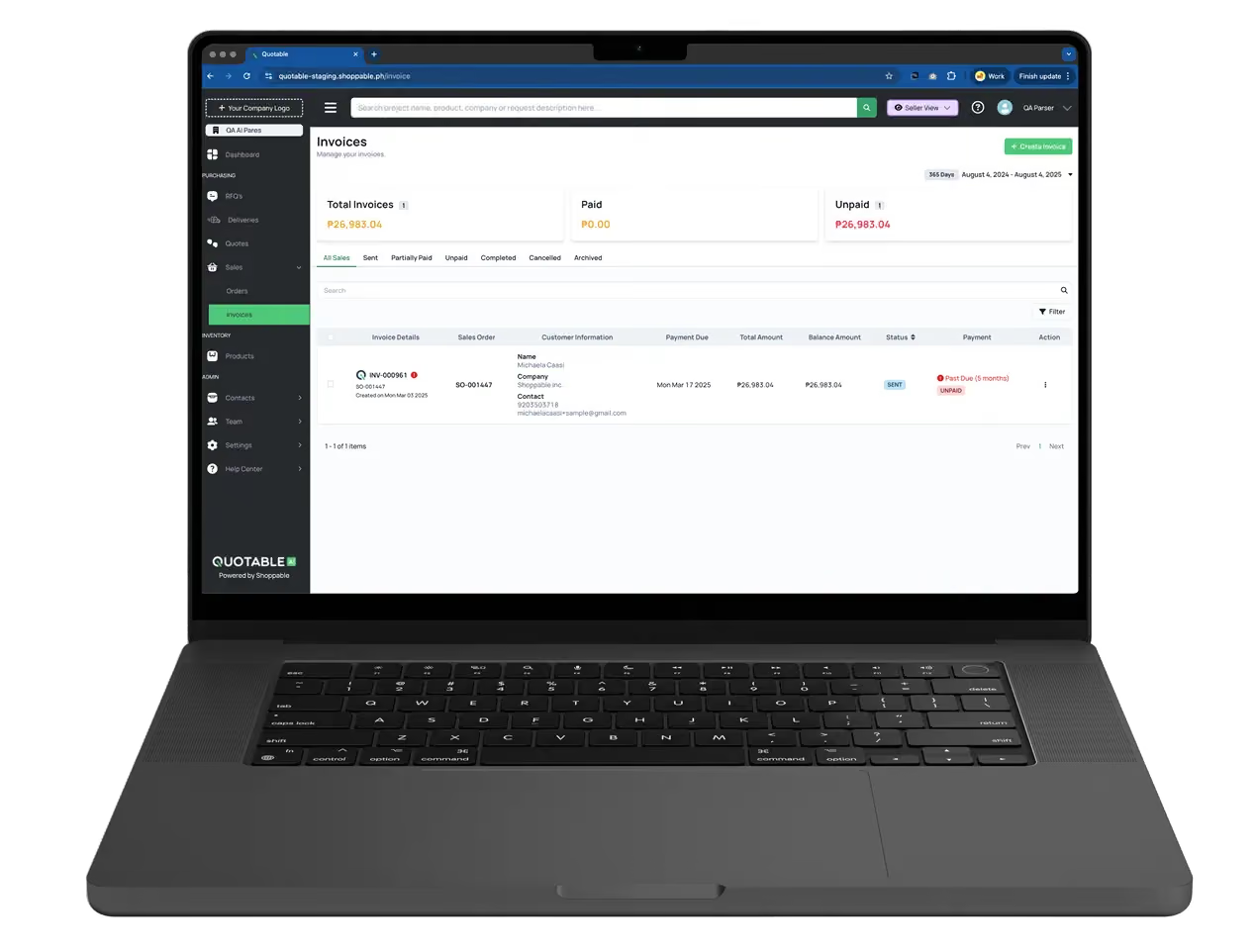
Each of those steps currently involves a separate tool, a separate login, and a separate person at most SMEs. The orchestration layer collapses them into one workflow. Platforms like Quotable AI are built specifically for this: connecting quoting, procurement, payments, and fulfillment into a single continuous process where the quote itself is the source of truth.
Automating Sales Quotations for Global B2B Trade
If you're selling across borders, the complexity multiplies. Currency conversion, landed cost calculations, customs documentation, and varying payment terms by region all add layers of manual work to every quote. A distributor selling electrical components to buyers in three countries might maintain separate pricing sheets, quote templates, and invoicing formats for each market.
Automation here isn't about replacing your sales team's judgment. It's about eliminating the repetitive encoding work that slows them down. An AI-powered document parser, for example, can extract line items from an incoming RFQ, match them against your product catalog, and pre-populate a quote in minutes rather than hours. Quotable AI's universal AI parser does exactly this: it reads incoming business documents like RFQs, purchase orders, and bills of materials, then structures the data automatically so your team can focus on pricing strategy rather than data entry.
The other overlooked piece is supplier participation. If your suppliers need to create accounts, learn new software, or jump through hoops to respond to your RFQs, you'll get slower responses and fewer competitive bids. Frictionless supplier engagement, where vendors can respond through a secure link without any software adoption, dramatically improves response rates and gives your procurement team better data to work with.
Optimizing Workflows for High-Growth Industries
Not all quote-to-cash workflows are created equal. A construction supply distributor faces different challenges than an IT reseller, even though both are quote-heavy B2B businesses. The blueprint needs to flex based on your industry's specific pain points, compliance requirements, and margin structures.
Streamlining Construction and Manufacturing Logistics
Construction and manufacturing supply chains are notoriously fragmented. A single project might involve 15 suppliers, 200 line items, and delivery schedules that shift weekly based on job site conditions. The common mistake here is treating each purchase order as an isolated event rather than connecting it back to the original project quote.
When a general contractor requests a quote for a commercial build-out, that quote should become the master document for all downstream procurement. Each line item maps to a cost code. Each cost code maps to a budget. When the supplier ships materials, the delivery confirmation updates the project's cost tracking in real time. This eliminates the painful monthly reconciliation where the project manager discovers they're 12% over budget because someone ordered the wrong grade of steel three weeks ago.
Manufacturing has its own version of this problem. Bill of materials (BOM) management is often disconnected from the quoting process, which means the sales team quotes based on one cost structure while procurement buys based on another. Closing that gap requires the quote to pull live supplier pricing and lead times, not static data from last quarter's spreadsheet.
Accelerating IT and Trade Distribution Cycles
IT distributors and trade resellers operate on thinner margins and faster cycles. A typical IT distributor might turn inventory 8 to 12 times per year, which means any delay in the quote-to-cash cycle directly impacts working capital. If it takes you three days to turn a quote into an invoice and another 45 days to collect payment, you're financing your customer's operations with your own cash.
The fix is speed at every stage. Quotes should go out within hours, not days. Accepted quotes should automatically trigger supplier POs. Invoices should generate the moment goods ship. And payment options should be embedded directly in the invoice so the buyer can pay via ACH, wire, credit card, or e-wallet without a separate process.
One pattern we see repeatedly in IT distribution is the "verbal change order" problem. A buyer calls to add three items to an existing order. The sales rep says yes, updates the shipment, but forgets to update the invoice. Three weeks later, accounts receivable is chasing a payment discrepancy that traces back to an undocumented phone call. Structured workflows that require documented changes before triggering fulfillment prevent this entirely.
The Finance Advantage: AI-Powered Invoicing and Collections
Cash flow is the lifeblood of every SME, and the quote-to-cash process is where most of the bleeding happens. According to Ardent Partners research, the average B2B invoice takes 10 to 15 days to process on the buyer's side alone. Add in the time to create, send, follow up, and reconcile, and you're looking at 45 to 60 days from delivery to deposit for many mid-market companies.
Reducing Days Sales Outstanding (DSO) by 10X
That "10X faster" claim deserves scrutiny, so here's how the math works. If your current DSO is 50 days and you can reduce it to 5 days on a significant portion of your transactions, you've freed up massive working capital. The way to get there isn't by harassing your customers for faster payment. It's by removing the friction that causes delays in the first place.
Most payment delays aren't caused by unwilling buyers. They're caused by invoice errors, missing PO references, disputed line items, and manual approval processes on the buyer's side. When your invoice is generated directly from the accepted quote, references the buyer's PO number automatically, and matches the delivery confirmation line by line, there's nothing to dispute. The three-way match (PO, receipt, invoice) happens automatically, and the buyer's AP team can approve in minutes rather than weeks.
Embedded payment options accelerate the final step. Instead of sending an invoice PDF and waiting for the buyer to initiate a bank transfer through their own banking portal, you include a pay-now link that supports their preferred method. Quotable AI handles this by embedding bank wire, ACH, credit card, and e-wallet options directly in the invoice, so the buyer clicks, pays, and the reconciliation happens in real time.
Unified B2B Payments and Real-Time Reconciliation
The overlooked cost in B2B payments isn't the transaction fee. It's the reconciliation labor. When payments arrive via wire transfer with cryptic reference numbers, someone on your team has to manually match each deposit to an invoice. For a company processing 100 invoices per month, that's a part-time job. At 500 invoices per month, it's a full-time position dedicated entirely to figuring out who paid what.
Real-time reconciliation means the system knows which invoice a payment is for the moment it arrives. No matching. No detective work. No end-of-month scramble. This is where a centralized payment system pays for itself many times over, because you're not just saving time on collections but eliminating an entire category of accounting labor.
The legal angle matters here too. SOX compliance and audit trail requirements mean you need documentation linking every payment to its corresponding invoice, PO, and delivery record. When these connections exist natively in your system, audit preparation shrinks from weeks to hours.
Future-Proofing Your Q2C Architecture
Building for 2026 means building for where your business will be in three years, not where it is today. The companies that struggle most with growth aren't the ones that can't find customers. They're the ones whose operational infrastructure collapses under the weight of success.
Scaling from $1M to $30M with Automated Infrastructure
There's a predictable pattern in SME growth. From $1M to $3M, you can run on spreadsheets and hustle. From $3M to $10M, you need structured processes and basic automation. From $10M to $30M, you need systems that scale without proportional headcount increases. The companies that get stuck usually hit a wall around $5M to $8M because their manual processes can't keep up but they haven't invested in the infrastructure to automate.
Right-sizing your investment is critical. You don't need an enterprise ERP at $3M in revenue. You need a system that handles your specific workflow: quoting, procurement, invoicing, and payment, without requiring a six-month implementation and a dedicated IT team. The right approach is to start with the workflow that causes the most pain (usually the quote-to-invoice handoff) and automate outward from there.
A practical benchmark: if you're spending more than 20 minutes per order on administrative tasks (data entry, document creation, status updates, payment tracking), you have automation opportunities that will pay for themselves within 90 days.
The Role of AI in Predictive Procurement and Supply Chain
AI in B2B isn't about chatbots or content generation. For SMEs, the highest-value AI applications are in document processing, demand prediction, and supplier performance analysis. A system that can read an incoming RFQ, extract the relevant data, cross-reference your supplier catalog, and suggest optimal sourcing in minutes is worth more than any marketing automation tool.
Predictive procurement takes this further. By analyzing your historical quote-to-order conversion rates, seasonal demand patterns, and supplier lead times, an AI system can recommend pre-purchasing decisions that reduce stockouts and improve margins. If 70% of your Q3 quotes for a specific product category convert to orders, and your supplier needs 6 weeks lead time, the system should flag that procurement window automatically.
Supply chain visibility is the other frontier. When your quoting, procurement, and fulfillment data lives in one system, you can spot patterns that are invisible when data is scattered across five different tools. Which suppliers consistently deliver late? Which product categories have the highest quote-to-order conversion? Where are you losing margin between the quoted price and the actual landed cost? These aren't theoretical questions. They're the specific insights that separate companies growing at 15% per year from those growing at 50%.
Where to Start: Your 90-Day Action Plan
The worst thing you can do with a blueprint like this is try to implement everything at once. Pick the highest-pain workflow in your current process and fix that first. For most SMEs in the $1M to $30M range, that's either the quote-to-PO handoff or the invoice-to-payment cycle.
Map your current process step by step. Count the manual touchpoints. Calculate the time and error cost at each one. Then look for a platform that addresses your specific bottleneck without requiring you to replace your entire tech stack. Integration with your existing ERP and accounting system matters more than feature count.
The quote-to-cash blueprint for SMEs heading into 2026 isn't about perfection. It's about building a foundation where data flows, errors shrink, and cash arrives faster. Start where the pain is sharpest, measure the improvement, and expand from there. If you're ready to see how a quote-first architecture works in practice, explore what Quotable AI can do for your specific workflow at quotable.ai.