Procurement used to be simple: pick up the phone, get a price, cut a purchase order, and wait for delivery. That world is gone. The buying process for B2B companies has become a multi-layered operation involving dozens of suppliers, real-time pricing shifts, compliance requirements, and cross-border logistics. For SMEs and mid-market distributors handling millions in annual spend, the old way of doing things isn't just slow - it's a liability. The procurement software market is projected to reach $9.5 billion by 2028, a signal that businesses are investing heavily in systems that match the complexity of their supply chains. Yet many companies still rely on spreadsheets, email threads, and disconnected tools to manage purchasing. The gap between what's possible and what's practiced is enormous. This article breaks down five strategies that procurement teams can use right now to modernize their operations, reduce waste, and move faster than their competition. These aren't theoretical ideas. They're hard-won lessons from companies that have already made the shift, and they apply whether you're a $3M distributor or a $40M manufacturer sourcing globally.
The Shift Toward Quote-Centric Procurement Workflows
Most procurement systems treat the purchase order as the starting point of a transaction. But if you've worked in distribution or manufacturing, you know the truth: the real transaction starts with the quote. Before a PO is ever issued, there are RFQs flying between buyers and suppliers, price negotiations happening over email, and quote revisions stacking up in inboxes. The quote is where the deal takes shape, and yet most software treats it as an afterthought.
A quote-centric workflow flips this model. Instead of treating quotes as informal documents that eventually feed into a "real" system, you treat the quote itself as the core data object. Every downstream action - PO creation, invoicing, payment, fulfillment - flows directly from the original quote. This eliminates the manual re-entry that plagues most procurement teams and creates a single source of truth from the very first supplier interaction.
Think about your own process. If a supplier sends you a revised quote via PDF, how many people touch that data before it becomes a purchase order? Two? Three? Each handoff introduces delay and risk. A quote-centric approach collapses those handoffs into one continuous workflow.
Treating the Quote as a Live Transaction State
The concept here is straightforward but powerful: a quote isn't a static document. It's a live transaction state that evolves as the deal progresses. When a supplier submits a quote, it should automatically update pricing in your system. When you approve it, the PO should generate without manual intervention. When fulfillment begins, the quote's line items should map directly to shipping documents.
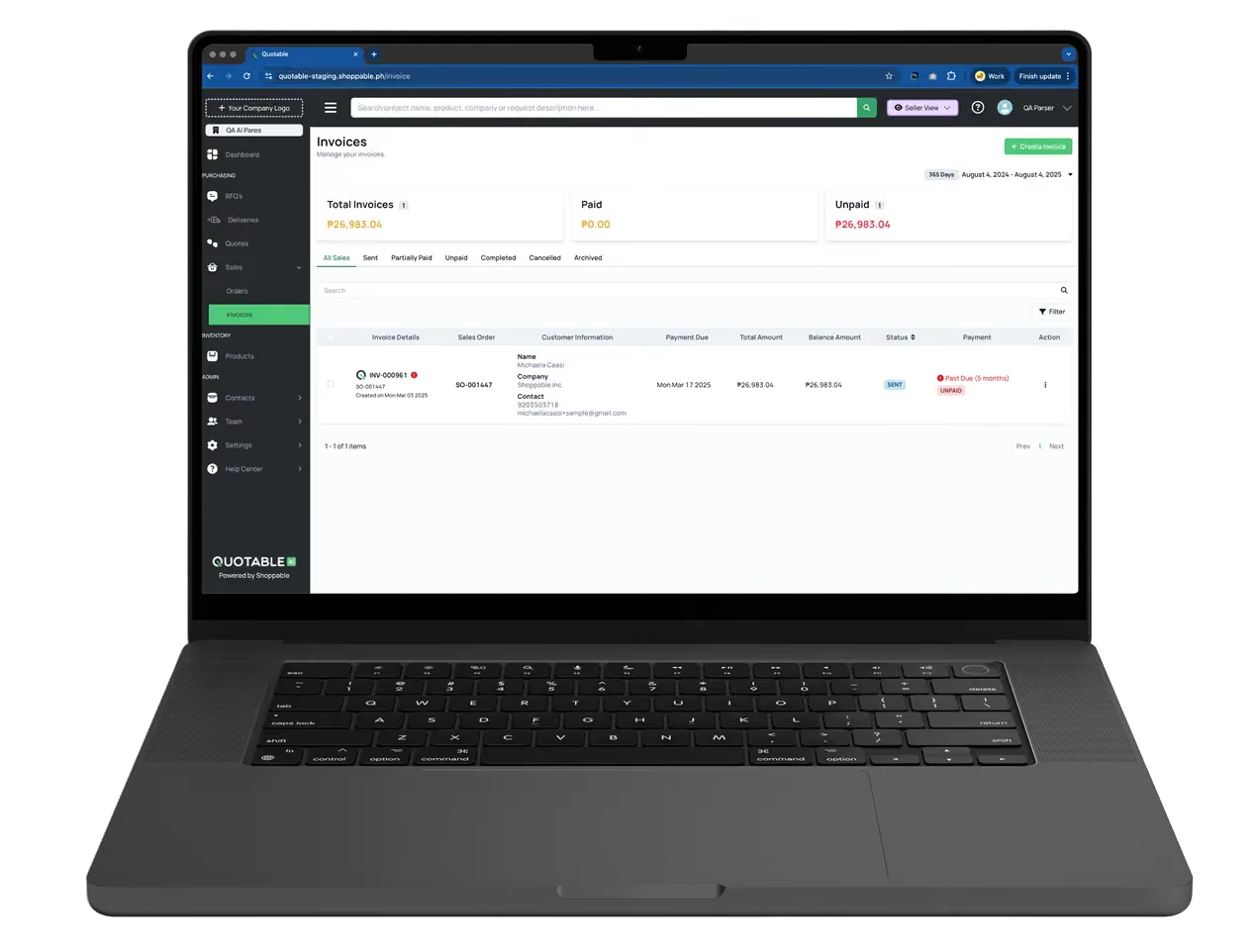
Quotable AI was built around this exact principle. Their platform treats every quote as a living object that connects to procurement, payments, and fulfillment in one continuous thread. Suppliers can respond to RFQs through a secure link without creating accounts, which means you collect structured responses faster and don't lose weeks waiting for vendors to onboard onto new software.
This matters most when you're handling 50 or more quotes per week. At that volume, the difference between a live quote workflow and a manual one isn't incremental - it's the difference between closing deals in hours versus days.
Eliminating Fragmented Data Silos in B2B Trade
Here's a red flag most procurement teams recognize: you have pricing data in your email, supplier details in a spreadsheet, PO records in your ERP, and payment confirmations in your banking portal. None of these systems talk to each other. When something goes wrong - a pricing discrepancy, a missed delivery, a duplicate order - you spend hours piecing together the story from four different sources.
Data silos don't just slow you down. They cost you money. A distributor processing 200 orders per month with even a 2% error rate due to manual data transfer is looking at four mismatched orders every month. If your average order value is $15,000, that's $60,000 in potential disputes, returns, or margin erosion annually.
Breaking down these silos requires a system that connects quoting, purchasing, and payments in one place. It's not about replacing your ERP - it's about creating a layer that sits on top and unifies the data your teams actually work with every day.
Automating Manual Tasks with AI-Powered Orchestration
Automation in procurement isn't new, but the kind of automation that matters has changed dramatically. We're not talking about simple approval routing or auto-generated email reminders. We're talking about AI that can read a supplier's quote PDF, extract line items, match them against your BOM, flag discrepancies, and push clean data into your purchasing system - all without a human touching a keyboard.
Over 80% of organizations are expected to actively integrate predictive analytics and AI into procurement processes by 2026. That's not a distant future. It's next year. The companies that have already started building these capabilities into their workflows will have a compounding advantage over those still debating whether to invest.
The key distinction is between automation that handles repetitive tasks and orchestration that coordinates entire workflows. A good AI procurement layer doesn't just speed up individual steps - it connects them so the output of one task automatically triggers the next.
Accelerating Sourcing for SMEs and Mid-Market Teams
Large enterprises have dedicated sourcing departments with analysts running category strategies. If you're a $5M distributor, you probably have one or two people doing everything from finding suppliers to negotiating prices to tracking deliveries. That's your reality, and your tools need to match it.
AI-powered sourcing tools can compress what used to take a procurement analyst a full week into a few hours. Imagine sending an RFQ to ten suppliers and having every response automatically parsed, normalized into a comparison table, and ranked by price, lead time, and compliance criteria. No copying and pasting from PDFs. No building comparison spreadsheets by hand.
Quotable AI's universal document parser does exactly this - it extracts and structures data from quotes, invoices, purchase orders, and bills of materials automatically. For a mid-market team that processes hundreds of supplier documents monthly, this kind of capability isn't a luxury. It's the difference between your procurement team spending their time on strategy versus data entry.
Reducing Human Error in Complex Supply Chain Calculations
Landed cost calculations are a perfect example of where manual processes break down. You're sourcing steel components from three countries. Each shipment has different freight rates, duty classifications, and currency exchange impacts. Your team calculates landed costs in a spreadsheet, and one wrong cell reference means your margin estimate is off by 8%.
If you're processing 30 to 50 international orders per month, you've likely already hit this breaking point. The complexity of tracking duties, freight, FX impact, and supplier pricing across multiple shipments exceeds what spreadsheets can reliably handle.
AI-powered systems can pull logistics data, apply current duty rates, factor in real-time exchange rates, and produce accurate landed cost estimates automatically. They can also flag anomalies - like a supplier whose quoted price suddenly jumped 15% compared to their last three quotes - before you commit to a purchase. This kind of error prevention doesn't just save money on individual transactions. It protects your margins across the entire portfolio.
Integrating Quoting, Fulfillment, and Payments
The biggest inefficiency in most B2B operations isn't any single step - it's the gaps between steps. A quote gets approved, but someone has to manually create the PO. The PO gets fulfilled, but someone has to manually generate the invoice. The invoice gets sent, but someone has to manually reconcile the payment. Each gap adds days and introduces errors.
Nearly 70% of procurement leaders say digital transformation is their top priority for 2026, yet only a third feel fully prepared for it. The preparation gap often comes down to integration. Companies know they need to modernize, but they're stuck with disconnected tools that don't share data.
True integration means the quote, the PO, the shipping documents, the invoice, and the payment all exist as connected states of a single transaction. When one changes, the others update. When one completes, the next triggers automatically.
Connecting Procurement Directly to Finance and Invoicing
One client we worked with - a regional building materials distributor doing about $12M annually - had a three-day lag between goods receipt and invoice creation. Their warehouse team confirmed delivery in one system, but their finance team worked in another. The handoff was a shared folder of scanned delivery receipts that someone checked twice a week.
This is more common than anyone admits. The quote-to-cash gap in standard procurement tools is real: most systems handle either the buying side or the selling side, but not the connection between them. For distributors who both buy from suppliers and sell to customers, this creates a painful middle ground where data has to be manually bridged.
The fix is a platform that treats procurement and finance as two sides of the same coin. When a PO is fulfilled, the invoice should auto-generate with matched line items. When payment is received, it should reconcile against the original quote and PO without manual intervention. Quotable AI connects with existing ERP and accounting systems to create this bridge, so you don't have to rip out your current infrastructure to get there.
Shortening the Quote-to-Payment Cycle by 10X
Consider the math. A traditional quote-to-payment cycle for a mid-market distributor might look like this:
- RFQ creation and distribution: 1-2 days
- Supplier response collection: 3-5 days
- Quote comparison and selection: 1-2 days
- PO creation and approval: 1-2 days
- Fulfillment and delivery: variable
- Invoice generation: 1-3 days
- Payment processing: 7-30 days
Excluding fulfillment, you're looking at 14 to 44 days of administrative overhead. With an integrated system that automates each transition, you can compress the non-fulfillment steps to under four days. That's not marketing hype - it's what happens when you eliminate manual handoffs between quoting, purchasing, invoicing, and payment.
Embedded payment options accelerate the final step dramatically. When your buyer can pay via bank wire, ACH, credit card, or e-wallet directly from the invoice link, you're not waiting for someone to process a check or initiate a manual bank transfer. Cash flow improves immediately, and your finance team stops chasing payments.
Centralizing Supplier Communication in One System
If you manage 20 or more active suppliers, your communication is probably scattered across email threads, WhatsApp messages, phone calls, and maybe a supplier portal that half your vendors refuse to use. This fragmentation creates real problems: missed quote updates, duplicate orders, conflicting pricing, and zero audit trail when disputes arise.
Centralizing supplier communication doesn't mean forcing every vendor onto a new platform. That approach fails almost every time because suppliers have their own systems and workflows. The better model is a hub that meets suppliers where they are - letting them respond to RFQs and submit documents through simple links that don't require logins or software adoption.
Here's what centralization actually solves:
- Pricing consistency: every quote and revision lives in one system, so you always see the latest number
- Accountability: every communication is timestamped and tied to a specific transaction
- Speed: your team stops searching through email to find that one attachment from three weeks ago
- Compliance: you have a complete audit trail for every supplier interaction
The operational threshold where centralization becomes critical is around 30 to 50 active supplier relationships. Below that, a disciplined team can manage with email and spreadsheets. Above it, the volume of communication creates information loss that directly impacts your bottom line.
One practical test: ask your procurement team how long it takes to pull up the complete history of a specific supplier transaction from six months ago, including the original RFQ, all quote revisions, the final PO, delivery confirmation, and payment record. If the answer is more than five minutes, you have a centralization problem.
Future-Proofing Trade for Construction and Manufacturing
Construction and manufacturing procurement carry unique challenges that generic software often ignores. Material prices fluctuate weekly. Projects require phased deliveries tied to construction schedules. Bills of materials change mid-project. And payment terms are often tied to project milestones rather than standard net-30 cycles.
Over 80% of companies are expected to have digitized procurement processes using e-procurement tools and automated platforms by 2026. For construction and manufacturing firms, this digitization has to account for industry-specific realities like change orders, material substitutions, and multi-site deliveries.
Future-proofing doesn't mean buying the most expensive enterprise system on the market. It means choosing tools that are right-sized for your current volume but can grow with you. A $5M contractor doesn't need the same system as a $500M general contractor, but they do need a system that won't collapse when they hit $15M.
Red flags that your current procurement setup won't survive growth:
- You can't track material costs against project budgets in real time
- Change orders require manual recalculation of every affected PO
- Your team spends more than 20% of their time on data entry rather than vendor management
- You've had at least one significant pricing dispute in the last quarter that took more than a week to resolve
- Duplicate orders have occurred because two team members sourced the same material independently
If three or more of these apply, you're already past the point where manual processes can keep up.
Scalable Operating Systems for Global B2B Logistics
Global sourcing adds layers of complexity that domestic procurement doesn't face: customs documentation, multi-currency payments, international shipping timelines, and compliance with trade regulations across jurisdictions. A system that works for domestic purchasing often falls apart when you start importing materials from three continents.
The concept of a B2B operating system - one that connects quoting, procurement, logistics, and payments into a single workflow - becomes essential at this scale. You need your purchase order to link directly to the bill of lading, which connects to the customs declaration, which ties to the landed cost calculation, which feeds into the final invoice. Break any of those links and you're back to spreadsheets and guesswork.
For mid-market companies expanding internationally, the right approach is to start with the workflow that causes the most pain and automate outward from there. If your biggest bottleneck is collecting and comparing international supplier quotes, start there. If it's reconciling payments across currencies, start there. Don't try to digitize everything at once - you'll overwhelm your team and your budget.
The companies that will thrive in the next five years of B2B trade aren't necessarily the biggest. They're the ones with procurement systems that can adapt as fast as their markets move. Smart money goes toward platforms that treat the entire transaction lifecycle as one connected process, not a series of disconnected steps stitched together with manual effort.
Building Your Procurement Advantage
The five strategies outlined here share a common thread: they all move procurement from a reactive, manual function to a proactive, connected one. Treating quotes as live transaction states, automating document processing with AI, integrating the full quote-to-payment cycle, centralizing supplier communication, and choosing systems built for your industry's specific demands - these aren't optional upgrades. They're the baseline for competing effectively as a mid-market B2B company.
The gap between knowing you need to modernize and actually doing it comes down to picking the right starting point. Identify your most painful bottleneck, fix it with a system that connects to the rest of your workflow, and expand from there. If you're ready to see how a quote-centric platform handles this in practice, Quotable AI offers a way to experience the full cycle from RFQ to payment in one system. Start where the transaction begins - the quote - and build forward.