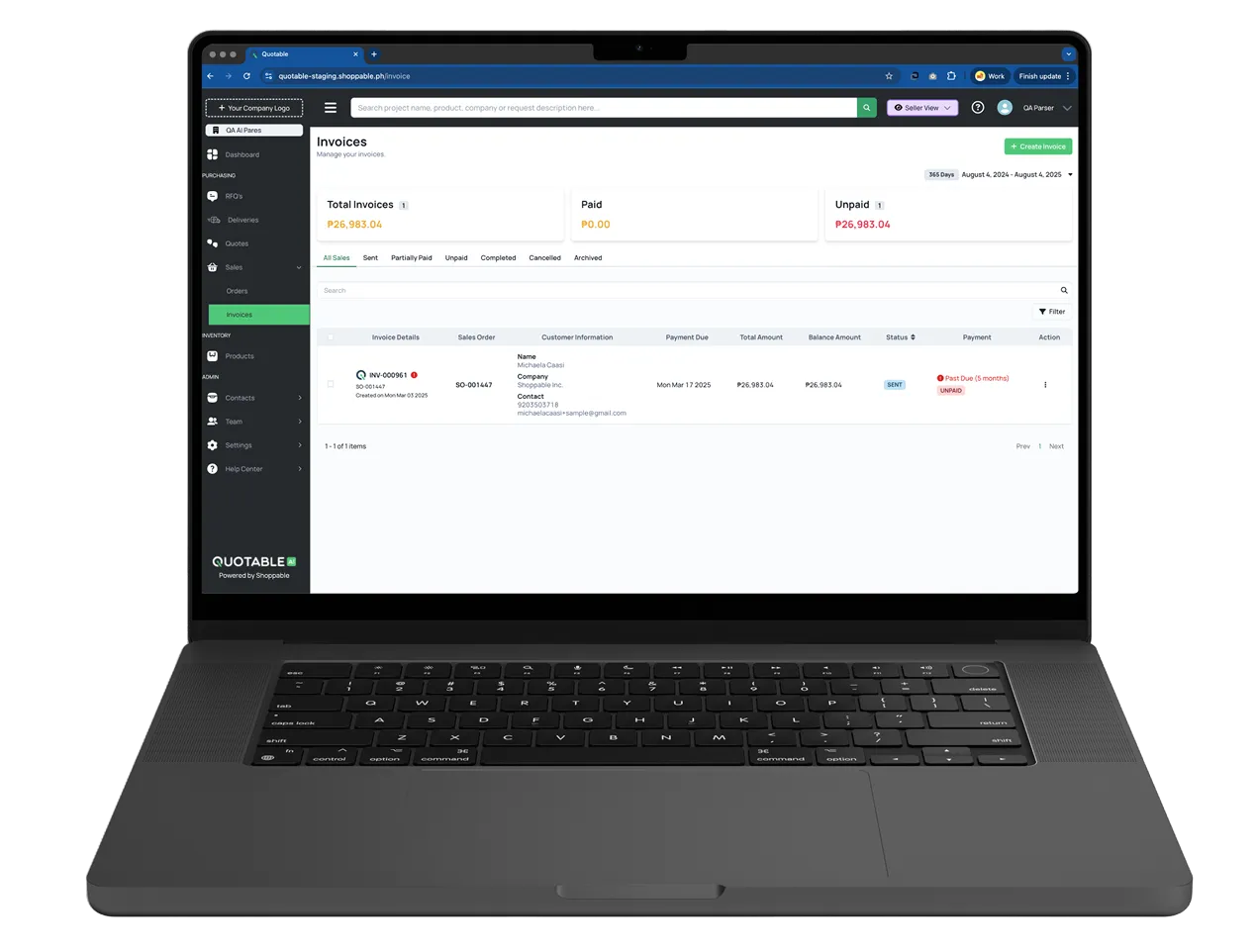
Every B2B transaction starts with a quote, yet most companies still treat quoting like an afterthought: a PDF emailed back and forth, manually reviewed, and eventually lost in someone's inbox. For SMEs and mid-market distributors processing hundreds of quotes each month, this bottleneck silently erodes margins and slows cash flow. The real cost isn't just time; it's the deals that stall, the pricing errors that go unnoticed, and the procurement cycles that drag on weeks longer than they should. AI-powered platforms are changing this by turning the quote itself into a live, trackable transaction state that connects sales, procurement, invoicing, and payment in a single workflow. If you're running a distribution or supply business doing $1M to $30M in annual revenue, the shift from manual approvals to automated quote workflows isn't a luxury. It's the difference between scaling and stalling. This guide breaks down how AI platforms handle B2B quote approvals, where the biggest efficiency gains hide, and what implementation actually looks like for companies your size.
The Evolution of B2B Quoting: Moving Beyond Manual Approvals
For decades, the quoting process in B2B trade has looked roughly the same. A buyer sends a request. A sales rep builds a quote in a spreadsheet or legacy system. A manager reviews it, maybe adjusts pricing, and sends it back. The buyer negotiates, the quote gets revised, and eventually someone prints it, signs it, and faxes or emails it for approval.
This process worked when order volumes were low and product catalogs were simple. But B2B commerce has grown more complex. Buyers expect faster turnaround, procurement teams manage dozens of suppliers simultaneously, and pricing structures involve tiered discounts, volume breaks, and region-specific adjustments. The old way can't keep up.
Why Traditional Quote-to-Payment Workflows Stagnate Growth
The breaking point for most SMEs hits somewhere around 30 to 50 quotes per month. Below that threshold, a small team can manage approvals manually. Above it, cracks start showing: duplicate quotes, inconsistent pricing, lost revision history, and delayed approvals that push payment timelines out by weeks.
Here's what typically goes wrong in manual workflows:
- A sales rep offers a 12% discount that wasn't authorized, and nobody catches it until the invoice is disputed.
- A procurement officer receives three versions of the same quote from different email threads and approves the wrong one.
- Finance can't reconcile an invoice because the original quote terms were verbally changed during a phone call, and no one documented the update.
These aren't edge cases. They're daily realities for companies still relying on email chains and spreadsheets. Each error creates downstream problems: delayed payments, margin erosion, and strained supplier relationships. One construction distributor I worked with discovered they were losing nearly 4% of gross margin annually just from pricing inconsistencies between their quoting and invoicing systems.
The Quote as a Live Transaction State in Global Trade
The traditional view treats a quote as a static document: something you create, send, and forget until the PO comes back. But a quote is actually the first binding signal in a transaction. It establishes price, terms, delivery expectations, and payment conditions. Everything that follows, from procurement approval to final payment, flows from that initial quote.
When you treat the quote as a live transaction state, it becomes the anchor for the entire deal lifecycle. Changes to pricing trigger automatic re-approval workflows. Acceptance generates a purchase order. Fulfillment updates connect to the same record. Payment terms are enforced from the moment the quote is accepted, not retroactively applied at invoicing.
This is the conceptual shift that AI platforms bring to B2B trade. The quote isn't a PDF anymore. It's a living data object that connects every stakeholder, from the sales rep who created it to the finance team collecting payment, to the logistics partner tracking shipment.
How AI Platforms Orchestrate Automated Approval Workflows
AI doesn't just speed up quoting. It restructures how approvals happen by replacing human bottlenecks with rules-based automation and intelligent routing. The result is a system where quotes move through approval chains in minutes instead of days, with full audit trails and zero ambiguity about who approved what.
Sales professionals are already adopting this shift. Roughly 43% of sales professionals reported using AI in their workflows as of 2024, and that number is climbing fast among B2B distributors who handle high quote volumes.
Automating Rules-Based Pricing and Procurement Criteria
The core of any automated approval system is a rules engine. You define the conditions under which quotes can be auto-approved, flagged for review, or escalated. These rules typically cover:
- Discount thresholds (e.g., auto-approve anything under 8%, escalate 8-15% to a sales manager, reject anything above 15% without VP sign-off)
- Customer credit limits and payment history
- Product-specific margin floors
- Geographic or regulatory requirements for international shipments
- Volume-based pricing tiers that adjust automatically based on order size
AI adds a layer on top of static rules. It can analyze historical quote data to flag anomalies: a quote priced 20% below the average for that product category, or a customer requesting terms that don't match their typical ordering pattern. This kind of pattern recognition catches errors and potential fraud that rule-based systems alone would miss.
Quotable AI, for example, uses a universal AI parser that automatically extracts and structures data from business documents including quotes, invoices, purchase orders, and bills of materials. This eliminates the manual encoding step that creates most data entry errors in traditional workflows.
Integrating Sales, Finance, and Fulfillment in One System
The biggest friction in B2B approvals isn't the approval itself. It's the handoff between departments. Sales creates the quote. Procurement reviews it. Finance checks credit terms. Fulfillment confirms inventory. Each department typically uses different tools, and information gets lost in translation.
AI platforms solve this by creating a single workflow that spans all departments. When a quote is created, the system automatically checks inventory, validates pricing against current cost data, confirms the buyer's credit status, and routes the quote through the appropriate approval chain. No emails. No phone calls. No waiting for someone to come back from lunch.
This integration matters especially for companies dealing in international trade, where payment workflows need to connect with logistics data like bills of lading, packing lists, and landed cost calculations that include duties, freight, and currency impact. A quote that doesn't account for these variables from the start creates reconciliation nightmares downstream.
Key Benefits of AI-Driven Quote Automation for SMEs
The business case for automating B2B quote approvals isn't theoretical. Companies implementing AI in their sales functions have seen a 6% to 10% increase in revenue, and AI can lift productivity by up to 40%. For an SME distributor doing $10M in annual revenue, even a 6% revenue lift translates to $600,000 in additional top-line growth.
But the benefits go beyond revenue. They show up in operational speed, error reduction, and cash flow predictability.
Achieving 10X Faster Cycles from Quotation to Payment
The promise of 10X faster cycles sounds aggressive, but consider the math. A typical manual quote-to-payment cycle for a mid-market distributor takes 14 to 21 days: 2-3 days to create and approve the quote, 3-5 days for the buyer to review and issue a PO, another week for invoicing and payment processing. Each handoff introduces delay.
With an automated platform, quote creation drops to minutes. Approval happens instantly if the quote falls within pre-set rules. The buyer receives a link, approves, and can pay immediately through embedded payment methods like bank wire, ACH, credit cards, or e-wallets. The entire cycle can compress to 1-2 days.
Sales reps are already experiencing this compression. AI-powered automatic quoting enables reps to generate quotes with 87% fewer clicks, which frees them to focus on relationship-building and deal strategy rather than administrative work.
Reducing Human Error in Construction and Logistics Tenders
Construction and logistics are two industries where quoting errors carry outsized consequences. A misquoted unit price on 50,000 concrete fasteners doesn't just affect one line item; it cascades through the entire project budget. A logistics tender with incorrect weight classifications can trigger penalty clauses and regulatory violations.
Common mistakes in these sectors include:
- Transposing unit prices (quoting $0.85 instead of $8.50 per unit on a 10,000-piece order, creating a $76,500 error)
- Failing to update material costs after a supplier price change
- Omitting cost codes required for project-based billing
- Applying the wrong tax jurisdiction for cross-border shipments
AI platforms catch these errors before quotes go out. Pattern recognition flags pricing outliers. Automated cost code assignment ensures compliance with project requirements. And because every quote revision is tracked, there's a complete audit trail for SOX compliance and contract dispute resolution.
As one industry analysis noted, quotation tools enable sales teams to create accurate, professionally designed quotes quickly and efficiently, improving their ability to convert leads and manage customer relationships. For construction and logistics firms, that accuracy isn't just a convenience; it's a contractual necessity.
Implementing Quotable AI as Your B2B Operating System
Moving from manual quoting to an AI-powered system doesn't require ripping out your existing infrastructure. The smartest implementations layer new capabilities on top of what you already have, connecting your ERP, accounting system, and supplier network through a single orchestration platform.
Quotable AI was designed with this approach in mind. It connects with existing financial systems, so you can modernize supplier collaboration without replacing your ERP infrastructure. The goal isn't to add another tool to your stack. It's to make your existing tools work together around the quote as the central transaction object.
Connecting SME Suppliers and Procurement Officers
One of the hardest parts of B2B procurement is getting suppliers to participate in structured quoting processes. Most SME suppliers don't want to learn new software, create accounts on yet another platform, or change how they submit quotes. This resistance creates a participation gap that forces procurement teams back to email and phone.
Quotable AI addresses this with a frictionless supplier participation model. Suppliers can respond to RFQs through a secure link without creating accounts or adopting new software. They receive the request, fill in their pricing and terms, and submit. Procurement teams collect structured responses faster, and suppliers don't have to change their workflow.
For procurement officers managing 20 to 50 suppliers, this means:
- RFQs go out from one centralized system instead of individual emails
- Supplier responses arrive in a structured, comparable format
- Pricing, lead times, and service capabilities are displayed side by side
- The best quote can be approved and converted to a PO in a single click
This centralized RFQ and quotation management approach eliminates the spreadsheet comparison process that eats hours of procurement time each week. Suppliers stand out based on competitive pricing and capabilities, not on who happened to reply first.
Data Orchestration for Seamless Invoicing and Collections
The quote-to-payment lifecycle doesn't end at approval. The real value of treating the quote as a live transaction state shows up in invoicing and collections. When a quote flows directly into an invoice, there's no re-keying of data, no discrepancies between what was quoted and what was billed, and no disputes over terms that were "agreed to verbally."
Here's what the full lifecycle looks like in an orchestrated system:
- Buyer submits an RFQ or requests a quote
- Seller creates and submits a structured quote with pricing, terms, and delivery schedule
- AI validates pricing against rules, checks inventory, and routes for approval
- Buyer receives a no-login link to review, approve, and issue a PO
- Approved quote automatically generates an invoice with matching terms
- Buyer pays through embedded payment options (bank wire, ACH, credit card, e-wallet)
- Payment is reconciled automatically, and fulfillment is triggered
Each step creates a data record that feeds into your accounting system. There's no manual back-and-forth for payment verification. Finance teams get real-time visibility into outstanding invoices, aging receivables, and cash flow projections.
Companies that integrate AI into their B2B quoting process see an average basket increase of 10 to 20% because the system can suggest related products, volume upgrades, and bundled pricing during the quoting stage. That's revenue you're leaving on the table with manual processes.
Future-Proofing B2B Trade with AI-Powered Vertically Integrated Layers
The companies that will dominate B2B trade over the next decade aren't the ones with the biggest sales teams or the lowest prices. They're the ones with the most efficient transaction infrastructure. When your quote-to-payment cycle runs in days instead of weeks, you can serve more customers, close more deals, and collect cash faster than competitors still stuck in email-and-spreadsheet mode.
AI platforms for B2B quote approvals and workflows aren't just about automation. They're about building a vertically integrated data layer that connects every stage of a transaction: from the first RFQ to the final payment, with full visibility at every step. This is the operating system concept that separates modern B2B platforms from legacy tools that only handle one piece of the puzzle.
Red flags that your current process needs this kind of upgrade include duplicate orders showing up in your system, visibility gaps between what was quoted and what was invoiced, delayed month-end closes because finance is chasing down quote approvals, and maverick spend that bypasses procurement entirely. If any of these sound familiar, you've already outgrown your manual workflow.
The hard-won lesson from working with dozens of SME distributors is this: the quote is where your business either accelerates or stalls. Every minute spent on manual approvals, every pricing error that slips through, and every payment that gets delayed because of a document mismatch is a direct hit to your bottom line. Platforms like Quotable AI exist because the quote deserves to be the center of your B2B operating system, not an afterthought buried in an email thread. Start by auditing your current quote-to-payment cycle, identify where the handoffs break down, and build from there. The infrastructure you put in place today determines whether you're scaling next year or still chasing approvals.