Small and mid-sized businesses have long treated procurement as a back-office function, something handled with spreadsheets, email threads, and the occasional phone call. That approach worked when supply chains were simpler and competition was local. But the rules have changed. Buyers expect digital-first experiences, suppliers operate across borders, and margins are tighter than ever. For any SME doing between $1M and $30M in annual revenue, digital procurement isn't a future aspiration: it's a present-day requirement for survival. The companies that recognize this early will compound their advantage. The ones that don't will find themselves bleeding cash through inefficiencies they can't even see. This isn't about adopting technology for its own sake. It's about fixing a broken workflow that quietly costs you thousands every month in wasted time, missed discounts, and preventable errors. If you're still running procurement through inboxes and filing cabinets, you're not just behind: you're actively losing money. The shift is already underway, and the global Digital Procurement Management System market was valued at USD 2645 million in 2024, signaling that businesses of all sizes are investing heavily. The question isn't whether to go digital. It's how fast you can get there.
The Shift from Manual to Digital: Why SMEs Can No Longer Wait
The gap between how large enterprises and smaller businesses handle procurement has never been wider. Fortune 500 companies moved to digital systems years ago, and they've been reaping the benefits in speed, accuracy, and cost reduction. SMEs, meanwhile, often operate with the same manual processes they used a decade ago: printing purchase orders, chasing approvals through hallway conversations, and reconciling invoices by hand. That gap is becoming a competitive liability.
The reality is that your buyers and suppliers are already digital. A staggering 91% of B2B buyers now prefer purchasing online, and they expect the companies they work with to meet them there. If your procurement process requires a phone call, a fax, or a multi-day email chain, you're creating friction that pushes partners toward competitors who've made the process easier.
The Hidden Costs of Paper-Based Procurement
Most SME owners don't realize how much manual procurement actually costs because the expenses are scattered and invisible. They show up as the two hours your operations manager spends every week re-entering data from emailed quotes into a spreadsheet. They appear in the duplicate orders that happen because nobody could find the original PO. They hide in the early payment discounts you miss because your invoice approval process takes 14 days instead of 2.
One construction distributor I worked with was processing about 40 purchase orders per month, all through email and a shared Excel file. When we mapped the actual time spent: creating POs, following up with suppliers, matching invoices to deliveries, and correcting errors: it added up to nearly 60 hours of labor per month. At a loaded cost of $35 per hour, that's $25,200 annually on a process that should be mostly automated.
There's also the maverick spend problem. Without a centralized system, employees buy from whichever supplier is most convenient rather than whichever one offers the best terms. A study found that e-procurement can achieve a high ROI, with survey respondents saving £38 on supplier costs for every £10 invested. Those savings are impossible to capture when your procurement data lives in dozens of disconnected inboxes.
Why Traditional Systems Fail the Modern Supply Chain
Traditional procurement wasn't designed for today's supply chains. When your suppliers are spread across three countries, your customers expect next-day quotes, and your materials pricing changes weekly, a manual system doesn't just slow you down: it breaks entirely.
Consider what happens when a supplier sends you a revised quote with different lead times. In a paper-based system, someone has to notice the change, update the spreadsheet, notify the project manager, and adjust the purchase timeline. Each handoff is a chance for error. Each delay compounds. By the time the updated information reaches the person who needs it, the window for action may have closed.
The breaking point for most SMEs hits around 30 to 50 orders per month or when they reach roughly 100 active supplier relationships. As Paul Ellis, Managing Director at Wax Digital, has noted, 77% of companies claim to need procurement by the time they have 100 supplier contracts. That threshold arrives faster than most business owners expect, especially during growth phases.
Bridging the Gap Between Quoting and Procurement
Here's a hard-won lesson from watching dozens of SMEs struggle with their workflows: the biggest source of procurement pain isn't procurement itself. It's the disconnect between the quote and everything that follows. Most businesses treat quoting as a sales function and procurement as an operations function, with a chasm of manual re-entry and lost context in between.
When a quote gets accepted, it should automatically trigger downstream actions: purchase orders, inventory checks, supplier communications, and payment scheduling. Instead, at most SMEs, someone prints the accepted quote, walks it to another department, and the entire data entry process starts from scratch. That's not a process. That's a liability.
Treating the Quote as a Live Transaction State
The most powerful shift in thinking for any SME adopting digital procurement is this: your quote isn't a static document. It's the first state of a live transaction that should flow continuously through your business.
Think about what a quote actually contains. It has line items with descriptions, quantities, and pricing. It has supplier information, delivery terms, and validity dates. It has customer details and payment expectations. Every single piece of that data is needed downstream: in the purchase order, the invoice, the shipping documents, and the payment record. Treating the quote as a disposable PDF means recreating all of that information multiple times, introducing errors at every step.
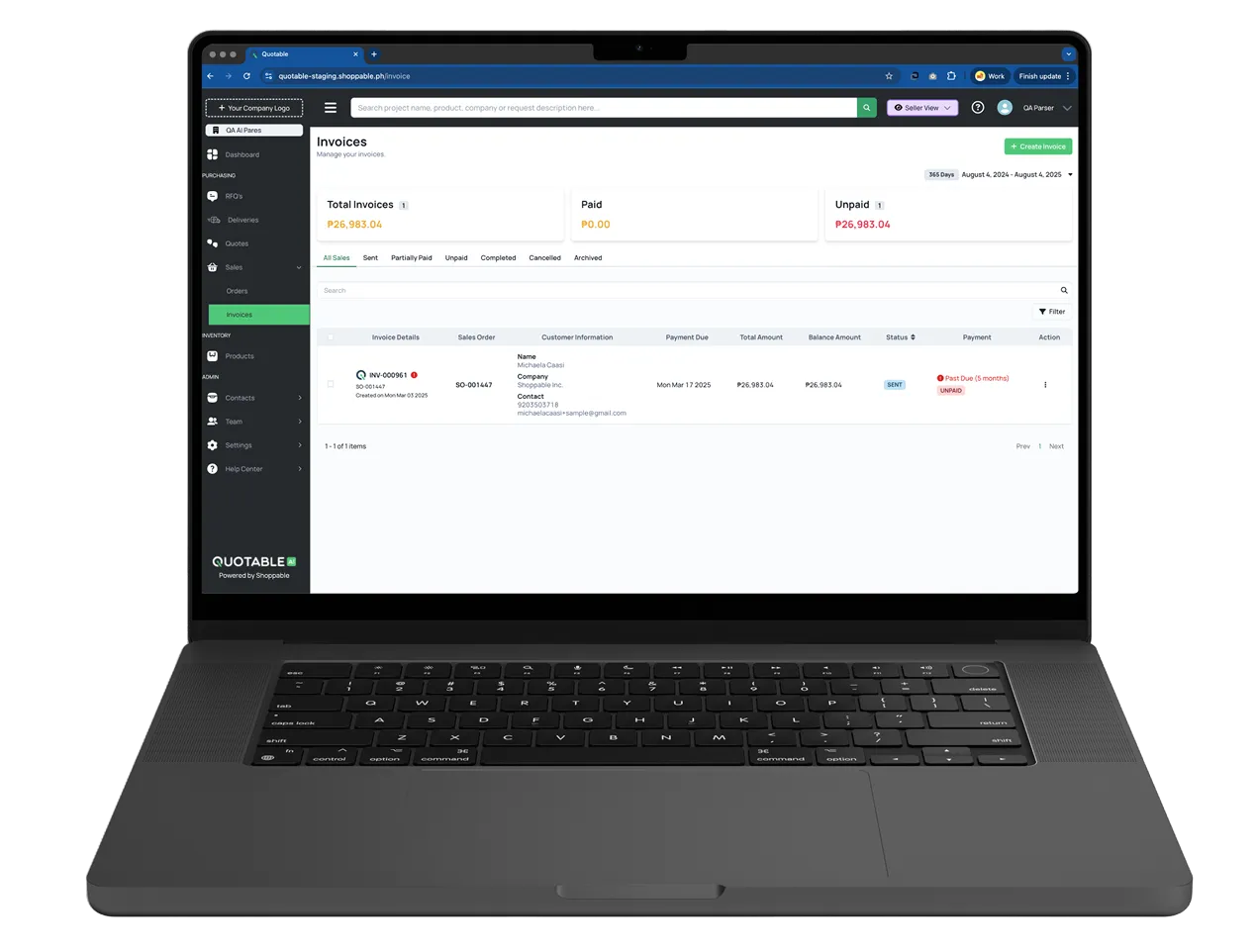
Quotable AI was built around this exact insight. Their platform treats the quote as the origin point of the entire transaction lifecycle. When a quote is created, it carries structured data that flows into procurement, invoicing, and payment without anyone re-keying a single field. Their Universal AI Parser can automatically extract and structure data from quotes, invoices, purchase orders, and bills of materials, which means even documents coming in from external suppliers get pulled into the same structured workflow.
This approach eliminates a class of errors that most SMEs don't even track. If you've ever had a three-way match fail because the PO quantity didn't match the invoice quantity, and the root cause was a typo during manual entry, you know exactly the kind of problem this solves.
Eliminating Friction in the Quote-to-Payment Lifecycle
The quote-to-payment lifecycle at a typical SME looks something like this: sales creates a quote in one tool, the customer approves it via email, someone manually creates a PO in another system, the supplier fulfills the order, an invoice arrives as a PDF attachment, accounting enters it into their books, and payment happens through a separate banking portal. That's six or seven systems and at least four manual handoffs.
Each handoff is a friction point where delays accumulate. A quote sits in someone's inbox for three days waiting for approval. A PO gets created with the wrong cost codes because the project manager wasn't consulted. An invoice gets lost in a shared folder and doesn't surface until the supplier calls about a late payment.
The fix isn't adding more people to manage the process. It's removing the handoffs entirely. A digital procurement system for SMEs should let a buyer approve a quote through a simple link, automatically generate the corresponding PO, match the incoming invoice against the original quote data, and trigger payment: all within one connected workflow. When you eliminate those friction points, you don't just save time. You fundamentally change your cash conversion cycle and your supplier relationships.
The Competitive Edge of 10X Faster Workflows
Speed in procurement isn't about rushing. It's about removing the dead time between steps. Most of the elapsed time in a procurement cycle isn't spent doing work: it's spent waiting. Waiting for approvals, waiting for supplier responses, waiting for someone to find the right document. Digital procurement for SMEs compresses those wait times from days to minutes.
When your competitor takes three days to turn around a quote and you do it in three hours, you win the deal. When your supplier gets paid in 48 hours instead of 45 days, they prioritize your orders. Speed creates a compounding advantage that touches every part of your business.
Accelerating Procurement for Construction and Manufacturing
Construction and manufacturing SMEs face unique procurement challenges. Materials pricing fluctuates weekly. Projects require coordinating dozens of suppliers with different lead times. A single delayed shipment can halt an entire job site, costing thousands per day in idle labor.
Consider a mid-size electrical distributor supplying materials to commercial construction projects. They might handle 200 line items across 15 suppliers for a single project. In a manual system, creating those purchase orders alone takes a full day. Tracking deliveries against the project timeline requires a dedicated coordinator. Reconciling invoices at project close can take weeks.
With a digital procurement workflow, that same distributor can generate purchase orders directly from the accepted quote, send RFQs to multiple suppliers simultaneously, and track fulfillment in real time. The time savings aren't incremental: they're exponential. Platforms like Quotable AI allow suppliers to respond to RFQs through a secure link without creating accounts, which means your procurement team collects supplier responses faster and can compare pricing and lead times side by side.
Data Orchestration as a Growth Lever for $1M-$30M SMEs
For SMEs in the $1M to $30M revenue range, procurement data is one of the most underused assets in the business. Every quote, every PO, every invoice contains information about what you're buying, from whom, at what price, and how often. Aggregated and analyzed, that data tells you where to negotiate harder, which suppliers are consistently late, and where your spending patterns create opportunities for volume discounts.
Manual systems make this analysis nearly impossible. Your data is trapped in email threads, spreadsheets, and filing cabinets. Even if you wanted to answer a simple question like "how much did we spend with Supplier X last quarter," it might take hours of digging.
Top-quartile CPO teams plan to allocate approximately 24% of their budgets to technology by 2026, and the reason is clear: technology turns procurement from a cost center into a strategic function. For a $10M distributor, even a 3% reduction in procurement costs through better data visibility means $300,000 back on the bottom line. That's not a nice-to-have. That's the difference between a good year and a great one.
Streamlining Global B2B Trade Through Vertical Integration
Running procurement across borders introduces complexity that manual systems simply can't handle. You're dealing with multiple currencies, varied payment methods, customs documentation, and shipping logistics that all need to connect. A purchase order to a domestic supplier is straightforward. A purchase order to a manufacturer in Shenzhen involves freight quotes, bills of lading, packing lists, duties calculations, and foreign exchange considerations: all of which affect your landed cost.
Vertical integration in procurement means connecting these disparate functions into a single data flow. Instead of managing quoting in one system, shipping in another, and payments in a third, everything shares the same underlying transaction data.
Connecting Quoting, Shipping, and Fulfillment
The link between your quote and your fulfillment process is where most SMEs lose visibility. A quote promises a delivery date. A purchase order confirms it. But between those two points and the actual shipment arriving at your customer's dock, there's often a black hole of information.
When quoting, procurement, and fulfillment share the same data layer, you gain real-time visibility into where every order stands. Your sales team can give customers accurate delivery estimates because they can see supplier lead times and shipping status. Your warehouse team can plan receiving because they know what's arriving and when. Your finance team can accrue costs accurately because they have access to the same shipment data.
This is especially critical for SMEs in trade and logistics, where a single container shipment might fulfill orders for multiple customers. Tracking which items in a shipment correspond to which purchase orders and which customer orders requires a level of data connectivity that spreadsheets can't provide. Overlooking landed costs: duties, freight, and currency impact: is one of the most common mistakes SMEs make in international procurement, and it directly erodes margins.
Automating Invoicing and B2B Payments for Better Cash Flow
Cash flow is the lifeblood of every SME, and procurement is where much of it gets stuck. Late payments strain supplier relationships. Manual invoice processing creates bottlenecks. Payment verification through back-and-forth emails wastes hours every week.
Here's a common scenario: your supplier sends an invoice as a PDF. Your accounts payable clerk opens it, manually enters the line items into your accounting system, matches it against the PO, flags any discrepancies, routes it for approval, and then initiates payment through your bank's portal. That process takes an average of 10 to 15 days for most SMEs. During that time, your supplier is waiting, your early payment discount window is closing, and your books don't reflect the actual liability.
Automating this workflow means the invoice data gets extracted automatically, matched against the original quote and PO data, and routed for approval with discrepancies flagged instantly. Payment can happen through embedded methods: bank wire, ACH, credit cards, or e-wallets: all from one centralized system. Quotable AI's approach to this is particularly relevant for SMEs because it eliminates the manual back-and-forth of payment verification while connecting to existing ERP and accounting systems. You don't have to rip out your current infrastructure. You add a layer that makes it work faster.
Future-Proofing Your SME with an Integrated Operating System
The SMEs that will thrive over the next decade aren't the ones with the biggest budgets. They're the ones with the smartest systems. An integrated operating system that connects quoting, procurement, shipping, invoicing, and payments isn't a luxury: it's the foundation for sustainable growth.
If you're running a $5M distribution business and you want to reach $15M, your current manual processes won't scale. You'll hit a wall around $8M where the errors, delays, and lack of visibility start costing more than the revenue growth is worth. Building digital procurement capability now means you're laying the infrastructure for that growth before the pain forces your hand.
The smart money is on building these systems early, when the cost of implementation is low and the compound benefits have time to accumulate. Every month you wait is another month of lost savings, missed discounts, and preventable errors adding up on your balance sheet. Digital procurement for your SME isn't something to evaluate next quarter. It's something to start this week. The tools exist, the ROI is proven, and your competitors are already moving.