Introduction
Most people think they understand the difference between a quote, a purchase order, a sales order and an invoice. Until a deal gets stuck and someone asks for an invoice too early.
The buyer says they need a PO first. Sales is waiting, finance is confused, ops is trying to figure out what’s been approved? And suddenly something that should take a few minutes drags out for days.
This isn’t a knowledge problem, everyone “knows” what these documents are. The problem is how they’re used in the real world, because every business operates differently and has a different workflow.
The Simple Explanation (And Why It’s Not Enough)
At a high level, it’s straightforward.
A quote is what you send before a deal is confirmed.
A purchase order is the buyer saying yes, let’s proceed.
A sales order is the seller saying yes, we can fulfill the order.
An invoice is how you get paid.
That’s the textbook version, but if you’ve actually run a B2B operation, you know that’s not where things break.
These Aren’t just Documents. They’re a Workflow.
The mistake most companies make is treating quotes, POs, SOs and invoices as separate files. They’re not, they’re three steps in the same transaction. A quote starts the conversation, a PO confirms intent, a SO confirms the order, an invoice closes the loop. When those steps are connected, deals move quickly. When they’re not, everything slows down.
Where Things Start to Go Wrong
Let’s take a simple example, you send a quote to a customer. It’s a PDF, maybe attached in an email, the buyer replies a day later with questions, you revise it, send it again. Eventually they agree, but instead of formally accepting it, they send a PO that doesn’t quite match the quote. Now someone internally has to reconcile the difference.
Finance creates an invoice manually, ops is waiting for confirmation, sales is chasing updates. No one is sure what the latest version is. Multiply that across dozens of deals and you start to see the real issue. It’s not the documents, it’s the handoffs between them.
The Hidden Cost No One Talks About
What looks like a small inefficiency compounds quickly.
You’re entering the same data multiple times.
You’re checking numbers across different files.
You’re relying on email threads as your source of truth.
And the biggest one, you’re slowing down cash. Invoices go out late because someone is still validating the PO, payments get delayed because something doesn’t match. From the outside, everything looks fine, internally, it’s friction everywhere.
Why This Matters More Than It Seems
Most teams think this is just part of doing business, it’s not.
The speed of your quote → PO → SO → Invoice flow directly impacts:
- How fast you close deals
- How quickly you get paid
- How much manual work your team has to do
And more importantly, how your customers experience working with you. If every transaction feels slow or confusing, that becomes your brand whether you like it or not.
What High-Performing Teams Do Differently
The companies that move fast don’t treat these as separate documents, they treat them as a single, connected system. A quote isn’t just something you send, it’s the starting point of a transaction.
When a buyer agrees, that acceptance is captured immediately.
When a PO is needed, it’s tied directly to the quote.
When a seller issues an SO, it confirms the goods are ready to be delivered.
When it’s time to bill, the invoice is generated from the same source.
No duplication, no guessing which version is correct, everything flows from one place.
A Different Way to Think About It
If you zoom out, this isn’t really about quotes, POs, SOs, or invoices. It’s about how work moves through your business.
Most companies are still operating like this:
- documents live in different places
- teams hand things off manually
- information gets re-entered at every step
A more modern approach is simpler, you start with one source of truth, and everything else builds from it. That’s the difference between managing documents and managing transactions.
Where Tools Start to Matter
This is where the gap between old tools and newer systems becomes obvious. Traditional setups, spreadsheets, PDFs, email, were never designed to connect these steps. They require people to stitch everything together, newer platforms, like Quotable AI, approach it differently.
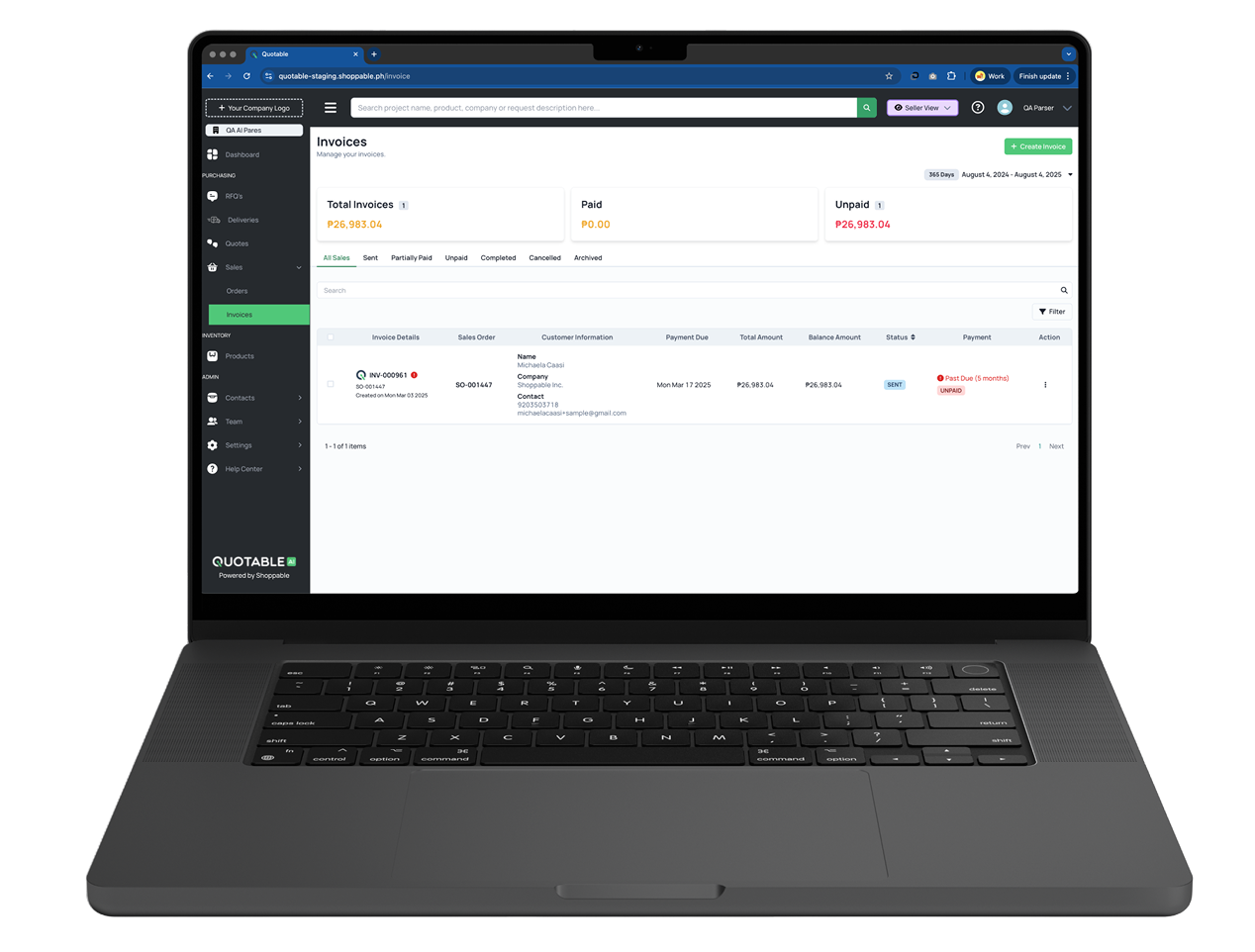
Instead of treating each step as separate, they link the entire flow: you create a quote, the buyer responds or uploads a PO (purchase order), seller confirms with a SO (sales order), and the system carries that forward into invoicing and payment.
The key difference isn’t just automation, it’s that the workflow stays intact from start to finish.
Quotable takes it a step further, the platform adapts to your workflow, if you don't issue sales orders, you can go straight to invoice. If you don't issue quotes, you can go straight to sales order or invoice. Other platforms force you to a fixed workflow, but Quotable is different. It adapts to your business and the way you work.
Final Thought
If your quotes, purchase orders, sales orders, and invoices all live in different places, your team will always be doing extra work to connect them. And that extra work shows up as delays, errors, and slower cash flow. Most businesses accept that as normal, but its not, once you see these as a single workflow instead of separate documents, it becomes obvious where things are breaking, and how to fix them.
If you’ve ever had a deal slow down because of this, you already know the problem. The next step is just making the process simpler, try running your next quote through Quotable AI and see what changes when everything is connected.